

And sometimes they kill.., p.1
And Sometimes They Kill You, page 1


“Deeply personal, honouring both the stories Cross has been entrusted with, as well as her own, And Sometimes They Kill You is honest, authentic, informative, and compassionate. Cross leaves us with a strategic and hopeful path forward. You’ll want to read every word.”
Sue Bookchin, executive director, Be the Peace Institute
“And Sometimes They Kill You is an impeccably subversive roadmap for anyone interested in an end to gender-based violence. Cross orchestrates decades of professional and personal experience into a no-nonsense harmony of truth and knowledge-sharing.”
Jennifer Good, MSW, psychotherapist, activist, survivor
“And Sometimes They Kill You is a powerful must-read for our times. With rates of intimate partner violence and femicide on the rise, there is no one better positioned to examine this issue than Pamela Cross. With the honesty and integrity that comes with decades of intentional collaborative grassroots experience and honouring of survivors’ stories, Cross offers a powerful truth-telling of the state of intimate partner violence and the systems that perpetuate it. Her thoughtful and innovative solutions provide readers with practical strategies to effect change. Most importantly, we are left with a message of hope to fuel our resolve to act for that change.”
Carol Barkwell, feminist advocate; founding executive director, Luke’s Place
“With sharp analysis carved from years of being on the frontlines, Pamela Cross gives us a behind-the-scenes look at the reality of intimate partner violence and femicide in Canada. Focusing on root causes and pathways to justice, Cross gives readers the necessary tools to create a world where women are free from men’s violence. A better world is possible and this book gives us the blueprint.”
Julie S. Lalonde, author of Resilience is Futile
“In this important and timely book, Pamela Cross weaves together the stories of survivors of intimate partner violence with her decades-long experience as an advocate to lay bare the multiple ways that law and other social institutions have failed to keep women and children safe. Cross offers insights into the root causes of intimate partner violence, the myths and stereotypes that impede our understanding, and the challenges survivors encounter in the legal system. Her reflections on her own learning and unlearning over time reinforce her message that if we bring humility, an openness to the perspectives of others, and energy for collaborative work, collectively we have the capacity to create spaces of safety for women and children and to eradicate intimate partner violence. Cross argues that we each have a role to play. And Sometimes They Kill You is exactly the resource we need to prepare for that role.”
Janet Mosher, professor Osgoode Hall Law School, York University
“And Sometimes They Kill You is an exceptional publication that will inspire both the community at large and justice professionals to redouble their efforts in preventing intimate partner violence. Pamela Cross’s many years of experience in the field, training and testifying about this violence, inform her powerful writing. She makes us painfully aware that there are practical solutions to preventing domestic homicides that we ignore at our peril, with more lives lost and more communities in mourning.”
Peter Jaffe, professor emeritus, Faculty of Education, Western University; director emeritus, Centre for Research and Education on Violence Against Women and Children
“Pamela Cross has worked for many years ‘in the trenches’ with women who have suffered violence in their family, in workplaces, and in public spaces. This book is testimony to her impact, dedication, and deep knowledge. Cross weaves in agonising stories of personal tragedy to illustrate just how short the legal system falls for women seeking protection from violence, as she calls for the recognition of intimate partner violence as an epidemic.”
Julie Macfarlane, author of Going Public: A Survivor’s Journey from Grief to Action; co-founder, Can’t Buy My Silence campaign
“Cross’s is a well-lived life full of passion and compassion to ease the pain of others. And Sometimes They Kill You deals with soul-destroying issues, but it is written simply and is accessible to diverse readers.”
Alia Hogben, past executive director, Canadian Council of Muslim Women; Order of Canada
“If you are interested in a book that provides insight into the cycle of violence, the courage of women, and the advocacy efforts toward systemic change, then this is a read for you! And Sometimes They Kill You is a thought-provoking, insightful, and inspiring book, which honours the journey of a true feminist advocate.”
Erin Lee, executive director, Lanark County Interval House and Community Support
“And Sometimes They Kill You is a powerful, important work on intimate partner violence. Pamela Cross’s decades of experience as a lawyer on the front lines and a leader in the field enrich her exposé of systemic legal failures in the response to assaulted women and their children. In clear, accessible prose, Cross provides a searing indictment of gaps in the law and the challenges confronting us in the eradication of this deep problem of gender inequality. Yet she offers us hope for finding a way forward. This book is a thoughtful, nuanced, and essential contribution to the conversation about how to end gender-based violence.”
Melanie Randall, professor, Faculty of Law, Western University
“Pamela Cross combines her knowledge as a skilled advocate with painful and inspiring stories from a career spent listening to, learning from, and helping survivors, in order to demonstrate our progress but also our failure to adequately address a continuing epidemic of intimate partner violence. More than that, Cross uses that personal experience to make a strong, persuasive case for transformative change in the way our systems of justice respond.”
George Thomson, former judge and former deputy minister of justice
“With tremendous heart, humility, and fearlessness, Pamela Cross gifts us with wisdom from her years of experience on the frontlines of the movement to end gender-based violence and compels us, collectively, forward. She calls us in with hope and optimism amidst the rippling devastation and reminds us of what’s possible when we centre survivors in the work and see gender-based violence—and femicide—as the public health and social crisis that it is. An important, truth-telling read.”
Sarah Boesveld, journalist and advocate
“With wisdom, compassion, and hope, Pamela Cross weaves seamlessly between the individual cases that have marked her career and the systemic issues and challenges that these cases evince. Despite the weight of all that she has seen over a career spent working on the sharp edge of one of our society’s most pernicious evils, Cross manages not only to continue to do the work, but, with this book, to urge the movement to end gender-based violence forward in the hope and belief that a better world is possible.”
Kirsten Mercer, feminist lawyer and advocate; lead counsel to EVA Renfrew at the 2022 CKW Inquest
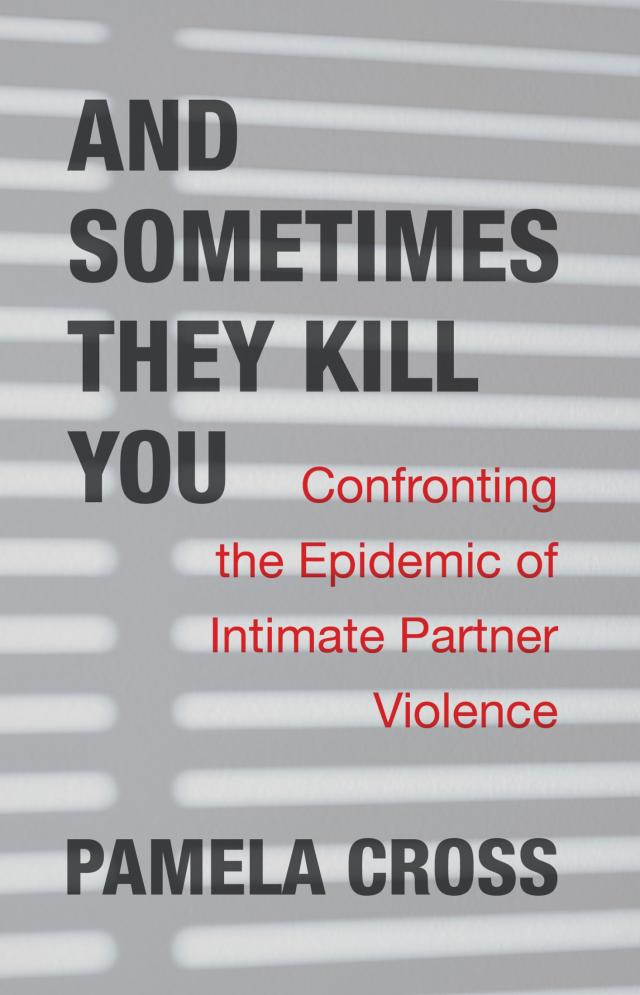
And Sometimes They Kill You
And Sometimes They Kill You
Confronting the Epidemic of Intimate Partner Violence
Pamela Cross
Between the Lines
Toronto
And Sometimes They Kill You: Confronting the Epidemic of Intimate Partner Violence
© 2024 Pamela Cross
First published in 2024 by
Between the Lines
401 Richmond Street West, Studio 281
Toronto, Ontario · M5V 3A8 · Canada
1-800-718-7201 · www.btlbooks.com
All rights reserved. No part of this publication may be photocopied, reproduced, stored in a retrieval system, or transmitted in any form or by any means, electronic, mechanical, recording, or otherwise, without the written permission of Between the Lines, or (for copying in Canada only) Access Copyright, 69 Yonge Street, Suite 1100, Toronto, ON M5E 1K3.
Every reasonable effort has been made to identify copyright holders. Between the Lines would be pleased to have any errors or omissions brought to its attention.
Library and Archives Canada Cataloguing in Publication
Title: And sometimes they kill you : confronting the epidemic of intimate partner violence / Pamela Cross.
Names: Cross, Pamela C. (Lawyer), author.
Description: Includes bibliographical references and index.
Identifiers: Canadiana (print) 20240365291 | Canadiana (ebook) 20240365321 | ISBN 9781771136617 (softcover) | ISBN 9781771136624 (EPUB)
Subjects: LCSH: Intimate partner violence—Canada. | LCSH: Intimate partner violence—Canada—Prevention.
Classification: LCC HV6626.23.C3 C76 2024 | DDC 362.82/920971—dc23
Cover and text design by DEEVE
Printed in Canada
We acknowledge for their financial support of our publishing activities: the Government of Canada; the Canada Council for the Arts; and the Government of Ontario through the Ontario Arts Council, the Ontario Book Publishers Tax Credit program, and Ontario Creates.
To all those who have survived and not survived intimate partner violence, and to those who have stood by their side during their journeys.
“At the end of the day, we can endure much more than we think we can.”
—Frida Kahlo
“Do your best, then do a bit better, and then don’t beat yourself up.”
—Winona LaDuke
Contents
Preface
1. Inquests and Inquiries
2. Understandings of Gendered Violence
3. Barriers to Ending Intimate Partner Violence
4. The Law
Epilogue
Acknowledgements
Notes
Index
Preface
“Please help me. My husband has a gun and he’s in the house with my son!”
These were the words uttered by a young mother, clutching her baby, as she ran into my office one sunny summer day in 1995. I didn’t flatter myself that she had sought me out because I was known as an expert on the issue of intimate partner violence (IPV) or, as we called it then, domestic violence. After all, I had just opened my practice and I wasn’t much of an expert on anything. Passion, I had; expertise, not so much. I didn’t even have any clients yet.
Susana (not her real name) was clearly in great distress and she had turned to me for help. So I sat her down at my as-yet-unused client table, brought her a glass of water, pulled out my brand new legal pad, and asked her to tell me her story.
Our initial encounter was a matter of coincidence. She later told me that she had come into my office simply because she’d spotted it as she got off the bus. Although I was sadly lacking experience in the real-life practice of law, I was able to be of assistance in her immediate moment of need. Then, over the next several months, we were able to get court orders that reunited her with the son she’d had to leave behind and that kept her and her children as safe as possible.
I have thought about Susana often in the three decades since, because whatever help I was able to offer her was far eclipsed by what I learned from her. Susana’s case opened my eyes to the reality that the legal systems to which many women turn are ill-equipped to respond effectively or compassionately to the violence in their lives.
* * *
I had wanted to be a lawyer since, as a nine- or ten-year-old, I had crouched behind the living room couch while my parents watched Perry Mason, confident that they had no idea I was there. What could be better, my young brain thought, than saving the innocent from wrongful conviction? I spent the next several years assuming I would become a lawyer and devouring books about lawyers who were clearly on the side of justice: Clarence Darrow, Mahatma Gandhi, the many lawyers who represented civil rights activists in the United States, and others. By the end of high school, I was very familiar with the LSAT exam, having spent many a Saturday afternoon doing sample tests.
But my life headed in an unexpected direction—one that took me far away from any thoughts of heroic lawyerly acts—when, at the age of nineteen, I became a mother. Once my daughter was born, it didn’t take me long to realize that neither of us was going to be happy if I were to be a stay-at-home mum. However, the university I attended had no child care facilities, the city I lived in had none that took children under two years of age, and I couldn’t impose on my mother-in-law indefinitely, so I needed to find somewhere to deposit my baby if I was to return to school.
With my infant daughter strapped into her car seat, I began attending meetings organized by other parents who wanted the university to establish a day care centre. The cause became a full-time activity for me, as we fought the university administration for on-campus space in which we could establish our day care.
While this advocacy led me into decades of in-the-street activism, my daughter was actually the one who first engaged—albeit without her knowledge or consent—in an act of civil disobedience when she, along with two or three other babies, occupied the office of the student government’s president, a young man who didn’t understand the importance of day care for many students. It took only a couple of hours of the diaper occupation before he agreed to support our cause with the university administration, and not too long after that, we had our space. (No children were harmed in the execution of this occupation: we had an ally in the president’s secretary—herself a mother—who kept a close eye on our babies during this small act of civil disobedience.)
After our success with the day care centre, my life as an activist continued to develop. Over time, that activism came to include more and more acts of civil disobedience, which often led to arrests, criminal trials, and, frequently, guilty verdicts. My interest in law was reignited through this activism, as I saw first-hand how often it served as a weapon of oppression rather than a tool for social justice. I was also attracted to the mechanics of law, to how it all worked, to the logic (and illogic) of it.
While I sat in courtrooms with my companions in crime waiting for our cases to be called, I watched, listened, and once again became seduced by the possibilities of law. Because the charges we faced were most often what are called summary conviction offences, we had the choice to represent ourselves, hire a lawyer, or appoint someone to speak for us. I began to take on this role and, happily if ignorantly, immersed myself in legal tomes and cases to try to develop unique legal arguments to defend myself and my companions.
I can’t point to a large body of legal successes over those years, but I learned a lot and realized I wanted to learn more. When I was thirty-five, I applied to law school. I did so with grand ideas about taking my activism from the streets to more erudite places like the Supreme Court of Canada, where I would argue persuasively on cases of great constitutional importance, playing whatever role I could to make sure that law functioned as a tool for social justice.
Once I met Susana, I realized that the social justice work I needed to do was going to be very different from what I had envisioned. I haven’t argued mighty cases that have changed the world. I’ve never set foot in the Supreme Court. In fact, I haven’t been in a courtroom of any kind for more than twenty years. Instead, my work has been focused on women and the legal systems they have turned to for help—systems that are largely ignorant of and hostile to their lived realities. I have never regretted this change in direction.
I built a practice around women whose partners had abused them (and, as I quickly learned, often continued to abuse them after they separated), who had been sexually assaulted by men they knew and didn’t know or sexually abused as children, or who were being sexually harassed at work and at school. Sometimes, I represented the community-based services that supported these women, especially when criminal defence lawyers tried to get access to their private records in order to intimidate them into silence.
I learned how to bring what is now called a trauma-informed approach to my work with clients—not by reading a textbook (there weren’t any on the topic then), but by listening to the women who trusted me enough to come into my office. I set up my space so the room felt safe to frightened women. I made my appointments long, to give women time to settle in and talk around the abuse until they were ready to talk about it directly. I learned to be patient. I came out from behind my desk to sit next to my clients. I bought boxes and boxes of Kleenex for my clients, but it turned out that I needed them too. I went to where the women were if they were too scared to come to me: the shelter, the sexual assault centre, the police station, their sister’s house, their workplace, a coffee shop, their therapist’s office.
Over time, I became a better lawyer. I learned how to write a strong affidavit, how to find and present compelling evidence, how to craft an argument that contained passion but also law. For the first few years, I took as many shifts as I could get as duty counsel in both family and criminal court to get much-needed courtroom experience.
Despite the assistance I was able to offer the women who sought me out, I began to realize that, however good a lawyer I might become, the women I represented were dealing with systems so flawed that the outcomes of their cases would rarely approach true justice. I was also forced to admit that the work was destroying my soul: while I had never heard of vicarious trauma—law school hadn’t even whispered such a term—that’s what I was dealing with.
It was time to shift my focus from representing individual women to working for change at the system level, which is the work I have been doing since 1998. Over this time, I’ve learned a lot about how legal and political systems work, what’s wrong with them, what changes are needed, and how to be effective in making those changes. I’ve done research, developed and delivered training, written resources for women and for those who provide support services to them, and, perhaps most significant of all, been an advocate for systemic change.


