

The tenants, p.1
The Tenants, page 1


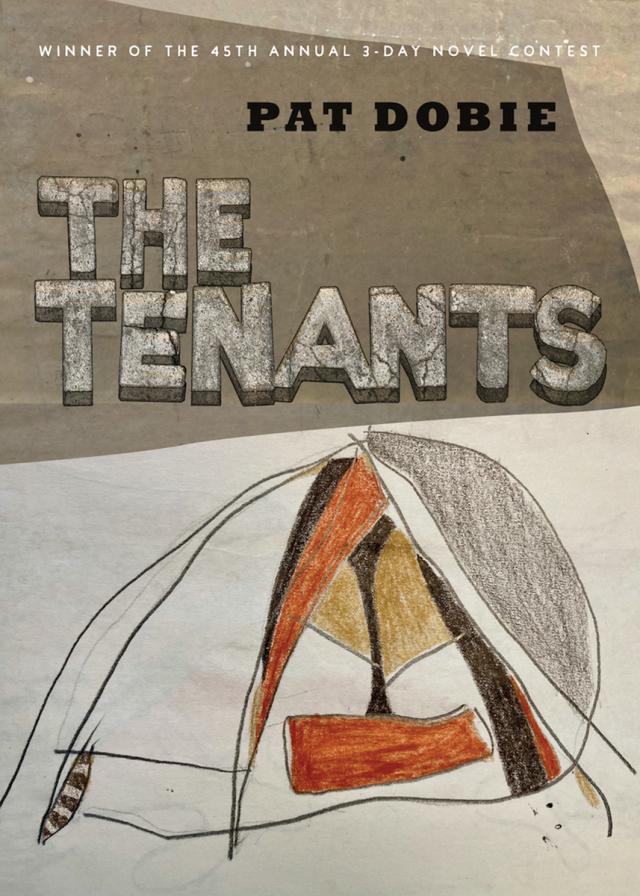
The
Tenants
Winner of the 45th Annual 3-Day Novel Contest
PAT DOBIE
The
Tenants
Anvil Press | Vancouver
Copyright © 2024 by Pat Dobie
All rights reserved. No part of this book may be reproduced by any means without the prior written permission of the publisher, with the exception of brief passages in reviews. Any request for photocopying or other reprographic copying of any part of this book must be directed in writing to Access Copyright: The Canadian Copyright Licensing Agency, Sixty-Nine Yonge Street, Suite 1100, Toronto, Ontario, Canada, M5E 1E5.
Library and Archives Canada Cataloguing in Publication
Title: The tenants / Pat Dobie.
Names: Dobie, Pat, 1963- author.
Description: “Winner of the 45th annual 3-day novel contest”.
Identifiers: Canadiana 20240365666 | ISBN 9781772142297 (softcover)
Subjects: LCGFT: Novels.
Classification: LCC PS8557.O2215 T46 2024 | DDC C813/.54—dc23
Book design by Derek von Essen
Represented in Canada by Publishers Group Canada
Distributed in Canada by Raincoast Books and in the US by Asterism Books
The publisher gratefully acknowledges the financial assistance of the Canada Council for the Arts, the Canada Book Fund, and the Province of British Columbia through the B.C. Arts Council and the Book Publishing Tax Credit.
Anvil Press Publishers Inc.
P.O. Box 3008, Station Terminal
Vancouver, B.C. V6B 3X5
www.anvilpress.com
Printed and bound in Canada.
To AJ and Laurel, who quietly
left snacks at my door while
I wrestled with the 3-day novel.
• 1 •
Scott
The first time I saw the woman in the tweed suit she was across the street, sailing down Victoria Drive toward the river. I was on the front porch drinking coffee, looking at the dawn sky. It was so early nobody else was out yet, so my eye naturally followed her as she walked down the street.
She had a big nose and a tight bun and was stuffed into a brown jacket and skirt. Her generous shelf of a butt jutted out behind her and her prow of a nose pointed out in front. She looked like a librarian on a mission except for her shoes, a pair of lavender Crocs. I would never have thought of her as dangerous, not then.
Dave came out with his coffee and saw where I was looking. “I saw her yesterday,” he said. “Think she’s new around here.” His morning self was as loquacious as he ever got.
“Did you talk to her?”
He gave me one of those, “Are you kidding?” looks.
Silly question. Between the two of us, I’m the conversationalist.
• 2 •
Maeve
Clock time bandwidth is narrow as a tightrope. The clock has two sounds, tick and tock. Four if you count the echo. Tick echo tock echo.
I used to have a bedside clock with those two alarm bells on top, old school. Its noise kept me awake so I put it in the next room. It kept coming back. If you asked me what the alarm sounded like I’d forget.
Clock time runs the show if you work in an institution. Or maybe if you watch cable TV and have to know when your show starts. Or if you make an appointment for the dentist or the shrink.
The clock narrows life down to the minute. It’s eerie, what we do with the clocks.
There’s a universal clock somewhere that smartphones align with. If you travel to a different time zone, your phone knows the time there before you do. If you see ten people on a train, each one’s smartphone will show the identical time.
The out-of-sync people are those with no smartphones. They have to set their watches by the TV or the radio or their computer. There used to be a number you could call when I was young and listen to the recording that gave hour, minute, second. I suppose it doesn’t matter where you get the correct time.
You ever wake up and wish the clock said something else? Who’s in charge, here? That’s not freedom That’s a humanmade situation. What the clock measures is just an idea: the hour, the minute, the second. They aren’t real, but the situation they represent is real. Your time is not your own.
People who wake up wishing the clock said something else have a problem, or some kind of deficit. Getting rid of the clock would help with this problem. For a while.
The tweed suit represents stability and serves as an armour. My tight bun is practical because the surface of my hair being under control repels twigs and leaves that would otherwise leave me looking like a wild woman.
I do the bun every morning before I leave my tent and walk down to the river for a splash of oily water on my nether regions and face.
My tent’s in a vacant lot up by Marine Drive and Victoria. The word ‘vacant’ gives the wrong impression because it’s a tangle of underbrush and big bushes and trees. I get in through a gap between the chain-link gate and the bushes. It’s blackberry season, but they’re late because of the wet spring so I’m eating them hard and sour. Still good, but they give me stomach aches. This is the cost of not believing in the clock.
I found the suit at Value Village the same day I found a twenty-dollar bill in the wallet I took from a woman’s open purse while she tried on coats. People don’t often carry cash these days, unless they’re teenagers on an allowance and too young to use a credit card. They can be careless about their bags, too — money bulging out of pockets and hanging from open compartments in their school backpacks. While sitting at the bus stop one day, I found forty dollars in the backpack of a kid who couldn’t have been more than ten. She had her back to me and was looking at her smartphone. Who brings that much money to school? I guess she cried when she discovered it gone.
The suit was a lucky find, being more or less my size. I’m a woman of generous proportions. You might be wondering, where does she get food? It’s going to have to be my secret. If I told you, I’d have to kill you.
The suit’s previous owner must have been an accountant or an English teacher in say 1965. Big boned, liked tweed, respectable. The suit makes a shape out of me that people can relate to, or at least recognize. Big chest, big rear, all contained in the most traditional fabric known to humankind, strictly through association with old movies. Don’t the professors always wear tweed? I don’t need the padding in its shoulders, but I left them in. The shoulder pads turn me into a linebacker, but they also balance the heft of the rest of me. The pencil skirt makes a difference, too. It’s not practical, as it forces me to take short strides. But it represents pencils, and that aligns it with the overall intent of the suit.
The suit wants some pumps or respectable shiny brown loafers, but what I have are these odd plastic shoes called Crocs — like clogs, but full of holes on the uppers.
As I strode, or minced, down to the river in the mornings, I thought those Crocs could signal me as a woman on her way to work, walking for health and fitness goals. I looked like someone with a pair of pumps in her desk drawer at work. I picture the desk as green metal, like the ones I’d seen at the Boeing factory offices back when metal desks were space age. This makes me feel like a scientist or some kind of scientific administrator, or maybe a neuroscientist. But I suppose what I really am is a scientist of time.
• 3 •
Scott
That same day we saw the woman in the tweed suit heading for the river, my truck broke down on the way home from work. I packed the tools I couldn’t afford to lose and walked to the nearest bus stop with my giant duffel bag digging into my shoulder. Some would have called a cab. Not me, because a penny saved is what? Anyone, anyone?
My mom, the queen of frugal, used to tell me that money doesn’t grow on trees. I don’t think it was deliberate, but the work I do has put her in the wrong. Every tree I touch pays in one way or another. I’m an arborist! Ha ha! Sweet revenge on that lie, Mom.
As I came down the block, Dave was standing on the front porch, looking at me. I gave a passing thought to why he wasn’t sitting at his desk. He was probably worried about me being so late home from work.
He gave a little wave. I couldn’t see his expression from the distance, but I knew what he was thinking: where’s the truck?
“Truck broke down,” I shouted from halfway up the block.
He nodded but didn’t reply. Dave hates shouting. He hates all loud noises created by humans. Pressure washers, chain saws, dump trucks, garbage trucks, street cleaners, big machines of any kind. The only loud noises I ever heard him say he liked were the howling and chugging of the trains that used to go along the tracks just south of our block.
“Bummer,” he said when I got close enough to hear him. “Do you know what’s wrong with it?”
“It’s just old,” I said. The truck was a rattletrap, no question. But my calculations were binding. No new truck until we had enough saved for a down payment on a house.
“So...?”
“I’ll take it in, get a quote.” We’ve been together seventeen years, if you’re wondering how I knew what he was asking. He’d been saying for a while that I should just bite the bullet and get a new truck. And he had a point about the repairs to mine costing more every year. But a new one was out of the question. Even a used one, no way.
I thumped up the stairs and saw him wince at the noise. I’d locked the box on my truck but my duffel bag full of tools was dragging at one shoulder. Still had on my work boots and mac jacket, despite the heat. What are you gonna do, princ
“Call CAA?”
“They said four hours. It’s over on Southwest Marine.”
He looked into his mug. “OK. I guess we should wait there, huh? Why don’t you get changed and I’ll take you back out whenever you want.”
* * *
In Dave’s Honda we had our separate thoughts for a while, only mine were coming out of my mouth. Dave is a man of few words and I’m a man of many. As I spoke, I could sense he wasn’t with me, though he was less than a foot away.
“Anyway, aside from the truck, work was good. The new guy has a great reach. Arms like a baboon.”
Reach matters in the tree business.
“Removed a line of sick cedars down at Southlands,” I went on. “You should see the houses down there, man. And the stables. And the pools.”
Dave glanced over. His beard was well trimmed, as always — a silver rectangle so neatly combed it looked like a sort of convex badge hanging off his chin. His pompadour was high. He’s a short man too. We’re both a shade under 5’3”. That’s one of the things we noticed about each other.
The night we met he told me about the Bantam Battalion, regiments founded in World War I, made up of men under the minimum army height of 5’3”. They’d lobbied for a role in the action and were some of the best fighters the British had. The Devil Dwarfs, some called them, for their ferocity and mischievousness.
Dave knows a lot of stuff like that. His brain is capacious, I guess you’d say. The pompadour is like a symbol of that.
“How was your day?” I asked him after a while.
“Not bad,” he said. “Met a deadline. Took it fairly easy after that.”
That irked me, I won’t lie. Dave’s a remote worker and a consultant slash contractor, which means no benefits, dental or otherwise. He doesn’t get paid for taking it easy. For him, effort and money are completely tied together.
But he’s sixty, fifteen years older than I am. And a couple of years ago he got so sick I thought I might lose him. So I can’t complain.
“You got projects lined up?” I asked.
He wanted to shrug but he knew better. “A sci-fi, 140 thousand words, coming in next week.”
He reads books for a living, how’s that for easy?
“OK, great.”
“Contract signed,” he added. “Deposit paid. Looks like rain.”
What he meant by that last bit was shut up about work and money.
“I don’t like being the worrywart,” I said, peering up at the heavy grey clouds. It had been a dry August after a wet spring. We could use some rain. Rain might delay CAA, though. “I mean, the spreadsheet says we’re behind. Now the truck again. Just gotta watch the spending and work as much as we can, OK?”
We were on Southwest Marine, heading toward Southlands. A Land Rover roared up on the shoulder and veered in front of us, so Dave had to jam on the brakes. I noticed his footwear for the first time. Knee-high rubber boots.
“You worked on the vacant lot?”
He nodded. “Thought I’d get those rose bushes in. Ordered some more dirt.”
I glanced over. “How much?”
“Five yards.”
“Shit, Dave.”
He met my eyes. “The garden needs it now, okay?”
What he calls the garden is a vacant lot out back of the house we rent down on Victoria below Southeast Marine, near the river. The lot is city-owned scrubland that Dave hopes never gets developed. It’s all blackberry canes plus a few trees, the thorns making it pretty much impenetrable except by following the little paths left by the homeless and the animals. Dave got the idea a couple years ago to make a secret garden back there. We started by ripping out the old blackberry bushes and carving out an empty space right in the middle. The only way in is a path from the laneway. The first year cost us nothing but sweat equity, but last year Dave went a little overboard with plants and materials. Turns out that even dirt costs. Ain’t that a bitch?
• 4 •
Maeve
The blackberries weren’t ready one day, then the next day they were. You have to keep going back because things can change so fast. A few hours of direct sunlight and they’re full and ripe, staining your fingers with juice as you pull the berry from its seat. I don’t know what that thing’s called.
The laneway across the street and down a little is a good place for berry picking. The bushes get dusty because of the cars passing and the lane not being paved, but they’re not picked over, either.
There’s a dilapidated empty house down that section of the block and it seems to be a nesting ground for rats. Methheads too, sometimes.
Some hos were renting the house, but one day I was coming down the lane when I heard loud voices. I just kept walking and saw men with pickup trucks standing outside the open door to the basement suite, arguing about how to fit all this furniture in the back of the pickups.
I didn’t want to attract their notice, so I went into the bushes a little and watched in disbelief while they did a terrible job packing the trucks. They threw stuff in with no rhyme or reason, chairs on their side taking maximum space, nothing stacked with precision or thought.
There’s a whole bunch of people in the world who don’t have a problem with doing things badly. They make their own lives so much harder, is the thing. I noticed the hos were nowhere to be seen on moving day. Presumably, their time was better spent doing the money work.
The next day I went back. The pickup trucks were gone; the basement door was closed. A piece of paper was stuck to it. I got closer and saw that it said the tenants were no longer allowed entry. The landlord name and address were given too. They lived in Surrey.
I did consider the empty house but dismissed it in the next thought. There could be fighting over it among squatters, and there would be rats at night. In my tent in the bush I had full control.
There was a raccoon family I had to coexist with, but they left me alone most of the time. An old blind one was always around somewhere, usually on his own. The others went out in packs to forage for food in gardens and garbages. There’s a whole ecosystem of the garbage-eaters at night — rats, skunks, raccoons, feral pets.
The lane was quiet, it being midday and most people at work, the hos gone too. I walked up and down until I found a few branches heavy with blackberries the size of, well, large ripe blackberries. They came off their stems with a soft tug. Birds sang in the bushes behind the blackberry canes and trees and whatever else was back there. This was much more densely covered with vegetation than my own vacant lot, which seemed dell-like in comparison. Strange to find even one of these in Vancouver, never mind two within a couple of square blocks of each other.
A trail led down from the alley, but I never went in there. Could be an encampment of homeless men, like the ones I’d seen in Florence in the Parco delle Cascine.
In one hand I held an empty cardboard coffee cup that I’d found on the bus bench and rinsed out with river water. It was a grande or a superbig, or whatever they call that size. I dropped ripe berries into it one after the other, while the sun crept a hair across the sky. I don’t use minutes; what good have they ever done me? Nor seconds. Whatever you might hope for now, I will not discuss time in clock terms. That bandwidth is just too narrow.
• 5 •
Dave
Historically, I’ve been a loner, a bantam cock who wanted nothing more than a deserted henyard. But Scott changed all that. Being with him all these years usually felt very comfortable. Back when we were on the same wavelength, his company felt almost invisible.
He was tight-fisted when we met, though even then he had more money in retirement savings than I’ll ever have. Now he’s gone completely crouching tiger, hidden wallet. We’re on year five of an austerity regime so tight I’m afraid to breathe. I feel crowded. He’s a friend and a lover one day, then the next he’s a nag and a jailer.


