The adventures of mary d.., p.1
The Adventures of Mary Darling, page 1


Praise for The Adventures of Mary Darling
“Put the beloved characters of Peter Pan and Sherlock Holmes into the blender of Pat Murphy’s prodigious imagination and you have a book that upends, complicates, situates, and explicates the stories we have always known. Full of surprises and deeply satisfying.”
—Karen Joy Fowler, author of Booth
“Delightfully clever! Pat Murphy has written a page-turner that is both a rousing adventure and an insightful critique of Victorian literary tropes. This is the real story of Neverland.”
—Theodora Goss, author of the Extraordinary Adventures of the Athena Club trilogy
“The bounty and wit of Pat Murphy’s generous imagination kept me reading through the night—just one more page, one more delightful reversal, revelation, surprise.”
—Andrea Hairston, author of Archangels of Funk
“A fresh new take on both Peter Pan and Sherlock Holmes that gives new depth and richness to each, unfolding a whole living, breathing world for readers to explore.”
—A. C. Wise, author of Wendy, Darling
“If you think you have outgrown Neverland, maybe you have. But you don’t have to believe in Tinkerbell to love this book.”
—Eileen Gunn, author of Stable Strategies and Others
“Outstanding characters, a deep understanding of [Murphy’s] new fictional world, and clever storytelling round out a novel that’s as exciting as it is emotionally satisfying.”
—Richard Kadrey, author of the Sandman Slim series
“Murphy does a masterful job of subverting Victorian tropes while delivering all the fairies, mermaids, and pirates anyone could desire.”
—Susan Palwick, author of The Fate of Mice
“A delightful mashup of familiar tales, written by an expert for the reader who hungers for something old, something new, justice borrowed and logical glue.”
—Meg Elison, author of Number One Fan
“A cracking read, a virtuoso act of gender jiu-jitsu, a Sherlock story like no other, a rough trip to fairyland, and the real, true story of Peter Pan. What a book!”
—Cory Doctorow, author of Red Team Blues
“A gem of a novel. I haven’t had this much reading fun in ages. A literary mashup that thrilled and tickled me to no end.”
—Joe R. Lansdale, author of The Thicket
“A clever and delightful secret history of Neverland. This twisty tale full of mystery and fairy magic, grand adventure, and deft character revelations challenges our societal expectations, and causes us to reconsider what it means to be strong.”
—Josh Rountree, author of The Legend of Charlie Fish
“Pages fly as the mystery unfolds and Pat Murphy gives girls and mothers the thrilling adventures they deserve.”
—Wendy N. Wagner, author of Girl in the Creek
Also by Pat Murphy
Novels
The Shadow Hunter (1982)
The Falling Woman (1986)
The City, Not Long After (1989)
Bones (1990)
Nadya: The Wolf Chronicles (1996)
There and Back Again, by Max Merriwell (1999)
Wild Angel (2000)
Adventures in Time and Space with Max Merriwell (2001)
The Wild Girls (2007)
Collections
Points of Departure (1990)
Letters From Home (1991), with Pat Cadigan and Karen Joy Fowler
Women Up to No Good: A Collection of Short Stories (2013)
As Editor
The James Tiptree Award Anthology, Vols. 1–3 (with Karen Joy Fowler, Debbie Notkin, and Jeffrey D. Smith)
A Note from the Publisher About Piracy
Dear Reader,
Thank you so much for purchasing this digital copy. We hope you enjoy it.
This book is intended for personal use only. Please do not share, reproduce, post, or resell it. All editions of this book are protected by international copyright law; all rights are reserved without the express permission of the author and the publishers.
Piracy is illegal. It hinders publishers from putting out more great books like this. Most importantly, piracy keeps authors from getting paid.
If you have any questions about copyright, or if you think this copy was pirated, please immediately contact us at tachyon@tachyonpublications.com.
Thank you,
Tachyon Publications LLC
1459 18th Street #139
San Francisco, CA 94107
415.285.5615
tachyon@tachyonpublications.com
The Adventures of Mary Darling
Copyright © 2025 by Pat Murphy
This is a work of fiction. All events portrayed in this book are fictitious, and any resemblance to real people or events is purely coincidental. All rights reserved, including the right to reproduce this book or portions thereof in any form without the express permission of the author and the publisher. No part of this book may be used or reproduced in any manner for the purpose of training artificial intelligence technologies or systems.
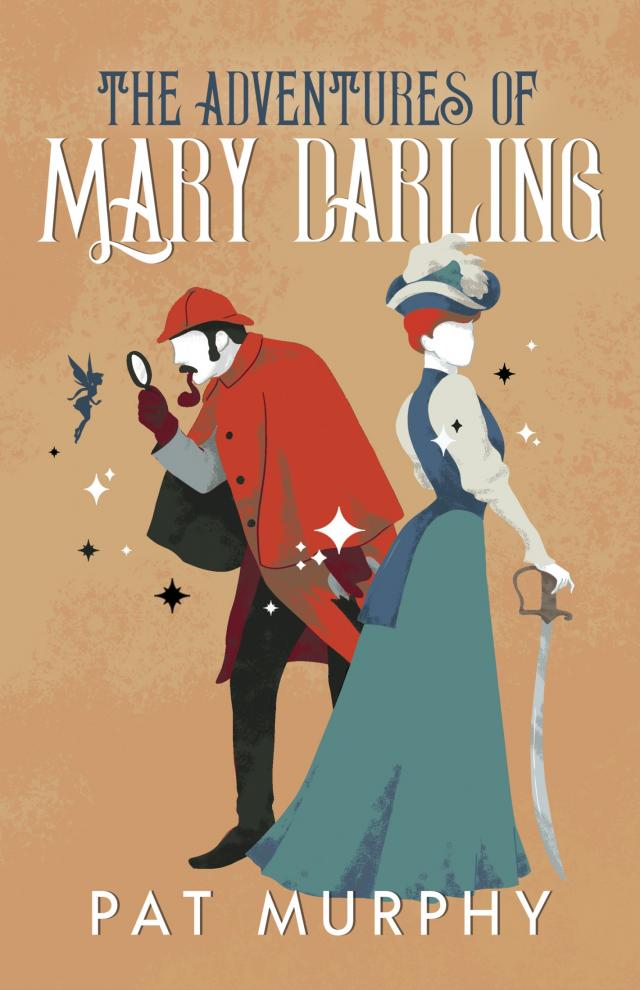
Cover design by Elizabeth Story
Interior layout design by John Coulthart
Tachyon Publications LLC
1459 18th Street #139
San Francisco, CA 94107
415.285.5615
www.tachyonpublications.com
tachyon@tachyonpublications.com
Series editor: Jacob Weisman
Editor: Jaymee Goh
Print ISBN: 978-1-61696-438-2
Digital ISBN: 978-1-61696-439-9
Printed in the United States by Versa Press, Inc.
First Edition: 2025
9 8 7 6 5 4 3 2 1
For Dave, with love. You are the best.
Prologue
Nosy Boraha, Madagascar
March 8, 1934
Dear Granduncle John,
Here’s the book I’ve been working on. I hope this will set the record straight once and for all. I have always thought it shameful that James Barrie’s Peter Pan is the only version of my grandmother’s story available to the world. He got so much wrong! And he left you out altogether! This book tells the true story.
When I was a child, you complimented me on my vivid imagination. I hope you don’t regret those comments after reading this book. I had to use my imagination when writing about what my characters said and thought. Whenever I had to fill in gaps that weren’t covered by what friends and family remembered, I made things up—including some things that you said and did and felt.
I respect your opinion—as a writer, as my beloved granduncle, and as someone who was there when all this was going on. I look forward (I think) to any comments or corrections you may choose to share.
Your loving grandniece,
Jane Darling
Chapter 1: The Events at Number 14 (The Children Are Gone)
I can picture it clearly: A light dusting of snow had settled on the cobblestones of a small London street in a respectable middle-class neighborhood not far from Kensington Gardens. The snow was white, a temporary condition for any snow falling in London. The soot of London’s smokes would soon blacken the snow, but at that moment, it was still pure and clean.
The year was 1900, the sixty-third year of Queen Victoria’s reign. The British Empire ruled over a quarter of the world’s population. That’s the big picture. But right now, I’m thinking about one small street.
There were footprints in the snow. They led away from the front door of number 14, a tall, narrow house much like the tall, narrow house to its left and the tall narrow house to its right. Two people—a woman in overshoes and a man in ankle boots—had picked their way over the snowy cobblestones to number 27, just a short distance down the street.
I imagine that it was a peaceful scene—except for the dog barking frantically behind number 14. Between bouts of frantic barking, a heavy chain rattled and clanked as the beast threw itself against the restraint that held it captive. The animal sounded desperate—raising an alarm that no one heeded.
On the third floor of number 14, the casement windows were open wide, which was odd on such a cold night. A light flickered in the room—a night light perhaps? No, this light moved about the room quickly, darting this way and that.
From behind the house came the crack of a wooden post giving way. A Newfoundland dog, its shaggy coat soaked with sweat and melted snow, bounded into the street. The dog dragged a chain that was looped through its collar. At the end of the chain was a wooden post that had broken off at the base. The top of the post caught on a cobble, a weak link in the chain gave way, and the chain slipped off the dog’s collar.
Free at last, the dog ran down the street and hurled itself at the door of number 27, claws rattling against the wood. A servant girl in a mobcap and apron opened the door. The dog bowled her over. Quicker than you’d think an animal that size could move, the dog was inside.
A few moments later, the dog dashed out again. A woman followed, calling after the beast in a voice as wild and desperate as the dog’s barking. “Nana! What is it?”
What is it? By way of an answer, Nana ran toward number 14.
The woman—her name was Mary Darling—ran after the dog. She was a slim woman with high cheekbones and dark curly hair. She wore a light evening dress with a full skirt—last year’s style, but she made it look good. She had left her overcoat and overshoes behind.
Her evening s
A sweet high sound, like the ringing of tiny bells, rang out over Nana’s panting.
“No!” Mary cried out as she ran through the snow. “No!”
Mary’s husband, George Darling, followed her, a few minutes behind. He had lingered to apologize to the hosts of the dinner party at number 27 for the dog’s unfortunate interruption. He had taken the time to put on his woolen greatcoat and to collect Mary’s overcoat and overshoes. He stepped carefully to avoid slipping in the snow. As George walked through the snow, he muttered under his breath, “This is what comes of having a dog for a nursemaid.”
Mary tried number 14’s front door. It was locked. She called frantically to George, who plodded through the snow, fumbled in his pocket, found the key, and unlocked the door.
Mary rushed into the house and up the stairs to the third floor, calling all the while to Liza, the young girl who was their only servant. Nana ran ahead of Mary, leaving a trail of wet paw prints on the stairs.
Liza came up from the tiny room off the kitchen that served as her bedroom, blinking as she pulled a shawl over her thin shoulders. “What is it, m’um?”
“The children!” Mary called. “Where are they?” She didn’t pause for an answer, continuing her dash up the stairs to the nursery.
“I went to the nursery not an hour since, m’um,” Liza was saying. “The children were sleeping—I heard them breathing softly, the little angels.”
Mary stopped in the nursery doorway, frozen. The beds were empty; the bedclothes, thrown back. The windows were wide open. Mary rushed to look out. Below, the snowy street. Above, the dark sky, speckled with stars.
She turned away from the window to stare at the empty beds where she had left her children sleeping. Then she sat on the window seat, as if suddenly unable to stand. Her hands were clasped in her lap, holding onto each other because there was nothing else to cling to.
The nursery was a cheerful room. The walls were a pale yellow. The curtains at the window were printed with bright yellow daisies. Mary had sewn the curtains herself. Over the mantel, she had hung a watercolor painting by her mother: three smiling fairies sat in the shade of a bottlebrush bush, sharing a pot of tea. On the mantel were framed photos of Mary’s children—a formal portrait taken in a studio and a photo of the children at the beach, taken when they were on holiday.
Mary had been happy in this room. She had thought this nursery was a place where her children would be safe.
George Darling reached the landing and stepped into the nursery. “Liza says the children are fine,” he said. There was an edge in his voice. He had been ready to light a pipe and enjoy a glass of brandy with their hosts when Nana disrupted the party.
“They are gone, George. The children are gone.” Mary’s voice was bleak and filled with pain.
George stared at the open window and then at the empty beds. “What? This is some kind of a joke,” he said, in the tone of a man trying to convince himself. “Wendy! John! Michael! Children, this isn’t funny.” He turned away from the window and looked under the empty beds. He peered inside the wardrobe and swept the curtains aside to look behind them.
Mary wasn’t watching him. Once again, she was looking out the window at the night sky. “I closed the windows before we left,” she said to no one, or perhaps to Nana, who sat at her feet, leaning against her knee and gazing at her face. “I’m sure of that.”
George wasn’t listening. He was asking Liza what had happened while they had been at dinner. “The children are gone,” he said gruffly, as if Liza couldn’t see that for herself.
The girl’s eyes were enormous, terrified. “The master had tied Nana in the yard, and she was barking and barking. She wouldn’t stop. I brought her to the nursery so she could see nothing was wrong. Then I put her in the yard again . . .”
A loud knock at the front door interrupted Liza’s recitation. George stomped downstairs to answer and returned a moment later, followed by a police constable. Their neighbors at number 27, alarmed by the Darlings’ sudden departure, had fetched the constable from the corner and told him to go to the Darlings’ house.
“Our children are gone,” George told the policeman. “Vanished.”
“Vanished?” The policeman raised his grizzled eyebrows. His gray hair was neatly cut beneath his helmet. Moustache trimmed to a regulation length. Nose red—perhaps fond of a bit of drink, but never on duty. Crystals of melting snow clung to his coat. He had a truncheon on his belt, ready to smack a wrongdoer. But there was no one to smack.
“Could the children be playing a joke?” he asked.
“They wouldn’t do that,” George said.
The policeman was looking in all the places that George had looked. There were no children under the beds. No children in the wardrobe. No children behind the curtains.
“Kidnapped,” the policeman said in a matter-of-fact tone. “I’ll tell headquarters.”
Mary shook her head in denial, her face wet with tears. George put his hand on her shoulder. “I’ll get your Uncle John,” he said. “He’ll know what to do.”
Chapter 2: Uncle John and the Great Detective
Dr. Watson sat by the fire at 221B Baker Street, reviewing his notes on one of the adventures he had shared with his friend, Mr. Sherlock Holmes. Holmes was at the table, working on a monograph about poisons—specifically about deadly potions that could be made with ingredients commonly found in the average household.
Watson gazed out the window. In the snow, Baker Street looked beautiful. So peaceful. Snow hid many things that people would rather not see, covering the soot that darkened the buildings, the horse manure in the gutters, the piles of rubbish in the alleys, and even the beggars that huddled in doorways.
Watson heard the clip-clop of a horse’s hooves and the rumble of wheels on cobblestones below. The sound stopped beneath their window. “We have a visitor,” Watson remarked. “Someone must be in desperate need to seek out your help on such a cold night.”
Holmes put down his pen. “A man, by the sound of it.” He glanced at Watson. “I know it’s a hansom cab by the pace of the horse and the sound of the wheels—lighter than a growler but not so quick as a dogcart. I hear only one passenger alighting—a respectable woman would not be in a hansom cab alone. And any woman would wait for the assistance of the driver to alight. But our visitor is too impatient for that.”
The visitor’s impatience was confirmed by a frantic knocking at the door. Watson moved to stand, but Holmes waved him back into his chair. “Don’t disturb yourself, Watson. Allow me.”
Watson heard a man’s voice, speaking loudly, quickly. Watson could not make out the words, but he recognized the voice. It was George Darling, his niece’s husband. In an instant, Watson was out of his chair, comfort forgotten.
“What’s wrong?” Watson asked, as George entered the room. The man’s hands were shaking—from strong emotion, from the cold, or perhaps from both.
“Mary needs you, John. Mary . . . I . . . we need your help.”
Though George addressed his appeal to Watson, Holmes answered. “We will do everything we can.” Holmes’ tone was calm and reassuring. He led George to the chair that Watson had vacated. “But first, you must calm yourself. Watson, get the brandy.”
Watson poured George a glass of brandy and draped a blanket over the man’s shoulders to ward off the chill.
George Darling was a tall, thin man with regular features and dark wavy hair. He was twenty-nine years of age, but he had the air of a much older man. Watson had always thought him rather dull. George took himself very seriously and expected others to do the same. He worked as a senior accountant in a Capel Court brokerage firm and was always talking about stocks and shares in a deadly earnest tone. Years ago, when George had come to Watson to ask for Mary’s hand, Watson had thought him an odd match for Mary, who was a lively, strong-minded young woman. But Watson was glad that his niece had married well and settled down.