

The darkness beyond the.., p.1
The Darkness Beyond the Stars, page 1


Published in the United States by Salt Heart Press.
www.saltheartpress.com
All rights reserved. No part of this publication may be reproduced, distributed, or transmitted in any form or by any means, including photocopying, recording, or other electronic or mechanical methods, without the prior written permission of the author, except in the case of brief quotations embodied in critical reviews and certain other noncommercial uses permitted by copyright law.
Any references to historical events, real people, or real places are used fictitiously. Names, characters, and places are products of the author’s imagination.
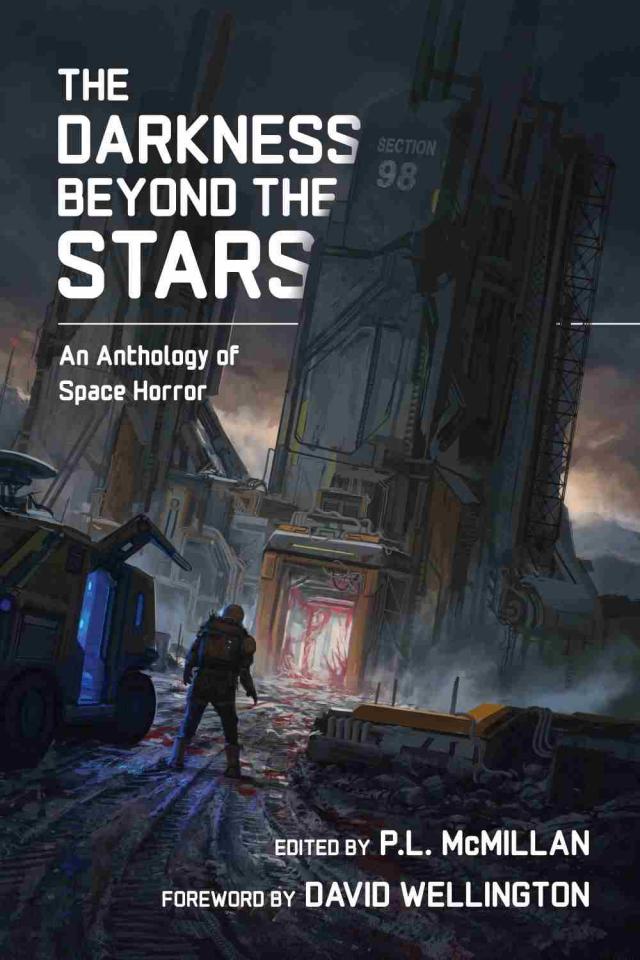
Front & back cover image by Stefan Koidl.
Book design by M. Halstead.
Formatting by M. Halstead.
Interior illustrations by P.L. McMillan.
First printing edition 2023.
979-8-9858713-4-0
dedicated to the horrornauts
who eagerly look to the stars
and shiver
Contents
Foreword
Introduction
Space Walk by Bob Warlock
A Voice from the Dark by Lindsey Ragsdale
Red Rovers by Patrick Barb
Son of Demeter by Bryan Young
The Scream by Timothy Lanz
The Weight of Faith by Carson Winter
The Faceless by Ryan Marie Ketterer
Planted in the Soil of Another World by Dana Vickerson
The Vela Remnant by David Worn
The Wreckage of Hestia by Jessica Peter
The Trocophore by Rachel Searcey
Locked Out by Joseph Andre Thomas
A Vine Is An Extension Of Life by mathew wend
Tempest by Emma Louise Gill
Last Transmission from the FedComm Sargasso by Bridget D. Brave
About the Authors
Acknowledgements
About Salt Heart Press
Other Publications
Foreword
The Non-Zero Chance
For writers of science fiction, the Fermi Paradox is the one question we can’t stop asking. Our galaxy is immense, filled with billions of stars, potentially millions of planets where life may have developed. Life that might have evolved sentience, curiosity, the desire to communicate with other beings. After all, that’s our story. It should have happened over and over again in the fourteen billion years since the Big Bang. So where are the aliens? Why, when we look outward, do we hear only silence? Why do we detect only dead worlds? Worse that dead worlds, actually, because dead suggests something lived there, once. We look out at the sky and we see: sterility. Worlds where life never had a chance. Choking skies. Dry deserts so cold they would freeze your bones. Unsolid worlds made of superhot poison gas.
Where are the others like us?
Why aren’t they talking?
There are many suggested solutions to the Paradox. A lot of the stories in this volume wrestle with one possible answer or another, answers that resound in the imagination like the faces of evil gods: the Dark Forest, the Great Filter, the horrible secrets of Deep Time.
But all those answers are optimistic, compared to the possibility that keeps me awake at night, the one I call the Non-Zero Chance. They all assume that there are aliens out there, aliens we might one day communicate with, even if that’s a bad idea. Even if that would mean the end of us.
The Non-Zero Chance is, to me, worse.
Given the enormous size of our galaxy, given the potential number of habitable worlds, it is nearly impossible, extraordinarily unlikely that, given enough chemicals and enough time, life would have emerged on just one single planet out of countless worlds.
Extraordinarily unlikely. Nearly impossible. But the equation doesn’t actually rule out the negative result. Imagine it:
We are alone.
Of all the planets whirling through the great galactic gyre, all the bits of rock and dust in an unfathomably big volume of space, life, you and me and everyone we know, every animal you’ve ever seen in a petting zoo, all the tiny little transparent bits of goo writhing on your face right now, all that bio-diverse panoply only happened once. Right here. Four billion years ago a stray cosmic ray hit a phosphorous molecule in a way it shouldn’t have, by complete accident, and it never happened again. Nowhere else.
We are alone.
Let this one sink in. The thing about horror is that it requires an open mind. Horror is the penalty—or, for some us, the reward—for chasing a thought too far. So if you want a good chill, really sit down and think about what the Non-Zero Chance means.
The galaxy, and all the galaxies beyond, reaching out into infinity, are empty. All of those planets are silent under empty skies. Out of all those craters dotting alien landscapes, not a single one has footprints crossing its dusty floor. No eye has ever opened blearily at the bottom of an icy sea and looked up to see the light of a red star. The voiceless winds blowing through all those alien canyons can’t even be called haunted, can’t be called spooky, because without life there are no ghosts.
Life only happened here. Nowhere else.
And life, as we know all too well, is finite.
Humanity won’t last forever. The Earth only has a few billion years left, and the chance that we will find a way to colonize other stars before then is starting to seem like a longshot. There will come a time when the last organism on this planet draws its last breath and then…
In every direction, there will be nothing alive. Nothing moving under its own volition. The universe will once again be unseen. Unknown. Unremembered. Unmourned.
Scary enough to contemplate, but now, the kicker: there is a non-zero chance that what I just described is an accurate picture of the cosmos.
Just keep telling yourself it’s extraordinarily unlikely.
★
Of course even if we were alone, we would still want to tell each other stories about bug-eyed monsters and little green men. Science fiction does not often trouble itself with empty skies. Thus the variety of tales in the present volume. There are aliens in this book—a lot of them! Rachel Searcey’s “The Trocophore” gives us a new take on that most beloved classic, the tentacled murderbeast. Bridget D. Brave’s “Last Transmission from the FedComm Sargasso” gives us something far weirder but very much alive, breathing and waiting just beyond the corner of your eye. The monster at the heart of David Worn’s “The Vela Remnant” is… no. You know what? I’m not going to spoil that one, not one bit. Go read it for yourself. You won’t regret it.
Other stories in this collection look at the Fermi Paradox from the opposite end of the telescope. What will it take for us to explore the galaxy, to find others like us? Some of them examine the interface between human life and the technology we will need to reach other stars. “Son of Demeter,” Bryan Young’s take on the generation ship, is downright horrifying in its implications. “Red Rovers”, Patrick Barb’s contribution, turns some of the cutest machines we’ve ever built into terrifying monsters.
My non-zero chance scares me, but it’s not the only possibility that does. Which is a good thing for us writers. A future with people in it, aliens and humans distorted by technology beyond comprehension, just makes for better stories. Before you lies a wonderful assortment of futures that explore their own non-zero chances. Because if there is a question more deeply rooted in the genre than the Fermi Paradox, it is the much simpler, but even more evocative: What if…?
It is the duty of a writer to ask questions. To go there. To look at all the myriad possibilities that exist and not to flinch away from what you find. Like the scientists whose ideas we borrow, we would rather have answers than ignorance.
Even if the things we discover are uncomfortable. Dangerous. Terrifying. Because there is some part of us that loves the tingling dread, the way the hair stands up on the back of our necks when we realize the universe is bigger—and darker—than previously suspected. That’s what this book is for, that deliciously awful feeling.
P.L. McMillan has put together a great assortment of frights for you. I hope you will enjoy the stories here collected, just as I have. And I hope, for your sake, for all of our sakes, that we are not alone.
But you never know.
—David Wellington, author of The Last Astronaut and Paradise-1
New York City, 2023
Interstellar Transmission From [CLASSIFIED]
I can feel your eyes seeking, looking up, straining as you gaze hungrily at the stars, the planets, the voids between.
I share your passion. To fall into the infinite galaxies and the darkness. I feel its pull, the same delicious shiver as it makes you feel oh so small.
The possibilities are endless. What lurks on those unknown planets, what hides in the dead light of stars now burned to dust?
Are you like me? Wishing to drown in interstellar terror, yearn to behold things larger than yourself, of things beyond belief and imagination?
Space, where beyond the thin walls of your spaceship, of your space suit, lies death. Where every planet could hold pain.
What could thrill more than to discover life elsewhere, even if hostile? It may be plant or animal or spectral being, or perhaps something else.
Something incomprehensible.
What of the dangers of travelling through the stars, of comp
The horrors are bountiful, they are beautiful and terrible in turn, and they will sate your desperate hunger for that next discovery.
For the darkness beyond the stars is decadent in its brutality.
Strive for the darkness. Scream for the stars. They are gone and only echoes remain. The planets you will discover will fight you, lay you low. Your companions cannot be trusted.
Perhaps worst of all will be your own mind, your paranoia, your failing strength.
You won’t be able to resist the pull. I know you’re as curious as I am. Nothing will stop you from reaching out and searching.
Take this, my offering to you. A gift, let’s say. A promise.
A declaration of war, even, on your sense of well-being and safety in your place in this cold, unfeeling universe.
I hope you enjoy each story, I hope in them you hear those cosmic whispers and galaxial cries. Feel each author’s howl of fear in the inked words, feast your eyes on the ominous visions. May every page pull you deeper, towards a literary event horizon.
Be seeing you soon.
Until then, look to the stars.
x P.L. McMillan
Space Walk
Bob Warlock
Everyone hates space walks.
That’s not quite right. I should say, of the vanishingly small number of humans who have experienced extra-vehicular activity in space, almost all come to hate it. Most of us think we will be the exception—when old hands tell us about how frankly unpleasant it is, we all nod respectfully and secretly think ‘yes, but I’m different.’ We’re adventurous types after all, we have to be. Only the cleverest, bravest, and most physically fit human specimens are ever offered the privilege of riding a hydrogen explosion out of Earth’s clinging atmosphere.
I was one of the happy few, and I am not the exception.
The date is June 13th, 2025. A quarter-mile below the ISS, a satellite owned by the Chinese government has collided with one owned by an American billionaire. Both are sent spinning out of orbit and into the atmosphere; an expensive but largely harmless mistake for which both parties refuse culpability. Meanwhile, in higher orbit, a solar panel is damaged by a shard of debris as it hurtles past, and two solar cells need to be replaced. A simple job for any electrical engineer, and it’s my shift in the rotation.
Here’s something we don’t tell wide-eyed schoolkids with dreams of flying through space. Putting on a space suit is a huge pain in the ass, second only to walking in one. Getting dressed starts with an adult diaper, followed by a cooling garment which looks like thick Lycra but is really 300 feet of water tubing in a synthetic matrix. Next is the pressure layer, and the oxygen layer, and the micro-meteor shield layer. On and on, until I’m safely encased in sixteen layers of clean, plastic-smelling extravehicular mobility unit. My own personal spaceship. And of course, of course, as soon as the life support system is strapped to my back and the door to the airlock closes, I realize I have an itch right between my shoulder blades, right under the backpack where I can’t reach with my bulky padded gloves. There’s no helping it now, and I push the sensation out of my awareness. Nguyen, coordinator for this EVA, gives me an ‘OK’ signal through the porthole and, when I respond, opens the airlock.
This is not my first spacewalk, but still when I step out of the airlock I make sure to keep my eyes anchored to the comfortingly ugly, man-made bulk of the station. Earth is an enormous blue beach ball behind me, and the other half of the sky cups me in a vast black fist. For a moment the awareness of being in space rises like nausea in my gullet, and I cling to the ladder, frozen. In just a few seconds the training kicks in, and I can bring my pulse to a more normal tempo. The terror is not gone exactly, just pushed to the side. A tiny, locked-out part of my mind is screaming at me that this is insane, but my body is an instrument of my will. I let the adrenaline buoy me up, not overwhelm me. I do not shiver. I can do the task before me, and I can ignore the environment.
“Mason confirmcommunicationover.” Nguyen’s voice in my earpiece, his words blurred together from habit.
“Confirmed. I’m outside. Suit function normal. Making my way to the panel now. Stand by for visual status update, over.”
Each step on the surface of the station is a tortuously slow process. I take a step, place my foot, engage an electromagnet, release my other foot, take another step. I’m tethered, of course, and my suit is fitted with air canisters which I can use in an emergency to pilot my body back to the safety of the airlock. But the first line of safety is iron, itself forged in dying stars and flung across the galaxy. Step, engage, release, step.
By the time I reach the outstretched arm of the solar panel, I’m sweating. The suit does its job, cooling my skin with tubes of flowing water and wicking away moisture into aquifers. Except for that one spot right between my shoulder blades, which still prickles infuriatingly. I picture tiny beads of sweat pressed against the fine hair follicles and the instinct to scratch is almost overwhelming. I breathe through it.
“Nguyen, are you receiving? Over.”
“Ten-four Mason, whatsyourstatus?”
“Visuals confirmed, surface shattering on modules 248 and 249. Definitely looks like collision damage. I’ll need to check the electronics, but it doesn’t look too bad. The cells should be ok.” Nguyen knows this already, of course; he can see what’s in front of me through the camera mounted on my helmet. But speaking aloud is comforting, makes me feel less alone.
I reach for the toolkit attached to my backpack and begin the painstaking process of replacing the tempered glass surface of the solar cells. It’s not difficult, but it is slow. First, I detach the frame of module 248 and lift it away, clipping it to my belt to make sure it doesn’t float away. Then I remove the cracked six-inch pane of glass and peer at the voltaic cells below. The steel microfibres laced through the glass have done their job and I breathe a sigh of relief.
“Good news Nguyen, no appearance of damage to the cells on 248. Commencing surface replacement, over.”
“Glad to hear it Mason, we’ll have you back on board in no time.”
I place the cracked pane into a disposal baggie and remove a fresh pane from its sterile container, working with gentle, deliberate movements in my insulated gloves. Just as I lower the clean square of new glass into position, the itching prickle on my back moves. Barely an inch, straight up my spine. The animal instinct battering at my conscious mind rises from a whine to a shriek.
I freeze. The glass in my hands is strong and highly resistant to surface damage, but it can still be snapped by pressure at the edges. I struggle to keep my hands steady and gentle. Cold sweat stands out on my forehead.
“Whoa, Mason! What happened there? Your heart-rate’s spiking.”
“Nuh—nothing.” I force myself to breathe. Slowly, in and out. I force a chuckle. “Thought I was gonna drop the new pane.”
Nguyen laughs, “Good thing there’s no gravity to worry about, huh?”
“Hah. Yeah.”
The itching sensation is still there, but it is not moving. It must be a fault in the suit, maybe an exposed tube rubbing at my skin, possibly even trickling droplets of water. I take a deep breath. I can do this.
It happens again just as I’m unclipping the frame from my belt, and I twitch so violently that I almost fling the frame into space. I keep working, but my breath is coming faster now despite my effort to slow it. Place the frame, secure it, move onto the next module.
“Mason, you sure you’re OK out there?”
I can’t trust my voice, so I don’t answer. All my energy is focused on two things: repairing the solar panel, and keeping my conscious mind from the thought that there is something in the suit.
At the moment I release the second frame from 249, the tickling moves to the nape of my neck, and I realize I’ve made a terrible mistake, because now it is inside the helmet. I barely manage to clip the frame to my belt before instinct takes over and I can’t stop myself from reaching up, batting at the back of the helmet. It’s useless of course, and I have the sudden mad impulse to release the helmet—just for a second—so that I can scrub my fingers through my hair, swat away whatever thing is slowly tickling its way up to the crown of my head. Instead I shake my head inside the helmet, trying to dislodge whatever it is against the padding that supports my neck. It has no effect but that the maddening tickle sharpens, turns into dots of pain on my scalp as sharp points (pincers? claws?) dig into the skin.


