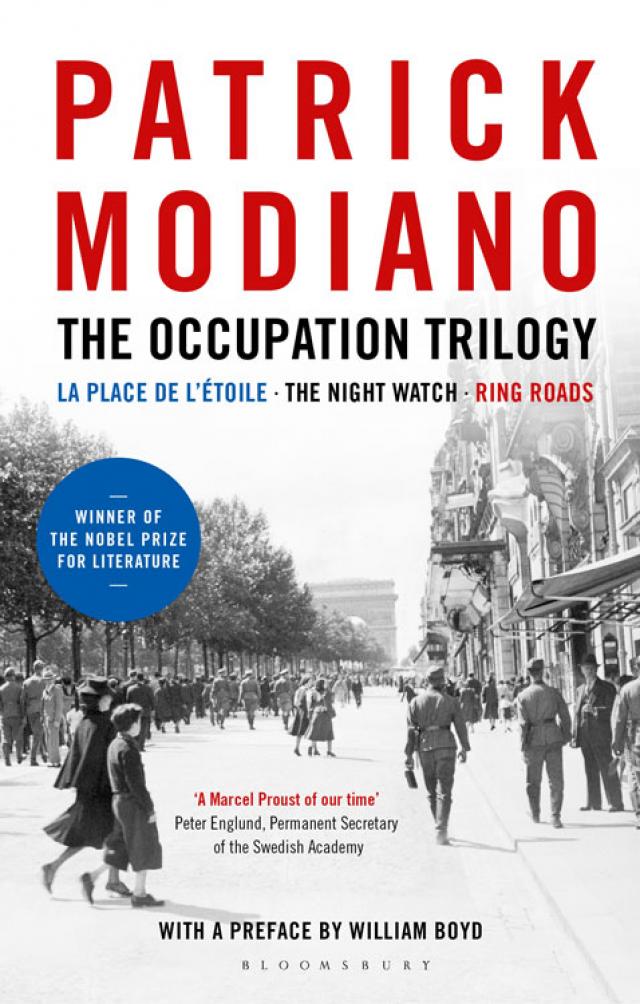
The occupation trilogy, p.1
The Occupation Trilogy, page 1


CONTENTS
Introduction
La Place de l’Étoile
The Night Watch
Ring Roads
Notes on La Place de l’Étoile
A Note on the Author
A Note on the Translator
INTRODUCTION
As our journey into the future continues – the present moment drifting away, our own biographies lengthening, our pasts receding, inexorably, quietly becoming ‘history’ in the distance – so certain aspects of those retreating eras seem to come more sharply into focus and claim our attention. The longer view allows us to see these features of the recent past as truly defining characteristics of those decades that we’ve lived through.
Take 1968, for example, nearly fifty years ago now, the year that the first novella in Patrick Modiano’s Occupation Trilogy was published. In 1968 I was running my school’s film society. I decided to conclude my tenure of the role with a controversial double bill and duly screened Alain Resnais’s Last Year in Marienbad (1961) and Federico Fellini’s Juliet of the Spirits (1965). I confess the choice was entirely pretentious, a consequence of pure sixth-form pseudo-intellectual bravado, but, while I was genuinely baffled by Marienbad, I was haunted by Juliet of the Spirits – for reasons that defy cogent analysis – and the film remains similarly haunting today, after several further viewings over the years. Something about those two films sums up for me the cultural mood of the 1960s – or at least one aspect of the cultural mood of that time: they are wilfully difficult to understand; they play fast and loose with chronology and ratiocination; the surreal seems more pertinent and familiar than the real. But in those days this seemed intensely stimulating and exciting – we were drawn to an art that occupied the mysterious, the vague and the allusive rather than one that conventionally confronted the blunt realities of the here and now.
Patrick Modiano’s three short novels – La Place de l’Étoile, The Night Watch (originally published in English as Night Rounds) and Ring Roads – resonate with that same knowing liberty and cool audacity and, as a result, Modiano became a modish and cult author at the time. Reading these novels anew for this introduction, I was still struck forcibly by this 1960s free-wheeling, free-form disregard for the well-constructed solidities of the traditional novel. Their tone, their style and their values are very much creatures of the time of their writing.
But Modiano’s trio are not just convenient cultural touchstones. There is an element in them, underlying the careful obscurantism and the nonchalant moodiness, that gives a deeper resonance. It’s important to remember that Modiano was exceptionally young when they were published: he was twenty-two when La Place de l’Étoile appeared in 1968. The Night Watch arrived a year later and he was only twenty-six when the last of the trilogy, Ring Roads, emerged in 1972. They are bravura, young-man’s novels, particularly the first, which announced the advent of a precocious literary talent and star. All three are short, each just over a hundred pages, and they gain their collective title from the connection with L’Occupation – France’s enduringly bitter and divisive subjugation by Nazi Germany during 1941–44.
La Place d’Étoile is the most frenetic. It’s as if the young Modiano had gathered together every controversial and combustible issue of twentieth-century French history and literature – and whatever else took his fancy – and thrown them together in this rambunctious tale of a Jewish collaborator called Raphael Schlemilovitch. Anti-Semitism, the Gestapo, Dreyfus, Auschwitz, Action Francaise, collaboration, betrayal and bad faith all contribute to the neurotic picaresque of this episodic and still startling, shocking novel. If, today, Michel Houellebecq is considered the bad-boy of contemporary French literature then he must have learned a lot from La Place de l’Étoile: blatant offence is freely given, taboos are blithely violated and no sacred cow is sacrosanct as we explore the fraught psychic landscape of Raphael Schlemilovitch, Jew turned Nazi sympathiser. He is, of course, the ultimate unreliable narrator. At one stage he fantasises about seducing Eva Braun and talks of his meetings with Hitler. When, at the novel’s end, he wakes up – entirely improbably – on the couch in Freud’s Vienna consulting rooms, everything we have read before is thrown into stark, sceptical relief.
Both The Night Watch and Ring Roads also deal with the Occupation. The Night Watch is the story of a young French collaborator instructed to break into and betray a resistance cell. In this novel, the narrator is unnamed and the point of view more subjective. There are long passages of unparagraphed internal monologue interspersed with lyrics from popular pre-war songs as Modiano confronts France’s guilty ambivalence about the Occupation years. In La Place de l’Étoile Schlemilovitch reflects that ‘There were many of us who slept with Germany and the memory of it is sweet’. In a significant way this assertion is the bedrock of all of Modiano’s fiction since his debut in 1967, a fact highlighted by the Nobel committee when they awarded him the literature prize in 2014.
Modiano was born in 1945 and has written of his own struggles to come to terms with what occurred in France during the years immediately prior to his birth. His father, a Sephardic Jew of Italian origin, seems to have been involved in the wartime black market and some form of petty gangsterism but never told his son anything of his life between 1941 and 1944. Therefore it is not surprising that fathers and father-figures proliferate in all three novels, notably in Ring Roads, the most terse and oblique of the three. It concerns a son’s quest for his father, a man somehow confined in a strange commune in a village near the forest of Fontainebleau. Modiano has a great facility for topographical description, both evocative and precise, but in Ring Roads everything else is deliberately blurred, including the historical period. Only at the end does it become apparent that the central character’s search for his missing father is taking place during the war. The encounter is unsatisfactory – the father has no recollection of his son, while the son’s abiding memory is of his father’s attempt to kill him by pushing him under the wheels of an underground train, some ten years before the events of the novel begin.
There is a change of style in Ring Roads – noticeably shorter sentences, a clipped objectivity. Modiano was classified by critics as having joined the ranks of the nouveau roman – but, whatever the novel’s mannered obliquities, the same historical concerns run beneath the surface. The novel has an epigraph from Rimbaud: ‘If only I had a past at some other point in French history. But no, nothing.’ This, you might imagine, is Modiano’s private plaint: condemned by the date of his birth and the shady wartime career of his father to spend his literary working life exploring the consequence of L’Occupation, Collaboration and Résistance – such as it was. He has often been a brave and solitary voice – what happened between 1941 and 1944 is not a subject that is raised in France with much enthusiasm, even today.
However, perhaps Modiano’s most controversial move in airing and confronting the unspoken subject of the widespread passive and active collaboration of the French population in the Second World War occurred just after the publication of Ring Roads when, working with the director Louis Malle, he wrote the screenplay of the film Lacombe, Lucien (1974). It is effectively the fourth panel of the trilogy, making it a tetralogy, and the light it casts back on the three novels is revealing. Lacombe, Lucien is the story of a simple country boy who tries to join the Resistance and is rejected, so guilelessly enlists in the French Gestapo instead. It’s a powerful and disturbing film precisely because it makes no moral judgements. Lucien seems an entirely thoughtless collaborator – without conscience or venality or any sense of guilt. It shows just how easy it is – in circumstances such as those of 1941–44 – to become complicit.
In an aside in La Place de l’Étoile – a novel steeped in French literature, by the way, for all its modernity – Modiano facetiously lists the clothes to wear and the ambience to arrange in order to read certain classics of the French literary canon there by enhancing the experience. You don’t need to put on your beads and flares and listen to Françoise Hardy to relish The Occupation Trilogy fully, but curiously and most unusually – usually it’s the other way round – your reading of these remarkable and seminal novels will be immeasurably enhanced by a viewing of Lacombe, Lucien, before or after.
William Boyd
London, June 2015
La Place de l’Étoile
For Rudy Modiano
In June 1942, a German officer approaches a young man and says, ‘Excuse me, monsieur, where is the Place de l’Étoile?’
The young man gestures to the left side of his chest.
(Jewish story)
I
This was back when I was frittering away my Venezuelan inheritance. Some talked of nothing but my beautiful youth and my black curls, others called me every name under the sun. Rereading an article about me written by Léon Rabatête in a special edition of Ici la France: ‘ . . . how long do we have to suffer the antics of Raphäel Schlemilovitch? How long can this Jew brazenly flaunt his neuroses and his paroxysms with impunity from le Touquet to Cap d’Antibes, from le Baule to Aix-les-Bains? Once again, I ask: how long can dagos of his ilk be allowed to insult the sons of France? How long must we go on washing our hands of this Jewish scum . . .?’ Writing about me in the same newspaper, Doctor Bardamu spluttered: ‘ . . . Schlemilovitch? . . . Ah, the foul-smelling mould of the ghettos! . . . that shithouse lothario! . . . runt of a foreskin! . . . Lebano-ganaque scumbag! . . . rat-a-tat . . . wham! . . . Consider this the Yiddish gigolo . . . this rampant arsefucker o
The Doctor never did forgive me for the copy of Bardamu Unmasked I sent him from Capri. In the essay, I revealed the sense of wonder I felt when, as a Jewish boy of fourteen, I read The Journey of Bardamu and The Childhood of Louis-Ferdinand in a single sitting. Nor did I shrug off the author’s anti-Semitic pamphlets as good Christian souls do. Concerning them, I wrote: ‘Doctor Bardamu devotes considerable space in his work to the Jewish Question. This is hardly surprising: Doctor Bardamu is one of us; he is the greatest Jewish writer of all time. This is why he speaks of his fellow Jews with passion. In his purely fictional works, Dr Bardamu reminds us of our Race brother Charlie Chaplin in his taste for poignant details, his touching, persecuted characters . . . Dr Bardamu’s sentences are even more “Jewish” than the rococo prose of Marcel Proust: a plaintive, tearful melody, a little showy, a tad histrionic . . .’ I concluded: ‘Only the Jews can truly understand one of their own, only a Jew can speak perceptively about Dr Bardamu.’ By way of response, the doctor sent me an insulting letter: according to him, with my orgies and my millions I was orchestrating the global Jewish conspiracy. I also sent him my Psychoanalysis of Dreyfus in which I categorically affirmed his guilt; a novel idea coming from a Jew. I elaborated the following theory: Alfred Dreyfus passionately loved the France of Saint Louis, of Joan of Arc, of Les Chouans. But France, for her part, wanted nothing to do with the Jew Dreyfus. And so he betrayed her, as a man might avenge himself on a scornful woman with spurs fashioned like fleurs-de-lis. Barrès, Zola and Deroulède knew nothing of such doomed love.
Such an analysis no doubt disconcerted the doctor. I never heard from him again.
The paroxysms of Rabatête and Bardamu were drowned out by the praise heaped upon me by society columnists. Most of them cited Valery Larbaud and Scott Fitzgerald: I was compared to Barnabooth, I was dubbed ‘The Young Gatsby’. In magazine photographs, I was invariably shown with my head tilted slightly, gazing towards the horizon. In the columns of the romance magazines, my melancholy was legendary. To the journalist who buttonholed me on the steps of the Carlton, the Normandy or the Miramar, I ceaseless proclaimed my Jewishness. In fact, my actions ran counter to the virtues cultivated by the French: discretion, thrift, work. From my oriental forebears, I inherited my dark eyes, a taste of exhibitionism and luxury, an incurable indolence. I am not a son of France. I never knew a life of grandmothers who made jam, of family portraits and catechism. And yet, I constantly dream of provincial childhoods. My childhood is peopled by English governesses and unfolds on beaches of dubious repute: in Deauville, Miss Evelyn holds my hand. Maman neglects me in favour of polo players. She kisses me goodnight when I am in bed, but sometimes she does not take the trouble. And so, I wait for her, I no longer listen to Miss Evelyn and the adventures of David Copperfield. Every morning, Miss Evelyn takes me to the Pony Club. Here I take my riding lessons. To make maman happy, I will be the most famous polo player in the world. The little French boys know all the football teams. I think only of polo. I whisper to myself the magic words, ‘Laversine’, ‘Cibao-La Pampa’, ‘Silver Leys’, ‘Porfirio Rubirosa’. At the Pony Club, I am often photographed with the young princess Laïla, my fiancée. In the afternoons, Miss Evelyn takes us to La Marquise de Sevigné for chocolate umbrellas. Laïla prefers lollipops. The ones at La Marquise de Sevigné are oblong and have a pretty stick.
Sometimes I manage to give Miss Evelyn the slip when she takes me to the beach, but she knows where to find me: with ex-king Firouz or Baron Truffaldine, two grown-ups who are friends of mine. Ex-king Firouz buys me pistachio sorbets and gushes: ‘You have a sweet tooth like myself, my little Raphaël!’ Baron Truffaldine is always alone and sad at the Bar au Soleil. I walk up to his table and stand in front of him. The old man launches into interminable anecdotes featuring characters called Cléo de Merode, Otéro, Émilienne d’Alencon, Liane de Pougy, Odette de Crécy. Fairies probably, like the ones in the tales of Hans Christian Andersen.
The other props that clutter my childhood include orange beach parasols, the Pré-Catalan, Hattemer Correspondence Courses, David Copperfield, the Comtesse de Ségur, my mother’s apartment on the quai Conti and three photos taken by Lipnitzki in which I am posed next to a Christmas tree.
Then come the Swiss boarding schools in Lausanne and my first crushes. The Duisenberg given me for my eighteenth birthday by my Venezuelan uncle Vidal glides through the blue evening. I pass through a gate and drive through the park that slopes gently to Lake Leman and leave the car by the steps leading up to a villa twinkling with lights. Girls in pale dresses are waiting for me on the lawn. Scott Fitzgerald has written more elegantly that I ever could about these ‘parties’ where the twilight is too tender, the laughter and the shimmering lights too harsh to bode well. I therefore recommend you read the author, you will have a precise idea of the parties of my adolescence. Failing that, read Fermina Marquez by Larbaud.
If I shared the pleasures of my cosmopolitan classmates in Lausanne, I did not quite resemble them. I often went off to Geneva. In the silence of the Hôtel des Bergues, I would read the Greek bucolic poets and strive to elegantly translate the Aeneid. In the course of one such retreat, I made the acquaintance of a young aristocrat from Touraine, Jean-François Des Essarts. We were the same age and I was astounded by the breadth of his knowledge. At our first meeting, he recommended that I read – in no particular order – Maurice Scève’s Délie, Corneille’s comedies, the memoirs of Cardinal de Retz. He initiated me into the grace and the subtleties of French.
In him, I discovered precious qualities: tact, generosity, a great sensitivity, a scathing wit. I remember Des Essarts used to compare our friendship to the one between Robert de Saint-Loup and the narrator of In Search of Lost Time. ‘You’re a Jew, like the narrator,’ he would say, ‘and I’m related to the Noailles, the Rochechouart-Mortemarts and the La Rochfoucaulds like Robert de Saint-Loup. Don’t worry, for a century now the French aristocracy have had a soft spot for Jews. I’ll show you a few pages by Drumont in which this upstanding man castigates us for it bitterly.’
I decided never to return to Lausanne and, without the slightest compunction, sacrificed my cosmopolitan friends for Des Essarts.
I turned out my pockets. I had exactly a hundred dollars. Des Essarts did not have a centime to his name. Even so, I suggested he give up his job as sports correspondent for La Gazette de Lausanne. I had just remembered that, during a weekend spent in England, some friends had dragged me to a manor near Bournemouth to see a collection of old automobiles. I tracked down the name of the collector, Lord Allahabad, and sold him my Duisenberg for fourteen thousand pounds. On such a sum we could live decently for a year without having to depend on having money wired by my uncle Vidal.
We moved into the Hôtel des Bergues. I still have dazzling memories of this early period of our friendship. In the morning, we would loiter among the antique dealers of old Geneva. Des Essarts passed on to me his passion for bronzes. We bought some twenty pieces which cluttered up our rooms, among them a verdigris allegory representing ‘Toil’ and a pair of magnificent stags. One afternoon, Des Essarts informed me that he had acquired a bronze footballer: