Western union, p.1
Western Union, page 1


Western Union
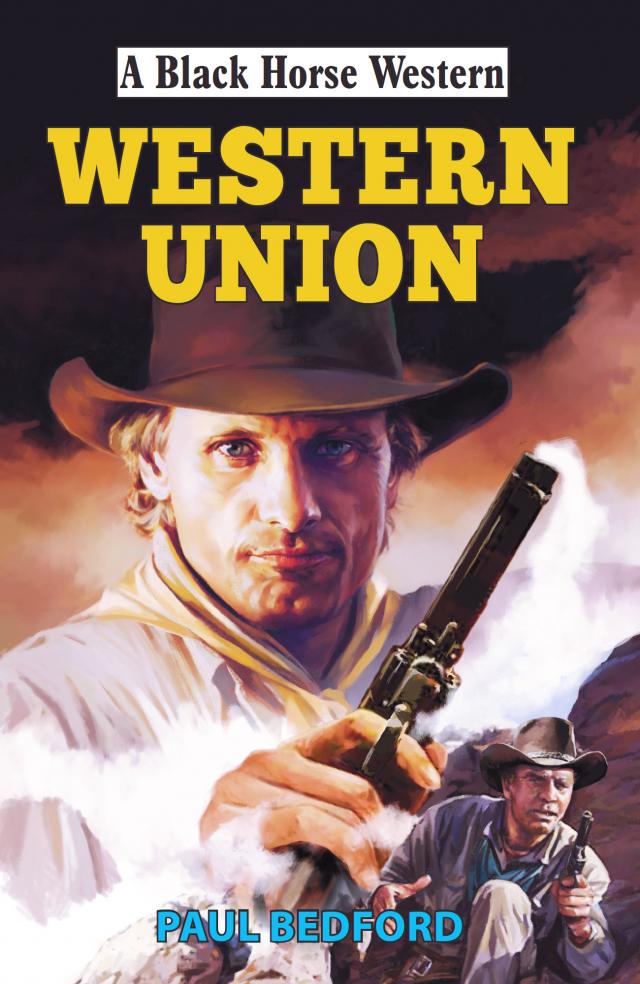
The year is 1861 and the nation is at war. The Western Union Telegraph Company intends to connect East with West as never before, but is beset by enemies. Wires are cut and telegraph poles burned, and then matters take a far darker turn when a repair crew is massacred. The question is, who might be responsible? Could it be embittered Indians, belligerent Confederates, or even the Pony Express, which will surely go out of business as soon as the transcontinental telegraph is completed?
Company boss Ezra Cornell employs a grizzled former Texas Ranger, known only as Kirby, to investigate. Paired up with young company employee Ransom Thatcher, the two men head out across the vast northern plains in search of the deadly marauders. Then it belatedly dawns on Thatcher that if his companion is a Texan, that must also make him a Confederate, and yet another potential enemy!
By the same author
Blood on the Land
The Devil’s Work
The Iron Horse
Pistolero
The Lawmen
The Outlaw Trail
Terror in Tombstone
The Deadly Shadow
Gone West!
A Return to the Alamo
Taggart’s Crossing
A Hell of a Place to Die
Death on the Bozeman
Bone Treasure
Western Union
Paul Bedford
ROBERT HALE
© Paul Bedford 2018
First published in Great Britain 2018
ISBN 978-0-7198-2643-6
The Crowood Press
The Stable Block
Crowood Lane
Ramsbury
Marlborough
Wiltshire SN8 2HR
www.bhwesterns.com
Robert Hale is an imprint of The Crowood Press
The right of Paul Bedford to be identified as author of this work has been asserted by him
in accordance with the Copyright, Designs and Patents Act 1988
All rights reserved. This e-book is copyright material and must not be copied, reproduced, transferred, distributed, leased, licensed or publicly performed or used in any way except as specifically permitted in writing by the publishers, as allowed under the terms and conditions under which it was purchased or as strictly permitted by applicable copyright law. Any unauthorised distribution or use of this text may be a direct infringement of the author’s and publisher’s rights, and those responsible may be liable in law accordingly.
For my good friend W Bro Stephen M. Dolan,
a true Western enthusiast
Chapter One
The sun’s rays had barely crept over the horizon, but they now illuminated a most unusual scene. The great pall of grey smoke was not what one would have expected to see on a late spring day on the northern plains. Then again, nothing about that spring of 1861 could be classed as normal, because after years of heated language and not a little bloodshed, the nation was finally at war with itself!
The roaring fire was stacked high with wooden telegraph poles, ruthlessly hacked down like small trees. The blatant destruction proved that, although nominally on Indian land, the figures enthusiastically cavorting around the blaze were either Indians themselves, or simply did not care about discovery – presumably because their work would be approved of. Under orders from their leader, two of the arsonists coiled up the severed telegraph wire for its removal. Whether it was destined to be a display trophy or for future use elsewhere, one thing was certain, when the next repair crew came looking, they would find serious damage and nothing that could be restored and made good.
Howling in triumph, the men mounted up and rode off, but they didn’t go far, because they had much more in mind than mere disruption. The fire would burn itself out, but events were destined to take a far darker turn, and for one very simple reason. This was intended to be a murder raid, because if the individuals tasked with maintaining the line were slaughtered, then pretty soon no one would be prepared to take on such a dangerous job, and the Western Union Telegraph Company would be ruined. Or more importantly, no longer functioning.
Reining in beyond a low rise, the marauders dismounted. One quickly moved back on foot to keep watch, while the rest of the group settled down to check their weapons. They had deliberately struck at dawn, only twenty odd miles from Omaha, but even so it would likely be quite some time before a repair crew arrived. And God help them when they did!
The two heavily laden wagons rattled westward across Nebraska Territory, alone in a seemingly unending sea of grassland. They carried ten men and all the equipment that they would likely require to get the telegraph working again. In the past, the line’s many and varied enemies had included strong winds, buffalo, heavy snow and occasionally hostile Indians. Hell, even lightning bolts had taken their toll. But recently, far more sustained damage had been carried out, hence the unusually heavy load on the wagons.
They had been on the move since early morning, when the break had been reported, and it was now late afternoon. Although the warm sun was well past its zenith, it was unrelenting, and the men would gladly have sought shade under the wagons for an hour or so. Unfortunately they had a great deal of work ahead, and an ambitious repair boss by the name of Chet Southall who intended to see it carried out.
Off to their right flowed the Platte River, sparkling temptingly in the bright light. The waterway had long been a lifeline for men and beasts alike, and formed the essential component of the great Platte River Road, followed by countless settlers on their way to California and Oregon. Its sustaining presence explained away the route of the telegraph line, and was also one reason why the planned trans-continental railroad would be taking the same course. The fact that the Western Union men hadn’t clapped eyes on anyone that day would have been considered quite remarkable, except for the fact that there was now a war on. Sudden uncertainty about the future had altered a lot of plans, but that sentiment wasn’t just confined to the east, as the work gang were about to find out.
The moment that Chet clapped eyes on the large pile of smouldering ashes, he had a bad feeling about the whole business. ‘What the hell’s occurred here?’ he growled uneasily. ‘And don’t tell me it’s buffalo, ’cause them big shaggies don’t tote Lucifers around with them . . . or carry off telegraph wire!’
The heavily built bruiser named Vinny, who both shared the bench seat with him and controlled the mule team, reckoned he had the answer. ‘Huh, for my money it’s the God-damned Sioux. They like nothing better than a good fire with other folk’s stuff. So for all our sakes, let’s hope they’re back in their village having a celebray.’
Chet didn’t answer. He just stared glumly at the wanton destruction. This was far more than casual spite. He knew it would require everything they had brought with them to get the telegraph back in working order. Failing to do so was not an option.
As his wagon finally ground to a halt near the glowing embers, the repair boss clambered down to the ground. Not even his aching back could distract him from the task ahead. Motioning the others to gather around, he addressed them in strangely hushed tones.
‘I don’t know who did all this, and right now I don’t care. We’ve got a job to do, so let’s get it done lickety split. The sooner we finish, the sooner we can get the hell out of here. And I don’t want any unnecessary noise, you hear? No hollering, no singing. Just hard work! And keep those firearms close.’
The nine men regarded their boss with unusual solemnity. Normally there would have been ribald banter and laughter, but not this time. All could sense that he was in deadly earnest, and they had eyes. They could see for themselves what had been done. What if those responsible were still in the area?
The unspoken question was chillingly answered by a piercing shriek from the south, and quite suddenly the urgent telegraph repairs were completely forgotten. As a large body of horsemen came into view, personal survival was abruptly all that mattered, because there could be no doubt whatsoever that the new arrivals were both belligerent and numerous.
‘Sweet Jesus, let’s get out of here,’ yelled one of the men, a scrawny cuss named Seaton, as he raced for the nearest wagon. There was no hiding the panic in his voice, and such an emotion was contagious.
As the others followed the frightened man, Chet bellowed after them, ‘Fort up behind the wagons, you morons, or we’re dead for sure.’ But no one appeared to be listening.
Boiling mad, and with the sound of pounding hoofs drumming in his ears, he raced after his men. Coming up behind Seaton, just as that individual clambered up onto the bench seat, he grabbed his right arm and heaved him off the wagon. ‘Don’t be a damn fool,’ he snarled. ‘We can’t outrun them with these. Our only chance is to stick together and fight.’ So saying, the repair boss levered a cartridge into the breech of his Spencer repeating carbine, retracted the hammer and fired directly into the skull of one of the lead mules. As that animal collapsed to the ground, still in its traces, as though pole-axed, Chet shifted position and repeated the brutal action with the other wagon team.
‘Now, we either all go together or not at all,’ he shouted. ‘So defend yourselves!’
His startled men, hardened by life on the frontier, got a grip on their nerves and spread out behind the wagons. As their assailants rapidly closed the distance, the Western Union employees levelled their assorted weapons. It was a sad fact that Chet was the only man in possession of a repeating long gun. Of the others, one had a battered Sharps breechloader, whilst the rest were equipped with out-dated muzzle-loading ri fles of the type being issued to the opposing armies.
Knowing that he would be needed to provide covering fire whilst his men reloaded, Chet resisted the strong urge to shoot and instead scrutinized their attackers. He had already surmised that he and his men had been lured into a carefully prepared trap, but it was the strange appearance of the charging horsemen that puzzled him.
Superficially, they seemed to be hostile Indians, or at least those in the lead did. But since when did the wild tribes all use saddles?
The Sharps crashed out first, and instantly claimed a victim. Yet even as the painted savage toppled from his mount, the drawing of first blood seemed to act as a signal, because with amazing discipline the phalanx suddenly split into two. Each flank swept off to the side of the wagons at the very moment that the eight defenders opened fire. Taken by surprise, their ragged volley achieved little, bringing only one more man down and wounding another. As a cloud of powder smoke temporarily obscured their positions, the repair crew then made the mistake of attempting to reload their rifles.
‘Forget those,’ their boss desperately bellowed out. ‘Use your belt guns!’
But it was too late. The ‘Indians’ were in amongst their vastly outnumbered victims, and the slaughter had begun. The Sharps crashed out once more, before its owner took a tomahawk to the head, the mighty blow cleaving through bone and soft tissue. Chet fired his Spencer up into a looming torso, and was rewarded by the heavy bullet thrusting his victim out of the saddle, but the fight was about to become very one-sided.
Utilizing the far greater size and weight of their animals, the marauders crowded in on the increasingly desperate labourers, disrupting their ability to fight back. The scrawny Seaton managed to scramble under a wagon, but he was only prolonging the inevitable. Although his companions carried a variety of ‘cap ’n ball’ revolvers, their discipline was poor, and they were overwhelmed by sheer numbers.
Vinny, Chet’s burly wagon driver, took an arrow deep in his neck and uttered a high-pitched scream. Another man fired his Colt Navy into the belly of a horse, but the poor beast toppled sideways, bowling him over and crushing his legs. Even as the labourer howled in agony, the creature’s enraged rider leapt to his feet and hacked at him with a hand axe. His inescapable demise was grim and bloody.
Instinctively parrying a lance with his carbine, Chet glanced up at his opponent’s tanned, brutalized features and flinched with surprise. ‘You’re no Indian,’ he shouted accusingly. The other man merely smiled sardonically and yanked hard on the reins. His animal swung around, so that its haunches smacked solidly into Chet, knocking him clear off his feet. Hitting the ground hard, he lay winded for a moment, unable to move. Peering under the nearest wagon, his eyes locked with those of the terrified Seaton. All around were screams, shouts and the occasional gunshot.
Then, without any warning, the diminutive labourer was dragged ‘out from under’ by his feet, his fingers frantically clawing at tufts of long grass. Chet never saw what happened next, because at that moment a tremendous stabbing pain of unbelievable intensity penetrated deep into his upper back. Nothing in his life could have prepared him for the unremitting agony. It was as though he had been impaled. As the awful pain threatened to engulf him, he reacted instinctively and attempted to crawl away from it.
Inch by dreadful inch he moved. There was surely no logic to it, because he had nowhere to hide. It was just pure dogged cussedness. And then, as his senses began to fade, his head butted up against something solid. Through eyes that were beginning to glaze over, he dimly made out the bloodied head of one of the mules that he had shot. The last thing that he heard was a harsh laugh, followed by the strangely accented words, ‘Looks like this one has met his end. Or is it his ass? Ha ha.’
Chapter Two
Ezra Cornell, a dour individual with a strangely flowing beard, glared around the room at his seated employees. He had been annoyed ever since receiving the message that had necessitated his travelling from Chicago to Omaha. Nearly twenty-four hours spent in various railroad carriages, culminating with the Mississippi and Missouri Railroad line to Council Bluffs, had been a very unwelcome experience. In addition to that, he loathed the primitive frontier life, and especially detested any situation that was likely to cost him money. And this latest crisis had all the hallmarks of being expensive. In fact, one particular acquisition had already set the company back a fair few dollars.
‘So how long overdue are they?’ he demanded testily.
The manager of the local telegraph office, a habitually serious-looking individual by the name of Stephen Ames, frowned nervously. He couldn’t see any fair reason why he might be taken to task, and yet the presence of Western Union’s chief officer was always enough to unsettle him. ‘They should have been back well over two days ago. There were two fully loaded wagons with ten men. Southall, the repair boss, was . . . is a good man.’
Cornell regarded his subordinate dubiously. For him, that slip of the tongue had been a clear indication of how Ames really viewed the situation. ‘Obviously not quite good enough,’ he remarked dryly. ‘And the line between here and Salt Lake City is still down?’
The manager nodded. ‘But any one of the crew could have tapped into the line this side of the break, to contact me.’
‘If they’re still alive!’ That provocative comment came from the youngest man in the room. Ransom Thatcher, dark haired and broad shouldered, displayed no signs of apprehension. He possessed the unbounded confidence of youth, coupled with the comforting knowledge that his father was high up in the company’s hierarchy.
Cornell stared hard at the young man. He didn’t particularly like him, but the same thought had also occurred to him. ‘Meaning that they were deliberately drawn out there and then killed?’
Thatcher’s only response was a bleak smile, but Ames was aghast, because his slip of the tongue had actually been genuine. ‘Deliberately murdered? Surely not. Who’d do such a thing?’
Cornell chose to answer that question with one of his own. ‘What other destruction has there been recently?’
‘Until about a month ago it was just occasional damage to the poles by buffalo and the winter snows. Since then it’s got more serious. Poles intentionally cut down. Wire severed and removed. That’s why I sent two fully loaded wagons out.’
‘But you didn’t think to tell me?’
Ames frowned again. ‘I didn’t see any need. You pay me to maintain the line, and that’s what I’ve been doing.’
‘Until now?’
‘This isn’t usual,’ protested the Omaha man. ‘I’ve never had employees go missing before. It’s unsettled the others. No one else wants to take another wagon out.’
Cornell stared at him long and hard, before heaving a great sigh. ‘Fair enough,’ he accepted heavily. ‘So who do we think is responsible?’
Thatcher had no hesitation. ‘For my money, it’s those God-damn savages.’
‘Which ones?’
‘Pawnee, Sioux. Who cares? They’re all the same to me. They’ve watched our poles spreading across their land and they don’t like it. All I can say is, they’re in for a hell of a shock when, and if, Mister Lincoln’s railroad heads out across the plains.’
Cornell chewed his bottom lip pensively for a moment before responding. ‘There’s something else you haven’t considered. This country has been at war with itself for just over one month now.’ He gazed meaningfully at Ames for a moment before continuing. ‘What if the Confederacy has it in mind to sabotage the North’s link with the West?’ He was pleased to see that both men’s eyebrows rose in surprise, but he hadn’t quite finished. ‘And what about the glorious Pony Express? Once we connect Salt Lake City with Carson City, we’ll span the whole continent, and those show-offs will be out of business . . . permanently. Kind of makes you think, doesn’t it?’
Thatcher and Ames exchanged startled glances. They quite obviously hadn’t considered such possibilities, but it was the younger man who recovered first. ‘What about the army? Surely it’s in the government’s interest to provide us with protection.’