The hanging tree, p.2
The Hanging Tree, page 2


‘Murder is …’ he whispered to himself. ‘Murder is and murder does. Did you …’ He broke off as he heard a sound behind him. He tensed and caught his breath, only to relax as the parish cat, the great, one-eyed Bonaventure, emerged from the shadows of the transept, a wriggling mouse caught firmly in its jaw. Clement hurriedly opened the postern in the main door so the cat could slide, swift and silent as any assassin, into the dark. Clement closed the door and returned to study the painting. So absorbed in the artist’s work, Clement was totally unaware that his own sudden, silent death was being plotted by the figure lurking deep in the shadows of the nave. Murder truly intended to make its presence felt, not just in paintings and frescos but in the very sinews of life.
Clement himself appreciated the dangers which sprang from the secrets he was beginning to unravel. He repressed a sudden sharp shiver of fear. Clement turned and looked back down the long, empty, hollow-sounding nave, where only a few sconce torches and the fast-fading day provided slivers of light. Clement breathed out noisily. He’d discussed his jumbled thoughts with his good friend and distant kinsman Crispin the Carpenter, who had advised him to come here. Brother Athelstan, the Dominican parish priest of St Erconwald’s, would celebrate his Mass and speak to those such as Clement, who needed words of advice. Clement had hurried to St Erconwald’s, only to be informed by Benedicta the Beautiful that Brother Athelstan had been summoned by Sir John Cranston to meet him at Westminster. Dreadful murders had occurred there. Nevertheless, Benedicta had added, Brother Athelstan would surely return, so would Clement, whom she recognized, wish to stay in the church, bearing in mind the freezing weather outside? Clement had accepted the widow woman’s kind offer, along with a jug of ale and a dish of scones from The Piebald tavern. Benedicta had brought the drink and food herself, as well as wafers from Merrylegs’ pastry shop. Benedicta had encouraged her visitor to eat, drink, then relax. Clement certainly needed to do that, warming himself over one of the wheeled fire-baskets placed judiciously around the church. Clement had both eaten and drank then warmed himself, moving a brazier close to the wall painting he was scrutinizing.
Clement continued his reflection, totally unaware of murder, creeping like a spider towards him, slowly, measuredly, listening to the different sounds from the church and outside. Clement himself felt an awful chill of loneliness, as well as a premonition that all might not go well. Clement wondered what he should do but then closed his eyes as he clutched his stomach. It was time that he was gone. There was some malignancy in his belly; he was bleeding from inside and growing weaker by the day. Clement suspected that he was grievously ill and that was another reason for coming here today. He breathed in, clutching his cloak more closely and, at the same time, brushing the pommel of his dagger. Clement continued to ignore the pain in his belly, that sharp disturbance of his humours. He just wished he had come earlier to consult with the small, dark-faced, innocent-looking friar. Crispin the Carpenter had urged him to seek out Athelstan and so, eventually, he had.
Clement realized this was all so different from the glory days when he was a true craftsman, a high-ranking official of the guild, a time when architects from all over Europe consulted with him over this issue or that. Clement would tell Athelstan about his lovely wife Anna, now gone to God. How the old King and his warlike sons had patronized Clement and showered the Key-Master with favour, rewards and sweet inducements. The old King had chosen him to fashion special locks for the treasury at Westminster. Locks which would control two important doors. Each door would have two locks, one at the top and one at the bottom. The King wanted a work of craftsmanship, a subtle piece of workmanship so the locks were unique, as were the keys. Clement had risen to the challenge, creating four such locks. Plaudits and congratulations had rained down on him and his family … and then disaster! One morning, long before the city mist had dissipated and the bells tolled out, Master Thibault, Keeper of the King’s Secrets, had unleashed his searchers. They had broken into both Clement’s house and workshop, confiscating his coffers, caskets and, of course, the fruits of his own stupidity. He should not have kept those plans, charts and drawings, the pieces of wood and metal all connected with the creation of those special locks. In truth, he had meant well, but Clement had been caught with documents and artefacts which should have been destroyed.
Clement closed his eyes and leaned his hot forehead against the cold plaster. Death and Destruction, those infernal twins, had swept into his life, and the blight had spread like some baleful mist. Anna, his beloved wife, had died of a bloody flux, now very similar to the one which weakened him. Clement had been dismissed from both the Guild and the royal service, no fees, no wages, no pension, no house or home, and then Columba! Columba, his one and only beloved son, a master craftsman in the making. Columba had met and married Isabella Fleming, and then what? In truth, Columba had been sorely affected by his father’s disgrace and matters slipped from bad to worse. Rumours even ran rife about Columba’s marriage, then silence. Nothing! Columba had just disappeared. No trace or sign of him. Clement had grieved for his son every day over the last few years. He and Columba had lost something, and Clement just wished that he could rectify what was wrong. But Columba had vanished, as completely and as swiftly as dew on a bright summer’s morning. Columba had apparently fled his narrow house in Crooked Lane near St Michaels, Dowgate. He had taken his clothes and all his valuables, except for one.
‘He didn’t take the Walsingham,’ Clement whispered into the darkness. ‘Columba would never have left the Walsingham. He took it with him everywhere. So why hadn’t he on that last great venture?’ Clement tightened his fist as a spasm of razor-sharp pain swept his stomach. Clement ignored this. There were more important matters. Over the last few days, so much had become manifest. Issues he had ignored now fell into place, both about Columba and other mysteries. So pressingly important, Clement had needed to have urgent word with Crispin the Carpenter, who had advised him to attend the dawn Mass here at St Erconwald. Brother Athelstan would be only too willing to hear his confession then shrive him. Moreover, Crispin had urged, once Clement had knelt at the mercy stool under the sign of the five-petalled rose, anything he said to the priest was locked and sealed under the sacrament. For a short while, Clement had objected, but Crispin, a shrewd man, had reassured Clement about their dark-faced Dominican friar. Crispin had explained how Athelstan had once been a soldier and campaigned with his brother in France. Athelstan might well be a man of God but he was also a man of the world. He had been through suffering. He knew how fraught families could become. After all, Athelstan’s brother had been killed in France. Athelstan blamed himself and brought back his brother’s corpse, but this proved futile; the tragic news had hastened the death of Athelstan’s parents. The shock and consternation this caused compelled Athelstan to reflect on his life. In the end this former soldier, in reparation for his misdeeds, had renounced the world and entered the Dominican Order.
‘For his sins,’ Crispin laughingly added. ‘Athelstan was appointed parish priest of St Erconwald’s. Just as importantly, the friar had been appointed as secretarius, personal clerk to the almighty Sir John Cranston, Lord High Coroner of London, a man of sharp mind and keen wit.
‘So you see,’ Crispin had whispered to Clement, ‘Athelstan is a man of the Holy Spirit. Speak to him, my friend. Inform him about all you have seen, heard and experienced. All those matters you cannot tell me. What you suspect, how you feel. Pour it out, as you would water from a jar. Seek comfort and absolution, Athelstan will certainly provide these.’
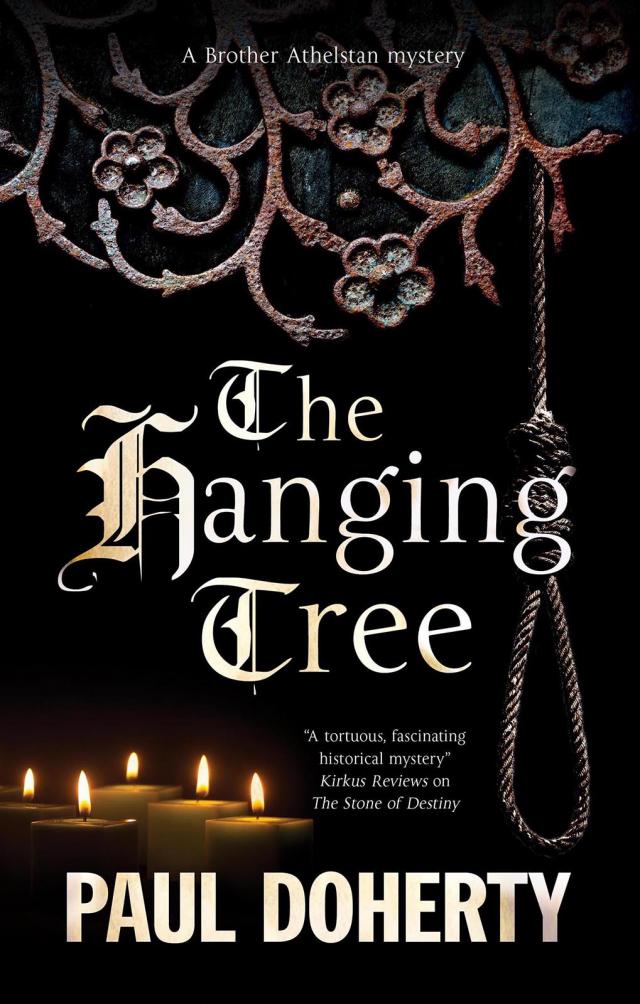
That was a matter of days ago. Yesterday Clement had plucked up courage. He had met Crispin at The Hanging Tree, where they had both feasted on fresh fish cooked in a sauce. Clement had insisted on meeting there. He did not wish to cross to Southwark and join Crispin in The Piebald, owned by that master of mischief, Joscelyn the one-armed former river pirate. In Crispin’s view, The Piebald was too noisy, whilst its customers were highly inquisitive of any newcomer. No, The Hanging Tree, despite its macabre title and chilling sign, was the most comfortable place to meet. This morning he had risen early. He had met Crispin, once again listened to his advice, then hurried across to Southwark. Clement startled as he heard a sound and turned to stare down the hollow nave, surely a haunted place, with its occasional flaring torch licking the encroaching darkness. Was he alone? Clement wondered. Benedicta said the church would be securely locked behind her. Surely, no one else was here, whilst the only way out was through the postern in the main door, by which the great tomcat had just left. What was that cat’s name, Clement wondered? Ah yes, Bonaventure!
Clement walked down the nave. Again, he heard a sound, a cough, low and gravelly. Clement stopped, grimaced, and gently banged the heel of his hand against his forehead. Of course, he had forgotten! Blodwyn the Blessed, the thief who, according to Benedicta, had fled into the parish a short while after Athelstan left. Blodwyn had apparently crept in, pleading for sanctuary, after Bladdersmiff the beadle had caught Blodwyn pilfering loaves and a few coins from a nearby common bakery. Benedicta had ushered the thief into the sanctuary and served him some morning ale, along with slices of the stolen bread Blodwyn had dropped just outside the church.
Clement walked up the nave, under the crudely carved rood screen and into the sanctuary. Blodwyn, clearly distinguished by his bright blond hair and tattered, blood-red jerkin, lay stretched out in the enclave of the apse behind the high altar. The sanctuary man was fast asleep, as snug as a pig in its sty. Beside him on the floor lay a small flattened wineskin, the obvious cause of Blodwyn’s deep sleep.
Clement turned and walked back into the shadows. Perhaps it was time he left. He could always come back. Clement glimpsed another painting on one of the squat, drum-like pillars and moved across to peer more closely. He clutched his belly as a sharp spasm of pain seared his stomach. He just wished Athelstan would return.
‘So much,’ Clement whispered into the darkness, ‘so much I have recently seen and reflected on. What went before was not the truth!’ A further spasm of pain caught him. Clement’s head went back and the assassin, now close behind him, looped the garrotte around Clement’s scrawny neck. The Key-Master, shocked as any rabbit in a snare, could only gape and splutter, his flailing hand catching his dagger sheath. He drew the blade but it was futile. He was too weak. Clement fell slack and let himself sink into the roaring darkness.
‘We have robbed the royal treasury.’ The leader of the Carbonari, gathered on the wasteland close to Westminster, was almost beside himself with glee. ‘We have robbed the royal treasury.’ He repeated and, lifting his arms, he performed a Tuscan country dance which provoked laughter from his comrades. He stopped all breathless and, lifting his mask, wiped away the sweat. He shivered and quietly cursed the hideous English winter, which seemed to fasten tight on everything. The leader walked over to the huge wheelbarrow. He and others had used this to carry the great sack containing the freshly minted gold and silver coins plundered from the treasure chamber. The leader turned, sitting on the edge of the barrow as he watched more of his comrades lead across two powerful dray horses to hitch them to the high-sided cart.
‘Isn’t this dangerous?’ One of them asked. ‘Surely …’
‘Nonsense,’ the leader replied. He gestured across the mist-shrouded common land which stretched for miles to the north of the hallowed precincts of Westminster. ‘Some of us will go back into the city,’ he declared, ‘to report our great news. A few of you will accompany me. Now!’ He plucked at his own filthy jerkin. ‘We have been chosen because we speak the tongue, so we will tramp from this place like surly mouthed peasants, carting sacks of miserable vegetables to this market or that. We shall always be on the move. We’ll camp out in the cold and act the part. I mean, who would want to steal sacks of vegetables? Coarse plants plucked from their meagre soil.’ He paused at the laughter. ‘We shall go all shabby and shuffling as we trundle the trackways and coffin paths of this benighted place.’
‘And where are we going?’
‘Oh, my friend, that secret will remain so until our masters decide otherwise. Suffice to say we shall travel due east and eventually—’
‘Our masters will join us?’
‘Precisely, my friend, so,’ the leader pushed himself off the barrow, ‘let us load the treasure onto the cart, hide it well, keep our weapons concealed and so move on.’
‘And the mistake? I heard you mention it in that brief conversation. A mistake was made during the robbery. Can it be rectified?’
‘Yes yes, my friend. A mistake was certainly made and, perhaps, we will have to deal with that swiftly and ruthlessly.’ The leader narrowed his eyes. ‘We have been alerted about the mistake – a singularly stupid one, but our masters will take care of that one way or another.’
‘And the fat coroner and his sharp-eyed friar? It’s no great secret,’ the man continued, ‘that when the English Crown learns that its treasure has been stolen, Cranston and his familiar will be assigned to hunt us down.’
‘And it’s no great secret,’ the leader replied, ‘that our masters strived to have them removed peaceably from Westminster in a subtly clever way but,’ he shrugged, ‘that failed. However, rest assured, if the fat coroner and his little friar pry and prod, a more lasting solution might have to be found.’
‘We would plot the assassination of Sir John Cranston, Lord High Coroner of London, and Brother Athelstan, priest of St Erconwald’s? A dangerous move, surely? Both the coroner and the Dominican are highly regarded by my Lord of Gaunt, his Master of Secrets and, of course, the young King himself! That could have dire consequences.’
‘Yet what choice do we have but to secure a treasure which is rightfully ours? Remember …’ the leader held up a black mittened hand, ‘we did not begin this dance, Master Thibault did. He nursed his own secret designs on the treasure and, for all I know, still does. However, although we have stolen the King of England’s treasure, and this is the delightful contradiction, we have simply seized what is rightfully ours. So, my friend, the likes of Gaunt and Thibault can go hang, as they certainly might when the news of this robbery sweeps the city. But that is their concern. We have the treasure and we shall keep it …’
PART ONE
‘If any soul in church this day, is guilty of an act so hideous.’
‘So.’ Brother Athelstan truly wished he was back in Southwark. Once again he was about to cross the murky meadows of murder to confront a monster, some malignancy lurking deep in the gloaming.
‘So what, little monk?’
‘Friar, Sir John.’
‘My apologies.’ Sir John Cranston, Lord High Coroner of London, certainly looked the part. Cranston’s rubicund face beamed with good health, his snow-white moustache and beard expertly cut and crimped. He was dressed in a field-green gown over a cambric shirt and black leggings of the purest and thickest wool. The coroner turned to raise a well-booted foot onto a stool. Cranston’s warbelt and earth-brown military cloak lay tossed over the table which separated him from his secretarius, clerk, confidant and close friend, Brother Athelstan. Cranston studied the little Dominican’s freshly shaven, olive-skinned face, his night-black hair shorn on all three sides, although the tonsure on the crown was clearly marked.
‘Not like so many priests …’ Cranston spoke his thoughts loudly. He then coughed and plucked his miraculous wineskin from the chair beside him.
‘You don’t finish sentences, little friar, so don’t give me that querying look.’
‘In which case, Sir John, I am in very good company. Yes, my Lord Coroner?’
‘To answer you bluntly, Athelstan. Many of your kind – priests, monks and friars sworn to chastity – allow their hair to grow and so hide their celibate status with the set purpose of having their wicked way with some hapless lady.’
‘Sir John, the cowl doesn’t make the monk or the tonsure a celibate.’
‘I agree. So what, little friar, were you about to say?’
‘Why are we here, sitting in a small antechamber in the House of the Exchequer at Westminster?’
‘Patience, my little friar. Let us be prudent and wait.’ Athelstan caught Cranston’s glance, followed by the coroner raising a stubby finger to his lips. Athelstan breathed out noisily. Of course, they were at Westminster, the centre of John of Gaunt’s web, the arena in which the powerful and the rich fought each other, be it in the council chamber or on the field of battle. A constant, never-ending struggle for power. In such a place, the walls had eyes as well as ears. A place where informants, spies and Judas men gathered, as Sir John tersely put it, like flies to a turd. Nevertheless, Athelstan was finding it hard to control his curiosity, and he wondered yet again why he and Sir John had been summoned here. The noble coroner had whispered about rumours of a most daring robbery and of clerks being found strangled in their chairs. How Flambard’s Tower, that massive concentric, black-stoned donjon, enjoyed the most macabre reputation, so it was hardly surprising that some dreadful mishap had occurred in or around it. Athelstan, who had visited the tower some years previously, could only agree with such stories. Moreover Sir John, who was writing his great History of London, had discovered and collected all the legends and lore about Flambard’s great keep, built like the massive peel towers to be found in Scotland and Ireland. Apparently, the donjon enjoyed a most sinister reputation.