

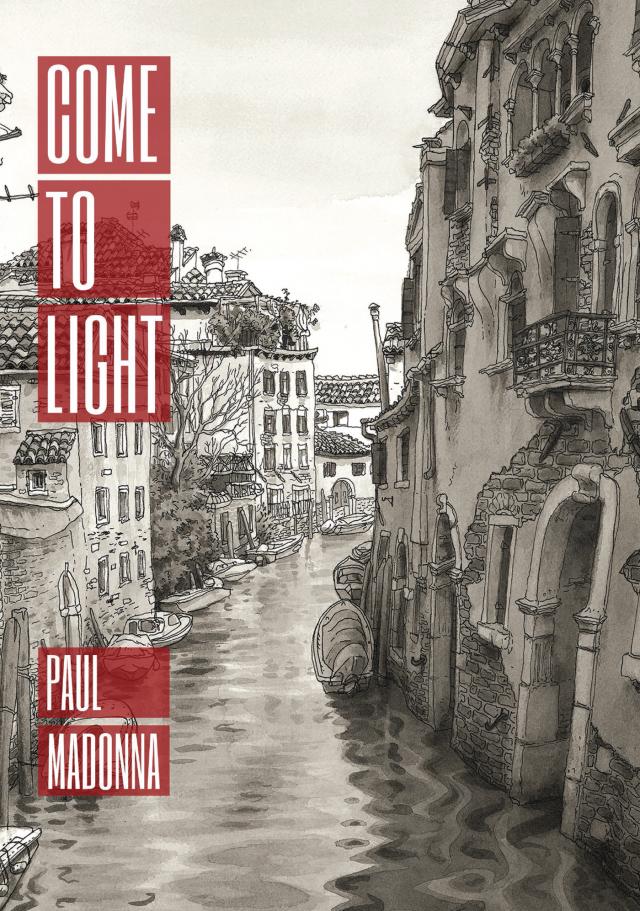
Come to light, p.1
Come to Light, page 1


CONTENTS
Volume 1: Order Chaos
0 Chiang Mai, Thailand
Part 1 Order Chaos
1 Barcelona, Spain
2 Lisbon, Portugal
3 France
Part 2 Like a Parking Lot with Metal Teeth at the Exit
4 Lisbon, Portugal
5 Italy
Volume 2: Villa of Misfit Toes
Part 3 Villa of Misfit Toes
6
7
8
9
10
11
12
13
Volume 3: Ants in the Bananas
Part 4 Ants in the Bananas
14: San Francisco, California
15: Los Angeles, California
16
17: San Francisco, California
Epilogue: Post Exorcism from the House of Lone Pine
18: Amsterdam, Netherlands
Acknowledgments
Copyright
0
Chiang Mai, Thailand
MAY 2 – 3, 2017
It’s maybe 11 PM, easily ninety-five degrees, and there’s a Thai cover band belting out a damn good version of “Hotel California” from the go-go bar across the street. I’m in the Night Bazaar along Chang Klan Road, sitting with Randy at a grimy purple plastic table on the sidewalk, waiting for a noodle soup. I’m trying to read a Dutch crime novel. Randy is trying to get my goat.
“What about one of them?” Randy says, motioning with his arm that isn’t in a sling to the pack of bikini-clad Thai women pawing every male tourist who walks by. “I’m sure any one of those lovely ladies would be happy to be your girlfriend.” Then he giggles. “They seem to love old white guys like you.”
“I’m fine,” I say, not looking up from my book. I’m fifty-five. Not young, but also not what I’d call old. Whereas Randy is twenty-three. Making fun of my age is his way of showing we’re friends.
“Just tell them you’re Emit Hopper,” he says. “Artist-author extraordinaire. Then they for sure won’t be able to help themselves. Maybe they’ll even inspire you to start putting people in your drawings.”
Still I ignore him. I put the book down and tune into the band. I’ve heard them before. Locals from the university.
“These guys are good,” I say.
But Randy is having too much fun. “I mean, your wife’s been gone for what? Six years now? She’d have wanted you to move on.”
Now I look at him. As the guitarist launches into the classic solo, I raise my brows and shake my head to let him know he’s crossed the line. To which he again giggles. I’ve known Randy for all of three weeks. Which makes him a regular in the weekly drop-in drawing class I started teaching six months ago. Like me, he’s American, as are around a quarter of the tourists passing through Chiang Mai who randomly show up to my sessions. Most are Chinese, the rest are Australian, British, or Irish. I get a range of ages, though most tend to be in their fifties, and pretty much all are women. Randy’s one of the rare young men. And despite his obliviousness to personal boundaries—such as showing up at my house on days when I’m not holding class, hanging around for hours, and interfering with my personal life—I like him. Which is why I let slide his jokes about my age and getting a girlfriend, and why I’m not actually offended by his mentioning Julia.
“Why did you even come tonight?” I say. “When your drawing arm is in a sling?”
“It’s not my fault I got hit by a scooter.”
I laugh, because I’m sure it is. But I do appreciate that he came and tried to draw with his left hand. His drawings were actually much improved.
The noodle vendor waves, so I go over and get my soup. As I’m loading it with extra bean sprouts and scallions I feel my phone buzz in my pocket. I take it out and look. Blocked number.
I hesitate a moment, glance back at Randy, see he’s lost in the music, bobbing his head of overgrown curls and air-drumming with his one free hand, then answer.
Silence.
I put a finger in my ear. “M, is that—”
“It’s Sara.”
“Sara. Is everything—”
“You haven’t heard?”
Just then my phone beeps with another call. I look at the screen. It’s a US number, California. I do a quick calculation: eleven at night for me, nine in the morning there.
“Sara, I’ve got another—”
“You need to take that.” And she hangs up. I click through to the other line.
“Mr Hopper?”
“Yes.”
“Sheriff Lawrence, Tuolumne County Sheriff’s department.” Forgetting Randy and my soup, I put a finger to my ear again and hurry through the line of plastic tables toward the back of the market.
“I’m sorry to call out of the blue like this,” the sheriff says, “but there’s been a discovery.” Then he pauses.
Weaving through aisles of jeans, sunglasses, and knock-off designer purses, I say, “Okay,” so he’ll keep talking.
“As you likely know, the past few years California has seen a major drought. Well, this spring all of that changed. We received excessive rainfall which resulted in a great deal of natural destruction. Several sections of the Pacific Crest Trail were severely damaged, which, until recently, have been inaccessible. But with the weather now cleared, we have multiple teams out working to restore passage. One of these sites is Lone Pine Ridge, where a significant portion of hillside collapsed. Three days ago, approximately two miles in from the trailhead, a survey team discovered what they believed to be a fractured human femur bone.”
I’ve passed through the maze of vendor stands and am now out on a side street where it’s quieter. At the mention of a human bone I stop.
“A cursory search immediately uncovered several additional human remains,” the sheriff continues, “most significantly a partial jawbone and breast plate, which triggered mobilization of an official search. The jaw retained several teeth which we began comparing against dental records of missing persons. The following day we recovered two backpacks. Given the durability of the synthetic materials, these were found relatively intact. An assessment of the contents positively identified the packs as belonging to Rachel Adams and Darlene Fenton.” He pauses. “If I have my facts straight, these were the two women who disappeared along with your wife, Julia Bowman, while hiking the PCT in November 2011, is this correct?”
“Yes,” I say, moving now toward a small park built by a hotel chain to compensate for how much money they bilk out of the tourist industry.
“We then narrowed our focus,” the sheriff says, “to the dental records of Mrs Adams, Mrs Fenton, and your wife, Julia, and yesterday came up with a match. The jawbone recovered along the Lone Pine trail belongs to Rachel Adams.”
I stop next to a shrine. “And the other bones?” I say, as mosquitos instantly swarm my legs.
“We are currently working to check DNA specifically against Rachel, Darlene, and Julia. However, the bones are in poor condition. Exposure to the elements has made extracting adequate DNA material surprisingly difficult. There is a possibility that these tests may prove inconclusive.”
“I understand,” I say, swatting a mosquito feeding on my ankle. “Tell me, sheriff, what do you think happened out there?”
“It’s too early to say anything for certain. Current theory is that the bodies and possessions were buried approximately ten to twenty feet off the trail. But beyond that I’m hesitant to speculate until we have more information. I can tell you, however, that a dedicated search is underway, of both the area affected by the slide as well as the surrounding terrain, and given all that we’ve recovered so far, so early on, I am hopeful that our chances of recovering more remains are high. That said, I also want to temper expectations. The nature of this kind of event makes excavation extremely difficult. This is a large site, making the search zone quite wide. The mud in some areas is over twenty feet deep, and there is a great deal of debris. The force of such an event causes an enormous amount of destruction—downed trees, boulders, all sorts of forest refuse that is now churned together—which makes the site highly dangerous to traverse. But listen—” his voice softens “—I can appreciate the delicacy of the situation. Almost six years ago we saw three women disappear without a trace, and now we’ve found definitive evidence of one, circumstantial evidence of a second, and no sign of a third. I can only imagine how emotionally exhausting the past six years must have been without answers, and how challenging this must be now—for you especially—given that in this scenario, the third woman is your wife.”
I nod, even though he can’t see me through the phone, and swat another mosquito siphoning blood out of me.
“However,” the sheriff says. “I can assure you, we are doing all that we can. And in the meantime, I ask for your patience while we do.”
“Thank you.”
“You should also know I have already informed Julia’s sister, Sara Bowman. I called her before you because… Well, seeing what happened to her parents, I just thought…”
“Of course,” I say, sparing him the explanation. He’s talking about the disappearance of Julia and Sara’s parents on the 1981 commercial flight from Chicago to Rome which fell out of airspace over the Atlantic Ocean. The sisters were teenagers at the time, and to this day not one trace of the plane has been found, nor has any conclusive explanation of the accident been proffered, which is why Julia’s disappearance has been that much harder on Sara. So I understand; I would have called her first too.
“Thank y
I thank him again, then end the call.
For a moment I just stand there in the darkness of the small park, listening to the din of the night market a block away. Then another mosquito attacks my leg, and as I swat I begin to walk. A half hour ago it was just another day: In the morning I wrote, then during the heat of the afternoon I read and napped. Early evening my students arrived and I guided them through a classic still-life drawing of fruit and bottles. At dusk I poured a whiskey for anyone who wanted to stick around, then we moved onto the deck where, as my students swapped travel stories, I tuned out, peered toward the ring road, and watched as bats swooped and dove for the evening’s bugs in the light of Tha Pae Gate. After that I would have just settled into bed to read myself to sleep had Randy—as he often does—not missed the obvious social cues to leave that everyone else—despite their widely-differing cultural backgrounds—easily caught, so I suggested he and I head to the Night Bazaar for soup to more easily send him on his way. Essentially, my regular routine, only tonight it’s been broken by a call informing me that, after almost six years, there are finally some clues to the biggest unsolved mystery of my life. The sheriff is definitely right about emotional exhaustion. You get so used to living with unanswered questions that you forget they haven’t always been there. Like hearing a jackhammer outside your window for so long that the deafening noise becomes your new silence. Then suddenly one day it quits, and it’s like—well, shit, I have no idea yet what it’s like. Seeing that this moment, right now, is that day.
• • •
I push back through the market and return to the noodle stand where I find my soup still on the condiment station but Randy gone. I sit at the table, drink the broth, and try to think. The band is rocking out with their version of Zeppelin’s “Black Dog.” They’re nailing the guitar parts, though the vocals leave more than a little to be desired.
I finish my soup and, during a raucous version of ACDC’s “You Shook Me All Night Long,” leave the market. As soon as the noise of the bazaar is behind me, I dial Sara back.
“So you know?” she says.
“I do.”
“What are you going to do?”
“What do you mean?”
“You know what I mean.”
“The better question, Sara, is what are you going to do?” Silence.
“Dammit, Sara—”
“There’s nothing to do,” she says.
I stop walking. “Of course there is. Just don’t—” A click.
“Sara?”
But she hung up.
• • •
As I walk toward the ring road, past the pharmacies, tattoo parlors, and shops of women calling, “Hello-hello. Where you go? Ma-ssage. Ma-ssage,” I replay the sheriff’s call in my mind. I keep trying to come up with alternate scenarios of what the discovery could mean but can’t imagine any beyond the obvious. I tell myself I need to make a decision, even though I know it’s already made. What I need to do now is accept that I’m actually about to do it.
In midstride I stop—it really is now or never. I turn back, take the soi—alley—that curves around the boxing arena, pass the ladyboy bar where drag queens decked out as Buddhist deities lip-sync to Thai pop songs, turn down the row of street vendors selling electronics, and buy a prepaid phone. It’s a cheap flip phone, but doesn’t matter. I won’t need it for long.
It’s after midnight when I arrive home. I go to the bedroom where, from the back of a bottom dresser drawer, I pull out a wooden box, take out a passport, notebook, and envelope of documents. In the notebook I find Ditti’s number and, using my new flip phone, dial. The line rings twice and clicks. I enter my personal numeric code, then hang up.
While I wait I go to the kitchen, pour myself a hefty dose of Bulleit Rye over ice, down it, then pour another. A part of me feels as if this moment was always coming, as if our every movement up until now was leading to this inevitability. But the rest of me knows that’s crap. We’ve just been living.
I open my computer then hesitate; I’d almost forgotten how tiresome it is to worry about the possibility that my every little action is being watched, and remember why I don’t miss the life of subterfuge. I close the computer. If I’m going to do this, I need to go all in. Which means every precaution.
I finish my whiskey, pour another, start packing.
Only the basics: underwear, T-shirts. I know how to do this, I’ve done it many times before: pack light. And when I get to wherever I’m going, buy the clothes of that place. And if and when I move again, repeat, discarding as I go. Mostly I take the necessities: chargers, cables, couple of paperbacks, and drawing supplies—which take up more room than anything. This definitely won’t be a vacation, but that doesn’t mean I can’t read and draw. I’m gathering my toiletries when the flip phone rings.
“Account number, please,” a woman says, and I read another series of numbers from the notebook.
“It’s a rush job,” I say. “How soon can he—”
“Can you meet?”
“Yes.”
“Can you travel?”
“Yes.”
“International?”
“Yes.”
“Europe?”
I think it over. Here in Thailand would be better, but I’m going to Europe anyway, so I say, “As long as it’s not France.”
“Barcelona. Two days.”
I hang up. From the safe I take out stacks of euros and US dollars, and along with the passport, documents, and notebook, slip them into the pouches I’ve sewn between the lining of my rollaboard. From another drawer I retrieve my legitimate passport—Emit Hopper’s passport—and set my packed luggage by the door.
Now it’s time for the computer. Online I book a morning flight to Bangkok, then the earliest connection to Barcelona. I use my own credit card, my own passport, my own name. I’m fine to continue being Emit Hopper, at least for the moment.
I finish my drink and do a mental check. I contemplate taking the computer. On it is the book I’ve been writing, but while I’ll have time to draw, I doubt I’ll have the attention for plotting a novel, and anyway, it’s safer to not have the machine with me, so I decide to leave it. What else? My drawing class. I draft a group email to my recent students saying I am out of town and there will be no more class for an indefinite period of time, but hesitate before hitting send, wondering if maybe I shouldn’t leave the trail. The sessions are pay-as-you-come, so there’s no money to refund, and most people—aside from Randy—attend only one or two evenings as they’re only passing through, so I’m sure my canceling will be of little consequence. But I decide it’s worth it. I don’t want anyone—again, Randy—pounding on my door, calling attention to my house being empty. Which is why I also delete my post on the local Craigslist, to avoid any new students. What else? Gai, my housekeeper. She’s used to my coming and going, but if I end up being gone for a while I don’t want her to wonder. So on a half sheet of paper I write: Gai, taking a short vacation. Not sure how long I’ll be away. Emit. Then I fold the note and, along with three weeks' pay, tuck it underneath the fruit bowl. What else? Nothing more comes to mind, so for now I should probably sleep. Except I’m completely wired. Still, better if I try. So I take myself through the routine: brush teeth, undress, turn off all the lights except the bedside, read a little. It works.
• • •
I wake to the first bloom of orange on the gray dawn. It’s just before six. My flight’s not for three more hours.
I get up, go to the kitchen, load the moka pot, set it on the stove. I drink a tall glass of water, tear off a banana, peel, and—shit, the ants are back. They erupt out of the banana and spill over my hand like a voodoo curse and I immediately chuck the infested fruit into the compost bin then wash my hands of the little pests. There are a lot of things I love about living in the tropics, but the plethora of bugs is not one. Spiders, roaches, even geckos, they get everywhere. Inside your cabinets, your sheets, your shoes. But bananas? For over fifty years I thought these were nature’s perfectly packaged fruits. Then about a year ago I was in Chatuchak, Bangkok’s largest market, and peeled one to find a nest of ants living inside. I have no idea how they got in and frankly thought it was a once-in-a-lifetime fluke, but now here they are again. It’s damn weird to discover, especially today of all days. Before they get everywhere I tie up the compost bag and stick it in the fridge, then grab another banana. This one’s fine. Taking a bite, I look out the window. The morning sun is reflecting off the moat water like twinkling diamonds. It’s a new day—in the most profound sense of the word. Which is a promising sentiment, if you ignore the lack of hint as to what kind of day it might be. Apparently one with ants.


