

They came first in the b.., p.1
They Came First: In the beginning..., page 1


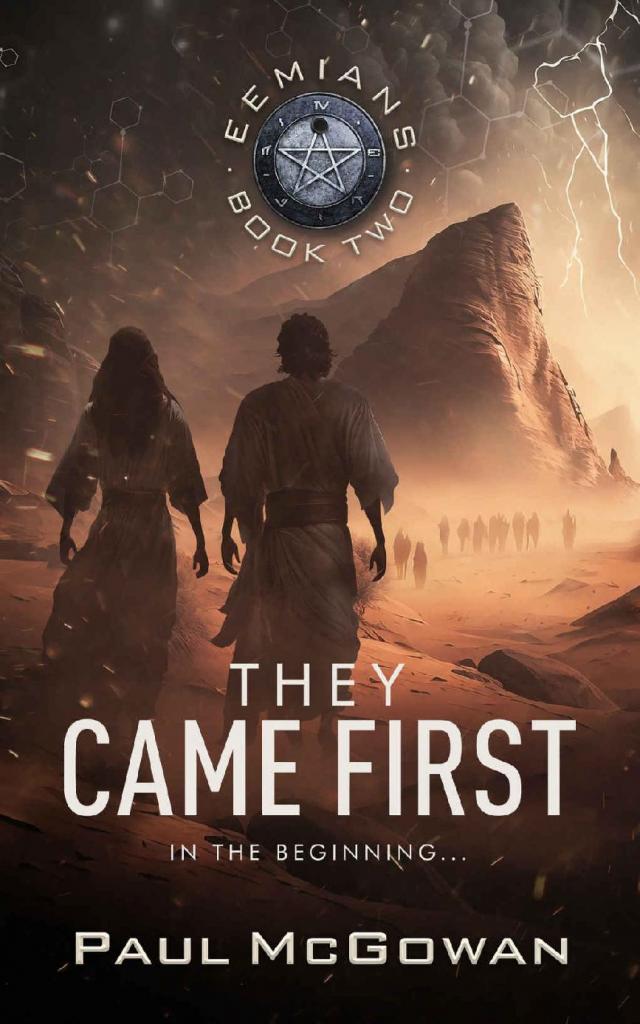
“From so simple a beginning, endless forms most beautiful and most wonderful have been, and are being, evolved.”
― Charles Darwin, The Origin of Species
Notes About This Book
While the characters and plot of Book Two of Eemians are fictional, I have done my best to ensure the setting, timeline, and environmental situations are accurate.
Our history books tell us civilization began twelve thousand years ago, at the beginning of the Holocene, when the glaciers melted and the planet warmed. Those history books do not include, however, the mirror-image interglacial warming event that occurred one hundred thousand years earlier, during the Eemian period. Anthropologically modern humans—Homo sapiens like you and me—had burst upon the scene to become the dominant hominin species. Twelve thousand years later, a sharp and unexplained rise in greenhouse gasses melted most of Greenland and much of the West Antarctic ice sheet, raising sea levels by at least fifty to sixty feet. Were these two factual events merely an interesting coincidence, or were they somehow related?
Eemians: They Came First suggests that these direct anthropologically modern ancestors of ours were responsible for the warming events that nearly wiped their civilization off the planet—a set of events we cannot know the details of for certain, yet, like our modern-day paleoanthropologist, we can make an educated guess based on what we know to be true.
Twelve thousand years ago, at the beginning of our most recent warming period—the Holocene epoch—the level of human sentience appears to have surged. It’s as if after millions of years of slow and steady growth through the darkness of time, a light switch had suddenly been thrown. Though no one knows for sure how or why this happened, there is no lack of speculation.
In the 1968 film, 2001: A Space Odyssey, that spark of sentience was imagined to be from an extraterrestrial monolith that somehow triggered an evolutionary shift. In that same year, author Erich von Däniken’s book Chariots of the Gods also popularized the notion that our ancestors got a helping hand from visiting space aliens.
Perhaps the divine intervention so often alluded to over the millennia wasn’t extraterrestrials, gods, or supernatural beings. Instead, perhaps that ancient knowledge and those helping hands that lifted us out of the darkness of our caves and into the light of our easy chairs were closer to home.
Paul McGowan
2023
Here is what they didn’t teach you in history class.
Chapter 1
100,000 Years Ago Near The End Of The Eemian Interglacial Event
The sun struggled to pierce the smoky sky as it sank into the western sea. The northern forests must be on fire again, thought Laúm. Far below his feet, red-tinged waves lapped against the rocky cliff face. The small forest of towering buildings, each a different height, that rose through the water’s surface left him unsettled, but he refused to look away.
The story always began the same way:
Once upon a nightmare, the end of the world came. After the Secret Light had vaporized the Great City of Arnum, the few remaining human beings had to ask if they were willing to die with the world, or if there might be a way to trick it into letting them live.
From there the tale would diverge into varied accounts about how humans had poisoned their planet by choking it with garbage, suffocating it with chemical-filled clouds, or contaminating it by converting into fire the black remains of creatures that had lived long before. Every child heard these tales often, so they might never forget why things were now the way they were.
“As if we could forget,” Laúm muttered. The parched land at his back, the drowning towers before him, and the nightmarish skies above fairly screamed the consequences of exploiting all that which sustained life.
Laúm scanned the distant hills surrounding the inland sea until he spotted small fires twinkling like evening stars where others of his clan had joined him in watching the red sun dip below the far horizon.
When the sun’s light faded and night arose, Laúm shrugged his pack off his shoulders. He frowned at the frayed straps as he rummaged around inside it. He’d grown broader in the chest and shoulders almost overnight; soon, he’d have to ask his father for a larger pack.
Though his teenage years were nearly past, his round, freckled face and large, almond-shaped eyes made him look younger than his age, so the evidence of his physical growth pleased him. Tomorrow, he would rejoin his village as an adult, an honor he’d waited eighteen years to claim.
Laúm turned his face to the cool, moist sea breeze, a welcome relief after the day’s relentless heat. But as the darkness deepened, so did the chill. Laúm brought out his portable fire. The metal cylinder was as big around as his thigh and fit easily in his pack. At the press of a button the flammable gas it contained ignited at once.
A single boat below, bow lights twinkling, left the tall spires and headed straight toward the horizon behind which the sun had just vanished. Oh, how Laúm wished he could be among those on the boats. He would stand on the prow, the crew at his back, salt water washing his face. Ahead would be distant lands, far from his parched, brown-dirt life.
In the distance, a low rumble slowly grew louder. Laúm looked to the north and saw the familiar red and blue blinking lights of an immense airship moving steadily along the coast. He touched the glasses perched on his nose to upload a holographic image of the ship’s schedule. Right on time. As usual.
The huge silver ship turned before reaching the bay, its eight down-firing fans rippling the ocean as it descended to a platform stretched between a grouping of towers. The fans’ roar quieted as the ship settled in its berth, and the encircling lights brightened as the cargo door opened.
An incessant blinking image at the bottom right of the ship’s schedule caught Laúm’s attention, and he pushed back his curly locks. He tapped the frame of the glasses again, enlarging the image. In it, Sophus and Alluria, his best friends and classmates, enticed him to join them. Sophus pulled a bottle from under his tunic and waved it. Days ago, they’d formed a wild plan to spend this last night of their childhood in the Forbidden City—the great ruins of a long-dead city from a time before Arnum—that loomed large in both their physical environment and in the cautionary tales whispered by their parents.
Laughing, Laúm double-tapped to make the image disappear. He fingered the thick frames of his glasses and gazed out over the water. As easy as it was to take the technology that fueled their civilization for granted, Laúm would have traded it all for trees and green grass and rain.
Laúm switched off his fire, packed the device, and headed away from the rocky cliffs toward the Forbidden City. The first sliver of moonlight nudged the eastern sky, and his steps quickened. He’d come this far before, but he had never ventured beyond. Tonight was different: tomorrow, he officially became a man. And as a man, he had to see the truth of the City for himself.
To his left, a small crackling noise set his heart racing. He crouched and listened. Perhaps a wild dog? Or a snake? He reached up and tapped his glasses three times on the right edge, then once on the left. The gray landscape turned white as he scanned for heat signatures. When no shimmering image appeared, Laúm crept onward, careful to avoid the dead plants and dried branches at his feet. The heat signature scan hadn’t quite eased the tension tightening his shoulders, and a sense of waiting, of anticipation trembled in the cool night air.
When he reached the tall berm that had once held back a river’s rushing waters, Laúm elbowed up the embankment to scan the riverbed below. Still no heat signatures. He tapped the right frame edge three times and the left twice. A lazy red electronic wave undulated along the riverbed: the Quondan security field that kept Sahu from crossing the river. Those who attempted to cross the barrier were often fried to a crisp, leaving behind only blackened shells curled into the fetal position, doomed to be dinner for the carrion eaters roaming the earth and sky.
After taking a deep breath, Laúm belly-crawled across the dry riverbed, ducking beneath the red crests of the moving barrier beam. Thoughts of dying galvanized Laúm to move faster than he ever had before, scooting forward with the frantic desperation of a fish out of water and a child desperate to prove his adulthood.
Sweat slicked his forehead as he scrambled beneath the electrifying beams. Partway across, he huddled in a dirt crevasse carved out by the forgotten waters of the streambed and waited for the crest of the red wave to pass. The wave came close enough to heat his skin, and the moment it passed over, he threw himself away from the crevasse and darted to the other side. He hastened up the far embankment before daring to look back. Even the wind had quieted. He lay low, his breath hot against the fine dust beneath him. He scanned the riverbed for the skeletal remains of those who hadn’t made it through the barrier but saw nothing. Perhaps the wild dogs had carried off their bones. Or perhaps they were part of the story designed to keep children safely on their own side of the riverbed.
Only ten lengths ahead, a broken pathway pointed toward the old city, its dark form broken by even darker shadows where Sahu might hide. On his hands and knees, with his glasses’ heat sensors on high, Laúm slowly approached it. The long, straight path had been cracked with jagged chunks of black material, as if ripped apart by a giant claw. Everyone whispered of the old road, the Forbidden City, and the horrible things the Sahu would do to any Quondan found in their territory. Laúm had only ever seen pictures of the Sahu, but he knew their history, and of their legendary lust f
Laúm skirted the road, darting between the large boulders, dead trees, and small mounds of earth lining the route. He approached each shadow carefully, then hurried to the next, holding his breath each time the moonlight left him momentarily exposed.
“Time,” Laúm whispered. The small display on his right lens revealed that an hour had already elapsed. Time to get moving. He had promised his parents he would return before the start of the new day, and Alluria and Sophus were probably already drinking the contents of that bottle without him.
The dark outline of the city appeared as he crested a small ridge and crouched behind the rusting hulk of an old vehicle. Ahead, open fields surrounded the buildings beyond. Though the openness provided no harbor for Sahu to hide, the idea of traveling so unprotected brought fresh sweat to his brow. Laúm dashed to the first structure at the end of the damaged road and leaned against the cool support of a stone arch to catch his breath.
To his right, beyond the arch that had once been a gateway into the city, a squat stone building sat alone in the square, surrounded by a low stone wall. A tall spire grew through the structure’s roof, the top half hanging askew like a broken tree branch. The small wooden gate at the wall’s entrance had long since fallen off; only a rusted hinge hinted it had ever been there at all.
Though he knew Alluria and Sophus waited for him, Laúm couldn’t resist the building’s allure. He’d never seen anything like it, and yet it almost seemed familiar. In a different life, a different world, he might have lived in a city like this one. He might have known this building’s purpose as he knew the purpose of every building in his home compound.
Laúm stepped over the dead bushes that had once lined the walkway, tiptoeing through the dry, brown carcasses of once-living plants scattered at his feet. At the end of the short path, the remains of a wooden door still hung in the arched stone entryway. The door groaned in protest as he pushed it aside. Inside, he navigated only by the moonlight filtering through the entrance and the cracks in the crumbling walls. Above him, a cavernous stone ceiling disappeared into darkness the moonlight couldn’t reach. The musty smell of old books and dust dared him to break the silence with a cough, but he resisted. Stone columns, cracked and stained, held the ceiling in place, and even his quiet footsteps echoed in the empty, ancient hall.
A nearby rustling sound startled a gasp out of him, and he quickly scanned for its source—an opening between the column and the domed ceiling. His glasses gave no warning of a dangerous heat signature, so Laúm took a deep breath, steadying himself. Jumping at birds, he thought scornfully. Am I a man or a child? Shaking his head, he continued onward. Long, straight rows of crumbled pews led to an open space like a stage. Was this once a place of worship where people prayed to their god, iLu? The bird that had startled him took flight, bursting from its hiding place and winging out the doorway, interrupting Laúm’s thoughts.
That strange feeling of tense anticipation grew. Time to go. Something had made that bird take wing, and he could only hope it had been him and not someone else. As he turned to leave, his toe caught something, and he wrenched his back to keep upright. When he reached down into the thick carpet of dust, his fingers wrapped around a metal object. Peering at it in the dim light, Laúm made out a flattened circle nearly the length of his thumb surrounding a five-sided star. The fifth point held a loop for an absent chain. Was this symbol significant to the worshippers of iLu? He slipped the curiosity into his pocket; Alluria knew more than he about such things. As he straightened, he couldn’t shake the feeling that something—
Another scraping sound emerged from the dark interior of the building, far from the soft moonlight’s reach. Laúm froze. The breaths he heard were not his own. Someone was inside the building with him. He took off running without waiting to see what emerged from the shadows. Darting through the entrance and out into the open, Laúm ran until he reached another stone arch deeper within the city. Throwing himself behind it, he tried to catch his breath as his heart pounded in his chest.
The wind had picked up, and between his gasping breaths, Laúm peered around the arch at the building from which he’d just sprinted. His glasses emitted two sudden beeps and his eyes locked onto a white heat signature moving quickly in the periphery of his vision. Sahu? Dogs?
His glasses beeped again. Another heat signature. More. Laúm’s vision was practically white with them. Lurching behind the stone arch, Laúm struggled to control his breath and his trembling limbs while his heart provided a deafening bass-line drumbeat. Dogs cast much smaller images. He took as deep a breath as he could manage and craned his head, looking over the top of his glasses for the source of the mysterious heat signatures. There, in the moonlight, a sweeping motion almost like laundry blowing on a clothesline. There! Another, to his left. And another! A group of dark-robed people moved silently through the shadows. Laúm bit his lip nearly hard enough to draw blood as the prickle in his eyes and a knot in his throat threatened tears.
He ran.
“Sophus?” he panted into his glasses. “Alluria? Are you there?”
But the glass remained dark, and the silence burned like the first hot ember of a wildfire.
Chapter 2
“Laúm? Where are you?” came Alluria’s voice from his glasses.
“There’s people—I’m being chased—I have to—Where are you?”
“Where we were supposed to meet. The tallest building on the outskirts of the city,” said Alluria with reassuring steadiness. “How many are there?”
Laúm chanced a look over his shoulder and immediately regretted it. The men with their billowing robes—the unreal, flowing movements of open wings, predators swooping in for the kill—were gaining on him. His lungs burned. “I-I don’t know.”
He searched the sky for tall structures as he ran, arms pumping and chest burning.
“Laúm. I see you,” said Alluria in his earpiece. Though it was only a trick of his imagination, she sounded closer. “But I don’t see—oh! Run, Laúm!”
He turned a corner and found his friends hopping from foot to foot with impatience. Alluria held her fire canister in her hands, her fingers twisting knobs Laúm couldn’t quite make out in the darkness.
“Hurry up, Laúm!” Sophus shouted.
“Go!” Laúm cried as he neared them.
Alluria raised her arms and threw the fire as far as she could. Laúm’s sweaty brow registered the breeze of its passing as it shot over his head and out of sight. Then they sprinted in the opposite direction without waiting to see what would happen.
From behind them came a swoosh, followed by a bright flash of heat and light that pulled their shadows out before them in frenzied flight as if hiding from their pursuers. With Alluria leading the way, they weaved and bobbed through the darkness. The city loomed above like an angry god or a disappointed parent.
Laúm couldn’t spare a thought for his parents now.
When Sophus turned a corner and collapsed against the side of a building, hand braced against a cramp in his side, Laúm crouched, gasping for breath even as he tapped his glasses in search of heat signatures. Thankfully, the city seemed empty of life. The birds of prey had vanished.
“Sahu?” Sophus whispered. Though he hadn’t run as far or as fast as Laúm, Sophus’s breath hitched and caught as if his body couldn’t bear to release it.
“I don’t know. And I don’t want to find out.”
“I think we lost them,” Alluria said after tapping her glasses and peering into the darkness. She pushed a hand through her cropped black hair, revealing wide, chestnut-brown eyes still dark with worry. As she tucked a lock of hair behind her right ear, the moonlight teased a sparkle from one of the small blue earrings she had worn since childhood.
The day Laúm had discovered them was etched in his memory. Though the stones were caked with ancient dirt, a glint had encouraged him to take them home. Beneath the filth, they were the clear blue of the skies and waters he heard about in stories but had never seen for himself. They were also broken. He’d rebuilt the housings from scratch, borrowing his father’s tools but refusing his father’s help.


