

Frankenstein lives, p.1
Frankenstein Lives, page 1


“Oh! Be men, or be more than men.”
—Mary Wollstonecraft Shelley,
Frankenstein; or, The Modern Prometheus
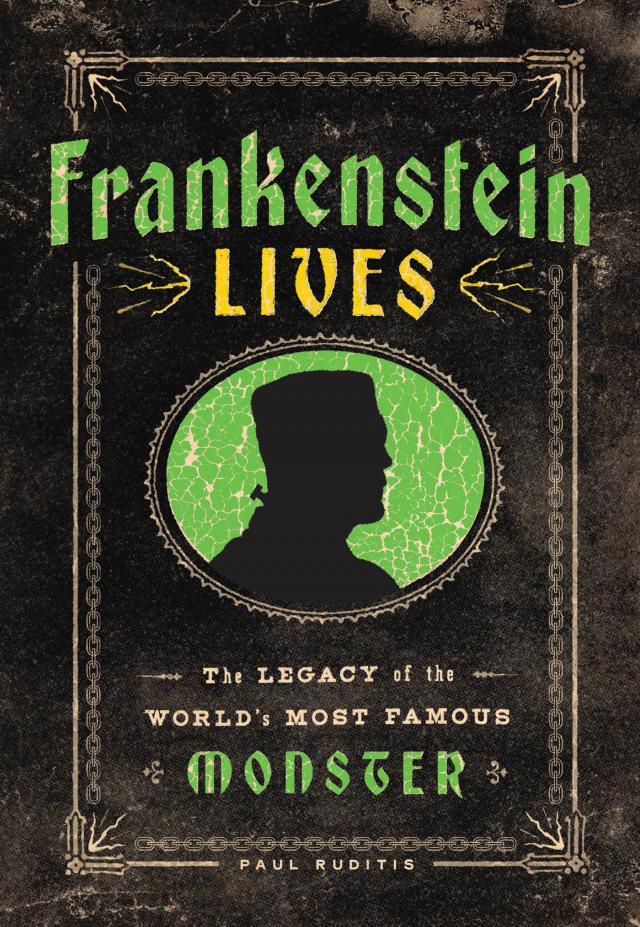
FRANKENSTEIN
LIVES
THE LEGACY OF THE WORLD’S
MOST FAMOUS MONSTER
PAUL RUDITIS
Boris Karloff as Frankenstein's monster (1931).
CONTENTS
INTRODUCTION
Chapter 1: RISE OF THE MONSTER
Chapter 2: THE MONSTER EVOLVES
Chapter 3: A MONSTER OF ALL MEDIA
Chapter 4: FRANKENSTEIN BREAKS OUT
Chapter 5: FRANKENSTEIN FUN
Chapter 6: POP CULTURE ICON
AFTERWORD
BIBLIOGRAPHY
FRANKENWORDS
INDEX
IMAGE CREDITS
ABOUT THE AUTHOR
Poster art for I Was a Teenage Frankenstein (1957), starring Gary Conway and directed by Herbert L. Strock.
INTRODUCTION
"It's alive!"
That short phrase has played a large role in pop culture. Today, people echo those words without even knowing where they originated. The line has been parodied in films, and it’s even been the title of films. It has appeared on album covers, even as the name of a band. But what exactly is the it that is alive?
It is so much more than people might think.
It started out as Frankenstein’s monster, the fictional creation that sprung from the mind of Mary Wollstonecraft Shelley and the medical manipulations of her character, Victor Frankenstein, a university student with dreams of creating everlasting life. Young Victor also came alive in the centuries since the story was first published in 1818, but he has never come close to reaching the same level of fame as the fruits of his labor.
In the beginning, it had no name. Frankenstein’s monster was a blank slate that grew and learned and created a life for itself. It became a companion as well as a murderer, as the lonely monster turned as conflicted on the inside as the patchwork of its exterior appearance. Frankenstein’s creation evolved to be more than a mere monster, but one of the most recognized fictional creations in history. Frankenstein grew beyond the simple horror story written by a teenage girl to become one of the most studied literary works and the progenitor of modern science fiction.
Actor Peter Boyle takes on the role of Frankenstein's monster in Young Frankenstein (1974).
Somewhere along the way it became Frankenstein. The monster took the name of its fictional creator. It lurched into pop culture on its own and developed a new life and new mythology, shifting and changing until it bore little to no relation to Shelley’s tale. It evolved to become an allegory on its own, and the source of stories that lacked monsters or mad scientists.
“It’s alive!” is never uttered in Mary Shelley’s work. The line was made popular by the movie that came out over a century after the story was first published. That movie is one of the key events in the monster’s history that cemented the connection between the creature and the name. From that point on the monster was Frankenstein. It had fully taken on the name of its fictional father. Sometimes the name was meant to indicate that it was his son. Often, the name existed without the doctor even entering the picture. There have been hundreds of Frankensteins since Shelley published the original story in the early nineteenth century. Each and every one of them has come alive in its own unique way.
Frankenstein Lives explores many of these iterations, both Frankenstein’s monster and the monster named Frankenstein. The character has appeared in print and in movies, as toys and on cereal boxes, with a now-familiar image that owes as much to noted horror actor Boris Karloff and makeup artist Jack Pierce as it does to Mary Shelley. But the legend of Frankenstein has grown beyond that one character, more than that one book. It has grown into an entire universe of its own, with branches in all realms of fiction and even reality. It would be impossible to catalog all the many ways it is now alive in our society, but, within these pages, we begin by examining Frankenstein: the man, the monster, and the myth.
Boris Karloff in the full iconic Frankenstein makeup.
1
RISE OF THE MONSTER
On a dreary night in June of 1816, at the Villa Diodati near Lake Geneva, a group of friends and writers came up with an intriguing way to pass the time. The weather in Switzerland was miserable, as it had been for months. They’d been holed up together for several days in the rented villa, entertaining themselves by sharing ghost stories, when the de facto leader of the group, a dreamy poet, came up with a game. It was a simple challenge, a bet among friends, to craft a haunted tale of their own. That game would lead to the birth of one of the most recognized—and most misunderstood—fictional characters in history.
The dreamy poet was Lord George Gordon Byron, acclaimed writer and politician, and a leading voice in the Romantic movement in literature. Lord Byron had already authored numerous works of note, including the narrative poem that catapulted him to literary stardom, Childe Harold’s Pilgrimage. He’d also achieved infamy by earning a reputation as “mad, bad, and dangerous to know,” from a former lover. Byron had rented the villa along with his close friend, confidant, and current lover, Dr. John William Polidori. Their guests were renting another home in the nearby village. The poet Percy Bysshe Shelley was effectively on the run, hiding out from creditors in Switzerland along with his love and her sister. His future sister-in-law, Claire Clairmont, would later bear Byron’s child. But it was Shelley’s paramour, Mary, who would come out of their game with a story that earned her literary acclaim.
The group was already scandalizing the locals by spending so much time shuttered away in the villa in what many felt was an orgiastic display of hedonism. Reportedly, one of the townsfolk was renting out makeshift telescopes to those hoping to catch a glimpse of the illicit happenings inside the mansion. On this night, if those watchful eyes could have seen through walls, they would have borne witness to the conception of a monster, one that is still being enjoyed and studied two hundred years later: Mary Wollstonecraft Shelley’s creation, Frankenstein.
Actor Glenn Strange as Frankenstein's monster, in costume and makeup, in an undated photo circa 1940s.
THE EDUCATION OF A WRITER
Mary Wollstonecraft Godwin was the child of two writers and famous nonconformists. Her father, William Godwin, had achieved notoriety through the publication of An Enquiry Concerning Political Justice and Its Influence on Morals and Happiness, which was considered the first publication on the subject of anarchism. Written near the outset of the French Revolution, Godwin argued that government institutions were corrupt and that the future would belong to individuals providing for their own needs rather than being subjected to their leaders’ whims. Mary’s mother, Mary Wollstonecraft, was the author of A Vindication of the Rights of Woman: with Strictures on Political and Moral Subjects, a treatise that argued women’s rights should be equal to men’s. It was one of the earliest works to cover a topic that would eventually give rise to feminism.
A portrait shows Mary Wollstonecraft Shelley writing.
Both authors found inspiration in rebutting Edmund Burke’s Reflections on the Revolution in France, but William and Mary did not connect romantically during their first meeting at the home of radical publisher Joseph Johnson. As William noted in a diary entry dated November 13, 1791, he had come to meet Thomas Paine, the author of The Rights of Man, but spent most of the evening listening to Mary speak on the subjects of virtue and religion. He summed up the encounter by noting that they left the gathering “mutually displeased with each another.” It was only when they reconnected five years later that they developed a deeper affection for one another. Though neither believed in the institution of marriage, the pair wed when Mary became pregnant with what would become their only child together. The reasoning behind this move was largely pragmatic: they wanted their offspring to enjoy a legal acknowledgment that Mary’s first child, Fanny, from an earlier affair with Gilbert Imlay, had lacked. Their union, however, would be forever tinged with sadness. Mrs. Wollstonecraft Godwin developed a postpartum infection upon the birth of their daughter and died of septicemia (blood poisoning) ten days later.
The newborn, Mary Wollstonecraft Godwin, was motherless. She would be raised by a father who was not prepared to bring up both her and her half sister, Fanny. To his credit, William recognized his deficiencies quickly and set about to deal with them. In an arrangement that seems to have come more out of convenience than affection, he remarried four years later to the former Mrs. Jane Clairmont, a woman with two children of her own. Mary would never grow close to her new stepmother. Few people did, as many of William’s acquaintances found Jane unpleasant, to say the least. But the union did provide Mary with a particularly beloved stepsister and a future partner in crime. Clara Mary Jane Clairmont, better known as Claire, would be a close companion of Mary’s into their adulthood.
Mary’s father may not have been demonstrative in his love, but his bewilderment in raising children, particularly daughters, had at least one benefit: Mary received the kind of education that was more akin to that of boys of the age than that of her female peers. Beyond the teachings of her anarchist father, Mary was exposed to a host of writers and poets while growing up. The family home was something of a gathering spot for the literati of the early nineteenth century. Though Jane forbade the children from attending the grown-ups’ events at the house, Mary and Claire once famously hid beneath the couches of their living room to listen to the poet Samuel Taylor Coleridge read passages from The Rime of the Ancient Mariner. It was little surprise that Mary herself began to write stories and poems as a child. She was ten when her first poem was published by a press owned by her father. Years later, she referred to writing as a favorite pastime in her childhood, and the primary way she chose to fill her hours allotted for recreation.
At fifteen, Mary was sent away to Scotland to stay with the family of noted radical William Baxter. Her visit was supposed to allow her to recuperate from an ailment credited to a nervous condition, while also partially intended to continue her philosophical education. Though perhaps it was to get away from her stepmother, as several scholars have suggested. While away, Mary developed a relationship with Percy Bysshe Shelley, a poet and philosopher five years her senior.
Mary Shelley was born in 1797 at Field Place, in Horsham, in Sussex, England.
Percy was something of a nonconformist, having published a pamphlet passionately extolling the virtues of atheism while studying at University College in Oxford. Percy idolized William Godwin and first met Mary after seeking an audience with her father. Though Percy was married at the time, his relationship with Mary grew while she was in Scotland, and he considered her both a romantic partner and an intellectual peer. Her father frowned upon the relationship at first, which—along with Percy’s status as a married man—initially forced the pair to meet in secret. They chose the grave of Mary’s mother as the spot for their rendezvous.
In 1814, Mary and Percy spent part of their summer exploring Europe, with Claire as their travel companion. Their trip would be recounted in the aptly titled History of a Six Weeks’ Tour Through a Part of France, Switzerland, Germany, and Holland, published in 1817. What they saw on the trip would inspire much of the setting of Mary’s future creation, the work that would make her famous.
Mercury and Herse (1811) by J. M. W. Turner is a prime example of his imaginative landscapes. Later, the artist depicted what Shelley called Geneva's "wet, ungenial summer" following the eruption of Mount Tambora in Indonesia in 1815.
Six months after their trip, Mary prematurely gave birth to their daughter. The child lived for only two weeks. The death reportedly drove her into a deep depression.
It was just one of many tragedies Mary faced that would impact her body of work. Her own mother’s death shortly after she gave birth to Mary weighed heavily on Mary throughout her life, as did her first child’s death. Scholars have long discussed the influence both losses had on Mary and what it might have inspired in her story in which a man plays the role of god by creating life, then abandons that life, which goes on to haunt him for the rest of his days.
Mary gave birth to another child, William, early in 1816, and soon after, the little family began a second tour of Europe, with an extended stay in Switzerland. Again, Claire was their traveling companion, and they rented a small house near the Villa Diodati. Percy was still legally married to Harriet Westbrook, though it was rumored that his estranged wife was in a relationship with another man. Either way, Percy’s closest friends—including Byron and Polidori, at Villa Diodati—had already started referring to Mary as Mrs. Shelley.
TELLING TALES
At their villa in the Alps, when the friends weren’t busy scandalizing the locals, they were taking turns reading tales from Fantasmagoriana, a French collection of German horror tales. Byron proposed that the group have a friendly competition: everyone would create their own stories of the macabre. The challenge was accepted, though with varied interest and accomplishment. Claire seemingly bowed out from the start. Byron was already at work on the third canto of his narrative poem Childe Harold’s Pilgrimage and likely was distracted by his larger project. His contribution to the contest resulted in a “fragment” of a poem eventually published as an addendum to a larger piece. Only Polidori and Mary produced fully fleshed-out stories that would prove to be significant entries in the Gothic Horror movement, with Mary’s having the larger impact by far.
The challenge couldn’t have been more aptly timed, as Mary Shelley recounted in her introduction to the third edition of Frankenstein, released in 1831. The passage has been reproduced many times since its first printing and has been reviewed and studied by students and professors, alongside with Mary’s and Percy’s journals and her early drafts of the book. These companion documents to the original manuscript and its follow-up versions have also been dissected by academics for almost two centuries.
Creation Tales
Frankenstein has become so enmeshed in pop culture that even the story of its initial creation has inspired tales both romantic and horrific. The challenge between the writer friends has been recounted numerous times over the years. It’s a perfectly wonderful anecdote about the genesis of one of history’s most recognized characters. That dreary night has been re-created in several supposedly biographical films based on the lives of the characters in that scene, but it has also inspired new stories that bear not even a passing resemblance to reality.
The scene was memorably rewritten for the opening to the 1935 film The Bride of Frankenstein, where it serves as an introduction to the movie. Mary Shelley, as played by Elsa Lanchester, basks in the compliments of her two male companions—Percy and Byron. The men are applauding her for the tale of Frankenstein, which she has already written in this revised telling of the historical event. The setup serves to introduce the sequel to the 1931 Frankenstein as if it is simply an unpublished continuation of Mary’s original novel. In truth, the movie does include scenes clearly inspired by her existing novel, but this bride for the monster never actually appears in Mary’s work, even though the idea of a female companion occupies a good portion of the text.
The 1986 film Gothic takes a deeper, and even more fictional, look at the events of that night. In the horror movie, with Natasha Richardson in the role of Mary Shelley and Gabriel Byrne as Lord Byron, the players reveal their darkest secrets. A séance is performed, awakening a malevolent spirit that haunts the villa, torturing them with their deepest fears. The tragedies that would befall the members of the party—with the premature deaths of Percy, Byron, and Polidori, as well as the future deaths of Claire’s and Mary’s children—are implied to be the result of this haunting.
Based a bit more in reality, but still fictional, are two films released in 1988. Both are centered on that night in 1816. Haunted Summer—with Alice Krige in the role of Mary and Eric Stoltz as Percy—is a psychological thriller, with the characters engaged in the kind of behavior the local villagers would have loved to witness through their makeshift telescopes. And Rowing with the Wind, starring Hugh Grant as Lord Byron, expands beyond the competition to follow Lizzy McInnerny’s Mary Shelley through the next six years of the author’s life as Frankenstein is published and tragedy befalls those she loves.
Frankie a.k.a. The Creature of Doctor Frankenstein is located in the heart of Geneva, an appropriate bicentennial tribute to Shelley's famous novel.
The contest was initiated during what has become known as the “Year Without a Summer,” following the eruption of Mount Tambora in Indonesia on April 10, 1815. The volcanic event was the largest eruption in modern history, killing over seventy thousand people. It sent so much ash into the air that it impacted global weather patterns, causing a “volcanic winter” by blocking out the sun, which led to dropping temperatures worldwide. Over the next year, crops failed, causing animals and people to suffer and die. It was also during this time that Frankenstein’s monster was born.
The volcanic winter of 1815 stretched into summer of the next year. While Mary wrote of spending time on Lake Geneva, she also acknowledged in her preface that it was a “wet, ungenial summer” trapping them at home for days at a time. It was a suitable setting not only for telling ghost stories but for drawing one up as well. Certainly, the dreariness of that summer can be seen in the tale. Much of Frankenstein is set during conditions in which a “noble war in the sky elevated [Frankenstein’s] spirits” until the creature’s form is revealed to its creator through a flash of lightning.


