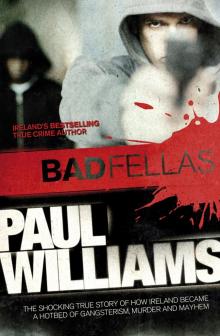
Crooks 2, p.5
Crooks 2, page 5


Behind the scenes it had left Phyllis Hamilton and her son in utter despair. I would subsequently reveal how shortly before Michael’s death his housekeeper got a visit from Patricia Moynihan. In a conversation witnessed by two others, she told Phyllis that she did not accept that Ross was her brother’s son and demanded that she sign a sworn affidavit that someone else was the father. Fortunately, Phyllis had refused.
In the meantime I forgot about the Cleary story as life under the new regime had become exciting and busy. One of the first things Brophy and MacGinty did was to lift the censorship ban on the General. I wrote an extensive investigation of Ireland’s infamous gang boss from the unpublished research I had compiled over a number of years. (See Crooks.)
My exposé led to the first death threats and consequent police protection which became a fact of life for my family and me over the next few decades. Then in August 1994 Martin Cahill was assassinated by the IRA. It was the biggest gangland story I had covered in the new world order of organized crime. Two days later our daughter was born.
When the excitement died down I decided to write Martin Cahill’s biography, The General – Godfather of Crime, my first book. As the months rolled on I became completely immersed in my research for the book and the world of crime reporting.
The time was punctuated with security alerts at my home as members of his gang plotted to attack me. By January 1995 I was still working on the book when Veronica Guerin was shot in the leg by a lone gunman at her home. That incident illustrated that there were no longer any lines that gangsters were not prepared to cross including shooting a journalist. The furthest thing from my mind was Father Michael Cleary. All that changed a month later.
I still remember the evening I got the phone call which led to one of the biggest religious scandals yet to shock the country. It was February and I was in the throes of writing the final chapters of The General. It was John Burns, my old friend since college days. He wanted to talk about Michael Cleary and the story that I had assumed was buried and forgotten. John confided that he had been approached by a solicitor called Peter Lennon who was acting on behalf of Phyllis Hamilton with a view to telling her story.
The legal eagle had approached John because of his role as a senior reporter with the Irish edition of the Sunday Times. John later became deputy editor of the paper. Today he is the Deputy Group Business Editor of Mediahuis Ireland, the current owners of the old Independent News and Media (INM) group.
John had met Peter in his office where he was shown evidence that a relationship did indeed exist between Cleary and his housekeeper for twenty-six years. There was further evidence that he had fathered two sons with Phyllis, the first of whom had been adopted. He’d had to sign a strict non-disclosure agreement (NDA) before he was shown anything. The reason Lennon went to the Sunday Times was that he believed that the Irish media might be too afraid to touch the story.
The reason for the approach, John explained, was that Phyllis Hamilton felt she had been left with no other choice but to go public with her story. It would have to be dealt with sensitively and responsibly. Michael’s friends, people who knew their secret, had publicly denounced the story of the affair and abandoned her and Ross fourteen months earlier. She had been left financially destitute.
After Michael’s death the Church had provided Phyllis with a number of lawyers but she had discovered that their real purpose was to control what she said and to whom. A well-respected corporate lawyer, Lennon had taken on her case after a mutual friend, Hamilton’s GP, had approached him to see could he help her and Ross. The doctor was concerned that the mother and son were going through a living hell due to the rejection and had nowhere else to turn. The doctor had no doubt that the story was true.
Lennon had much bigger and more lucrative corporate fish to fry but he was moved to help. He had taken a keen interest in getting justice and recognition for his new client. It was the best bit of luck Phyllis had experienced in a very long time. He was looking into aspects of Michael’s will in which he had left her property but was being hobbled at every level by the Cleary family. That was when Lennon contacted John.
The lawyer had two main requirements for his client: firstly, to ease her financial burdens, he wanted Phyllis paid a sum of money in return for her story; secondly, to get her as much money as possible and give her story a wider spread, the journalist concerned would then have to be prepared to write her book about the affair. John said the Sunday Times wasn’t interested at the time but, as a very honourable man, he still wanted to help in any way he could.
Then he recommended that I would be a suitable candidate because I was just completing a book and had the necessary experience to deal with such a story. He reckoned it would be a good fit with the new look Sunday World Brophy and MacGinty had created. John gave me Lennon’s number and said it was up to me what I wanted to do. Thirty years later I am still incredibly grateful to John for that. The conversation had to be kept strictly secret.
I was stunned by the development. I immediately rang Colm MacGinty to relay the gist of the conversation. We both agreed that it was the biggest untold story of the time. The following day I phoned Peter Lennon and arranged to meet in his office. I signed the obligatory NDA and with the formalities out of the way he pointed me to a box of files and documents sitting on his varnished boardroom table.
Over the next few hours I perused letters, pictures and legal documents that confirmed what John had told me – on the basis of the documents alone the story stood up to scrutiny. I was stunned as I read love letters that had been exchanged between Cleary and his housekeeper, going back years. There were diaries and dozens of pictures of the unofficial secret family together. Lennon showed me a copy of Michael’s will in which he had left property to Phyllis and Ross.
However, there was a complication which Lennon was worried would scupper a deal with the Sunday World. The executor of the will was Father Brian D’Arcy. In a letter written shortly before his death Cleary informed Phyllis: ‘Brian D’Arcy, as you know, has his instructions, as we all discussed a few weeks ago in the kitchen.’ Brian has always insisted that Cleary never confided his secret to him.
Peter then played a short recording of a conversation between Phyllis and Monsignor Gerry Sheehy from the office of then Archbishop of Dublin, Desmond Connell. Before his death Michael had given her Sheehy’s number and told her to phone him if she ever needed help. Since Cleary’s death her only income was her unmarried mother’s allowance which he had insisted she continued collecting throughout their relationship. It was part of the cover. When the utilities bills piled up and she couldn’t cope the diocese agreed to pay them. It was their way of maintaining control of the narrative.
Connell and his staff were obviously anxious to know whether she had talked to the media. Their sole concern was to keep the scandal under wraps just like they had done with serial paedophiles. In Ireland, and indeed across the world, the Catholic Church’s modus operandi was to shift the perverts between parishes and countries which allowed them to continue abusing children. It would take another fifteen years before the government-appointed Ryan Report finally laid bare the full shocking extent of paedophilia in the Church.
On the recording Phyllis sounded confused and anxious about what she should do. It was clear from the tone of the conversation that the Archbishop’s emissary had full knowledge of the secret relationship. She wondered out loud whether she had made a mistake by not clarifying the situation by issuing a media statement denying the allegations in The Phoenix.
Sheehy’s voice came across as firm and adamant as he Jesuitically intoned:
Not at all, not at all. All these people [the media] are looking for is to make money themselves. . . that is all there is to it. They are not in the slightest bit interested in you.
When Phyllis said she was prepared to take the secret to the grave with her the man of God agreed wholeheartedly: ‘Oh, and that would be the place for it, Phyl.’
I was astonished by what I had just heard. Here was proof that the Church was aware of the situation and was actively trying to cover it up. We then discussed how the paper would handle the story and Lennon’s conditions. I instantly agreed to the second part of the deal, to write her book. When the time came I would seek out a publisher and see what they were prepared to pay in terms of an advance. I said that I would go back to Michael Brophy and Colm MacGinty to discuss the next steps.
Back in the office I met my bosses in the MD’s office away from prying ears. Given the explosive subject it went without saying that it would have to be dealt with in the strictest confidence. At the meeting I remember laying out the incredible bones of the story I had been shown and what it meant. I was in no doubt that the story was true.
The bottom line was we had evidence that at the height of Cleary’s powers, when the bombastic cleric finished lecturing the world on all issues moral on his radio show or on the Late Late Show, he went home and got into bed with his housekeeper. It was a contradiction of everything the powerful priest had stood for.
Cleary had effectively lived for several years with his lover and son in full public view as a family unit in all but name. The cover was that Phyllis worked for Cleary as his housekeeper and personal secretary which, by all accounts, she was very good at. The public line was that she’d had a child out of wedlock and the kind-hearted priest was being charitable by giving them a home as part of the conditions of her employment.
The picture taking shape from the revelations disclosed Cleary as an intensely conflicted character. To some he would be seen as a hypocrite, a moral coward, a liar and a charlatan. But he was also a deeply flawed, dysfunctional and emotionally immature individual who was trapped between love, celibacy, ego and status.
Cleary’s first son was adopted and he did not reject his second son, unlike his friend Bishop Casey. He seemed to genuinely love his illegitimate family although Phyllis would later tell me that she was never sure whether Michael stayed with her purely to ensure that their relationship remained a secret. If the story had ever come out it would have meant disgrace and the loss of the job that he clearly loved. He wanted it every way.
The story had everything. It exemplified the inherent contradictions and frailty of human life. But one thing was certain: it would be the Church and Cleary’s relatives and friends who would ultimately take the blame for the story coming out. They had left Phyllis Hamilton with no option but to go public.
We knew that if we did eventually publish the story it would set off a firestorm on a par with the one that had blown up in the wake of the Casey affair. To my absolute delight, Brophy and MacGinty seemed to relish the challenge.
Brophy asked how much money Peter Lennon was asking for. I said he mentioned £30,000 (around €70,000 in today’s values) which was, to my mind, an enormous amount at the time. Unlike the British tabloids there wasn’t a culture of paying for stories in the Irish media. This was completely new territory for the three of us sitting around the table. But given all the circumstances of this case paying a sum of money was certainly justified. It was a perfect synergy of mutual interest.
We would inform the public of a terrible injustice by giving a voice to someone who had been trampled on, humiliated, lied about and left in penury by an all-powerful, mendacious church and its willing media acolytes. And all because of a woman’s devotion and love for a high-profile priest who had broken his vow of celibacy. It would expose the infallibility and imperfection of a church which enforced a cruel moral code on its flock. And, most importantly for us, it would sell a lot of newspapers. It would be a win-win situation all round.
Michael Brophy said not to worry about the money. He would negotiate directly with Lennon himself. He was determined that we would get the story. When we talked about how we would go about presenting the story Brophy said that the facts would speak for themselves; there would be no need for editorializing or exaggeration. We would just tell it as it was. I remember expressing my concerns that despite their enthusiasm the investigation might never see the light of day because of the Church and Cleary’s network of powerful friends which included people at the highest levels of our own newspaper group.
Brophy and MacGinty assured me that that would not be a problem either. That is what I admired most about my new bosses, their determination not to be intimidated by vested interests and their willingness to push out the boundaries. They were firm believers in the principal of print and be damned. That’s what made them the best newspaper men I ever worked with.
There was no timeframe yet in play as we were still in the preliminary stages of a very complex process that none of us had experienced before. There was no guarantee that it would work out, especially if Phyllis changed her mind for some reason. We agreed that it would have to be kept a closely guarded secret not even to be shared with our colleagues.
I had a lot of work to do before I met with Phyllis. Every aspect of the story had to be corroborated because we knew we were taking on a powerful entity that would do everything to undermine her credibility and ours. We had to know every aspect of the story including any skeletons she had hidden.
A few days later Colm and I went back to Peter Lennon so that the editor could familiarize himself with the documentation that I had been shown. When the meeting was over Colm and I went for ‘lunch’ to celebrate and didn’t leave the pub until closing time. The game was on.
In the weeks and months that followed I spent a lot of time compiling every piece of information I could find on Michael Cleary. At the same time my primary concern was putting the finishing touches to my book The General including editing the manuscript and having it screened by libel lawyers. It was a very busy time.
In early May Michael Brophy called me to his office with Colm. He announced that he had done a deal. He had agreed to pay £20,000 or the equivalent today of about €47,000. After that Peter Lennon organized the first meeting with Phyllis and Ross.
Peter, Colm and I met them in the lawyer’s office. We wanted to firstly reassure Phyllis that we would handle her story sensitively and responsibly. We also had a mountain of questions to ask.
In the subsequent book Phyllis explained how nervous she was coming to meet us:
The day we went to meet with them for the first time, Ross and I were terrified. They were the kind of people we had lived in fear of, the people Michael said never to trust. . . now we would find ourselves sitting across a table from them.
As they were leaving the house she described how Ross asked if they were doing the right thing. She replied:
I don’t know, Ross. We will never know that. All I know is that we have to do something because nothing is happening. It is the only way I can see us getting out of this hell.
She then described the meeting:
I had expected two brash, obnoxious newsmen. Deep down I felt that I wouldn’t like them, and we would decide not to go ahead. Instead, they were reassuring, courteous and friendly. Professionals with a human touch. I suddenly felt at ease with them and the knot in my stomach loosened somewhat. They had done their homework and put forward their proposals for how to deal with the story which they were totally happy with. There were a lot of questions and clarifications.
Our plan was to run two major interviews over consecutive weeks. The first instalment would be an in-depth interview with Phyllis, followed by a second interview with Ross. It was agreed that I would start the process of interviewing them both once The General was published and I had finished the publicity campaign around it. Looking back, it was one of the most rewarding and exciting times of my professional life.
I was also facing a daunting challenge. I was about to publish my first ever book and then, once the Cleary story had been published in the Sunday World, I would have to sit down and begin writing a second book immediately afterwards. I didn’t know it at the time but I was about to make a tiny bit of publishing history by writing and publishing two books in less than eight months, as a provisional print date was set for 25 June 1996.
The General was published by The O’Brien Press on 19 May, the same day that I was scheduled to appear with Gay Byrne on the Late Late Show. Being invited onto the biggest TV show in Ireland was the kind of break that every journalist dreamt of. Colm MacGinty sent me down to Louis Copeland to get a smart new suit for the big night. I had been watching the show for as long as I could remember. I was excited and extremely nervous. But I was also worried as the gardaí had increased patrols around our family home in case the General’s men decided to mark the occasion with an attack of some kind.
It’s funny the kind of things that stay in the memory banks. I still recall the moment I was led in to take the interviewee’s seat behind the famous desk on the Late Late set in RTÉ’s Studio One. I was the last guest that night. The lights were dimmed as the Dublin rock band, The Devlins, played their hit song ‘Someone to Talk To’. My very first encounter with Gay Byrne, Ireland’s chat show king, was the back of his chair as he sat watching the performance. I remember him offering his hand back to shake mine in welcome without turning his head.
The strange thing was that despite the nerves of appearing on TV for the first time to talk about my precious book, I couldn’t get the Cleary story out of my head. In about a month’s time I was about to traduce the memory of the host’s dear friend and piss off a powerful elite. As I looked at the back of Gaybo’s head I remember thinking that this would be the first and last time I would sit in the famous chair.
Just two years earlier Eamonn Casey’s former lover, Annie Murphy, had sat in the same chair when Gaybo interviewed her about her groundbreaking book. It wasn’t his finest hour, and he was later criticized for coming across as being hostile and sceptical about her story. Gaybo was one of the celebrities to pour scorn over the original story in The Phoenix. In any event my inaugural TV interview went well and The General quickly topped the book charts in the week that followed. It was a great experience and one of the highlights of my career.