Irish knit murder, p.1
Irish Knit Murder, page 1


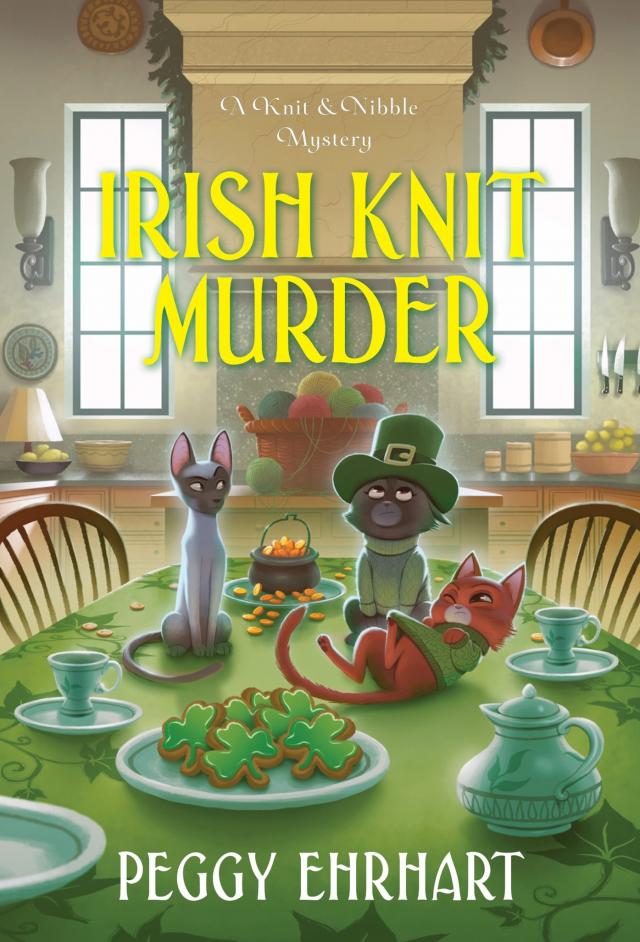
IRISH KNIT MURDER
Bettina had been staring bleakly at the unadorned tombstone. Now she stared bleakly at Pamela. “What shall we do?” she asked.
“Go back home?” Pamela shrugged.
“It might be here, somewhere,” Bettina said. “It might have blown away.”
“But the point of your photo was going to be that someone placed it on Isobel’s grave. If it’s just lying in the grass, far from the grave, the connection with the Isobel Lister story is lost.”
Pamela’s words were wasted. Bettina was off again, scurrying toward a path that led up a slight incline. Pamela followed, but at some remove. The incline leveled off to a plateau bordering a wooded area that marked the cemetery’s eastern boundary. Ancient tombstones worn to shapelessness by wind and weather shared the space with a few gnarled trees. Then the grass gave way to land claimed by a dense thicket of trees.
“I think I see something white,” Bettina cried, plunging among the trees.
From the thicket came a wordless shriek.
“Bettina! What happened?” Pamela called. “Are you okay?”
“I am,” Bettina called back. “But somebody isn’t.”
Stepping into the thicket, Pamela caught sight of Bettina kneeling near the base of an especially large tree. A twisted swath of white, like a knitted scarf or shawl, trailed over the composted leaves, but it was tethered at one end to the neck of a recumbent body . . .
Books by Peggy Ehrhart
MURDER, SHE KNIT
DIED IN THE WOOL
KNIT ONE, DIE TWO
SILENT KNIT, DEADLY KNIT
A FATAL YARN
KNIT OF THE LIVING DEAD
KNITTY GRITTY MURDER
DEATH OF A KNIT WIT
IRISH KNIT MURDER
CHRISTMAS CARD MURDER
(with Leslie Meier and Lee Hollis)
CHRISTMAS SCARF MURDER
(with Carlene O’Connor and Maddie Day)
Published by Kensington Publishing Corp.
IRISH KNIT MURDER
A Knit & Nibble Mystery
PEGGY EHRHART
Kensington Publishing Corp.
www.kensingtonbooks.com
All copyrighted material within is Attributor Protected.
Table of Contents
IRISH KNIT MURDER
Also by
Title Page
Copyright Page
Dedication
ACKNOWLEDGMENTS
CHAPTER 1
CHAPTER 2
CHAPTER 3
CHAPTER 4
CHAPTER 5
CHAPTER 6
CHAPTER 7
CHAPTER 8
CHAPTER 9
CHAPTER 10
CHAPTER 11
CHAPTER 12
CHAPTER 13
CHAPTER 14
CHAPTER 15
CHAPTER 16
CHAPTER 17
CHAPTER 18
CHAPTER 19
CHAPTER 20
CHAPTER 21
CHAPTER 22
KNIT - Cozy Egg Cozy
NIBBLE - Wilfred’s Irish Coffee Trifle
KENSINGTON BOOKS are published by
Kensington Publishing Corp.
119 West 40th Street
New York, NY 10018
Copyright © 2023 by Peggy Ehrhart
All rights reserved. No part of this book may be reproduced in any form or by any means without the prior written consent of the Publisher, excepting brief quotes used in reviews.
To the extent that the image or images on the cover of this book depict a person or persons, such person or persons are merely models, and are not intended to portray any character or characters featured in the book.
This book is a work of fiction. Names, characters, businesses, organizations, places, events, and incidents either are the product of the author’s imagination or are used fictitiously. Any resemblance to actual persons, living or dead, events, or locales is entirely coincidental.
If you purchased this book without a cover you should be aware that this book is stolen property. It was reported as “unsold and destroyed” to the Publisher and neither the Author nor the Publisher has received any payment for this “stripped book.”
The K and Teapot logo is a trademark of Kensington Publishing Corp.
ISBN: 978-1-4967-3885-1
ISBN: 978-1-4967-3887-5 (ebook)
In memory of my father, Matthew Nicholas Ehrhart
(1918–2021)
ACKNOWLEDGMENTS
Abundant thanks to my agent, Evan Marshall, and to my editor at Kensington Books, John Scognamiglio.
CHAPTER 1
Bettina Fraser’s amiable features usually radiated cheer, but at the moment her expression revealed that her feelings had been hurt.
“The Advocate may be a weekly,” she said, raising her voice to be heard over the many conversations echoing in the large room, “but many people—most people—in Arborville appreciate a newspaper that focuses exclusively on their own town.”
“Of course they do.” Pamela Paterson reached an arm around her friend’s shoulders and gave her a quick squeeze. “I don’t see the County Register’s Marcy Brewer here to cover the senior center’s St. Patrick’s Day luncheon.”
“She wouldn’t come to a thing like this. She thinks she’s too important.” Bettina’s head drooped forward, and the scarlet tendrils of her carefully styled hair quivered. The scarlet coiffure offered a striking contrast to the bright Kelly green of her ensemble, a silky blouse and tailored wool pants in the same shade.
Pamela had overheard the offending comment too. A woman sitting at a nearby table had nudged her companion, pointed at Bettina, and remarked that she was a reporter for the Arborville Advocate—whereupon her companion had replied, making no effort to keep her voice down, “Oh, that silly thing. Nobody takes it seriously or even reads it.”
“Anyway,” Pamela added, with another squeeze, “they’re coming around with coffee and dessert now, and the entertainment is about to start.”
The luncheon menu had been a very appropriate corned beef and cabbage, with boiled potatoes and Irish soda bread still warm from the oven. As Pamela spoke, a server whisked away the plates bearing the luncheon remains, and a few moments later dishes of chocolate ice cream appeared, as well as a platter of cookies the shape and color of shamrocks. Another server circled the large table filling coffee cups.
Cheered by the sight of the cookies, the ice cream, and the steaming cup of coffee, Bettina seemed happy to nod and agree when a woman across the table, sixtyish and cheerful, began to praise Meg Norton, who had organized the event. “The volunteers from the high school too,” she added, “cooking and serving all this delicious food.”
“Too bad about the flower delivery though,” observed a gray-haired woman who had acknowledged the holiday by looping a bright green scarf around her neck.
“Flowers? I don’t see flowers.” This was uttered by a woman who had heretofore been focused more on her dessert than on the topic at hand.
“You don’t see them because they weren’t appropriate,” said the gray-haired woman. “Not appropriate at all!”
“What was wrong with them?” Bettina inquired, postponing the bite of cookie she was about to take.
“They were all white,” the gray-haired woman explained. “Lilies and things, mournful things, not like something for a party—and worst of all, there was a card that read ‘In deepest sympathy for your loss.’ Meg was horrified, but by the time she saw the card, the delivery man had gone.”
But that conversation was cut short when a lively run of notes drew their attention to the piano near the back wall of the room—Arborville’s spacious rec center had been pressed into service because the senior center was too small for an event like this. A man no less dashing for being well into middle age had just launched a melody that Pamela, after a moment of thought, recognized as “When Irish Eyes Are Smiling.”
He paused after a few verses and swiveled around to acknowledge the sprinkling of applause with a nod. Then he advanced toward a microphone on a stand a few yards from the piano and flung an arm out toward a doorway in the back wall. Into the doorway stepped a statuesque woman smiling a bright, lipsticky smile. The undulating waves of her blonde hair evoked the Hollywood of decades past, but her sleek leggings and stiletto heels brought a more up-to-date glamour to the look. The ensemble was completed by a form-fitting green sweater in a shade that was more Day-Glo than Kelly.
“Isobel Lister!” the man exclaimed, arm still extended. “Let’s hear a big welcome for Arborville’s own Isobel Lister!”
The woman took his place at the microphone after an inaudible but flirtatious exchange with him, and he returned to the piano. In a moment Isobel Lister’s amplified voice, husky but pleasant, rang out in celebration of “Whiskey in the Jar.” As she sang, she scanned the room, bestowing a teasing wink here and an insinuating smile there, particularly at the piano player. Meanwhile, the fingers of her right hand snapped in time to the rhythm, and her feet—impractical shoes notwithstanding—hopped about in a kind of jig.
The applause that followed the song was hearty and well-earned. When it had died down enough to make conversation possible, the gray-haired woman in the bright green scarf leaned forward.
“She’s over seventy, you know,” the woman said. “I don’t know how she does it. I couldn’t wear those shoes.”
But there wasn’t time to explore the topic further. After brushing her hand across her forehead
And she launched into a raucous version of that familiar tune, complete with a hint of Irish brogue.
Bettina had rummaged in her handbag for her phone as soon as Isobel started to sing. Now she left her seat and moved to the side of the room, where she could angle for good shots without obstructing other people’s views of the performance. Pamela found herself tapping her foot in time to the music, cookies and coffee forgotten. The women facing her across the table had rotated their chairs to face the makeshift stage. Pamela couldn’t see their expressions, but their bobbing heads suggested they were as caught up in the lively rhythms as was Pamela herself.
“Here’s a classic one,” Isobel said, as the applause for “Molly Malone” trailed off. Turning toward her accompanist, she added, “We’ll slow things down a bit . . . and try not to cry. ‘Danny Boy’!” She closed her eyes, tossed her head back, and sang the opening line, “Oh, Danny Boy . . .” with a hint of a smile, as if savoring some memory awakened by the song.
A hush fell over the room as Isobel’s husky voice lingered on each phrase of the song, with her accompanist supplying a gentle chord here and a delicate trill there. The respectful silence made the loud squeak coming from a chair near the edge of the room all the more startling. Heads swiveled in the direction of the squeak, eyes stared as a stern-looking elderly woman rose, seized her handbag and walking stick, and stalked from the room, but Isobel carried on. She seemed so caught up in the world evoked by the song as to be oblivious of her surroundings, unruly though an audience member might be.
“That was a sad one,” she declared as the last few notes of the song faded away, but before the applause began. When the applause died down and it was possible to be heard again, she said, “Let’s cheer things up with something fun. Shall we?” She glanced around the room as if inviting agreement. A few people nodded and she nodded back, smiling mischievously as her eyes continued to roam.
Then the roaming stopped and, as if addressing one particular person, a woman about Isobel’s own age sitting at a table near the front, she went on. “You know, we Arborville girls weren’t as goody-goody as some people thought. I could tell stories”—she looked into the distance and laughed—“but I won’t, just now at least.”
She nodded at her accompanist and offered him a mischievous smile. He played a few chords, but before she began to sing, she added, “This one isn’t really Irish—but it’s got clover. That’s the same thing as shamrocks, right?”
Bettina, by this time, had returned to her seat next to Pamela. As Isobel belted out the opening lines of “Roll Me Over in the Clover,” she grabbed Pamela’s arm and gave a delighted giggle. Then she reached for another shamrock cookie.
A few people began to laugh, and the heads that had bobbed to “Whiskey in the Jar” commenced bobbing again. But apparently not everyone was delighted with the choice of material. The woman Isobel had seemed to address before launching into the song slipped out of her seat, edged toward the side wall, and tiptoed quickly to the entrance.
The remainder of the concert was something of an anticlimax, though the audience members smiled, tapped their feet, and swayed back and forth as “The Harp That Once Through Tara’s Halls” gave way to “My Wild Irish Rose,” followed by “Erin Go Bragh,” “Mother Machree,” “Foggy Dew,” and “How Are Things in Glocca Morra?”
It was coming up on one thirty when Isobel leaned toward the microphone and said, in her husky voice, “You’ve been a great audience and we’re going to wind things up now. But first”—she flung out an arm—“let me introduce this handsome guy at the piano. Nate Riddle!”
Then, with a saucy head-toss, she belted out the opening lines of “The Wild Rover.” Verse followed verse until, nearing the song’s conclusion, Isobel spread her arms wide. The tempo slowed and she lingered over the last few words as if plumbing them for every bit of meaning. The piano punctuated the end with a resounding chord, Isobel dipped forward in a dramatic bow, and the room echoed with the sound of applause.
After another bow, and a generous round of kisses blown to the audience and her accompanist, Isobel darted back through the doorway from which she had emerged.
“She’s really something,” Bettina declared when normal conversation was possible again. “‘Arborville’s own,’ the pianist said. It’s amazing that I’ve lived here all this time and I never came across her before. But I got some good photos for the Advocate.”
Many shamrock cookies remained on the platter in the middle of the table, and servers were circulating with fresh pots of coffee. Soon chatter and laughter had replaced the sounds of Isobel’s voice and the accompanying piano. Bettina had been drawn into conversation by the woman sitting on the other side of her and Pamela was content to drink her coffee and nibble on a shamrock cookie—just a simple butter cookie, really, with buttercream icing tinted green, but the shamrock shape made it festive and fun.
“Will she come back out, I wonder,” inquired the gray-haired woman with the bright green scarf from across the table. She and the others who had turned their chairs around when Isobel began to sing were now facing the table again. “She was sitting up there during the lunch”—the woman pointed at a table close to the piano—“next to the piano player.”
“She certainly earned her coffee and cookies,” said the cheerful sixtyish woman sitting next to her. “And I’ll bet a few people would even like her autograph.”
“Yes,” the gray-haired woman laughed, “her adoring public. And she’s certainly not shy. So where is she?”
The same question seemed to have occurred to Meg Norton, the event organizer. Looking past the heads of the women facing her across the table, Pamela watched as Meg, a pleasant-looking woman in her sixties, with undemanding features and well-groomed hair tinted an inconspicuous shade of brown, made her way toward the door in the back wall.
She was gone no more than two or three minutes. When she emerged, she was still alone, but she no longer resembled herself.
Her expression evoked the cover graphics of a pulp paperback: a desperate woman with forehead creased, eyes wide, and mouth distended as if frozen in mid-scream. Meg did not scream, however. Instead, she clapped her hands, like a schoolmarm calling for order. Due more, perhaps, to the expression on her face than to the handclap, the room fell suddenly silent. It was as if a plug had been pulled on the laughter and chatter.
“Isobel is dead!” Meg announced. “She’s just . . . dead!”
Instantly, Bettina was on her feet. She snatched up her phone and launched herself toward the doorway where Meg stood.
“Where are you going?” called a voice as she passed.
“I’m a reporter,” she replied, slowing down only briefly. “Bettina Fraser from the Arborville Advocate.”
Suddenly the festive room was no longer festive. No one spoke, not even in shocked whispers directed to tablemates. The fanciful decor—featuring giant shamrocks with leaves the size of dinner plates, tissue honeycomb rainbows, papier-mâché leprechauns, and pots of foil-wrapped chocolate “coins”—seemed a puzzling mockery of the mood that had descended over the gathering. Even the cheery ensembles, which included green sports jackets for some of the men, now appeared out of place.
Without quite thinking about what she was doing, Pamela leapt from her seat and followed Bettina as she wove between tables, nearly catching up with her as they approached Meg, who still stood in the same spot from which she had made her announcement. But instead of speaking to Meg, Bettina veered around her and swerved into the hallway that led to the back entrance of the rec center. Pamela reached her friend’s side just as Bettina screeched to a halt in the doorway of the office that had been pressed into service as a green room.