

The mansion of mirrors, p.1
The Mansion of Mirrors, page 1


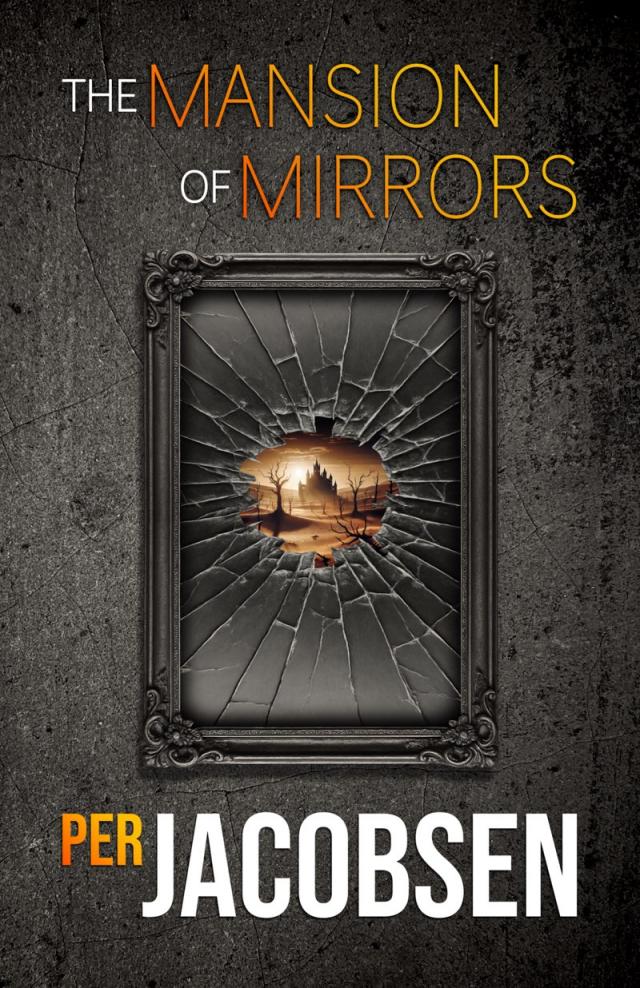
The Mansion of Mirrors
PER JACOBSEN
HUMBLEBOOKS
The Mansion of Mirrors
Copyright © 2020
Per Jacobsen & HumbleBooks
1st US edition, 2025
Cover art: Per Jacobsen
ISBN (e-book): 978-87-94319-34-8
All rights reserved.
This book is dedicated to Stefan Grave,
whose untimely death sent me on my first journey
through the Wastelands of Urari.
Back then, my search for the Mansion of Mirrors ended blindly.
Only now, more than twenty years later,
have I been able to gather the courage to return.
—Per Jacobsen
Foreword
Dear Reader,
Before we start, I’d like to tell you a bit about the book you’re about to read—because there’s a fair chance that you and I have met before through one of my other stories. And if that’s the case, you may have certain expectations of this one.
Now, for the most part, your expectations will be met, as The Mansion of Mirrors fits my usual M.O. The themes are dark, no one is safe, and there’s no guarantee of a happy ending.
However, this book is also a bit different from the others. The reason is pretty simple, though: although it’s being released as my eighth book on the international market, The Mansion of Mirrors is actually the first novel I ever published. It was originally released by a Danish publishing house in 2020, and I only recently got the rights back, allowing me to translate it and bring it to my international readers.
So, this is my first novel—and not only that, it’s also the first story I ever wrote. You see, it wasn’t really in the cards for me to become a writer. I didn’t grow up dreaming of publishing novels, nor do I have a drawer full of unpublished stories that I just had to get out. I only discovered—relatively late in life and mostly by accident—that I had stories to tell.
And since Mansion is my first written work, it’s also the story that taught me all the basics of the craft. I must admit that, at times, I was speeding down the highway with my eyes closed. But I learned a lot from this book, and if you look for it, I’m pretty sure you’ll be able to spot a development in my writing style throughout the novel—especially if you’ve read some of my other stories.
Another difference is the genre. The Mansion of Mirrors has an element of fantasy that you won’t find in my other books. That shouldn’t matter too much, though, as I rarely stick to one genre anyway. I like to mix and match. Besides, my regular readers will know my opinion on genre: it’s just the wrapping around the real story. Most good stories could work in any genre.
Okay, I’ve said what I needed to say. Let’s see what’s on the other side of that mirror, shall we?
Per Jacobsen
“Hell isn’t fire.
Hell is a hall full of mirrors.”
—Tom Cerveau
Part One
Given Your Situation
Prologue 1
For some artists, it starts with the blank canvas. For others—arguably the best—it starts with the final motif. The best don’t see the glossy surface of the canvas. They see the picture.
This is also the case for the boy who now sits in the warm lamplight in front of a blank canvas. He doesn’t see the frame, nor the white fabric stretched across it. He sees only the image that has called him up from his sleep and drawn him to the desk and the blank canvas.
For now, the picture is clear, but experience has taught him that it won’t necessarily stay that way. Like dreams, the images are fleeting, and if you don’t know how to grab ahold of them, they can crumble and disappear right in front of you. Therefore, he doesn’t hesitate to reach for the tools that will help him immortalize it.
He starts by making the outline of the central motif; A girl sitting on her knees, hunched over. As more details are added, it becomes clear that the girl’s hands are resting on her own shoulders, clinging to them as if she is trying to embrace herself. She sits with her back turned, so her face is hidden from the viewer. Nevertheless, the young artist manages to make the lines that his brush leaves on the fabric come together into an unambiguous message:
The girl is grieving.
1
Jean Cocteau was right, he thinks, as he stands there in front of the mirror in his bathroom. Mirrors should reflect a little more on what they show us.
Michael Bendixen is only thirty-three years old, yet the man staring back at him seems much older. The deep, marine-blue eyes, which during his teen years were his strongest weapon in the battle for the favor of the opposite sex, have taken on a grayish hue and appear expressionless. Underneath them lies a network of furrowed wrinkles that he has never noticed before.
As if expecting to be able to wipe away the wrinkles, he raises his hand and runs a finger beneath his eye. When that doesn’t work, he leans over the sink, turns on the tap, and lets the cold water flow freely over his hands for a moment before shaping them into a bowl and bringing them up to his face.
A stinging sensation spreads through his skin when the water splashes against his cheeks, but it doesn’t have the desired effect. The uneasiness in his body that drew him out to the mirror in the first place still lingers. In fact, it increases, and while he closes his eyes and feels his way over the tiles to the towel on the wall, it grows into an absurd thought:
The bathroom will be gone. When he opens his eyes, it simply won’t be there anymore, and he will find himself isolated in some godforsaken place. A desert, maybe.
On the rational level, he is obviously aware that this idea is completely insane. Still, it seems so real that he can almost hear the wind pushing tumbleweeds over the sandbanks and crows violating the calm of twilight with their shrieks.
Slowly, he lowers the towel and opens his eyes. Meeting his own gaze behind the glass this time, he is relieved to find that the anxiety attack—if that is the explanation—has passed. The bathroom is still there, the sound of screeching crows has been replaced by a lawnmower engine at one of the neighbors’ houses, and the man in the mirror is once again Michael Bendixen, a thirty-three-year-old high school teacher.
He starts to turn away from the mirror but hesitates as his gaze catches something on the sink next to the tap. Something small and light brown. He picks it up by pressing the tip of his finger down on it—and feels a chill run down his spine when realizing what it is.
Three tiny grains of sand. Were they there a moment ago?
As if to emphasize the question, his cell phone starts to vibrate with a soft:
Hmm . . . hmm . . . hmm . . .
The phone lies on the kitchen table alongside a stack of flyers that somehow made it past the No Junk Mail sign they put up the year before. His wife, Ann, has—after a lot of campaigning—convinced him that advertising flyers are the root of all evil when you have a ten-year-old son.
Poverty guarantee with glossy toy illustrations was the main slogan of her campaign, and, as with so many other debates, Michael had to concede she was right.
That was nothing new, though. The fact that Ann usually has the better arguments and the deeper insight is the rule rather than the exception—even though he is the one who teaches psychology.
He’d never dream of complaining about it, though. After all, Ann’s intelligence, along with her ability to always bring out the best in others, is the main reason he chose to share his life with her.
He picks up the phone from the table and taps the green icon.
“Hello, Michael speaking.”
“Oh? Yes, hello,” says a man’s voice on the other end, its tone suggesting that its owner wasn’t expecting the call to be answered. However, it doesn’t take many seconds before its brought down to a calm and thoughtful pitch. “You’re speaking to Erik Starck. I’m calling from the County Library regarding . . . is this a bad time?”
“No, it’s fine. How can I help you?”
“It’s about a problem that we’ve had with your profile here at the library in connection with the implementation of our new system. There have been a number of teething problems, and unfortunately, your profile has been hit pretty badly. We don’t know why, but the system keeps registering new loans in your name.”
“I see. And I’m guessing that also means a bunch of fines?”
“Well, sadly yes. One of the consequences is that the circulation fees are piling up on your profile.”
“But I haven’t received any reminders,” Michael says as he roams through the flyers on the kitchen table with his free hand to check if there is a letter from the library hidden somewhere. “I should have gotten a bunch of them, right?”
For a moment, there is silence at the other end of the line, as though the question has rendered the librarian speechless. Then he clears his throat and says:
“Well, you would have, but we turned off all automatic emails and letters in the system as soon as we became aware of the problem. So that part is under control. Unfortunately, we have not been successful in stopping it from adding new loans to your profile. Hence, you will probably have to create a new profile and delete the old one.”
“Aha,” Michael says. “I’m guessing I can do that online?”
“Well, if it’s not too much of a hassle, it’d be best if you could come in person,” the librarian says. “You see, I’ll need your signature to set up a new library account. Technically, you could do it from home, but with all the issues weâ€
“Not at all,” Michael says. Although he isn’t overly enthusiastic about the solution, he can easily follow the librarian’s way of thinking. Being employed in the public sector himself, he knows all too well the challenges of IT systems on public budgets. “I work at Oakwood High, which is close by, so I’m happy to swing by. I’m just impressed that you actually called me in person to inform me. You should be commended for that.”
“Of course. That’s the least we can do . . . given your situation.”
Something about the way the librarian hesitated before the last three words bothers Michael. He can’t quite put his finger on it, but it’s as if that slight pause makes the words sound awfully solemn. As though the librarian knows something he doesn’t—and that the situation he’s referring to is something completely different.
“Um, yeah . . . why don’t we say that I swing by after work tomorrow? I’m off at a little past four.”
“It’s up to you,” the librarian says. “You just come by whenever you’re able.”
Whenever you’re able. There’s nothing inherently wrong with this phrasing, but coming right after the other words, it sends an unsettling prickle down Michael’s neck. Therefore, he is relieved when the man on the other end of the line takes the initiative to end the conversation with the words:
“Well, I’d better get on with today’s work.”
“Huh? Oh yeah, of course. Thank you again, and I’ll make sure to swing by the library as soon as possible.”
“You’re welcome. Goodbye.”
“Goodbye.”
After the conversation, Michael pulls a small yellow note from his work bag, writes Library issue on it, and places it loosely between the pages of his calendar.
Before returning the calendar to his bag, he adjusts the position of the photo that he has placed behind the plastic of its cover.
The picture is one he took on a cold and cloudy December day three years ago, yet it always fills him with warmth. On it, a seven-year-old version of his son, Benjamin, sits with one hand outstretched. Between two of his fingers crawls a small lizard, and under the hood of the raincoat, the winter-red nose and the blue eyes on the boy’s face are drawn together in an expression of unreserved wonder. Maybe even a stronger feeling. Because Benjamin loves animals, he always has, and whether they have four or eight legs, fur, skin, or scales doesn’t really matter.
Once the calendar is back in place in his work bag, Michael glances out the window and then up at the clock above the bulletin board.
Quarter past four . . . and the driveway is still empty. It shouldn’t be. They should be home by now. It’s Wednesday, so he knows Ann gets off work at 2:30. He can’t remember if Benjamin finishes at the same time, but usually, the boy spends the waiting time doing homework on the days he goes shopping with his mom before they head home.
Michael reassures himself that it’s probably just the usual traffic jam on the Haywood Bridge and then picks up a flyer from the top of the stack. With FullCart's best offers in hand, he then walks into the living room and takes a seat in his favorite chair; a classic Chesterfield in dark brown leather.
Sitting there in the autumn sun’s rays from the window, slowly surrendering to the enticing siren song of sleep, Michael hears the sound of a car parking in the driveway and breathes a sigh of relief. His relief is short-lived, though, as the sound he is waiting for next—Ann and Benjamin yelling that they’re home—never comes. What he gets instead are three short knocks, followed by a sharp, metallic ringing from the doorbell.
As he gets up from the armchair and walks out into the hallway, he considers if Ann could have somehow left her keys at home. That thought can quickly be dismissed, though, since she and Benjamin took the car today. Besides, the silhouette waiting behind the frosted glass of the door is at least a head taller than Ann could ever hope to be, even with the highest stiletto heels on the market.
With that thought in his head, Michael straightens his shirt collar and puts on his most welcoming smile, after which he opens the door . . . and freezes.
The person on the other side of the frosted glass indeed isn’t his wife. It’s a police officer.
“Are you Michael Bendixen?”
The sight of the police uniform has Michael’s heart beating so hard that the man’s words are muffled behind the sound of his own pulse. But he doesn’t need to hear them clearly, because he has a deeply disturbing premonition at this moment. A sense of what’s about to happen, so strong that it feels like an indisputable knowledge.
“I, yeah . . . yes, that’s me.”
The pale man in the police uniform nods and pulls the corners of his mouth up in the hint of a smile that makes the hairs on Michael’s neck stand up. Undoubtedly, it’s just a service smile—a rehearsed expression the officer keeps in reserve for easing the tension in uncomfortable situations where some tragic news needs to be delivered. But accompanied by the large and shiny pupils in the man’s eyes, that smile seems eerily real.
“Married to Ann Bendixen?”
Michael replies with a hesitant nod, and the officer’s face takes on a different, far more compassionate expression, putting to shame the idea that he should have found the situation amusing.
“And the father of Benjamin Bendixen?”
Without him even noticing, Michael’s one hand slides over and grabs the doorframe. Hooks onto it. He tries to answer, tries to force the words over his lips, but they refuse to come out, and he has to settle for another nod.
The officer stares down at his folded hands for a long, nerve-wracking moment. Then he takes a deep breath and nods.
“There really is no easy way to say this,” he says.
Three weeks after the day when Michael Bendixen opened the door to a police officer and watched his world crumble, he is still far from ready to go back to work. He decides to do so anyway. Not because he has studied psychology for five years and understands the importance of everyday routines for processing grief. By now, he has realized that one doesn’t necessarily understand what grief truly entails, just because one has read what Cullberg has to say on the subject.
No, Michael decides to return because every single night since the terrible car accident that claimed the lives of both his wife and his son, he has been haunted by different variations of the same nightmare—and because this night’s version has been the worst so far. He is, quite simply, starting to fear that the demons of the night will eventually drive him insane if he lets them.
The nightmare takes place in a huge, dark hall, in which the only source of light is a dusty column of moonlight streaming in through a skylight. Below it, he finds himself wandering among endless rows of sheet-covered mirrors, arranged with such meticulous precision that they resemble pieces in a massive domino run.
What in the dream enables him to determine that it’s mirrors hiding under the dusty, burgundy red sheets, he doesn’t know. Nevertheless, he doesn’t doubt it for a second.
In the same way, he instinctively knows that the low, jarring chorus of voices that all of a sudden rises from the darkness belongs to them. It’s the voices of the mirrors, and it’s him they’re calling out to. There is something in this large, dark hall that they want him to see.
With hesitant steps, he moves in the direction of the sound, and as row upon row of burgundy shadows glide by at the edges of his field of vision, Michael notices an unsettling detail about the mirrors. Like tombstones in a graveyard, they all bear names. They’re engraved on small bronze plaques hanging from chains draped between the twisted, ornate legs jutting out from beneath the sheets.
This realization fills him with an unpleasant suspicion, and shortly afterward, upon entering the passage where the mysterious voices seem to come from, it’s confirmed.


