

Death at the bodega, p.1
Death at the Bodega, page 1


Copyright © 2024 by Pete Jarvis
All rights reserved under International and Pan-American Copyright Conventions. No part of this book may be used or reproduced without written permission from the publisher, except in the case of brief quotations used in critical articles and reviews.
This is a work of fiction. All characters, organizations, and events portrayed in this novel are either products of the author’s imagination or are used fictitiously.
Cover by Sue Campbell Book Design
Author website: www.petejarvis.com
Chapter One
“THERE’S A BODY in the compost,” said Gael, a little winded from the short hike up to the bodega’s laboratory. “It creeped me out. I’m glad you’re still here.”
“A body?” said Martina, holding up the neck of a globular beaker in the slanted sunbeams of the window, swirling it, its deep red wine contents aglow. “What kind of body?”
“A human one. Sticking out of a grape skin cake from last year. The foot of one at least. First all I saw was a shoe, and then I poked at it with a stick and it rolled away with some little bones spilling out of it. Another bone—it looks like a leg bone—is sticking out of the cake.”
Martina set down her beaker. “You’d better show me.”
The early April Chilean sun sank as they made their way down the hill from the bodega to the edge of the field where the compost windrows lay. Martina’s little black dog, Cholo, trotted alongside them. Bright slanting sunshine illuminated the vivid green expanse of the adjacent, neighboring winery’s vast irrigated and mechanized grape field, and turned buttery wheat-gold as it struck the grasses of the bodega’s dry-farmed, hand-hewn vineyard at the base of Corucalíl Hill. Ahead, the two rows of composted grape stems and skins looked haunting in the late light. This year’s row lay covered in black tarpaulins to discourage invasive insects, which swarmed and flitted nonetheless. Alongside it lay what remained of last year’s row, uncovered. It was dry and ruddy, the color of old brown blood, and the insects had long lost interest. Together the rows created an eerie and chilling scene that was amplified by the blackened, burnt aspen trees nearby that had been ravaged by a brushfire the previous year.
“It’s in last year’s row,” Gael said as they approached.
“Last year’s?” Martina exclaimed. “Why is last year’s still here? Don Toledo did not take it?”
“Looks like his men took about half of it.”
They reached the edge of the older windrow. About five feet high and eight feet wide, it had been created by backing up and tipping successive trailer loads of winemaking waste. What resulted was a composite of now-brown, gnarled grape stems mixed with purplish clumps of what had once been cylindrical grape skin cakes. The cakes came out of the hydraulic press damp and perfectly formed, but after a year they’d lost their shapes and were falling apart.
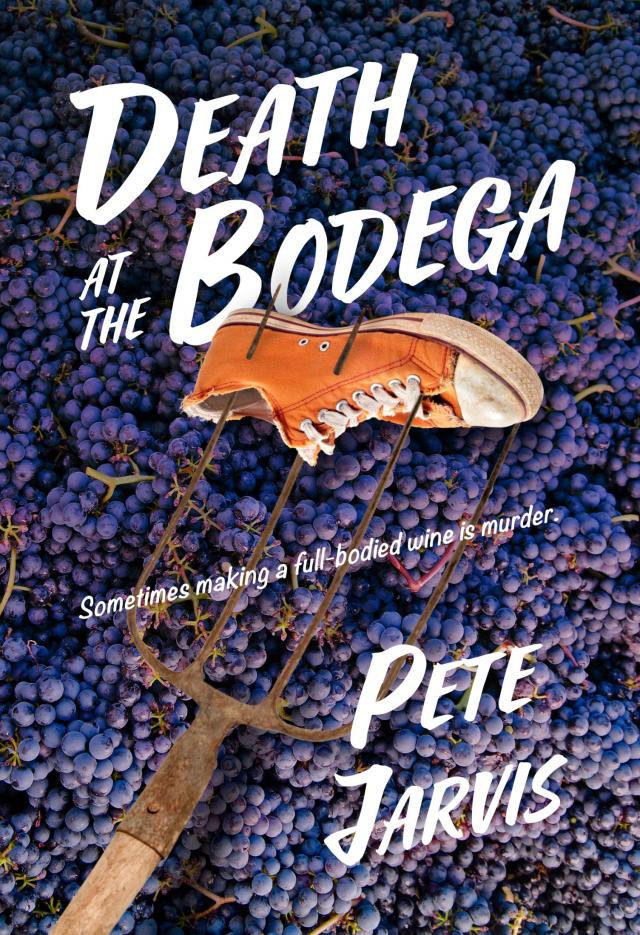
“There,” said Gael, pointing to a small, flattened tennis shoe laying at the base of the windrow. It appeared to have once been orange. “Looks like a child’s shoe, unfortunately.”
Martina inspected the shoe and its contents, which appeared to be crushed white toe bones, along with fragments of what looked like ankle and foot bones spilling down the windrow. “Oh dear,” she said, her voice wavering.
“And there.” Gael pointed to the glob of a former grape skin cake at the top of the windrow. From it protruded the broken-off stump of what looked like the lower leg bone to which the foot had belonged.
“Oh dear,” Martina repeated. Now she was shaking. Gael guided her to a seat on a nearby log cross-section, where the field workers had chain-sawn some of the deadwood of last year’s fire.
“Cholo!” Gael called to the little dog, which was sniffing the shoe. “Get away from there!”
Martina took some breaths and closed her eyes. Her brow knitted and her normally kind-looking, peaceful face contorted in distress. Her straight charcoal hair, streaked slightly gray, had come loose in its clasp, and some fly-aways hovered above her forehead.
“I know,” said Gael. “It looks like a child’s shoe.”
“It is not a child’s shoe,” she said, sitting up straighter. “It is Eder’s shoe. And I believe that is Eder in the cake.”
“Eder?”
“He wore bright orange sneakers. His feet were too small for the bodega boots, so he worked in his sneakers. They were more orange in color back then, but I am pretty sure that is his shoe.”
“Who is Eder?” asked Gael.
“He worked here last year. A Peruvian man. Perhaps you have heard us talk about him? He worked the vintage, or part of the vintage rather—half of it, until this time last year.”
Until half of last year’s windrow, Gael noted. To Martina he said, “Yes, I’ve heard of Eder. I’m living in his former rooms, in fact.”
“Such a sweet and nice-looking man,” Martina continued, moisture welling in her eyes. “And small! People teased him about that. But despite his size he was a very hard worker, and Gustavo liked that. He was always willing to work, and to come in at night and do the things that had not been completed during the day. Gustavo had to give him the keys to do this, and some of the others did not like this, and warned he should not be trusted. They felt vindicated when he stole money and ran away. But now it looks like that is not what actually happened.”
“Stole money and ran away?”
“Yes, or so we thought. It was this same time last year. A little later—on Easter night, in fact. Gustavo asked Eder to come in and do some procedures, which was convenient because he lived here at the bodega and Gustavo’s house is in the village. We all thought this proved to be too much of a temptation, and that Eder completed the procedures and then helped himself to the petty cash in Alexandra’s office—which that week was a lot of money—and vanished. No one knew he was gone until they knocked on his door in the morning after he did not turn up for work. His rooms were cleared of his things and we assumed he had gone to Santiago, and then probably onward to Peru.”
“Didn’t the police verify that never happened? If that really is Eder in the compost, I mean. Didn’t they check the bus passenger lists, or follow up at his address in Santiago?”
“Eder did not have an address. He was undocumented. He was not supposed to be in Chile. Oh, the poor man, what is he doing in the compost? Cholo! Get away from that poor man’s bones!”
Gael gazed at the legbone sticking out of the crumbling grape cake, which Cholo had begun to excavate. “Eder, or whoever that was, is not only in the compost. He is also part of last year’s vintage.” He shuddered. “What a way to go. Hydraulically pressed to three hundred bar to squeeze out every last drop. I hope he was unconscious during the pressing. Or dead already.”
“We need to tell Gustavo,” said Martina, taking out her phone. “I will text him—no, it is better that I go and tell him in person.” She put her phone in her pocket and stood up.
“Wait!” Gael found himself saying, somewhat to his own surprise.
“Wait? For what?”
Gael took a breath. “Maybe we should think about this a little more before we tell anyone. Right now you and I are the only ones who know someone’s bones are buried in a grape skin cake. You and I, and—”
“I see what you are saying, Gael. You and I, and the person, or persons, responsible for…,” she put her hand over her face and motioned to the windrow. “That.”
“It’s a small community,” said Gael.
“And word is going to spread fast, and whoever did this is probably still among us.” Martina sat back down. “Once we inform Gustavo, everyone in Corucalíl will be affected. As if things were not bad enough already.”
Gael nodded. He’d been at the bodega only a little over a month, but was well aware of the dire straits the two-hundred-year-old operation was in. After entering the new millennium barely scraping a profit, Imago proceeded through the aughts operating at a loss, not helped by cycles of drought alternating with periods of extreme inundation attributable in part to climate change, but exacerbated by centuries of agricultural ravaging. The destruction had ramped up during the 1970s, when ill-conceived forestry farms were sown on the hillsides which upset the water balance and so many other things. All this combined to back the Galáz family into a corner, such that they welcomed the investment of Vidal Luzzago, an Italian count of very old money. The Count took a shine to the place and decided that resurrecting Imago to its former glory was his purpose in life. He invested in equipment and facility upgrades while retaining the majestic, lovely old bodega structure that had been perfectly purpose-built in an age before electricity.
“Imago is my love, my soul,” the Count had been known to declare, and from what Gael understood, people looked to him as a beacon of hope. Then came the Christmas Day fire two seasons ago, a blaze that destroyed more than half of the family’s prized País grapevines and nearly burned down the bodega building itself. According to Martina, this had a huge effect on the normally optimistic and jovial Count. Everyone could see the change when he arrived for his annual three-month stint to babysit the vintage and tinker, and he’d ended up leaving early. This year, for the first time in fourteen years, the Count hadn’t shown up at all. There were reports that his mother, a woman with vast business dealings, was sick, and that he needed to attend to matters for her. Even so, his absence spoke volumes and reverberated through the bodega to the extent that Gael had no problem sensing it. An atmosphere of stress hovered over everyone, from Head Winemaker Gustavo, whom they all respected t o the utmost, to family scion and General Manager Pasqual, whom received decidedly mixed reviews, down through the bodega staff, field workers, and community at large. “Community at small” was a better term for Corucalíl, a collection of houses on the riverbank two kilometers away, with intermittent three-car ferry service connecting it to the outside world, and a grades one through twelve school with six students.
This year the bodega was making some wine, but again operating well below capacity thanks to the torched vines. It was unlikely they would turn a profit yet again. This was one of the reasons Gael was here, working solely for room and board and experience.
“Yeah, this is not good additional news,” he said, staring at the bleached white legbone sticking out of the compost. He lifted the bota bag that was slung around his neck and took a swig. He’d filled it with Indominable, the bodega’s name for its pooled odds and ends that it sold cheaply to the community in five-liter plastic jugs. Gael had brought it with him for his evening ritual of sitting in the clear, slanting, disappearing light, to sip and soak up the delicious silence that was a far cry from his former city life in the USA.
As Gael swallowed, something stirred within him. “Let’s think about this a little more. Those bones have been there for a year and they can stay there a little longer, don’t you think? While we think?” He removed the flask and offered it to Martina.
She waved it away. “You have a point, my American Brother.”
“So. What do we know for certain about this situation?” he asked, after a moment in which Martina did eventually accept a swig of Indominable.
“I do not know for certain, but I am pretty sure that is Eder. Used to be Eder. No one else had shoes like that.”
“Okay. What used to be Eder is imbedded in one of last year’s grape skin cakes. Imbedded in such a way that, apparently, he was an integral part of it, which means—”
“He was integral during the pressing,” said Martina.
“Central to the pressing, so to speak. Halfway down in the cake, it looks like. How did this person come to be part of the middle of a pressing?”
“Unless he buried himself voluntarily, which would have been very hard to do, he was placed there by coworkers who were removing skins from a tank. And they covered him up.”
“I think we can assume he did not go voluntarily,” said Gael. “Therefore he was probably unconscious when he became buried in skins, if not already dead.”
“Definitely dead after being covered with more skins,” said Martina.
“How can you be sure that is Eder and not someone’s missing child?”
“It is Eder. Was Eder. No children went missing last year, or in the years before that. Only Eder went missing last year.”
“Tell me again how big Eder is. Was.”
“He was very small. Even Inés looked tall when she stood next to him. But he was a strong worker, and being small has certain advantages with respect to getting certain work done. Eder was particularly good at getting into and out of the…,” she paused and drew a breath. “Tanks.”
“Hold that thought for a moment. So, you’re saying Eder was shorter than our little Inés? How much shorter?””
“Several centimeters. Maybe five.”
“Inés can’t be more than a hundred and fifty centimeters, which means Eder was small enough to fit inside the pressing castle, and be covered on all sides so that no casual observer would notice he was becoming part of the grape cake. We only make red wine here after all, so his red, um, liquid would have blended right in.”
“No one would notice as long as the cake slid out of the castle in one piece. Which it looks like it did that day.” Martina glanced at the ex-cake, then looked away.
“Tell me again what you said about Eder getting into and out of the tanks.”
“He was very adept! He would crawl in and out like a kittycat through the bottom hatches, or through the oval side hatches.”
“Okay,” said Gael. “Let’s think about where this body could have been prior to doing this pressing. There are two possibilities: inside a tank, or outside of one. Which do you think was more likely?”
“People have fallen into tanks and died unnoticed, only to be found later, so many times over the centuries. If that is what happened to poor Eder, it would not be the first time someone went missing and was found later when the skins were being removed. Those fermentation gases can put you to sleep instantly if you take a big enough sniff of them. As you know, this is not hard to do, particularly if you are working from above.”
“Are you saying this could have been an accident?” asked Gael. “Let’s consider that angle. There was Eder, working solo on Easter night, when he became overcome by fermentation gases and fell into a tank, only to be discovered later by his coworkers when they were removing the skins. They proceeded to perform a snap burial in the pressing castle and tell no one, presumably to avoid the nuisance of a workplace safety incident that would need to be written up and investigated. As an additional bonus, they didn’t have to tell the guy’s family back in Peru.”
“It is not as implausible as it sounds, unfortunately,” said Martina. “I liked Eder. He was my friend. But I cannot speak for everyone and how they truly felt about his presence here.”
“Not as implausible as it sounds? Does this mean you can’t rule out this version of events? It would be important to know this if we were to go and inform—”
“Gustavo! He would never, ever, have been involved in such a cover up, if that is what you want to call it! He would have immediately reported it as a workplace accident and gone through all of the correct procedures!”
“Do you have any reason to believe that the workers, knowing this, might have taken matters into their own hands? Not informed Gustavo, for the sake of avoiding all the complications, and loaded Eder into the pressing and called it done? Could be a temptation, I suppose. I can’t think of a more clandestine way to get a body out of a bodega, provided the cake slides out of the castle in one piece like you said.”
“I highly doubt it,” said Martina.
“I do too, since this idea contains a host of complications. One of the workers would have had to somehow discover right away that Eder had fallen in on Easter night. Then, using enormous quick thinking, put the equipment away and close up the tank to make it look like he’d completed his tasks. And then,” Gael’s voice slowed and his eyebrows arched, “In the cover of night, get into the office, steal the petty cash, and clear Eder’s things out of his rooms to make it look as though he’d stolen and run.”
“This is getting complicated,” said Martina.
“A doubtful scenario, but possible I suppose. Also…” Gael paused and rubbed his chin.
“Also?”
“Removing skins from a fermenter is a hard job for one person to accomplish. Much better to have two people, or three.”
“I see what you are saying.”
“Who worked last year’s vintage?” asked Gael. “In particular, who did the skin removals and pressings?”
“It was the same as this year. It depended on the tank and the day. Osvaldo of course, and Tomás, and Felipe. And Joaquín was here for peak vintage like he is this year. And—”
“Eder.”
“Yes. You are essentially Eder this year.”
“What about Inés?”
“Inés never does skin removal, not from the large tanks anyway. She will stomp on the castle to make room for more skins if she is asked, but as you have seen she stays busy in the finished product area, except when they need her to come and help pitch grapes into the de-stemmer.”
“And this cake,” said Gael, eyeing the crumbling mass on the windrow, “Was clearly from one of the large tanks.”
“Yes. The skins from the large tanks are always pressed in the large press, as you know.”
“Sometimes we get two or three cakes from one fermenter,” said Gael. “We did three the other day, from tank eighteen, which had been filled nearly to the top. And what do you see here?” He pointed to the crumbling cake with the bone poking out of it.
“I see a cake with Eder in it, and beneath it some old grape stems, and then what looks like another cake.” Cholo was sitting at Martina’s feet now. She gently stroked his neck.


