

Death by two hands, p.4
Death by Two Hands, page 4
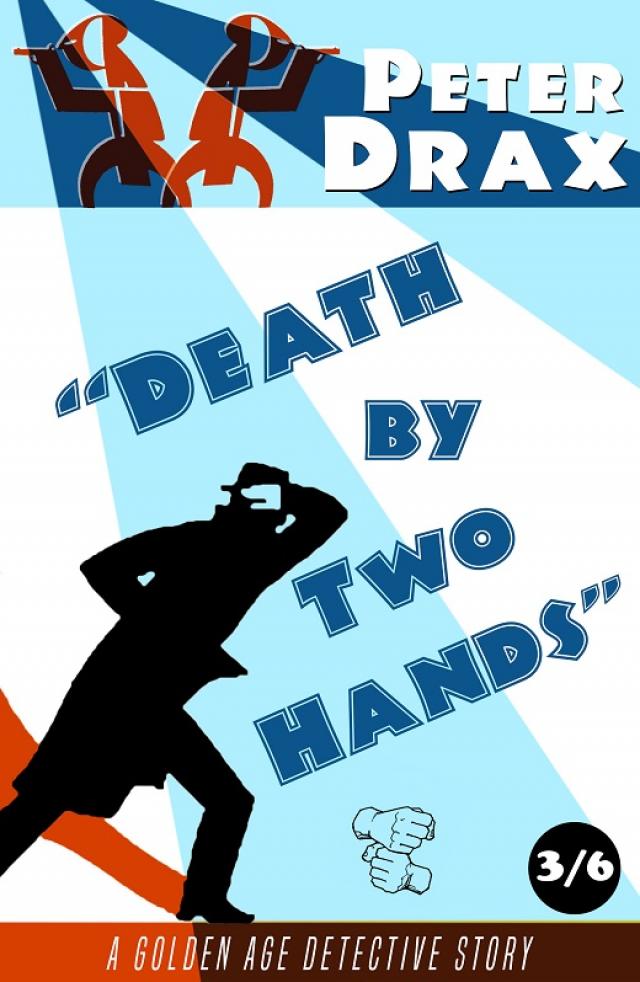


Suddenly he shouted: “Who’s that?” and Spike heard some one kick a box and swear. Mr. Rivers shut the door and turned his head. “It’s Leith. Better get out. Through the front room and the shop. The stairs are on the right.” Spike looked round for his hat, found it and ran across the room on his toes. He took care to avoid the bare boards.
Mr. Rivers waited till he heard Spike on the front stairs; then he opened the door and walked boldly on to the landing, overlooking the yard.
“What’s the matter, Mr. Leith?”
“I’m coming up.”
Mr. Rivers went back into the room. He fluffed up the cushions on the chair by the fire, emptied the ashtray Spike had used and was at the door when Leith walked in.
“Got a visitor?”
“No, Mr. Leith.”
“Mind if I squat?” Leith took off his dripping raincoat and looked round for a peg.
“I’ll put it in the hall,” Mr. Rivers said.
“Thanks. It’s a filthy night. All alone?”
Mr. Rivers nodded over his shoulder and Leith took a pipe from his pocket. He frowned at the fire as he filled it; then he rolled up his pouch and looked round the room. “You’ve got this place fixed up all right,” he said. “I like that piece.” He took the laughing boy from the table and turned it in his hands. “Looks like something good. What did it sting you?”
“Thirty shillings.”
Leith looked at Rivers for a moment.
“Here, you put it back. I might break it. When did you start going in for art?”
Mr. Rivers smiled and moved to the sideboard. “Whisky?”
“Beer if you’ve got it.”
Mr. Rivers stooped and opened a cupboard door. When the glass was full, Leith took it and said: “I saw a bloke along that back street. I fancied he came in here.”
“You mean into my yard?”
Leith nodded and wiped his mouth.
“I thought he did. I had a look round but everywhere else is locked up. You ought to do the same.”
Mr. Rivers drew up a Windsor chair and sat down. “I’m not frightened of burglars. I’ve got nothing to lose.”
“I saw Barney to-day.”
Mr. Rivers shifted his position on his chair and crossed his legs before he answered. “Yes. He was in the market. I saw him myself.”
“I wonder what he’s up to?”
“What d’you mean?”
“Well, trouble always seems to start when he’s around. You wouldn’t have noticed it, but—”
Leith stopped talking as though he had said too much. He took a deep draught of beer and sat staring at the fire. When he spoke again it was about football. Mr. Rivers wasn’t interested, but was polite and agreed with Leith in everything he said.
At eleven o’clock the detective got up. “Well, I’ll have to be moving.”
Mr. Rivers made a half-hearted protest as he went to get his coat and hat.
“I’m glad I haven’t got your job. ’Specially in this weather.”
Leith buttoned up the collar under his chin and put his hands in his pockets.
“I’d put a lock on that gate if I were you,” he said.
“Yes, I will. Good night.”
Rivers watched Leith until he was out of the yard. Then he locked and bolted the door and called out: “Spike!”
There was no reply. He walked quickly into the passageway, and, looking down the stairs, called again. He could hear the rain driving against the window of the shop. He switched on a light and ran down the stairs. The street door was shut, but not bolted. It was as well that Spike had gone. He shot the bolts and turned the heavy lock. “Wants a drop of oil,” he muttered to himself and went up to bed.
Barney, with all his belongings in a handkerchief, left No. 3 Napier Terrace shortly after Mr. Rivers. He said he’d be round in the morning to see Alma. It was something to get her settled, and as he strode along the cinder path he hardly felt the rain nor the wind which drove in his face.
Mrs. Kemp would look after Alma much better than he. He had nothing to bother about now but to find a bed. The handful of coppers in his pocket weighed heavily and jingled as he walked. There was enough there to buy a doss if the Tibbetts weren’t back yet. Eightpence for a bed. Fourpence for breakfast.
A cold pin-point touched his fingers and a warm, furry little body wriggled into his hand. It was George. Fanny was more stand-offish. She was curled up in a corner, sleeping off a surfeit of biscuit.
Funny that people, especially women, should shudder at the sight of a mouse. Trusting, affectionate little blighters. So small, so helpless, and they demanded so little.
Barney laughed and chuckled to himself as he strode along, up the rise to the bridge. He was thinking now of Mr. Rivers; of his face when he’d first mentioned the foxes to him. Thought he was being made a fool of and not too sure even now. This was only one of the many good things he’d put in Rivers’s way, and what had he got out of it all? A few shillings and a grudging word of thanks. That was Mr. Rivers’s way. He took all and gave as little as he dared.
Barney pushed his way through the evening shopping crowd on the lamp-lit pavement. Trams with bells clanging ground their way along. There was movement here. Life! To Barney it meant nothing. He shut it out from his mind.
He swung off left-handed, short of a public house. A man, infinitely sad, was playing a cornet. Barney didn’t give him a glance as he plunged down the slope of a dark street. His feet slipped and slithered over the greasy cobbles.
At the end of the street a path ran into blackness between high board fences. Barney did not slacken his stride. He could smell wood-smoke driven back on the wind. Not far now. In the shelter of the fence he raised his head and saw clear cut against the sky the roof of a caravan. He sighed his relief. Tibbett was there. There was no mistaking his crooked chimney. He could tell it anywhere, for he himself had helped to beat it out of biscuit tins.
Α dog barked, low pitched and warning. White teeth showed between lips drawn back in a snarl.
“That you, Captain?”
Barney put out a hand. The snarl turned to a welcoming whine. A warm muzzle was thrust into his hand. He talked to the dog.
“Got here all right, you old scoundrel? And how’d you like it? Bit of a change, ain’t it?”
Captain jumped up pawing at his coat.
Barney pushed him off. “Easy on. You’ll scare Fanny.”
A square of yellow light showed against the black bulk of the caravan. Barney struck a match and found the door. The ladder was drawn up and he had to reach up on tiptoe to knock on the panel of the door.
There was a startled movement inside the caravan and a shrill voice asked who was there.
“Open up. It’s me.”
The upper half of the door swung outwards and Barney could see Mrs. Tibbett.
“Is that Barney?”
“None else and perishing cold.”
A bolt shot back. “Coming down. Catch a hold.”
Barney caught the ladder as it fell and clambered up.
Mrs. Tibbett pulled up the ladder and shut and bolted the door as Barney came, blinking, into the tiny room.
Mr. Tibbett, with a pair of steel-rimmed spectacles on the end of his nose, looked round a newspaper. With his scrubby beard he had the look of a startled, and slightly cross, brown bear.
“Oh, it’s you,” he said in a high-pitched voice. “We’ll be wanting some more wood for the fire, Maria. Well, where have you been?” Mr. Tibbett lowered his paper, pushed back his glasses and looked at Barney.
“You’ve still got Captain?”
“Sure, we’ve got him. Lucky for you he didn’t pin you.”
Barney grinned as he edged along the seat to make room for Mrs. Tibbett. “He knows me.” He felt in his pocket, groped around and produced Fanny. “Don’t want anything to happen to her. She’s going to have a family.”
Mr. Tibbett sniffed his disapproval of Fanny and her family to be.
“Where’ve you come from to-day?” Mrs. Tibbett asked as she took up her needles and began to knit.
“Working, and fixing Alma up at Kemps’.”
Mrs. Tibbett stopped knitting.
“Alma at that place! Why did you take her there?”
“Sal’s dead and Alma had nowhere else to go.”
Mrs. Tibbett pursed her lips as her needles flashed into action.
“Mrs. Kemp’s all right,” Barney said defensively.
Mr. Tibbett crumpled his paper and put it to one side.
“When did it happen?”
“Last week.” Barney took his day’s earnings from his trouser pocket and spread the pennies out on the table.
“There’s not enough there to keep two. Alma’s got to earn her own living.”
“Still—” Mrs. Tibbett continued to show her disapproval of the arrangement.
The pennies clinked as Barney’s fingers played among them. “You see, it isn’t as if she had any training. She couldn’t take a place.”
“Mrs. Kemp won’t keep her for nothing. She’s not that sort.”
“Alma can learn what’s wanted. She might get a job with Rivers later on.”
“Him!”
Mrs. Tibbett’s face wrinkled on a frown of disgust.
“She’s right,” Mr. Tibbett said shortly. “Rivers is no good. You know that, Barney, as well as we do.”
Mr. Tibbett reached up to a shelf and took down a short, blackened clay pipe. He filled it slowly, carefully, packing in each stray string of tobacco with a stubby forefinger.
Mrs. Tibbett nodded twice. “Why you have any truck with that man, I don’t know, Barney. One of these days he’ll leave you flat.”
Barney gathered up his pennies and put them back in his pocket.
“I’ve often thought of it, breaking with him, but it’s not so easy. It would mean shifting my beat, and I can’t do that. I’ve been working round these parts too long to try new ground.”
Mr. Tibbett put his elbows on the table and puffed fiercely at his clay.
“What’s the matter with you, Barney, is, you haven’t any guts. You should tell Rivers to get some one else to do his dirty work.”
“It’s not so easy as all that.” Barney sought to change the subject. “D’ye hear anything of Spike Morgan these days?”
“Never heard no good of him. He’s broke and came asking for the loan of a dollar. Captain got him, near as a toucher, he did.” Mr. Tibbett took his pipe from his mouth, chuckled and choked.
“Captain knows him, don’t he?”
“He knows Spike all right. Knows him too blamed well for Spike’s liking.”
“It was only a week ago he was round,” said Mrs. Tibbett. She put down her knitting and turned up the wick of the lamp over the table. “And what Roger says about him is right enough.” She sighed. “I know I tried with him hard enough. Mended his clothes and tried to make him save his money, but it weren’t no good.”
“Where is he now?” Barney asked.
“Southwark,” snapped Mr. Tibbett; “and if he don’t fetch up in jug afore long, then I don’t know nothing.”
He relit his pipe and cocked an eye over the match flame at a clock on a shelf. “Time for a game. Hand us them cards down, Maria. The board’s behind you, Barney.”
Mr. Tibbett shuffled the cards as Barney stuck two matches in the holes of the cribbage board.
“Tuppence on the game?” suggested Mr. Tibbett.
Barney agreed.
“What was you asking about Spike for?” Mrs. Tibbett asked.
Barney didn’t answer for a moment. “Spike?” he said when he’d gathered up his hand. “Oh, I dunno.”
“You’ve been hearing something about him,” accused Mrs. Tibbett. “What was it?”
“Two for his boots,” said Mr. Tibbett.
“King,” said Barney, thumbing his first card.
Mrs. Tibbett, who had no respect for the game, repeated her question.
“What was it you heard about Spike Morgan?”
Mr. Tibbett glared at her.
“Mr. Rivers said something about him,” Barney replied.
“What did he say?”
“Just that he’d seen him. That was all.”
Barney played his second card quickly, as though to avoid further questioning, but Mrs. Tibbett was not to be put off so easily.
“Then what Mrs. Benson told me was right. Spike is working for Mr. Rivers.” Mrs. Tibbett nodded several times to herself and went on with her knitting.
When the game finished and her husband had pocketed his winnings, she wound up her wool.
“Bed, and time too,” she said. She stepped into a curtained-off pantry and took a straw palliasse from a locker.
“There’s your bed, Barney. If there’s anything you want, you’ve only to ring.” She laughed at her little joke, as she had done a score of times before.
Barney went into the pantry and Mr. Tibbett hung over the half-door finishing his pipe, while his wife made his bed. When it was ready, he took off his coat and slippers and lay down.
“Ready, Maria.”
Mrs. Tibbett put out the lamp.
“’Night, Roger.”
“’Night, Maria. ’Night, Barney.”
Two minutes later the caravan was filled with a rhythmic high-pitched snore. Mr. Tibbett was asleep.
CHAPTER FOUR
Next morning Mr. Rivers told Joe to take the barrow to the market. He helped him load it.
“You start off on your own. I’ll be along about dinnertime.” Rivers went back into the shop and put on a collar and dickey. He clipped a tie, which was knotted on a wire frame, into place and buttoned up his waistcoat, took a hat from a peg and let himself out into the street.
Two buses took him to Aldgate. He walked eastward for a hundred yards or so, then turned left up Houndsditch and, at the corner by the Feathers public house, right-handed into a narrow street, crowded with children playing.
He went into a shop where half a dozen women were sewing and chattering and laughing. They were black-haired and dark-skinned. One of them looked up from her work and said in a sing-song voice, “Good morning, Mr. Rivers. Lovely day, is it not?” The others laughed.
Another, older than the rest, turned her head and called out, “Mr. Hy-ams. Mr. Hy-ams. Mr. Rivers is here.” A door at the back of the shop opened, and a little man came through it, fussily, bustling. He raised his two hands and smiled broadly, his neat moustache narrowing to a black line across his upper lip.
“Mr. Riverss.” He added at least one “s” to Mr. Rivers’s name, hissing it through his even white teeth. “Come along. Come along. With me.” And he put an arm round Mr. Rivers’s shoulders. “And you girls! You get on with your work.”
Mr. Rivers went into Izzy Hyams’s office. It was a bare, dirty little room, furnished with a wooden desk, a high stool, and two chairs upholstered shindy and hardly with black horsehair. For decoration there were two tradesmen’s calendars, and cuttings from fashion papers of impossibly thin women wearing fur coats which fitted them like wet bathing dresses.
Izzy knelt before a safe standing on the floor, opened it, and took out a box of cigarettes.
“It is the boy I have to help me. He steals them,” he explained, with a hunching of his shoulders, and a broad white-toothed smile.
Mr. Rivers sat down on one of the horsehair chairs. He lit a cigarette, and talked about business. It was terribly bad, Mr. Hyams said, and the weather was also terrible. As Mr. Hyams saw little of the sky and practically nothing of the sun even when it shone, his interest in the subject soon died. There was a pause. Rivers coughed, and looked at the door.
“There’s something I want to talk to you about,” he said. “Private.”
“That is all right. It is a thick door, and they talk so much they do not have time to listen, even to each other. Women are all like that.”
Rivers made no comment on the scathing criticism of women. He wasn’t interested in them.
“I may have a parcel of skins coming my way one of these days. Are you in the market?”
Izzy’s mouth set in a line, and all expression was wiped from his face. This was business.
“What sort of skins?”
“Fox.”
“Red or black?”
“Black.”
“You mean real fox?” Izzy leaned forward in his chair, and his eyes grew round. He had dropped the correct business attitude, but almost at once regained it. He leaned back, and laughed, and his eyes closed to slits. He pushed his fingers through his wiry black hair.
Rivers leaned back and crossed his legs. “Yes. Real enough,” he said carelessly. “Good stuff, too.”
“Where are they?”
“I’ll bring ’em along some time.”
“Where did they come from?” Izzy showed the caution common to Scot and Jew alike.
Rivers said, “I bought them, but I’m not going to tell you where. You might try to short-circuit me.”
“Shorrt circuit?” Izzy’s knowledge of the English language was not complete. Russian was his native tongue. German he knew, and French a little.
“It doesn’t matter. But what does matter is that I’ve got something to sell. Do you want to buy?”
“What were you thinking of asking, Mr. Rivers?”
“Twenty-five pounds.”
Izzy laughed, genuinely this time. He laughed so that he choked and coughed. “Twenty-five pounds. For how many?”
“One,” replied Rivers stolidly.
Izzy wrapped his arms about him and rocked on his chair. He wiped tears from his eyes with a dirty handkerchief.
“But, Mr. Rivers, that is ab-surd. Altogether ab-surd. Fox! Why I can buy them at the sales for fife, six, seven pounds. For a very good one perhaps I would give ten or eleven pounds. Never more.”
“These are good stuff.”
“Are they English?”
“Yes. Why?”
“Some of them are very poor. Not like the Can-adian fox. You see, the climate makes a lot of difference. In England it is too warm.”
Rivers grasped the arms of his chair, and half got up. “If you’re not interested, I’ll try somewhere else.”
“Interested? I am always interested in furs, but the price you name—I confess that does not interest me.”


