The last ranger, p.1
The Last Ranger, page 1


Also by Peter Heller
Fiction
The Guide
The River
Celine
The Painter
The Dog Stars
Nonfiction
Kook: What Surfing Taught Me About Love, Life, and Catching the Perfect Wave
The Whale Warriors: The Battle at the Bottom of the World to Save the Planet’s Largest Mammals
Hell or High Water: Surviving Tibet’s Tsangpo River
Set Free in China: Sojourns on the Edge
THIS IS A BORZOI BOOK
PUBLISHED BY ALFRED A. KNOPF
Copyright © 2023 by Peter Heller
All rights reserved. Published in the United States by Alfred A. Knopf, a division of Penguin Random House LLC, New York, and distributed in Canada by Penguin Random House Canada Limited, Toronto.
www.aaknopf.com
Knopf, Borzoi Books, and the colophon are registered trademarks of Penguin Random House LLC.
Library of Congress Cataloging-in-Publication Data
Names: Heller, Peter, [date] author.
Title: The last ranger : a novel / Peter Heller.
Description: First United States Edition. | New York : Alfred A. Knopf, [2023]
Identifiers: LCCN 2022046772 (print) | LCCN 2022046773 (ebook) | ISBN 9780593535110 (hardcover) | ISBN 9780593535127 (eBook)
Classification: LCC PS3608.E454 L37 2023 (print) | LCC PS3608.E454 (ebook) | DDC 813/.6—dc23
LC record available at https://lccn.loc.gov/2022046772
LC ebook record available at https://lccn.loc.gov/2022046773
Ebook ISBN 9780593535127
This is a work of fiction. Names, characters, places, and incidents either are the product of the author’s imagination or are used fictitiously. Any resemblance to actual persons, living or dead, events, or locales is entirely coincidental.
Title page art by takahiro / Shutterstock.com
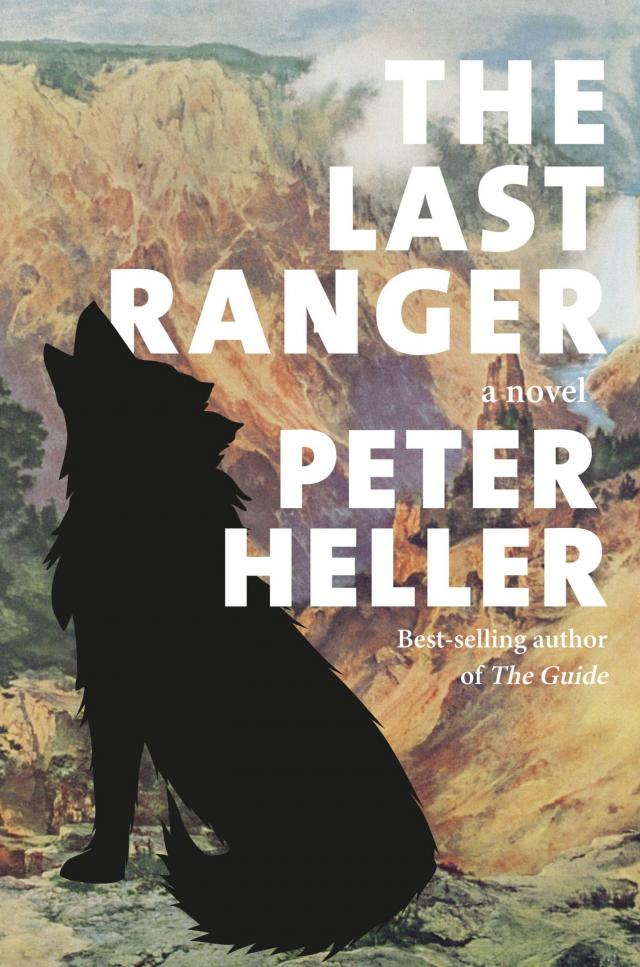
Cover images: Yellowstone Park, after Thomas Moran. DaTo Images/Bridgeman; (wolf) artshock/Shutterstock
Cover design by Kelly Blair
ep_prh_6.1_144303411_c0_r0
Contents
Cover
Also by Peter Heller
Title Page
Copyright
Dedication
Prologue
Chapter One
Chapter Two
Chapter Three
Chapter Four
Chapter Five
Chapter Six
Chapter Seven
Chapter Eight
Chapter Nine
Chapter Ten
Chapter Eleven
Chapter Twelve
Chapter Thirteen
Chapter Fourteen
Chapter Fifteen
Chapter Sixteen
Chapter Seventeen
Chapter Eighteen
Acknowledgments
A Note About the Author
_144303411_
To Becky Arnold. And to her sons, Landis and Thor.
And to her husband, Andy, in memoriam.
Prologue
The night of the buffalo it rained. Hard, flooding the creek for hours as if trying to wash away the stain. He let them in—at first he thought the knocking was the limb of the pine at the corner of the cabin; too bad it wasn’t. The two were panicked, cold, she was hyperventilating. They talked over each other. He smelled of probably bourbon. He let them lie about the accident for ten minutes while he gave them blankets and made them coffee. He built up the fire in the stove, and then he shrugged into his slicker and pushed out into the downpour and took care of it. Poor guy. The bull had been smashed at speed in the left hindquarter, and the force had spun him into the side of the van and crushed the left side of his face but not enough to kill him or knock him out. The cruelty of the thing. The bison was on his right side in the gravel of the shoulder, breathing in rapid strained snorts, and Ren put a hand on his neck and said, “I’m sorry, bud. I’m so sorry. Better them than you,” and he meant it. The animal’s eye was intact and in the headlights it shone black and wet, wide with desperation maybe, or simply pain. Ren unholstered his SIG .45 and gave the animal a coup de grâce. The bull heaved and scrabbled his front legs and lay still.
The van was crushed along the right side and askew on the shoulder, just into the lane. In the lights of his truck he could see skid marks to the west of the bull, and the broken glass of the mirror, making it clear that the van had been traveling east. But where he found the van was again well west of the wreck and aimed west—away from help, from the nearest town by far, from the ranger station just up the road, which the couple clearly knew about because they had walked straight there in the rain. Ren swore. They had left the poor bull alive and suffering and tried to drive away, but the van had not cooperated.
Ren ducked his head into the driving rain and glare of headlights and hustled back to the truck. Had the carcass been farther from people and the road, he would have left it for the wolves and bears and ravens. Instead, he radioed his friend Pete in Cooke City and told him he was point-nine miles south of the station at the fishermen’s pullout and asked him if he needed help and Pete said, “No, take off. Aliya and I got this. Thanks, Ren.” Aliya was Pete’s sixteen-year-old daughter, and together they would skin the huge carcass and quarter it with a cordless meat saw and debone the quarters with knives by hand and load two hundred pounds of meat into plastic tubs in the back of the truck. They would do it all in the sheeting rain, under the floodlights mounted to the rear of the ladder rack, and in three hours they would be heading home.
Ren drove back in a blowing squall. The manic wipers couldn’t keep up with the downpour and he had to drive slowly, and as the truck crawled his anger welled. It was the second unwarranted kill that day. In the afternoon, his neighbor, Hilly, had reported that she had found the fresh carcass of an uncollared female wolf from the Junction Butte Pack. She had been shot in the head and skinned yards from the bank of Soda Butte Creek, just inside the park. The slaying bore all the signs of a trained sharpshooter using a rifle with probably a noise suppressor.
Inside the park. It was brazen poaching and it was a Fuck You to anyone who cared about the wolves.
When Ren returned to the cabin, it was overheated and smelled a little of the alcohol and something else unwanted, something rancid or unwholesome. The man—Dave was his name, wasn’t it?—knew enough to open the damper on the woodstove to make the cabin warmer, and the fire rushed in the flue, and the base of the stovepipe was cherry red. Way too hot: they could have burned the place down. A serious fire might have been seconds away. Ren stepped fast across the rag rug, pushed past their knees in the rocking chairs, and shut the vents down.
He hadn’t been going to do it before, but now he did. He said, “How fast did you say you were going?” She started to speak, but the man spoke over her.
“Forty. Less. Thirty-eight.”
“How do you know?”
“I could see the speedometer, I was dri—”
She had said she was the driver when they first told the story in a rush at the door.
Ren took the pad from his breast pocket and wrote it down. “Stand up,” he said.
“What?”
“Stand up, please.”
The man handed his mug to his wife and reluctantly stood. “Walk to me, please.” Ren had backed to the front door. He didn’t need a painted highway line. Panic blurred the man’s face, then a reddening of anger. He stepped, put one hand out as if on a high wire.
Ren tugged the compact breathalyzer from his belt, handed it to the man. “Blow,” he said.
“Whoa, look—”
“Blow,” Ren said.
After Ren read .12 on the screen, he put his hands on the man’s shoulders and spun him around and cuffed him. The woman was in the rocker, crying. It was too late to drive the three hours to Cody. He called Ty from the handset charging on the counter and said he was bringing someone in. He could be there in forty minutes. Ty was the Park County Sheriff’s deputy stationed part-time in Cooke City, twenty miles to the northeast. A ranger from Yellowstone headquarters would transport the man in the morning. The man’s wife was sobbing openly now, and he let her use the landline to book a room at the Super 8 that was right across the street from the two-room jail.
Chapter One
It was the anger in him that scared him. The more time he spent in Yellowstone, the more he wished that people would just go away, leave the bears, the herds of elk, the foxes, the hawks alone. The wolf packs. Yesterday morning he had issued a summons to a man and his nine-year-old son for walking across the shallow Lamar River to within sixty yards of where the Junction Butte Pack were trying to feed their pups.
The river ran through open meadows here, mostly wheatgrass and sage, and on the far side they were hedged by woods that climbed steeply. The four hunting wolves had loped in from a fresh kill down-valley, and the rest of the pack had run to meet them. Nineteen, twenty, strung out in the tall grass—the image frozen like a photograph in Ren’s mind, a portrait of how the world ought to be—the wolves lean from summer, grays and blacks and buffs, one big male nearly white, sprinting flat out in what looked to be a joyous line beneath a wall of trees. They didn’t have to run. But it was daybreak on a brisk mid-September morning, and the pack was all together, and there was meat. The sun had just cleared the pass, and it burnished the grass and threw the shadows of the runners ahead of them. If he himself could feel joy, it was now. And then, through the binocs, he saw the two figures. Man and boy already over the far bank, through the willows, stalking for a better look. Already too close.
Integrity, Honor, Service. He would run. Splash knee-deep across the river, and in forty more yards he would hail them. Yell. The pack, which had known the two were coming since well before they crossed the river—and decided to ignore them—had tumbled together in an exuberant moil, yelping, wrestling, but now, at the shout, they would freeze and stand and look. The father and son would turn, confused. Ren would wave them back, retrieve them, as he was trained to do. Back at the road he would give a stern lecture about harassing wildlife and the safety of the boy and the wolves themselves, and write the man a summons that would result in a five-hundred-dollar fine. He would tell them that the wolves would have tolerated their proximity only so long and so close, and maybe within seconds the entire pack would have raised the alarm and moved into the trees, and that every calorie they spent retreating from the boy and the man was another calorie closer to starvation. Which was true.
But it was not what Ren wanted. What did he want? In a parallel life, the wolves would stand all together and turn and decide enough was enough. They would fan out in an arc, eyes steady and fast on their prey, and they would flank the father and son. And one of the fast females would feint a charge, and one of the big males would dart in behind and hamstring the man, and in minutes it would be over.
Wolves had never once attacked a human in Yellowstone. In Ren’s fantasy they would spare the boy. And when Ren had shaken himself from his reverie, he thought, Jesus, what the hell has gotten into you? Do you think you’re the last ranger that puts the animals first?
But that was the anger that frightened him. In his world lately, the life of a wolf, or a hawk, might be worth more than the life of a man.
Now, with the rain gusting against the roof of the cabin, he left the door to the porch wide open for a minute and filled the kettle in the steel sink and set it on the woodstove. He’d make tea. It was late, and he was amped from the night, more from what he’d seen in the buffalo’s eye than anything else. The animal was one of those huge, scarred old bulls who had lived a life of hardship and battle and now browsed alone, and dozed in the open, sometimes skylined on a grassy spur because he feared nothing now, not wolf packs nor storm. As Ren squatted over him in the rain, he had thought he saw, beneath the confusion and fear and raw pain, a sadness: after wolves, lions, drought, snowdrifts so deep the calves drowned in them…had it come to this? Or maybe the depthless black eye was only a mirror for Ren’s own bafflement and grief. In any event, he needed to open the cabin door wide and let the gusts smatter the screen door and fill the room with the cold of the autumn night. On the wind he could smell the faint sweetness of aspen turning and the unmistakable scent of snow, which must now be falling on the highest ridges. It was already past midnight. He wouldn’t sleep much.
He picked a smaller stick of firewood out of the box and knocked the chrome handle of the woodstove and let the door swing open. He stuffed in two more chunks of aspen—not the best firewood, it burned hot and wouldn’t bank all night, but there was plenty of it standing dead on the pass above Cooke City, and it was easy to cut a truckload. Part of the deal for him to stay at the research station: he’d supply his own firewood. He didn’t mind. He liked it. To get out of the park and onto a highway whose speed limit wasn’t forty. Where nobody was gawking. Where the pickups going too fast were the parents fetching their kids from the bus stop down in Ranford, and where sometimes a passing teenager flashed him the finger, because Ren’s truck had a green stripe and “U.S. Park Ranger” on the side, and all things park were bogus because they wouldn’t let the boy or his father kill the wolves in there, or the trophy elk that wandered the clearings so close to the road you could slay them with a shovel. He didn’t mind. Life in Cooke City was hardscrabble. In the summer the tourists came in tidal floods, a local could work sixteen hours a day for thirty days straight, and in winter moms took their schoolchildren over the pass on snowmobiles in the dark. And so, having this enforced Eden right next door, enjoyed by mostly privileged folks from away who were on vacation, and where idyllic herds roamed and the lion practically lay down with the lamb—it galled. More than a few people along the park’s borders would abolish Yellowstone in a heartbeat. Ren got it. He didn’t mind. He usually met the flipped birds with a smile. He liked to leave the park, and then he loved to drive back in. There was wildness going in either direction.
But once in a while a resident in Cooke City did kill. There was today’s wolf. And now Mink Man was back. In the same wooded canyon, and in another creek one drainage over, never far from the park boundary, seven leg traps had been discovered in the last few weeks. Each trap had had a red ribbon tied to the chain ring. It had baffled Ren and the other rangers. A taunt or a brag, who knew. A fisherman had reported the first, and after that Ren had made a point of fishing that stretch and scouting, and he had found the rest. In the silt of the creek at water’s edge he had photographed a single boot print. Ren laid his Pilot pen next to the track before he took the picture. The foot was large—size fourteen, it turned out. How many trappers out of the handful in Cooke City had feet that big?
There had been other disturbing incursions. Outside of Mammoth, along Lava Creek, an enforcement ranger named Jim Lefevre had his tires slashed. Farther upstream, in plain view of the road, a nesting osprey had been blasted with a shotgun. A growing sense of organized harassment had begun to percolate slowly up the park’s chain of command; but the chain of command did not at all like making a decision, especially one that carried a smidgen of political risk. And so the rangers’ reports were tucked into a Review in Six Months file and ignored.
And then the note. A week ago, he had been fishing up Slough Creek, and he’d come back to his truck, and tucked under the wiper blade was a cash receipt from the general store in Cooke City. Someone that morning had bought ten dry flies for twenty-five dollars cash. It was folded in half, and Ren opened it, and on the back was scrawled in scratchy ballpoint a stick figure hanging from the inverted L of a gallows and in capital letters below it, each letter underlined, his name: H-O-P-P-E-R.?
Question mark after the period. A barb like an uncrimped hook. Ren on reflex took a step closer to the side of his truck, the protection of it. He looked down the line of seven pickups and SUVs still parked at the edge of the gravel road. Backpackers and fishermen, mostly. He glanced at the trail climbing steeply into the aspen. No one.
Tonight Ren wouldn’t sleep much. He knew. The kettle would boil and whistle and he’d steep a chamomile and sit in the chair where the woman had listened to her husband lie. He’d let the buffeting wind from the open door chill his back, and then he’d get up and step onto the porch and let it truly freeze him. Until chest and hands were numb and he began to shake. And then he’d sing—“River in the Rain” or “Guantanamera”—just so he could listen to the hard quaver and chatter, and finally something clean and good would rise in his torso and warm it. “Stop whining,” he would think. “This is fun.” Not whining. “Well, you’re something. This is the best place and one of the jobs you always wanted.” He’d end the song with a loud “Brrrrrr” and body shake, then step inside and close the door and stretch out on the bunk in back and drift.
It was true. It was one of the jobs he’d always wanted. But then he’d been one of those kids who had wished he had a dozen lives to try out. Game warden had been one aspiration—among more conventional careers like cowboy, salvage diver, and founder of a new country—but when he landed the job with the NPS and was assigned to Yellowstone his fifth year, he had felt like he’d come home.