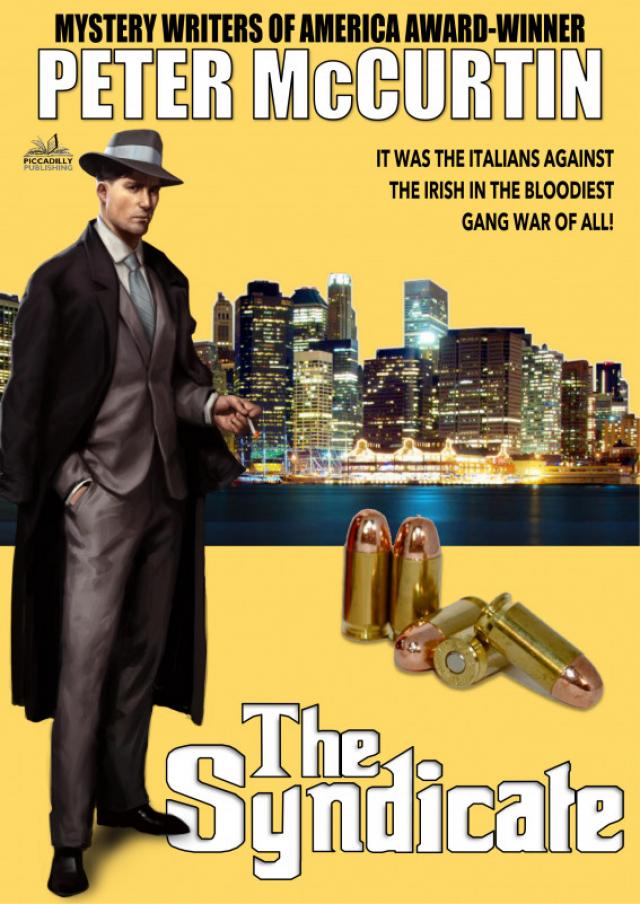
The syndicate the mafia.., p.1
The Syndicate (The Mafia Chronicles), page 1


The Home of Great
Crime Fiction!
Mafia hit man James Broderick had to break into a fiercely defended old Irish castle to kill C. Alex Ritter, a neo-fascist who made Hitler look like a choir boy. First Broderick had to get rid of Ritter’s stooges, then a beautiful redhead who almost made him forget his mission. The Mob figured Ritter was set to ruin its organization and that Broderick was the only man big enough and tough enough to kill him before he could.
THE MAFIA CHRONICLES 3: THE SYNDICATE
By Peter McCurtin
First published by Belmont Books in 1972
Copyright © 1972, 2023 by Peter McCurtin
First electronic edition: July 2023
Names, characters and incidents in this book are fictional, and any resemblance to actual events, locales, organizations, or persons living or dead is purely coincidental.
All rights reserved. No part of this book may be reproduced or transmitted in any form or by any means, electronic or mechanical, including photocopying, recording or by any information or storage and retrieval system, without the written permission of the author, except where permitted by law.
This is a Piccadilly Publishing Book
Series Editor: David Whitehead
Text © Piccadilly Publishing
Published by Arrangement with the Author Estate.
Visit Piccadilly Publishing
Chapter One
THE HELICOPTER LANDED on the roof of the boathouse and took off again as soon as I jumped down and got clear of the rotors. Climbing fast, the chopper turned and swooped back toward the low outline of the Georgia coast ten miles away through the morning haze. A cabin cruiser big as a torpedo boat bobbed at the dock, and a man in Marine fatigues looked up once, then went back to polishing the brass work.
I went to the edge of the roof, down iron stairs, and stood in front of a door without knocking. An eye showed at the peephole and looked me over without hurry. When the eye had had enough of me, a buzzer sounded and I went in.
There was no one in the small bare room on the other side of the door. Another door with a peephole faced the first door, and without waiting to be told, I stripped and held up each article of clothing for the eye behind the peephole. Then I turned out the pockets and held up wallet, keys. After that I turned slowly to show there was nothing taped to my back.
“Okay,” a voice said.
I got dressed. When I went in a short heavy shouldered guard was reaching for the button panel that closed the door. A bank of closed-circuit television screens flickered silently. There were two other guards, one with binoculars at a table facing the wrap-around window, the other behind a metal desk with a telephone in his hand. The man with the binoculars had a telescopic-sighted rifle beside him on the table. He didn’t turn to look, didn’t speak. They all wore clean, pressed Marine fatigues and P-38s and moved with the quiet efficiency of crack troops.
The guard at the desk put down the phone and said, “Let’s go.”
A Land Rover was parked outside, and about a thousand yards from the boathouse we stopped in front of a high gate in a chain-link fence. Two guards looked out through the plated window of a one-room cement block building; only one man came out.
At the next gate, the next fence, the routine was the same. One man came out and didn’t pass us through until he checked my face in a book of photographs. The other guard, when he got the nod, telephoned ahead.
The house was in the center of the island, at the highest point. It was long and low, and the walls looked as thick as they were. Outside it was pale pink stucco; beech and black walnut grew in close. Bright green lawns, barbered but not fussy, ran down the slope from all sides of the house; and the morning sun, now breaking through the haze, sent rainbow colors shimmering through the water hissing from the sprinkler system.
The door was heavy oak, no peephole, and it didn’t open until the Land Rover went away. The man who opened it wore a black suit, a white shirt, a black tie. No gun showed or bulged. He looked like a butler who could kill with his hands. He knew who I was, but the only greeting was a nod. “Go in. He’s waiting,” he said.
I knocked on the library door and opened it. After the glare outside seeing was hard; harder because the heavy curtains were drawn and the only light in the huge room came from a green-shaded reading lamp on the polished refectory table in front of the fireplace. Crackling logs contrasted oddly with the almost silent hum of the central air conditioning. Books in leather-bound sets went from floor to ceiling, and there were paintings where there were no books. The carpet was rich and dark, and so was everything else.
The old man, small in the high-backed chair, got up when he saw me and came across the room to grip my shoulders with both hands. They were frail, ugly hands with not much strength left. “Good to see you, Filipo,” he said. “A drink, coffee, anything?”
I said thanks but no. “You look all right, Don Edouardo.”
His smile said I was a respectful liar. “I’m alive. One day at a time, the way I take it now.” Back behind the table, he pushed buttons, making two clusters of wall lights in frosted globes burn dimly. He looked older, more tired than the last time I had seen him, three months before.
“You know what day this is?” he asked.
“Tuesday.” That’s what I said, but I knew.
“No good bastard,” he said mildly, shaking his head. A few strands of gray were plastered across the top of his hard freckled skull. “Your father died twenty-six years ago today. June second, 1946. My poor dopey brother. You saying you don’t remember?”
“I remember,” I said. I remembered all right. Filipo Maggiora, my father, the nervous half-bright ambitious Italian kid from the lowest part of Lower Manhattan, who worked himself up from nothing, to discover that he was still nothing when he got there. He was proud and ashamed of being Italian, so when he changed his name on his way to becoming a big Wall Street lawyer, it came out as Philip Magellan, a compromise. Filipo was Philip, and Magellan, the explorer’s name, was close enough and still Italian but without the dago sound. Except that he never got to be a big Wall Street lawyer, not even a little one. Days he worked as a process server for a nest of shysters; nights as a page at the Bar Association library on West 44th Street. At home there wasn’t much to eat; my mother died in 1937, when I was four.
“Maybe he could have made it if he had a chance,” Don Edouardo pondered. “I don’t know—maybe.”
“Not a chance,” I said, and there wasn’t. This Philip Magellan, this would-be White Protestant Italian Wall Street lawyer, didn’t pass the bar exams, the third try, until he was thirty-three. And when he was able finally to put “attorney at law” on his cut-rate business cards, Sullivan & Cromwell didn’t break down his door. They didn’t come at all, and they didn’t make him a partner at forty, his dream. At thirty-nine he was defending bad-risk burglars and candy store heisters out of a twenty-five dollar office at 1133 Broadway. At forty he was dead, tortured half to death by mobsters trying to set up an ambush for his gangster brother Eddie, then shot in the back of the head when he wouldn’t make the necessary phone call.
“I was dirt to him, but he wouldn’t set me up,” Don Edouardo said, picking up a folder. He held it unopened, thinking about his dead brother. “A proud poor bastard.”
I was thirteen at the time. Eddie Maggiora, now Don Edouardo, took care of the guys who did the killing. We never discussed it, then or later, and he had a hundred button men who could have handled it, but I knew that he had done the job personally. The photographs of the dead killers were too gruesome for even the Daily News.
“You ought to show more respect, your dead father,” Don Edouardo said, putting on glasses and opening the folder. I knew I was there because of what was in that folder.
Edouardo took care of me, too. In the beginning, when some real Wall Street lawyer, an elderly fixer named Madison O’Neal, shipped me off to a New England prep school with a yarn about a trust fund from a long lost and now deceased great uncle, an olive oil importer in Argentina, I didn’t think about it at all. I didn’t begin to wonder until five years later when O’Neal was dead and his son, not so young himself, was prodding me about college. I could have any school I wanted, Madison O’Neal, Jr., said. Harvard: no sweat. Princeton: a breeze. Yale: just ask. After college, Harvard Law, naturally. The guardian lawyer said something about following in my father’s footsteps, as he had followed in his father’s. I thought his smile was a bit forced.
Don Edouardo looked up from his reading. “Today I keep thinking about it. You could have been everything your father wasn’t.” It was a thought, not a reproach, and he turned a page and read on.
At eighteen I was a snotty preppy with a Jaguar and a checking account with an overdraft provision. If I no longer spoke like a kid from Broome Street, there was still some of the New York brashness left. College was the worst pain in the ass I could think of, but O’Neal controlled the money and more or less controlled me until I was twenty-one. So I did two years at Harvard, then switched to West Point with the help of a friendly senator, Franklin “Bo” Simonetti of Louisiana. Later, as a captain with the Special Forces in Vietnam, I got sick of killing little brown brothers in black pajamas. I was out of the Army and in New York, undergoing therapy for a bullet-stiffened left arm, when I read about Bo Simonetti in a Life expose. Don Edouardo’s name was mentioned.
He was still living at Sands Point, Long Island; harder to s ee than Howard Hughes; when I did see him he denied everything. What was I—crazy? Would he lift his little finger—he showed me the finger—to help his dopey brother’s Goddamn kid? They never were friends, he was no friend of mine, so get the fuck away from him. Crap like that. I put it together for him. Okay, all right, so he was a sentimental jerk. I had mine—education, money, no connection with wop gangsters. There was tired old bitterness when he said the last part. So what the hell did I want?
He blew up when I said I wanted to earn my keep. For an answer he gave me my father spinning in his grave, time and money down the Goddamn drain. The answer was no, absolutely not. But I knew he was pleased.
“We’ll talk in a minute,” Don Edouardo said.
Now it was eleven years later and Don Edouardo, a very old seventy-one, was in semi-retirement, but he still held all the power in his ugly invalid’s hands. He had survived everything, the best shots the Government could throw at him, the periodic assaults from inside and outside the Organization. Only sickness and old age were a threat; he had become a hypochondriac with real illnesses. For years he hadn’t left the island, and Fortune magazine, in an unusual article, ventured the opinion that he was the third richest man in the world and certainly one of the four most powerful.
“Okay, here it is,” Don Edouardo said abruptly, pushing the folder away. “You ever hear of a guy calls himself C. Alex Ritter?”
“Industrialist, newspaper publisher, horse breeder, big in right wing politics,” I said. “Born in Italy, now lives in Ireland.”
That was about all I knew, but Don Edouardo was pleased. “Very good,” he said. “I want him hit.”
“Okay,” I said.
“‘Okay,’ he says,” Don Edouardo said to one of the paintings, a sixteenth century princeling with shifty eyes and a hat like a stack of soggy pizzas. “Just like that he says, ‘Okay.’”
“You mean this is a hard one?” I knew it must be or he wouldn’t have sent for me.
“In a minute,” Don Edouardo said. He pushed a button and a guy with horn-rims and a head of gray curls came in through a side door. It was June in Georgia and the tweed suit he was wearing would have kept him warm in Lapland in any season. But there was nothing funny about him. Behind the thick lenses his eyes were cold as black olives in ice.
“Say hello to Tommaso Giacinto from Palermo,” Don Edouardo said. No further explanation was given, and maybe he was from Palermo and maybe his name was Tom Giacinto. Nobody is close to Don Edouardo, not even me, and there are many things I don’t know. C. Alex Ritter had been mentioned, so I guessed Giacinto was the man to see about industrialist right wingers.
He was. First there was a handshake, great economy of effort. His English was precise, abrupt, without color. I don’t mean that he spoke clipped educated-foreigner’s English. He spoke English like a man from Mars; no feeling at all. I knew his Italian would sound the same way, and that’s hard with Italian.
Don Edouardo offered to give him the folder, but he didn’t need it.
“He knows something about the man,” Don Edouardo said. He meant me, not this captive professor. The professor knew everything.
“His real name is Carlo Alessandro Ritter,” Giacinto began. “Born northern Italy, Italian and Austrian, son of Carlo Girolamo Ritter, factory owner and newspaper publisher, early backer of Mussolini, last Minister of Public Information—that’s Propaganda—in the Mussolini government, captured and executed by the same group of Communist partisans that executed Mussolini at Dongo.”
“He was traveling to meet Mussolini, to go north with him.” Don Edouardo added. “They grabbed him the day after.”
“His son was nineteen then,” Giacinto said, “and because he spoke German and Italian, was serving as a translator with an anti-insurgent SS detachment. Before that he was a philosophy student at the University of Milan. Perhaps a coincidence, the Germans he was with found the body of his father hanging from a bridge.”
“I remember now,” I said. “I mean, I read about it.”
“Quite so,” Giacinto said, doubtful of my scholarship. “All the Ritter holdings were confiscated after the war. Ritter, young Ritter, sued and eventually regained everything. By 1950 he was a force in the neo-fascist movement. In 1952 he was imprisoned for six months for activities detrimental to the good of the state. His principal newspaper, Il Martello, named after Mussolini’s old paper, was suppressed. At that point Ritter moved to Spain, later to Ireland, where he became a naturalized citizen while retaining his Italian citizenship. Dual citizenship is common in Europe. Ritter is the author of A New Beginning. A critic on the Times Literary Supplement has called it a rational Mein Kampf. Ritter is widely respected in Ireland because—”
Don Edouardo cut in, “The point is, Ritter has more money than Ireland ever saw. The bastard is a fascist and he wants to bring fascism back. What are you shaking your head for? Yeah, I know a lot of guys want to bring it back. But they’re nuts and this guy isn’t. This guy can do it and that’s bad for everybody. Italy’s going that way now, so is this country, so are a bundle of countries. Crime in the streets, these fucking bombers, rotten dirty sex movies, kids pissing on the flag. Am I right or wrong, Tommaso?”
The man from Palermo said: “History follows a pattern: permissiveness followed by repression, the suspension of constitutional safeguards, impatience with due process. Mussolini almost destroyed the ... the Organization in that way.”
“He didn’t almost, he did it,” Don Edouardo said.
“True,” Giacinto agreed. “To be suspect was to be shot. Shot or exiled to the Lipari Islands. The effect was the same. Now there is a greater threat to—”
Don Edouardo was tired of the foreigner’s screwing around. “You’re an educated man, but you don’t talk straight English. Say what you got to say, for God’s sake. This guy Ritter is the worst thing come along since... I can’t think since what.”
He slapped the folder, a sign for me to take it. “I say hit the son of a bitch and you say okay. Maybe that’s right. Okay, then hit him—do it.”
Chapter Two
I WAS READING through the rest of the folder when the Irish Airlines jet took off from Kennedy. Many of the Irish pilots get their start in the RAF; this guy had that sound, a mixture of blarney and pip-pip. He said something cheerful about being sixth for takeoff; if so, we were sloppy sixth because I had read to the end of the folder before we climbed up over Jamaica Bay with the whining roar of a runaway elevator.
By then I knew that C. Alex Ritter was richer than Texas, lived in a castle, was hardly ever seen except by his father’s old friend, Sir Anthony Jameson, no lover of Democracy or the democracies; and certain hard-to-crack social circles in Dublin and London. The castle was in the mountains of County Leitrim and it had a real moat. The folder spoke of guards, guns, dogs, not one but several alarm systems, and I didn’t question that description for a minute.
On the Irish Airlines the bar is open before the kitchen, and passengers—none of them Greek—have been known to dance in the aisles. A stewardess with red hair and a nice voice brought a scotch and water. I said I could do without the pillow.
C. Alex Ritter used a helicopter for short hops between his Irish factories, a Lear jet for overseas travel. Giacinto’s information was that he traveled a lot—Rome, London, Paris, Madrid, New York, Buenos Aires. Knighted by the Pope as an outstanding Catholic layman in 1959, Ritter looked for support to the threatened middle class in all countries. The whole tone of his operation was subdued. He saw the return of fascism as inevitable, and since it was inevitable, he wanted to hurry it up. He was the secret money behind some of the crazier New Left sheets in New York, Amsterdam, Copenhagen.
I asked the stewardess if they had the Dublin papers on board. They had, and Ritter’s morning tabloid, The Irish Sketch, was in the stack. I skipped Agnew’s speech to the Golden Age Club of Ogden, Utah, (SDS: SINISTER DEGENERATE SUBVERSIVES, SAYS VICE PRESIDENT) and the latest atrocities from Belfast, and went to a big story about a heroic policeman who died saving an old woman from a fire. There was a small picture of the dead cop, a big picture of his widow and kiddies smiling through their grief as the editor of the Sketch laid a check on them. That gave the editorial writer a hook for a quietly impassioned piece on the virtues of “our everyday supermen.” He urged citizens not merely to support their local police but to love them.