

Boys like us, p.1
Boys Like Us, page 1


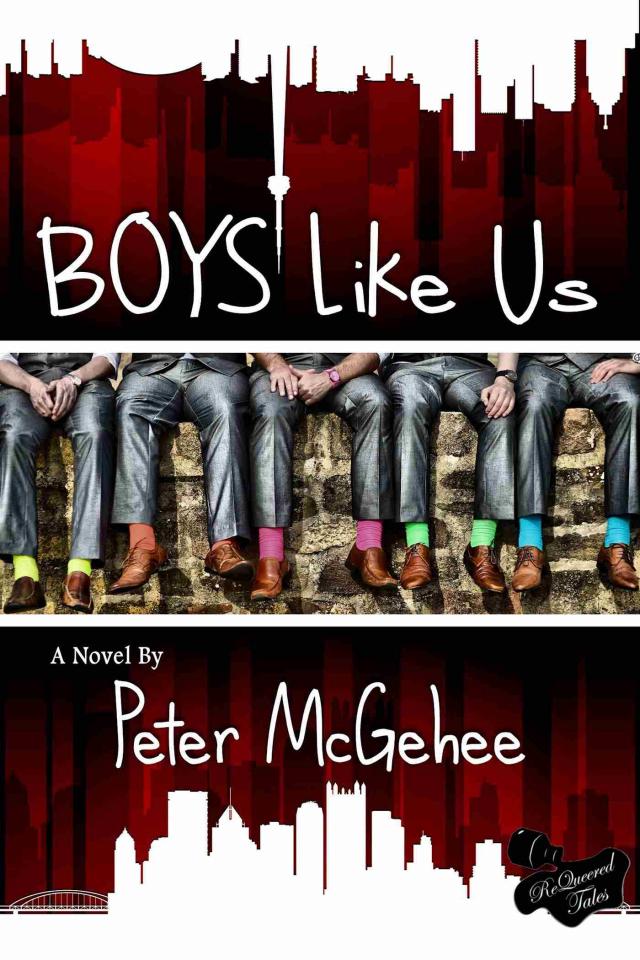
BOYS LIKE US
by Peter McGehee
Foreword by Dr Raymond-Jean Frontain
Introduction by Fiji Robinson
ReQueered Tales
Los Angeles • Toronto
2022
Boys Like Us
Boys Like Us Trilogy, Book 1
by Peter McGehee
Copyright © 1991 by Peter McGehee.
Foreword: copyright © 2022 by Dr Raymond-Jean Frontain.
Introduction: copyright © 2022 by Fiji Robinson.
Cover design: Dawné Dominique, DusktilDawn Designs
First American edition: 1991
This edition: ReQueered Tales, September 2022
ReQueered Tales version 1.31
Kindle edition ASIN: B0BFB64WQ7
Epub edition ISBN-13: 978-1-951092-71-9
Print edition ISBN-13: 978-1-951092-72-6
For more information about current and future releases, please contact us:
E-mail: requeeredtales@gmail.com
Facebook (Like us!): www.facebook.com/ReQueeredTales/
Twitter: @ReQueered
Instagram: www.instagram.com/requeered/
Web: www.ReQueeredTales.com
Blog: www.ReQueeredTales.com/blog
Mailing list (Subscribe for latest news): https://bit.ly/RQTJoin
ReQueered Tales is a California General Partnership.
All rights reserved. © 2022 ReQueered Tales unless otherwise noted.
By PETER MCGEHEE
Beyond Happiness (1985)
Boys Like Us (1991)
The I.Q. Zoo (1991)
Sweetheart (1992)
By DOUG WILSON
Labour of Love (1993)
PETER MCGEHEE
Peter McGehee (1955-1991) was born in Pine Bluff, Arkansas and grew up in Little Rock. He studied at Southern Methodist University in Dallas before moving to San Francisco to work in theatre. While living in San Francisco, he wrote his first play and first comedic musical revue The Quinlan Sisters, and later met Canadian activist Doug Wilson, who became his life-partner.
He moved to Saskatoon, Canada, in 1980 to be with Wilson, and subsequently the couple moved to Toronto in 1982. Facing potential deportation because of his citizenship status, McGehee briefly moved to New York in 1984, returning to Toronto by 1986. He published his first novella, Beyond Happiness, in 1985, and premiered his second revue, The Fabulous Sirs, in 1987. In 1988, McGehee and Wilson were both diagnosed HIV-positive.
McGehee also wrote two novels, Boys Like Us and Sweetheart, and a book of short stories, The I.Q. Zoo. Boys Like Us was published in 1991, shortly before McGehee’s death of AIDS-related causes; Sweetheart and The I.Q. Zoo were published posthumously. The novels focused on the life of Zero MacNoo, a character who much like McGehee himself was an American living in Toronto, and his family and circle of friends. Inspired by brief notes that McGehee had written in preparation for his third novel, Wilson subsequently wrote Labour of Love before his own death in 1992.
Critical Praise for Boys Like Us Trilogy
“An utterly delightful book. I enjoyed every word of it!”
— Quentin Crisp
“A genuinely delightful gay domestic comedy so full of tangy dialogue and wacky situations that it screams for the stage or, better yet, the screen.”
— Booklist
“… a gem of a novel. Boys Like Us is funny, sexy, tender, and touching – often in the same sentence.”
— Larry Duplechan
“As it celebrates the strength and staying power of gay friendships, Peter McGehee’s Boys Like Us goes out of its way to show you a good time – and you won’t hate yourself in the morning.”
— New York Native
“Boys Like Us is an affable, enjoyable story … McGehee has the ability, through an ingratiating style and witty observations, to transform Zero’s everyday life into something we care about.”
— Michael Bronski
“Accomplishes what may seem impossible: a humorous romp in the face of widespread death.”
— Library Journal
“Peter McGehee has a deceptively light touch. Boys Like Us pulls us into a world we recognize instantly and travel through effortlessly. The surprise is how well McGehee uses the ordinary details of our daily lives to evoke the demons we all struggle with: sex and love, friendship and family, life and death.”
— Helen Eisenbach
“Labour of Love is more a testimony to living bravely than a cry of despair. Wilson uncannily matches much of McGehee’s light-hearted, but not shallow, tone and temperament.”
— Stan Persky
BOYS LIKE US
by Peter McGehee
The Camaraderie of the Front Lines
“I lose people. Friends, family, lovers. Sometimes they come back; sometimes not,” Zero MacNoo reflects in the opening lines of Boys Like Us, sounding one of the most haunting notes heard in gay letters at the height of the AIDS pandemic. And in that bittersweet qualification (“sometimes … sometimes not”), author Peter McGehee gives witness to the ambivalent hope that characterizes the two novels that he lived to complete of a planned trilogy that valiantly hold out the possibility of renewal even in the face of the most excruciating loss.
It is difficult to imagine what kind of writer McGehee would have been had he not been caught in the maelstrom of AIDS. His earlier works, while promising, did not yet reach the heights of comic madness nor pathos of his later work. Beyond Happiness: The Intimate Memoirs of Billy Lee Belle (1985) is a series of vignettes about growing up in the homophobic, hypocritical, religious fundamentalist wilds of McGehee’s native Arkansas that he performed as a one-man show in gay venues across Canada and in New York City. Even while anticipating some of the comic outrageousness of the Zero MacNoo novels, Beyond Happiness was eclipsed by the horde of other coming-out stories written in the wake of Stonewall. Conversely, the short stories collected in The I. Q. Zoo (1991) – nearly all of which had first been published in magazines and anthologies in the 1980s – treat the pain of adolescence, or of a gay adult living in a homophobic environment, but generally lack the emotional depth and singularity of voice he found in later work that allowed him to transcend melodrama.
Only in Boys Like Us (1991) and Sweetheart (1992) did McGehee find an authentic voice and a significant purpose. In their mix of heartbreaking pathos and wry comedy the novels allow the reader to confront the tragedy of so many lives lost to AIDS without being overwhelmed by that loss; they encourage the reader to find a way to cherish life and to go on loving (to “fight back with nothing but affection,” in Zero’s words). Much of the novels’ effect is accomplished through the shrewd maneuver of juxtaposing Zero and his family of friends in Toronto who share “the camaraderie of the front lines” in the battle against AIDS, with his narrow-minded, self-indulgent birth family in Little Rock, Arkansas. McGehee’s extraordinary success in balancing between pathos and comedy is highlighted by the radical change in tone and narrative pace that occurs after Peter’s lover, the gay political activist Doug Wilson, worked from Peter’s notes to complete the trilogy in Labour of Love (1993) following Peter’s death. In the final novel, Zero and his Toronto comrades risk sinking into mordant self-pity, while Zero’s family in Arkansas is denied any redemptive qualities whatsoever. As David (who succeeds Zero as narrator in Labour) observes, “In my view, Zero was very kind to them [his family in Arkansas] in his writing. For the most part, they really are just a bunch of greedy, mean-spirited drunks, and he transformed them into crazy, interesting characters. They should be forever grateful, because without his tales they’re a dull and disagreeable lot.”
In Wilson’s defense, one may wonder how McGehee himself might have held out the hope of comic redemption in the final novel as the effects on the gay community of the AIDS pandemic became more apparent. The strain to find the strength to carry on against increasingly overwhelming odds intensifies across the three novels. In Boys, Zero and his friends go about their daily affairs and negotiate personal crises as they care for Zero’s former lover, Randy, who, as the novel opens, has recently been released from the hospital following a bout of pneumonia. By end of the first novel, Randy, an actor, is well enough to leave town to make a movie, allowing the reader to skirt the threat of AIDS and feel that the impending danger’s been averted. But as Sweetheart opens, the reader learns that not only did Randy die of AIDS complications shortly after completing his movie, but that Zero, Zero’s former lover David, and Zero’s current lover Jeff have all been diagnosed as HIV-positive. The comic goings-on in Sweetheart are undercut by anxiety about falling T-cell counts and anger at the medical establishment’s lack of knowledge about HIV and the government’s indifference to the rising gay death toll. Sweetheart climaxes as Zero attends the assisted suicide of his cousin and boyhood lover, who’d gone on to become a gay porn star, and who is in the final stages of an AIDS-related illness.
The increasingly fragile raft of humor is finally swamped by the torrent unleashed by AIDS in the concluding volume of the trilogy. As Labour of Love opens, the reader learns that Jeff is now dead and that Zero has moved back in with his former lover, David, so that they may support one another as their health continues to decline. Drawing upon the metaphor advanced in the 1991 novel Spontaneous Combustion by David Feinberg (“According to Ray Bradbury, books undergo spontaneous combustion at Fahrenheit 451. Perhaps humans do at a lower temperature, I thought, given the AIDS crisis”), characters are mysteriously no longer there, as though suddenly evaporated or dis integrated. (Jeff, for example, dies in a flash of light and billow of smoke while sitting playing the piano.) Having assumed control of the narrative after McGehee’s death, Wilson is able to memorialize the actual circumstances of McGehee’s own death from AIDS-related toxoplasmosis under the guise of narrating the death of Zero. The trilogy anticipates that David himself does not have long to live, which proved only too true: much as McGehee died shortly after submitting Sweetheart to his editor at St. Martin’s Press, Wilson did not live to see Labour of Love in print.
“I lose people. Friends, family, lovers. Sometimes they come back; sometimes not.” The Boys Like Us Trilogy constitutes a bittersweet celebration of the comrades who fought on the front lines against AIDS, in particular their ability to appreciate what has been found even in the midst of so much loss. Zero articulates the paradox in Sweetheart: “I’ve never felt more alive than I’ve felt in this last year. I don’t know if it’s age or AIDS, but something in me is just burning.” Loss permits reinvention, making for the kaleidoscopic movement of the plot. Searcy loses his drag club, but finds a career in local politics. Zero’s father disappears into the fog of bipolar disorder, yet periodically reappears when needed by his children, most crucially when he summons Stellrita to restore order following the infamous “MacNoo Family Capital Hotel Shoot-out.” Lance seems to have been forgotten when Zero must hurriedly return to Toronto after receiving word of Randy’s death, only to be rediscovered as Stellrita’s grandson and David’s new lover. Female impersonator Jesus de Las Vegas not only artfully transitions from Carol Channing to Marilyn Monroe while performing “Diamonds Are a Girl’s Best Friend” on stage, but reappears so many times in the most unexpected fashion in the course of the novels that he might be a gay Houdini, refashioning himself chameleon-like in order to survive. And although Zero’s cousin and boyhood lover seemed to disappear entirely from Zero’s life when Trebreh found his escape from Arkansas (where “nobody smart stays”), he is perpetually on the verge of reappearing, only to actually do so just before he dies. In similar fashion, in Labour, David – who’d lost Zero to another lover years earlier – reunites with him only to lose him again to AIDS.
In the face of crippling loss, one perseveres for as long as one can, supported by one’s “comrades on the front line.” Sweetheart closes with the image of Zero and Jeff dancing in the moonlight, an image that Wilson repeats in Labour of Love. Laboring under what was at the time the death threat of AIDS, such perfect moments may grow fewer and further between as the illness progresses. But in McGehee’s and Wilson’s world, one savors the dance as long as one can.
Dr Raymond-Jean Frontain
June, 2022
Raymond-Jean Frontain is an independent scholar who has published eight books and over 100 scholarly articles on the Bible as literature, gay literature, Renaissance poetry, the Indian novel, and modern drama. His most recent publication is Conversations with Terrence McNally, forthcoming from the University Press of Mississippi.
Introduction
I was Peter McGehee’s singing partner and he was my “sister with a difference.” A Southern belle who was born and raised in Arkansas, Peter, aka Marie Quinlan, was a powerhouse of creativity and a man of many voices.
His decade-plus writing career produced one novella, two volumes of the Boys Like Us trilogy, one play, a one-man show, and two wildly popular a cappella musical revues bursting with social, political, and sexual satire.
While you could say that the silliness of the National Enquirer was a constant source of inspiration, so were the bright lights of Broadway and his love of jazz.
His charming novella Beyond Happiness, the Intimate Memoirs of Billy Lee Belle, is the foundation for all things Peter McGehee. It marks the beginning of McGehee’s legacy of screwball comedy and his love of the absurd.
While he was amused by the alleged spontaneous combustion of Mary Reeser and the irony of Karen Ann Quinlan’s right-to-die controversy, he was also moved by absurdities such as the need to fight for womyn’s rights and the opulence of organized religion. All of this was influenced, of course, by human rights activist and Prairie boy Douglas Wilson, who was his muse, best friend, lover, conscience, collaborator, and editor.
It was the depth of their connection that allowed Douglas to finish the Boys Like Us trilogy with Labour of Love and do so in a way that honoured much of McGehee’s vision, his pace, his love of the ludicrous, and his search for social justice. One only needs to listen closely to hear how McGehee influenced Wilson’s voice as much as Wilson influenced McGehee’s over the years.
It was love at first sight when they met over brunch at Pete’s place in San Francisco during Gay Pride 1978. Together, they produced numerous tours of McGehee’s musical revues, The Quinlan Sisters (1982 -1984) and The Fabulous Sirs (1987-1990). They also produced Peter’s 1984 tour of his one-man show of “Beyond Happiness,” and the taping of the Sirs’ performances at the Edmonton Fringe Theatre Festival in August 1988.
It was with Doug’s great sense of love and support that Peter wrote about what beguiled him – the joys, challenges, and perils of family, whether immediate, extended, or chosen. It is at the heart of Boys Like Us and Sweetheart and what kept Peter and his alter ego Zero MacNoo both inspired and exasperated.
Their chosen family, aka the “Quinlan Family,” were friends like me that Pete and Doug gathered up along the way. Our inner circle celebrated many special events and days together, with essentials such as guacamole, rattlesnake pie, Champagne, and the gyrations of Yma Sumac!
But, of course, it was his family in Little Rock, Arkansas who provided Peter with an infinite source of inspiration for his fiction. For the comedic world of Zero MacNoo, Peter plumbed the depths of the attitudes and traditions of his own American South.
Zero’s madcap adventures remain as distinctively sassy as McGehee himself and I can’t help but feel the presence of Peter and Doug as I reread them.
There’s nothing I’d rather see than Zero’s frantic flight to Little Rock via Chicago come to life on the big screen – truly a madhouse of thanksgiving!
Fiji “Champagne” Robinson
August, 2022
Fiji Robinson has a rich background in performance, film production and communications. She first sang and toured with Peter McGehee in his a cappella trio The Quinlan Sisters, a musical revue of social, political, and sexual satire. They later reunited for McGehee’s a cappella duo The Fabulous Sirs. Fiji currently resides in Saskatoon.
For Doug
Acknowledgments
Special thanks to Doug Wilson,
Gail van Varseveld,
Norman Laurila,
Michael Denneny,
the Ontario Arts Council,
and the Saskatchewan Writers’ Colony.
ILLICIT INVALIDS
I lose people.
Friends, family, lovers.
Sometimes they come back; sometimes not.
Randy answers the door wearing an old brown raincoat. “Can’t find my goddamn bathrobe.” The walk from the bedroom has exhausted him. “Hope to hell I didn’t leave it in the hospital.” He eyes my grocery bag. “What’s for supper?”
“Fettuccine with bacon and mushrooms – rather, three kinds of mushrooms – just like you ordered.”
He plops down on the couch. “I’ve got the most horrible taste in my mouth.”
“Want a beer?” I go to the kitchen and open one for myself. “You can still drink beer, can’t you?”
“I can drink anything I want to drink,” he says, irritably flicking on the television by remote control. “But all I want’s a Perrier.”
I roll my eyes and pour him a glass.


