

In a deep blue hour, p.1
In a Deep Blue Hour, page 1
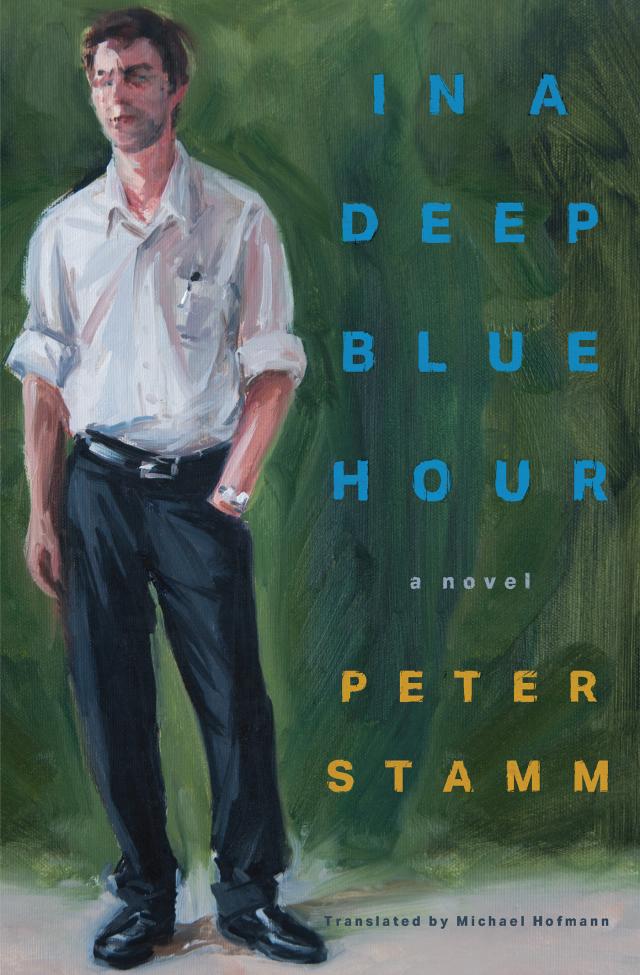


Praise for
IN A DEEP BLUE HOUR
“In his finest novel yet, Stamm grapples with the riches and risks of a life lived at the mercy of one’s art. As a character proclaims: ‘Once you’ve read a book, you’re never rid of it.’ Dear reader, In a Deep Blue Hour is a book you won’t want to be rid of, a book both birdhouse and bird, eggs in the head. A hatching, flapping achievement of the highest order.”
—David James Poissant, author of Lake Life and The Heaven of Animals
Praise for
PETER STAMM
“Stamm’s prose (beautifully translated by Michael Hofmann) is plain but not so simple…A subtle but deadly style.”
—Zadie Smith
“Peter Stamm is an extraordinary author who can make the ordinary absolutely electrifying…Hard to recommend too highly.”
—Tim Parks
“A master writer…His prose…is as sharply illuminating as a surgical light.”
—The Economist
Praise for
THE ARCHIVE OF FEELINGS
“A gorgeous novel, constructed with subtlety and nuance and the sort of prose that seems to simply disappear as you read, like footsteps on a beach…understated but profound.”
—Kirkus Reviews (starred review)
“Affecting…Stamm delivers a striking and earnest conclusion. Fans of the author will love this efficient and wistful work.”
—Publishers Weekly
“Stamm writes with the seemingly effortless precision of an artist…[His] prose is remarkable, exerting a hypnotic draw that may catch readers unaware but will surprise them with its force.”
—Shelf Awareness
“A case study on intimate feelings that develop over a lifetime.”
—Booklist
Praise for
IT’S GETTING DARK
“[Stamm’s] story collection shows the instability of a world we think we know.”
—New York Times
“Stamm, whose precise, dry prose builds suspense in its very insistence on the quotidian, creates narratives simultaneously ordinary and strange, even uncanny. Atmospherically, these stories recall Arthur Schnitzler, or even Edgar Allan Poe…haunting…beautifully translated, as are all his books, by the remarkable Michael Hofmann.”
—Harper’s
“[Stamm’s] powerfully unsettling short-story collection catalogs moments when the familiar shifts into the unknown, when we realize how flimsy our constructed realties really are.”
—Literary Hub, Most Anticipated Books of the Year
“From an author one critic called ‘one of Europe’s most exciting writers’ come a dozen reflective and somber stories about the tenuousness of reality.”
—Los Angeles Times
“[These stories] all have a latent uneasiness to them, making the reader turn the pages both quickly and apprehensively…Stamm effectively sustains a dark mood.”
—Publishers Weekly
“Stamm sketches out painfully realistic stories that slowly but surely reveal their strange, uneasy underbellies.”
—The Millions, Most Anticipated Books
“Peter Stamm doesn’t so much yank the rug out from under the reader as ease it slowly, mesmerizingly away, until we stagger and realize that the world has shifted beneath us. These tales are eerie, menacing delights.”
—Caitlin Horrocks, author of Life Among the Terranauts
“A casual, effortless voice belies the intense structural formality in these stories, which take place on the blurred edge between reality, memory, and dream. Language is wielded subtly, sharply, in masterful hands. It’s Getting Dark burns like ice.”
—Shruti Swamy, author of The Archer and A House Is a Body
Praise for
THE SWEET INDIFFERENCE OF THE WORLD
“An entrancing tale about a writer haunted by his past self…[Stamm’s] stripped-down, pared-back prose still works wonders, exploring complex issues and probing singular minds in a thoroughly compelling way.”
—Star Tribune
“Acclaimed Swiss writer Peter Stamm tells the mysterious, complex story of a time-traveling love affair that tests the boundaries of reality and raises as many questions as it answers.”
—Vogue, Best Books to Read This Winter
“Excellent…this amorphous tale folds in on itself, becoming a meditation on how memory can distort reality…Fans of Julian Barnes will love this.”
—Publishers Weekly
“Haunting…The fascinating overall effect of Indifference makes it a worthy inclusion among Stamm’s other compelling novels.”
—Literary Review
“There’s a satisfying tension between the complexity of the novel’s conceit and the simplicity of the writing…lively and well paced, fully capturing the rhythm of two people walking and speaking…it’s a novel about a writer and about people talking, which, in its distortions, takes on larger questions of storytelling and memory.”
—Los Angeles Review of Books
“The Sweet Indifference of the World explores questions of time, identity, and art in prose that is dreamy, melancholic, and beautiful.”
—Book Riot
“Adroitly translated by the award-winning Hofmann, [Stamm] explores the timeless doppelgänger phenomenon through dual couples whose fleeting interactions engender intriguing questions about singularity and agency and confirm the impossibility of absolutely sure answers.”
—Booklist
“An elegant dart of a novel as clear and mesmerizing as an M. C. Escher drawing. I felt both lost and found at once. Peter Stamm is a truly wonderful writer.”
—Catherine Lacey, Whiting Award winner, Guggenheim fellow, and author of Certain American States, The Answers, and Nobody Is Ever Missing
ALSO BY PETER STAMM
NOVELS
Agnes
Unformed Landscape
On a Day Like This
Seven Years
All Days Are Night
To the Back of Beyond
The Sweet Indifference of the World
The Archive of Feelings
STORY COLLECTIONS
In Strange Gardens and Other Stories
We’re Flying
It’s Getting Dark
Copyright © 2023 Peter Stamm
Originally published in German as In einer dunkelblauen Stunde in 2023
by S. Fischer Verlag GmbH, Frankfurt am Main
Translation copyright © 2025 Michael Hofmann We wish to express our appreciation to the Swiss Arts Council Pro Helvetia for their assistance in the preparation of this translation.
Poetry extract on this page by Gottfried Benn, from the poem “Blue Hour” in Impromptus: Selected Poems and Some Prose (tr. Michael Hofmann, FSG, 2013), used by permission.
Verse on this page by Carl Sandburg.
Production editor: Yvonne E. Cárdenas
Text designer: Patrice Sheridan
All rights reserved. No part of this publication may be reproduced or transmitted in any form or by any means, electronic or mechanical, including photocopying, recording, or by any information storage and retrieval system, without written permission from Other Press LLC, except in the case of brief quotations in reviews for inclusion in a magazine, newspaper, or broadcast. For information write to Other Press LLC, 267 Fifth Avenue, 6th Floor, New York, NY 10016.
Or visit our Web site: www.otherpress.com
The Library of Congress has cataloged the printed edition as follows:
Names: Stamm, Peter, 1963- author. | Hofmann, Michael, 1957 August 25- translator.
Title: In a deep blue hour : a novel / Peter Stamm; translated from the German by Michael Hofmann.
Other titles: In einer dunkelblauen Stunde. English
Description: New York : Other Press, 2025.
Identifiers: LCCN 2024030487 (print) | LCCN 2024030488 (ebook) | ISBN 9781635424447 (paperback) | ISBN 9781635424454 (ebook)
Subjects: LCSH: Authors, Swiss—Fiction. | Motion picture producers and directors—Fiction. | Documentary films—Fiction. | LCGFT: Novels.
Classification: LCC PT2681.T3234 I5313 2025 (print) | LCC PT2681.T3234 (ebook) | DDC 833/.92—dc23/eng/20240709
LC record available at https://lccn.loc.gov/2024030487
LC ebook record available at https://lccn.loc.gov/2024030488
PUBLISHER’S NOTE: This is a work of fiction. Names, characters, places, and incidents either are the product of the author’s imagination or are used fictitiously.
a_prh_7.1a_150523329_c0_r0
Contents
Also by Peter Stamm
Title Page
Copyright
Epigraph
Chapter I
Chapter II
Chapter III
About the Author
About the Translator
“I know not what tomorrow will bring…”
—Fernando Pessoa
I
I don’t know
how much time I have left, says Wechsler, but then who does? Sometimes I’ve felt closer to the end than I do just now.
He is standing on the banks of the Seine, the sky is overcast, a couple of pigeons fly past. Wechsler gesticulates, as though to dispel the thought. In the ba ckground there’s a bateau-mouche going past at surprising speed. Wechsler turns away from the camera, looks down at the river, shrugs.
What about starting with that?
That was after he told us about his accident in the mountains, isn’t that right? says Tom. He is sitting on the bed, reading.
What’s that you’re reading? And it wasn’t an accident, just a near thing.
For Wechsler it was un moment critique.
Are you proposing that we take him up into the mountains and film him stumbling around remembering? If he shows at all. We’ve heard the story anyway. Thomas.
Lately, he’s wanted me to call him Thomas. Why would someone who for forty years has gone by Tom suddenly want to be Thomas? I rewind.
It would be nice if we could get some footage in the mountains, says Tom. Mountains always look good. Paris, the village, the mountains.
Presumably, the story gets more dramatic each time he tells it. What’s that you’re reading?
The hotel brochure. A brief voyage of discovery round the hotel, surrounded by varied scenery in idyllic wine-growing country. A sought-after gastronomic area, offering delights for every taste. An ideal venue for the combining of work and pleasure, free Internet connection, an El Dorado for the businessman.
What about the businesswoman?
There it is. I switch to play.
…got lost, says Wechsler, but instead of going back…you know I’ve always hated retracing my steps. I was going up an incline, steeper and steeper, and the footing was loose, I had the feeling nothing was moored anymore. And then I got to these boulders. I thought…I really had a sense of my own mortality…It suddenly struck me…
He has the annoying quality of not finishing his sentences. You know what he means, but he never says it. We can’t make a film of all broken-off sentences.
I push fast-forward.
…but then who does, says Wechsler. Sometimes I’ve felt closer to the end than I do just now.
We could stick it at the end, says Tom. As a perspective. The film’s over, life goes on. And he walks into the sunset, at that little lake. There’s one of his books that ends like that.
No, that was the sea, I say. I’d like to have my own room.
I’m going for a walk, says Tom. Thomas.
Thomas? I can’t keep a straight face when I call him that.
Andrea? he says, and looks at me expectantly. He climbs down off the bed with a groan and puts on his shoes.
Why don’t your shoes have laces? And why haven’t I noticed that before?
They’re Japanese.
And the Japanese can’t tie shoelaces? Bah! I ought to go out myself. I’m going stir-crazy in here.
* * *
—
Tom was gone all afternoon. I would have liked to go for a walk myself, but we’re not here for fun, we only have so many days we can film on. Paris was a strain on the budget as it was, with the hotel and meals. Even if there’s not much we can do just at the moment, I think it’s important to be here, keep some sort of presence. That’s a typical Wechsler word: presence. He was supposed to arrive today, and I went to the station to collect him but he wasn’t on the train he said he would be on. Perhaps he got the day wrong.
Call him, Tom said.
He doesn’t have a mobile.
Of course he has a mobile, I’ve seen him with it.
Well, then he hasn’t shared the number. I’ll send him an email.
I sent him one already. That was this morning, and he hasn’t replied. I’ve eaten nothing all day.
I take a sheet of paper, and write: Childhood, Mountains, Water, Paris, Women. And then one more: Books. Who is the woman? I write. I crumple up the paper and throw it in the bin.
I play around with our footage, piece together a short video. Wechsler walking. He crosses Montparnasse Cemetery, he walks along a broad boulevard, he walks in the Luxembourg Gardens. He walks down a different boulevard, he strolls along the banks of the Seine, looking at the secondhand book stalls, he takes a book out of one of the boxes, a book of photographs, flicks through it, takes it and pays. He walks down a narrow lane, the camera is close behind him. He approaches the camera, he does something with his hand in front of his face, it looks nice. Even though he has this unworldly demeanor, he has a pretty good idea of what looks good on film. He walks past the camera. I could make a two-hour film of Wechsler walking in Paris. He enters a bakery, comes out again, says something, and laughs. That was when he bought croissants for all of us. He can be charming sometimes.
Something has got my attention, but I couldn’t say what it is. Something somehow out of the ordinary. I play through the video again. Now I notice the same woman in the background of two of the sequences, first in the cemetery, then on the boulevard. She’s too far away, and I can’t really see her features, but she’s wearing a light-green raincoat, which is fairly unusual. Also her movements seem the same, there’s something skippy about her walk, I’m sure it’s the same woman. Maybe it’s coincidence, but they were shot at different times. Curious. Another Wechsler word, that: curious.
Now I wonder what’s keeping Tom?
* * *
—
Something happened that day, I don’t know what, but it wasn’t anything good. It was the last day of the shoot in Paris, we had met up as always in the café on the Rue du Bac, the Café Les Mouettes. I don’t know of anywhere in the world that you would associate less with seagulls. Maybe there’s somewhere in the Gobi Desert, or the South Pole. To begin with, we’d assumed it was Wechsler’s local, then it turned out that he had picked it at random and had never been there. I think he wanted to meet us in a neutral place. Or maybe lay a false trail. It could easily be my local, he said, if I had anything like that.
At our first meeting in the Café Les Mouettes, he pointed out a little gate that led to a courtyard and then to the Chapelle de l’Epiphanie of the Missions Etrangères. From here thousands of missionaries were dispatched all over the world, to make converts…He spotted the Nespresso store next door, and laughed. These are the missionaries of today. Coffee for all, the new epiphany of taste.
Toward the end of the filming that day, I noticed that Wechsler was in a bad mood, and something was annoying him. Early afternoon, postlunch slump, typical. There was a bit of trouble with the microphone, Wechsler was impatient, though he sought to disguise it. He always tries to keep everything under wraps. It was Tom who was conducting the interview this time.
The unnamed narrator in your books, that’s always you, isn’t it?
I’d gone on and on to him about never asking that question, so presumably it was the first thing that leapt into his mind, maybe the only thing he could remember.
It’s not, Wechsler replies, it’s you, Tom, didn’t you notice?
Tom’s expression made me laugh. Luckily you can’t hear it on the soundtrack. Wechsler grinned.
Let’s talk about women, then, says Tom from out of shot. They are very important in your writing, but you’ve never been married.
Wechsler’s expression goes rigid, he stares straight into the camera. For a moment I wonder if he’s even heard the question, or was off in his thoughts somewhere. Then, very slowly and in a pained voice, as though explaining something to a clueless child, What else am I going to write about? Keeping rabbits? Tom laughs awkwardly. The evening before, he had laid out his theory about Wechsler and women, a complicated structure of desire and seduction, with narcissism and Wechsler’s mother also involved, or maybe it was his father, I’m no longer sure. He had another theory, too, about confrontational communication, which he was evidently just putting to the test. For now he seems to have come up short anyway, because a long silence ensues.
Is it more important to you to love or to be loved? he finally asks. I mean, honestly, what a question.
What a question! says Wechsler. Is this a film about books or bed? I write about men and women because men and women populate our world. He gets up, and I take off after him with the camera. He stalks out of the café.
The camera stays fixed on the door for a moment, then pans to the side, you see Wechsler outside the café, lighting a cigarette, people go by, a flash of green, it’s not the woman in the raincoat again, is it? Traffic, a bus, a bicycle messenger in a hi-vis jacket. You hear the noise of cars on the soundtrack, and Wechsler’s voice, softly, he’s still miked up. I play through the footage a couple of times before I can make out what he’s saying: This isn’t going anywhere. Afterward, he apologized for his behavior.


