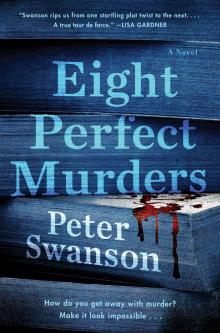
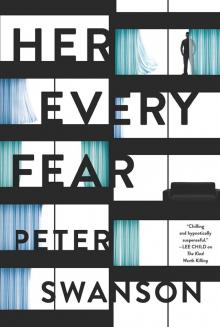
The kind worth saving, p.25
The Kind Worth Saving, page 25


She made a face like I’d just told her the dumbest thing she’d ever heard. I imagined briefly the succession of girls in Joan’s past who had seen that very face: the elementary school friend who still believed in Santa Claus; the girl in middle school who’d never kissed a boy; a series of mildly bullied friends and enemies.
“Well, are you?” I said.
She stood up and spread her arms out wide. She was wearing a light gray cashmere sweater, tight white jeans, and black boots. I knew she wasn’t wearing a wire, of course, but stood and ran my hands down her sides, feeling a crackle of static electricity. I took off my leather jacket and she did the same for me, checking the pockets.
“I’m only telling you because I know that Richard trusted you,” I said, “so I suppose I trust you too. When I was in high school, I found out that my best friend was seeing this much older guy, a professor at a nearby university. He’d been invited to give a reading to our English class and that’s how she met him. She told me everything about him, how he was getting her involved in all this creepy sex stuff, and how he’d started to hurt her. I knew the guy, as well, because the three of us had hung out, and he’d hit on me a bunch of times. So one night I went over and told him I wanted to talk with him but in his car. We sat in his back seat, and I made him close his eyes, which was really easy because he thought it was a sex thing. And I slit his throat with a kitchen knife.”
Joan was watching me, and I could tell she wasn’t sure whether to believe me or not. “It wasn’t easy,” I said. “And I knew that if his body was ever found I would get caught. So I made sure to hide that car, and his body in it, in a place that no one would ever find. And they never did. He’s a missing person’s case, now, and that’s all he’ll ever be.”
“Wow,” Joan said. I still didn’t know if she believed me. The story wasn’t true. The part about my friend and the creepy older professor was, however. And I had definitely formed a plan to kill that man and hide him in his car. I had even begun to dig a hole in some nearby woods, but I had never gone forward with it. My friend had stopped seeing the professor, and I hadn’t completed the hole, and I let it go. But sometimes I remember it as something that actually happened, just like occasionally I pretend things that have happened actually didn’t.
“So you told Richard all that?”
“I told him on the message board. Well, I told everyone on the message board because it was anonymous. But then he and I started sending private messages back and forth and eventually we told each other our real names. And then, eventually, we met.”
“And what did he tell you?”
“He was really vague, at first. He said he’d been involved in two incidents he could talk about. The first was when his cousin drowned in Maine when he was just fifteen. And the second was a school shooting. He didn’t go into specifics, but he said that he had help from the same person in both circumstances.”
“And he said that person was me,” Joan said.
“He didn’t, actually. Not at first. He said it was a girl, and that he would never tell me your name, even though he trusted me. He wouldn’t have, either. But then that detective showed up, and he really freaked out.” I lowered my voice, and leaned in. “We met, the two of us, at the place we always meet. It’s this divey bar in Waltham, and he told me how he was involved with the murder-suicide that had happened in Bingham. I knew all about it, because it was big news, and I was just interested, I guess. I’d read about it, and I read how both the dead man and his wife had gone to the same high school. To Dartford-Middleham. And I read your name, and I knew. I mean, I knew even before I googled you and found out that you had been one of the survivors of the school shooting. I told Richard, our Richard, about it, saying your name, and he tried to deny it but he couldn’t. I saw it in his eyes, and eventually he told me that you were the one. He didn’t want to tell me, but he knew he was caught out.
“The other thing you need to know is that at this point he wasn’t worried about my knowing who you were, he was worried about the detective. That detective had tracked him down, and asked him all these questions, and Richard knew that it was just a matter of time. The last thing he told me was that he was going to take care of it.”
Joan was thinking. I had tried to keep things vague enough, to make it look as though I only had the most general picture of what had happened, so that I wouldn’t screw up a detail. I knew that she wanted to trust me.
When she finally spoke, she said, “Do you know if Richard meant to kill himself at the same time as Henry Kimball, or was it an accident?”
I leaned back in my chair, realizing just how tense my body had been. “I don’t know,” I said.
Joan turned her head slightly, her eyes on a tall painting on the wall, a full-body portrait of some long-dead library patron, holding a leather-bound book in one hand. She was deciding whether she could trust me or not, and I honestly didn’t know which way she would go. But when she turned her eyes back to me I knew somehow before she spoke that I had hooked her.
“You think if Henry Kimball lives, he’ll be able to prove that Richard killed my husband?” she said.
*
We stayed in the library for another hour. As far as we knew no one had even come up to the balcony level all afternoon. I left first, walking briskly to my car that I had parked along the street instead of in the lot. I’d been stupid to not change the license plates and if she’d left first, then there would have been a possibility of her seeing me get in a car with Connecticut plates. Driving back to Cambridge I told myself that I needed to be even more careful moving forward, especially now that I knew what I had to do.
I was sick of eating out, so I bought a sandwich at a sub shop in Huron Village, and took it back to the apartment. It had just gotten dark, and there were no lights on in any of Henry’s windows. I went upstairs and pushed open the door, stepping inside, and heard the sound of Pye jumping from the bed to the floor, then bounding toward me. I looked him in the eye to see if he was disappointed it was me returning to the apartment and not Henry. I couldn’t tell. Maybe he was simply hungry.
After eating I got into bed and continued to read The Green Marriage, but only managed a chapter before putting it back on the bedside table. I turned off the light and went over the entirety of the conversation with Joan Whalen. The more we had talked the more I had sensed in her the excitement she felt at what we were planning to do. I don’t think I generally understand people, but I had understood Joan that afternoon. She and Richard had taken lives together, and once you’ve done that and gotten away with it, everything else in life pales a little. And now she’d found me—not me, exactly, but Addie Logan—and her life was exciting again. It wasn’t meaning she was after, but the thrill of transgression.
“How are you planning on killing him?” she’d asked me.
“I’m going to smother him with a pillow. It shouldn’t be too hard.”
“I have a better way,” she said, her voice just a whisper. “Get a piece of piano wire and sharpen one end, bending it slightly. It just needs to be about five inches long. You push the sharp end through the inside corner of one of his eyes, straight into the brain, then twist it around. Do it a couple of times, and if you do it right, there won’t be any external sign of damage. It will just look like he had a brain hemorrhage. They’ll never even know it was a murder.”
I’d widened my eyes, and said, “How do you know all this? Did you do it?”
I saw her contemplate lying, but instead she said, “No, but I read about it. It’s just a suggestion. I trust you.”
“Okay,” I said, and reached out and touched her leg, and saw something else in her eyes. I thought at first it was superiority, but then I recognized it as happiness.
CHAPTER 36
JOAN
After getting home Joan stared into her refrigerator for a while, but she was too amped up to even think about cooking dinner. She went and changed instead, got back into her car, and drove three towns over to a trendy farm-to-table bistro called Glasshouses. She’d been once with just her husband, and once with a group of friends, mainly real estate people that Richard had known.
She entered the restaurant and told the hostess she was looking for a bar seat, then made her way to the long, elegant bar constructed from refurbished barn wood. She took a seat near the far end of the bar, and only after her water was poured did she swivel on her stool to survey the other patrons at the bar and in the dining room. It didn’t look as though there was anyone she knew. She turned back to the bartender, young enough to be sporting what was probably an ironic mustache, and ordered a glass of cabernet and the beef tartare.
It wouldn’t be the end of the world if there was anyone she knew in the restaurant—widows needed to eat, after all—but she was glad that so far no one had recognized her. Something about her conversation with Addie Logan had made her want to celebrate, to be alone in a place full of people. She felt good. Not as good as she’d felt all those years ago when she’d met Richard Seddon for the first time at the Windward Resort and she realized there were other people like her in the world, but meeting Addie made her feel pretty darn good, especially the fact that they had concocted a plan, one they were putting into action tomorrow. Who knew what would happen next? Maybe Addie was a total flake, but, then again, maybe she wasn’t.
The bartender gave her a taste of the wine, and it tasted thin to her. She must have shown it on her face because he cracked open another bottle almost immediately—a Spanish wine—and splashed it into a new glass. It tasted unfinished somehow, raw and funky, and she nodded at him. When the beef tartare arrived, she mixed the raw egg into the meat, adding a little bit of onion, then devoured all of it, asking for more toast at some point. She hadn’t remembered being this hungry in years, and if she had been a little less self-conscious, she would have ordered a second plate. Instead, she ordered the duck breast and another glass of the same wine.
When the food was gone and she’d said no to the dessert menu, a man who seemed vaguely familiar to her tapped her on the shoulder.
“Joan Whalen, right?”
“Uh-huh,” she said.
“You won’t remember me, but I actually went to your wedding. I was a plus-one. Olivia Waring’s date.”
She actually did remember him, very vaguely. Olivia was one of Richard’s college friends, one of those fake-nice people that was always complimenting everyone, and the only reason she remembered this guy—Olivia’s date—was because he’d worn a white linen suit and Richard had mentioned it, saying he thought it was pretentious.
“Sure,” Joan said. “You wore a white suit.”
“Ha,” he said. “I did. Olivia made a joke about it, said I was upstaging the bride.”
“Yes, I’m still livid.”
“I’m sure you are.”
“Are you still with Olivia?”
“God, no,” he said, and looked back toward the dining area. Joan followed his eyes, looking for this man’s wife or some new girlfriend anxiously waiting for him. Instead, a group of three men were getting up from a table, nodding and waving in this man’s direction.
“Are those your friends?” Joan said.
“Those are the men I just had dinner with. But they’re leaving now, and I have my own car.”
“Tell me your name again.”
“You remembered my suit but not my name?”
“I did.”
“It’s George Mayer. Nice to see you again.”
“Nice to see you, too.” They shook hands, and a few more memories of this man came back to her. He’d actually been stunning in his suit, which was why Richard had made the comment, and he was fairly stunning now in a dark blue woolen shirt and gray jeans.
“I heard about what happened with Richard,” he said, “with all of it, and I was totally shocked.” Joan just nodded. “And I’m so sorry for what you must be going through,” he continued. “I can’t even imagine.”
It was the conversation she’d been hoping to avoid when she’d decided to go to a restaurant, but she put her hand on his arm and said, “Thank you.”
“Hey, you look as though you’re leaving but I’d love to buy you a drink if you have the time. No pressure.” He was leaning up against a stool, ready to slide on top of it.
“Do you live around here?” Joan said.
“I don’t. I’m here for work. That dinner was a client dinner.”
“Oh. Where are you staying?”
“Wadsworth Inn. About ten minutes away. You know it?”
“Yeah, of course. Why don’t we just go directly there,” Joan said, sliding off her own stool, suddenly feeling short next to George Mayer, who had at least a foot on her.
“Okay, sure,” he said, and Joan led him out of the restaurant.
*
She got back to her house at five the next morning. At the inn, she’d managed to extricate herself from the tangle of sheets, and then the room itself, without waking George.
After making coffee she sat on the back deck, watching the early morning mist burn off, wondering why she didn’t get up early more often. She felt as good as she’d felt in a long while. It was cold, but she’d changed, after getting home, into jeans and a thick sweater, and the coffee mug was keeping her warm for the moment. Why was it that when you swam in icy water in the summer your body acclimated to the cold, but in cold air you just kept getting colder? When her coffee was gone, she went back inside the house. On the island in the kitchen was her purse. She pulled out the burner phone that she’d gotten the day before from Addie Logan and looked at it. It was a flip phone with a small digital screen and didn’t do a whole lot more than make phone calls. Her instructions for later that morning were pretty simple. Call the Boston Police Department and tell them there was a bomb placed in the oncology wing of the Boston Memorial Hospital, the same hospital where Henry Kimball was currently recovering. She knew they’d try to keep her on the line, and she’d been wondering if it made sense to say more, maybe that her husband had died of cancer and she was getting her revenge. But there was no real reason for her to do that. The call was only a slight diversion, and maybe not even necessary. Addie Logan had told her that she worked for seven years in a hospital as a receptionist, and she said that bomb threats were not uncommon, but all personnel were immediately notified and it put the staff on edge. It would make it a little easier for her to walk into Henry’s hospital room and take care of him the way they’d discussed.
Joan wondered if it really made a difference calling in the bomb threat, but she also thought it was Addie’s way of making sure Joan was at least somewhat involved with the plot to kill Henry Kimball. It would also potentially connect Joan with what happened to Henry if they could prove she was the one who made the call, and for that reason, Joan was considering not making it. She just wasn’t sure yet. Maybe it would help Addie, and if Addie was able to get rid of Henry, Joan’s life got safer, in return. She decided to make a game-time decision.
When it was ten thirty Joan went to her car and removed the transponder, leaving it in the garage as she drove two towns over to the busy lot of one of the farm stands that sold pumpkins and apple cider doughnuts during the fall season. She had the flip phone with her but had left her own phone at home. She wasn’t sure it was going to make any difference that she wasn’t near her house if she made the call but decided it couldn’t hurt. She sat in her car, the engine turned off, the window cracked. It was a weekday but there were a lot of cars in the lot, city couples hunting through the pumpkin piles for perfectly round specimens, taking pictures of one another for their Instagram accounts. She decided to make the call. She trusted Addie, actually, or at least she trusted that she hadn’t suggested the bomb threat as a way to implicate her in the crime.
At exactly eleven she dialed the number for the Boston Police Department, then holding her mouth open the way she’d practiced at home, she said, “I’m calling to report that there is a bomb in the oncology wing of the Boston Memorial Hospital.” The words sounded garbled in her own ears, but the woman on the other end of the line calmly said, “Can I have your name and where you’re calling from?”
“The bomb will go off in ten minutes. I don’t want to hurt anybody, but I want to destroy the building. You’ve been warned.”
She hung up, skin buzzing. She put the phone in her pocket and got out of the car, wandering through the displays of pumpkins to the large market building. Outside were pallets covered with fall produce, apples, squash, brussels sprouts still on the stalk, plus piles of decorative gourds and ornamental corn. She skirted around the building, passing a parking lot that was for employees only, and found a half-filled dumpster. She pulled the SIM card from the phone, snapped it in half, then threw the pieces, along with the disabled phone, into the dumpster.
Instead of going straight home, she wandered through the market, picking up a half gallon of apple cider and a frozen chicken potpie. Driving home she listened to NPR, curious if there’d be anything about an evacuation at Boston Memorial, but there was nothing, of course. And there was nothing on the news that night, after she’d eaten half the chicken pie, while flipping through news channels and drinking wine. Of course, if everything had gone according to plan there would be nothing on the news. All that would have happened was a fake bomb threat, and a patient in critical condition suffering an entirely predictable brain hemorrhage. Neither event would be remotely newsworthy.
She was starting to fall asleep on the sofa in front of a Real Housewives marathon, so she forced herself up the stairs, stripped out of her clothes, and slid under the bedcovers. Her bones were heavy, and she realized she hadn’t really properly slept in two days. Twenty-four hours ago she’d been in bed with the man in the white linen suit. His name suddenly escaped her. Even though she was exhausted she went through the routine she used every night to fall asleep, closing her eyes and imagining herself tipped back on the surface of the sea, sun baking her skin, the cool water keeping her afloat, and the sky impossibly blue.