The ticklers jam murders, p.1
The Tickler's Jam Murders, page 1


‘A superb book, relentlessly honest and filled with mounting tension’
– Mystery People
‘Deliciously thrilling and wildly unpredictable’
– Oxford Today
‘An authoritative style, a generous sprinkling of recurring images and clues, and plenty of twists …
I couldn’t put the book down until the end’
– Daily Information
‘He has a wonderful gift of creating geographically factual settings for his fictional characters’
– Oxford Times
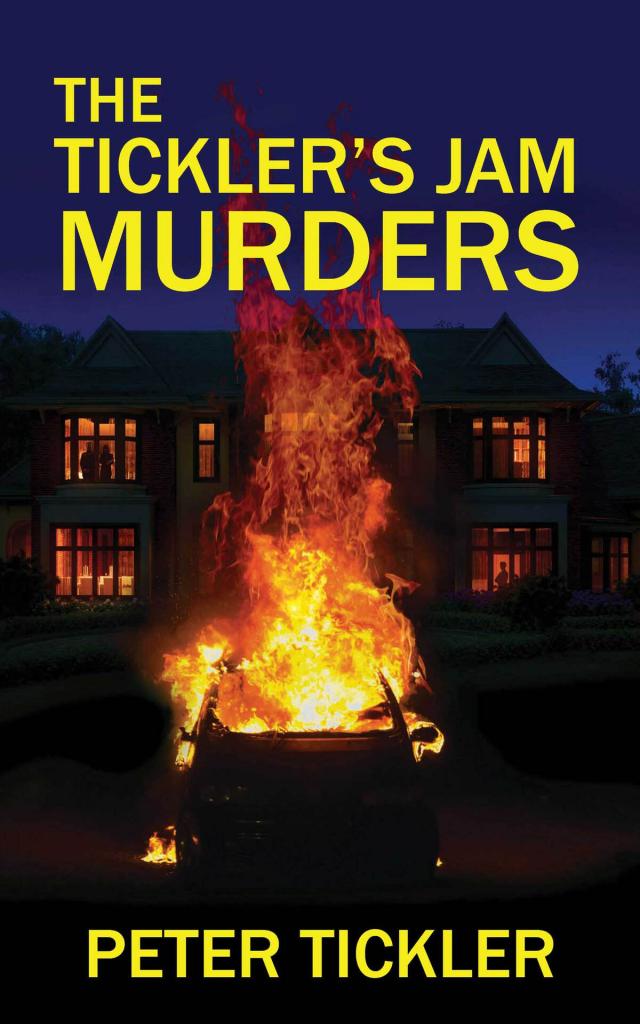
THE
TICKLER’S JAM
MURDERS
PETER TICKLER
The Tickler’s Jam Murders
© Peter Tickler 2024
www.petertickler.co.uk
@ptickler
This book is sold subject to the condition that it shall not, by way of trade or otherwise, be lent, resold, hired out, converted to another format or otherwise circulated without the publishers’ prior conjunction in any other format other than that in which it is published.
The right of the author to be identified as the author of this work has been asserted in accordance with the Copyright, Designs and Patents Act 1988.
eBook production
by Oxford eBooks Ltd.
www.oxford-ebooks.com
The characters in this book are fictional and any resemblance
to real persons is coincidental.
Author’s Note
This is a work of fiction.
The Crowthorpe Jam Company never existed.
Tickler’s Jam (or, more correctly, Tickler’s Fruit Growers and Preservers) did exist. It was active through much of the first half of the twentieth century, but became best known after winning a contract with the Ministry of Defence to supply jam to the British army during the First World War. (They had also done so to the troops in the Boer War.)
As boys, my twin brother and I were sent away to a preparatory school (Winchester House in Brackley) where we encountered Mr Bates, a teacher with a formidable reputation. When he read out the register in the first lesson and got to us – ‘Tickler H, Tickler P’ – he burst out with delight: ‘Plum and Apple’. The jam meant so much to him. I think that as a consequence we received a much easier ride than the rest of the class!
That was the first hint to me of the emotional connection that Tickler’s Jam had for those many, many men who served on the Western Front and elsewhere. It was a connection to their homeland and homes which they clung onto through dreadful circumstances.
Later, I was to discover that:
The British troops sang songs about Tickler’s Jam
They made home-made bombs/grenades out of the empty jam tins
The poet Robert Graves, who was nearly killed in 1917, wrote a poem ‘Escape’ in which he attributed his survival to Tickler’s jam
Tickler’s jam even appears in a George Formby song
Finally, T G Tickler ran the company during its most successful period, but any reference to him made in this story is entirely derived from my imagination.
A Death
Sir Wilfred Walker was not a man easily taken by surprise. He had throughout his life been a man who anticipated things and took whatever action was necessary to ward off any perceived threat. At prep school, when his friend Briggs had had his tuck box filled with broken eggs by ‘Slasher’ Seligman, he had taken precautionary measures of his own, cunningly inserting three of his father’s razor blades inside the lip of his own tuck box and then provoking Seligman in public. Three days later Seligman had to be taken to hospital for surgery on the fingers of his right hand. As a consequence, the first XI’s opening bowler and captain was forced to sit out the rest of the season on the boundary. When Walker was summoned to the headmaster’s study, he half expected that he was going to be expelled or, at the very least thrashed with the cane, but all he received was a verbal dressing down. ‘Slasher got what he deserved’ was the unspoken message, and from that day on, Walker’s reputation as a boy to be respected and secretly admired was established amongst both pupils and staff.
This was one of his favourite memories because it had taught him a lesson which had stood him in good stead throughout his life. Tricky situations required clear-sighted thinking, careful planning and decisive action. He had that very evening reached the decisive action phase to resolve another very tricky situation, and already he felt better for it. Light hearted even. His mood had been enhanced by the glass of brandy in his hand and the very fine Cuban cigar that he was smoking as he sat in the driving seat of his much beloved Rolls-Royce Silver Ghost – 50-horsepower of wonderful engineering and craftsmanship.
When he heard the door of the garage creak open, he didn’t bother to look to see who it was. Why should he? If they wanted to speak to him, to beg and grovel, then he would know soon enough. Besides, turning round to see who it was would be an act of weakness. But whoever it was didn’t come into his eye-line, didn’t even move. They were silent and still, summoning up the courage, he imagined, to plead their case.
Still not a word or sound. He drained his brandy and tossed the glass onto the floor where it exploded into multiple fragments.
‘Well, who the devil is it? I’m not in the mood. I just want to finish my cigar in peace and then I’ll go to bed. You can save it for the morning.’
But the person behind him wasn’t saving anything for the morning. There was a clatter behind him and Sir Wilfred, suddenly annoyed, turned round as far as his over-padded body would allow. He saw momentarily who his visitor was and then felt an excruciating pain as the Rolls-Royce’s starting handle crashed into his skull.
That was not the final conscious moment of his life. He was not that fortunate. Later – moments or minutes later, he didn’t know – he returned to some sort of consciousness and became aware of a strong and distinctive smell. Petrol! He felt a groundswell of panic. He tried to move, but his wrists were bound tight together with rope. His mouth was gagged and, in the dim light afforded by the garage’s lamp, he saw more clearly who his assailant was. But they had no interest in looking at him as they silently rammed a very familiar object into his hands and then with great deftness twisted another piece of rope round that object and his hands. He tried to shout, to call for help, to shake himself free of his bonds, but he couldn’t.
Now fear kicked in as he realised the vicious intent in the face of his assailant and the reality of what was going to happen to him. He shook his head vigorously, in a vain attempt to communicate and negotiate with his murderer. But nothing was going to save him. There was another sudden sprinkling of petrol, over what was left of his hair. It ran in terrifying rivulets over his forehead and down his cheeks. After that came the sudden flash of a match, followed by a noise like a blast of wind, and then all around him was the searing heat of flames. Terror gripped him and moments later so did an agony such as he had never experienced in his life before. And soon after that, mercifully, he lost all consciousness.
When Sir Wilfred Walker died…
His wife Lady Beatrice was asleep in bed, dreaming of the day she met Queen Victoria
– or so she said.
His son Captain Alec Walker was lying still dressed, in an inebriated stupor, on his bed
– or so he said.
His daughter-in-law Elizabeth Walker was dozing in her newly purchased nursing chair in her bedroom, intermittently cursing the fact that her unborn child had such powerful and active feet
– or so she said.
His daughter Maud Walker was sitting at the desk in her father’s study writing a pamphlet entitled ‘Votes for Women: the Unanswerable Case’
– or so she said.
His trusted factotum and chauffeur Frank Tomkin was asleep in his attic room dreaming of rats in the trenches
– or so he said.
Rose Bates, maidservant to Lady Beatrice, was lying awake in her attic room, studying the personal columns of a copy of The Lady magazine which Lady Beatrice had given her
– or so she said.
David Graves, his loyal Production Manager at the Crowthorpe Jam Company, was sitting in his bed reading the newspaper with a nightcap of brandy
– or so he said.
His devoted secretary, Miss Mary Graves, had fallen asleep in her bed while reading a crime novel about a murdered businessman
– or so she said.
The Reverend Justin Ransom was writing and rewriting his latest sermon on the sins of the fathers
– or so he said.
Mrs Jane Ransom was asleep on her bed after imbibing too much wine, the consequence of a certain marital disharmony
– or so she said.
Arrival
Detective Sergeant Thomas Kite felt as if he had been banished to the ends of the earth. Lincolnshire in the winter is a county where the wind whips relentlessly in from over an inhospitable North Sea, chilling the bone and numbing the spirit. He was already missing London more than he could have imagined – the familiarity of the streets, the cosiness of the lodgings he shared with his sister and her family, even the dank smell of the Thames and the choking smoke of innumerable coal fires, not to mention the sound of humanity from before dawn to long after sunset.
‘Not far now, sir,’ shouted Constable Sparrow.
Sparrow was an incorrigibly cheerful young man. He had served three years in the trenches, seen several ‘good friends’ die, had witnessed one of his officers blow his own brains out rather than
‘Ahh!’ Kite bit back his cry of pain as the bike bounced into and out of a deep rut. He was stuck on the back of Sparrow’s pride and joy – a Lincoln Elk 6 hp Twin Model A. Not that it belonged to Sparrow. It belonged to the Lincoln police force, who had purchased two of them only a few weeks previously. And Sparrow, who knew how to blow his own trumpet, had been quick to put himself forward as an experienced rider based on his time as a despatch rider for the British Expeditionary Force on the Western Front. So when there was suddenly a murder to be investigated, and it was some thirty miles from Lincoln, Sparrow and his motorbike had been assigned to Kite.
‘He’ll get you there,’ Chief Constable Bostock had insisted. ‘He had a very good war, and he grew up in the area, so he should be a great help to you.’ The bike lurched again, wheels spinning in the mud, and Kite hung on even more grimly.
‘This is my first murder.’ It was Sparrow again, bellowing his way into Kite’s musings. ‘It’ll be a feather in both our caps if we can catch the bastard who did it.’
‘It will,’ Kite shouted back. If we get there in one piece, he might have added. Because Sparrow, apart from being a very chirpy man, was also a man who drove his motorcycle as if he was being pursued by a squadron of demons from hell. In the pub the night before, he had regaled Kite with stories of his time on the Western Front. ‘There were even nurses riding around on bikes. I met two of them, Elsie Knocker and Mairi Chisholm. Helped them repair their carburettor. Elsie drove and Mairi whooped and hollered from the sidecar.’ At that point in the conversation Sparrow had raised his glass as if toasting them and then knocked back the remainder of his pint in a single gulping gurgle. Then he belched and laughed. ‘What a madcap pair they were!’
Madcap summed up Sparrow too at this precise moment, skidding around and through the mud and puddles, squealing like a kid on ice-skates. But if Sparrow had survived the blasted landscape of France, surely (Kite reassured himself) he wouldn’t come to grief here on the agricultural outback of Lincolnshire. Kite huddled down a bit further behind his constable and wished he believed in the power of prayer.
‘Not too far now, sir.’
The welcome words broke Kite out of his reverie. He sat up a bit and looked around.
‘Over there, that’s Crowthorpe village, sir, where the jam factory is, and where I grew up. Crowthorpe Manor is another two or three miles, but Sir Wilfred owns all the land in between and more.’ Sparrow waved his right arm carelessly to indicate the extent of the man’s domain.
A man of considerable wealth then, Kite surmised, and a man on whom a lot of locals must rely for their livelihoods.
‘Hell’s teeth!’ The bike skidded viciously, and Sparrow hurled himself to the left to try and stop them crashing over. Somehow, he managed it and seconds later they were on firmer ground – bumpier but safer – and Sparrow bellowed out his delight. ‘That was a close one, sir. The road is worse that I remember it. They need to bloody well repair it.’
‘I’d like to get there in one piece, Constable!’ he yelled back.
‘Don’t you worry, sir,’ was the reply. ‘I ain’t ever lost a sergeant.’
‘Here we are, sir,’ Sparrow announced proudly as he skidded to a halt on the gravel drive.
‘Thank you, Constable.’ Kite groaned in relief.
Sparrow swung his leg over and was off the bike in a moment, but for several seconds Kite couldn’t move.
‘You all right, sir? Need a hand?’
Kite shook his head. His back was rigid with pain, and he couldn’t feel his right leg. Both sensations were familiar to him, the legacy of a struggle two floors up on a scaffolded house and the subsequent fall. He had been lucky, much more so that the thug who had tried to clobber him with an axe and had ended up breaking his own spine instead. With a determined effort, he eased himself off the bike, conscious of Sparrow’s gaze and hoping against hope that the back pain would recede and some sensation return to his leg. His shoulder, which under his layers of clothing sported an impressive scar where the thug’s axe had dug into him, by contrast betrayed only a slight stiffness.
He limped forwards a few steps, trying to straighten himself up fully while eyeing up the stone edifice which was Crowthorpe Manor. It was an unevenly structured house. The central block was symmetrical: a main entrance – two dark red doors framed by a pair of plain classical columns – was flanked on either side by two pairs of bay windows, and these were matched on the floor above by slightly smaller windows. And above them two small windows indicated the presence of further bedrooms under the roof. To the right of this was tacked on a single-storeyed room with two smaller windows. A later addition Kite surmised. A billiard room perhaps. Didn’t every knight of the realm aspire to a billiard room in his house?
By contrast on the left-hand side of the manor, there stood a much more impressive three-storeyed structure topped by a square turret which exceeded the height of the main house by three or four feet. It also sported a clock. Five minutes to two. Kite pulled his own watch out of his jacket pocket and checked it for the time. They had taken nearly three hours to cover the thirty miles from Lincoln to Crowthorpe Manor. Given the state of the roads, this was impressive, and a tribute to Sparrow’s skill. Kite slowly turned around, scanning the area and trying to familiarise himself with where they were.
The village of Crowthorpe, which they had driven past without pausing, was some three miles away, and yet would have been invisible were it not for the tip of a church spire. That was where they were due to stay that night, in the Red Lion pub. Otherwise the land all around was grey and almost featureless under the heavy clouds. God, he hated the place. He had only been stationed in Lincolnshire a month, but it felt like half a lifetime. ‘Put out to grass,’ his sister had said, and she had been right. All because he had said the wrong thing, ruffled feathers and made one mistake which they could fasten upon.
‘Good morning.’
The greeting came from behind him, clipped and upper class. Kite turned to see who it was. A man had emerged from the house and was striding across the gravel. ‘I am Sir Wilfred’s son, Captain Alec Walker. I have met the constable before, so I presume you must be Inspector Kite?’
Kite took the proffered hand. ‘Sergeant, sir. Detective Sergeant Kite, sir. And I am only sorry that I have had to meet you in such sad circumstances.’
‘Quite.’ Walker released Kite’s hand. His eyes went from Kite to Sparrow and back to Kite. ‘It has been, it is… awful. Bloody awful.’
‘I’m sure it is. But let me assure you that Constable Sparrow and I will make every effort to spare you further distress. It is, of course, our duty to investigate the killing of your father and bring the killer to justice, so we will need to ask questions of the family.’
‘Not too many, I hope. I don’t believe any of us witnessed anything,’ Walker said again, ‘so I cannot see that we can be a lot of help. It must have been a burglar or someone with a grudge against my father, jealous of his success and his lovely car. In my opinion, you would be better off starting your investigations in the village.’
‘I understand your distress, Captain, but I have my methods, and I would like to start with everyone living in the house and also of course I would like to examine the scene of the crime.’
Walker frowned. ‘If you must ask questions, you must. But let me warn you that the ladies are very distressed, in particular my mother of course. In addition her health is somewhat delicate.
‘I fully understand,’ Kite said.
‘I do hope so.’ Captain Walker turned away and stalked back towards the house. Kite followed.