A five year plan, p.1
A Five Year Plan, page 1


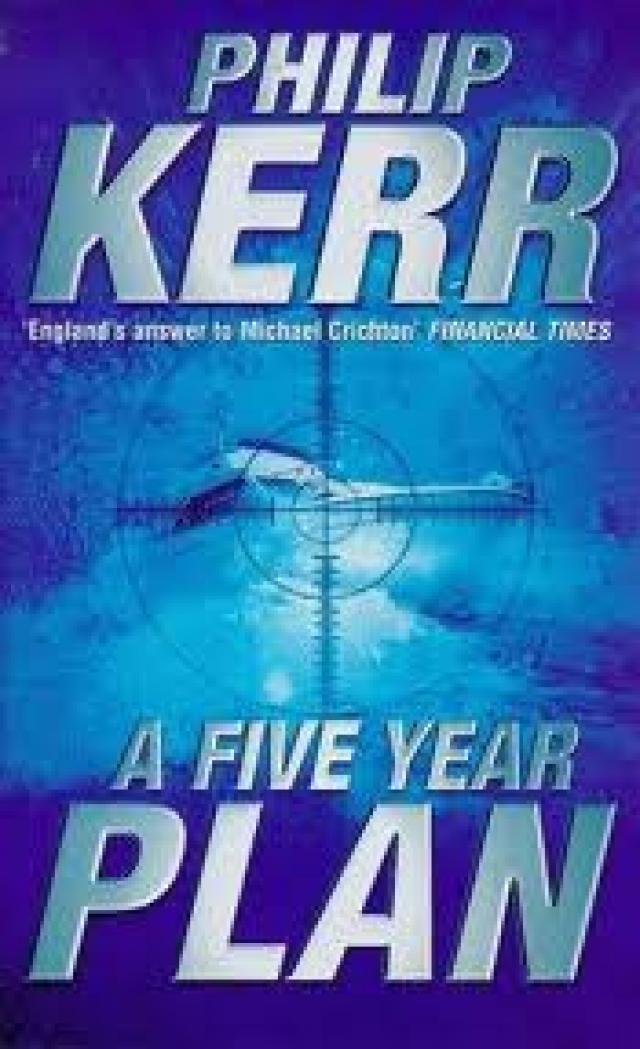
A Five Year Plan
Philip Kerr
Published: 1999
Tags: Mystery, Contemporary
Mysteryttt Contemporaryttt
* * *
SUMMARY:
Five years in a Miami prison for a crime he didn't commit gave Dave Delano a long time to think. Not that Dave is so innocent. He knew that by failing to finger mobster Tony Nudelli for murder he would take a complicity rap -- and $250,000 in hush money. But when his cellmate tips him off to boatloads of laundered mob money being ferried overseas in the hulls of U.S. yachts, Dave devises a flawless plan to net himself $30-$40 million -- and a new life.A hopeless romantic, FBI Agent Kate Fury joined the bureau in search of action, excitement, and occasional danger. Instead, the most hazardous thing she's done is forget the safety catch on her Lady Smith & Wesson. So when Colombian cocaine is suspected of being smuggled to Europe in a hollowed-out yacht hull, she's determined to make the biggest collar of her career.Yet neither Dave nor Kate are prepared for each other, and their shipboard meeting is pure combustion -- in a novel full of hidden identities, misunderstood motives, and major mayhems that goes full-throttle right to its shocking climax.
Philip Kerr was born in Edinburgh in 1956, and now lives in London with his wife and family. He is the author of March Violets, The Pale Criminal, A German Requiem, A Philosophical Investigation (which is shortly to be filmed), and Dead Meat (shown on television as Grushko). His last two novels, Gridiron and Esau have been sold for film development, along with A Five Year Plan.
By the same author
March Violets
The Pale Criminal
A German Requiem
A Philosophical Investigation
Dead Meat
Gridiron
Esau
A FIVE YEAR PLAN
Philip Kerr
Version 1.0
© Philip Kerr, 1997
ISBN 0 091802350
For Tom and Paula
ACKNOWLEDGMENTS
Special thanks are due to Ben Gunn for supplying me with much of the information about merchant shipping; to Robert Bookman, for doing the business, as always; and to Marian Wood, my editor, and Michael Naumann, my publisher, for their faith. I should also like to thank Nicholas Bognor, Graham Saltmarsh, Frances Coady, Linda Shaughnessy, Caradoc King, Terry Burke, Deborah Hayward, Nick Marston, and my wife, Jane Thynne for all their help and encouragement.
CHAPTER ONE
'Ah-choooo!'
The sneeze reverberated like a gunshot.
Jimmy Figaro glanced around his well-appointed office to check nothing was damaged.
'Fuckin' hay fever,' sniffed Rizzoli from behind a napkin-sized handkerchief. 'According to the fuckin' Herald, the pollen index is 129. That's on a scale of 201. On account of all the fuckin' mango trees we got down here in Florida.'
Rizzoli sneezed again, a great explosion of noise that was half growl, half whoop, like the yahooing sound a rodeo-rider might make on exiting the ring aboard a bucking horse. He said, 'It was up to me? I'd burn every fuckin' mango tree in Miami.'
Figaro nodded vaguely. He liked mangoes. He'd never given the trees much thought, but now that he did, his mind's eye saw Ursula Andress in Doctor No, singing a song about mango trees as she wiggled her ass out of the Caribbean sea with a conch in her hand. Why couldn't he have a client like that for once instead of a minor mobster like Tommy Rizzoli?
'Every fuckin' one of them. Bonfire of the mango trees.' Rizzoli chuckled. 'Just like that fuckin' movie, huh?'
'Which movie is that, Tommy?'
'Bonfire of the mango trees.'
Figaro felt himself frown. He was uncertain if Rizzoli was making a joke, or if he really did think that was what the movie was called.
'You mean Tom Wolfe?'
Rizzoli rubbed his nose furiously and shrugged.
'Yeah, right.'
But it was plain to Figaro that Tommy Rizzoli knew as much about Tom Wolfe as he did about fine porcelain. Figaro turned his attention back to the notes he'd been making. The facts were as clear as Tommy Rizzoli's guilt. He and an unnamed associate — but most probably it had been Rizzoli's half-brother, Willy Barizon — had taken extortionate control of most of Dade County's ice-trucking. There was that and the assault on one of the arresting police officers that had left the man with a broken nose.
'Ah-chooo!'
The trooper's nose. It was almost ironic in view of the allergic condition of Rizzoli's own Durante-sized hooter. But Rizzoli was adamant that the trooper had slipped and fallen.
'How do you feel about a plea, Tommy?'
'As in guilty plea, or plea for mercy?' He took hold of his nose and bent it one way and then the other, almost as if it had been broken. 'No fuckin' way.'
'As in plea bargain. I figure they'll drop the assault if we put our hands up to the extortion. Meanwhile I suggest you sell your interests in the ice and trucking business and get ready to pay some kind of fine.'
Both men flinched as outside the office door, a woman screamed. Figaro tried to ignore it.
'The People's evidence is at best not much more than hearsay,' he continued. 'Just a couple of undercover cops. I can make them look like Swiss cheese.'
'That's the cheese with the holes in, right?'
'Precisely. The DA knows it too. I don't see that you have to go to jail for this.'
'You don't?' Rizzoli snorted like he had been fast asleep. 'You don't? Well, that's great Jimmy. You know, I never much liked ice anyway.'
There was a knock at the door.
'It's a bitch to handle. On account of the interesting crystalline structure.'
'Come.'
'Somethin' I read about. S'got a laminar structure. Which means it deforms by gliding. That's why ice kind of falls apart the way it does. Like a deck of cards.'
Figaro's secretary peered round the door.
'And I ask you, Jimmy, what kind of business can you build on a crystalline structure like that?'
'I don't know, Tommy. Yes, Carol?'
'Mister Figaro? I wonder, could you spare a minute please?'
Figaro glanced at his client.
'I think we're about through here,' he said, standing up. 'I'll speak to the DA's office. Give me a week to structure a deal, Tommy. OK?'
Rizzoli stood up, automatically straightening the cuffs and the creases on his shiny sharkskin suit.
'Thanks Jimmy. 'Predate it a lot, man. Naked Tony was right. You're one of us.'
Buttoning his own jacket and ushering Rizzoli toward the open door, Figaro looked pained.
'No, don't make that mistake, Tommy. Y'know, Tony means well by that remark, but it's not true. I'm your priest, is nearer to it. Priestly intercession before judgment on your behalf. Only don't ever fuckin' confess to me. I don't want to know. If you're guilty I don't give a shit any more than I would if you were as innocent as a walk round a church on a Sunday afternoon. All I care about is whether we can make a better case than the other guy.' He grinned. 'It's a lawyer thing.'
'I got ya.'
The two men shook hands, which served to remind Figaro of how tough and strong the other smaller man really was.
'So long Jimmy, and thanks again.'
Figaro waved Rizzoli through the reception area and beyond the doors of Figaro & August, and then glanced questioningly at Carol.
'I think you'd better come and see this for yourself,' she said and led the way through the suite of offices to the boardroom.
'When we saw what it was, we thought we'd better have it put in here,' Carol explained nervously. 'Gina's in the Ladies' room with Smithy. It was Smithy who unpacked it. I think she had a bit of a shock.'
'It was Smithy who screamed?'
'She's sort of a nervous individual, Mister Figaro. Nervous, but loyal. Smithy cares about you. We all do. That's why an incident like this is so upsetting. I suppose, with our client list, it's understandable. But this — this is like something out of the movies.'
'Now I really am intrigued,' said Figaro and followed her into the boardroom.
Smithy was now lying on the sofa beneath the window, and Gina was fanning her pale-looking face with a copy of the New Yorker.
Figaro recognized the cover. It was the issue that included the profile of himself. He glanced around the room, his dark, quick eyes serving a usefully photographic memory, taking in the probable chain of causation. The New Yorker piece. The dismantled packing case. The pubic clumps of straw. The delivery item itself.
Free standing, about five feet high, and looking like something that had met the stony gaze of a Gorgon, was a topcoat made of stone.
'What kind of sick person?' Carol bleated. 'No, wait just a minute. I know what kind of person. There's a name on the delivery note.'
She handed him a sheet of pink paper and placed a tentative hand on her boss's shoulder. It was the first time in three years of working for Figaro that she had ever touched him and she was surprised to find hard muscle underneath the jacket of his expensive Armani suit. He was a tall, attractive man, in good shape for someone who spent most of his time in the office and the rest of it in court. Kind of like Roy Scheider, she thought. The same long nose. The same high forehead. The same glasses. Only paler. Almost as pale as the woman lying on the couch.
'Do you feel all right, Mister Figaro? You look a little pale.'
Figaro, who was rarely in the sun, looked away from the stone topcoat and met her eye. For a moment he said nothing. Then he laughed.
'I'm fine, Carol,' he replied , and started to laugh again, only this time it really took hold of him until he had taken off his glasses and was leaning with both hands on the boardroom table, tears streaming down both cheeks.
CHAPTER TWO
Two things happened on the morning of Dave Delano's release from the Miami Correctional Center at Homestead.
One was that Benford Halls, recently transferred from Homestead to the State Penitentiary at Stark, was executed. Although Stark was many hundreds of miles upstate, the circumstances of Halls's final hours — meticulously reported on almost all of Florida's TV and radio stations — caused a lot of anger and resentment among the cons at Homestead. Not only had Halls been kept waiting for several hours after his scheduled 11 p.m. execution because of a problem with the ancient electric chair, but it had also been reported that movie actor Calgary Stanford had been allowed to attend the execution in order to research a death-row role he was soon to play.
Dave Delano had good reason to remember Benford Halls. They had both been sentenced in the same Miami courthouse on the same day, exactly five years before. That Dave should have served the full term — since 1987, parole for federal prisoners had been more or less eliminated — didn't seem so bad when he compared it with waiting around for five years to be put to death in front of some movie actor. If that didn't rank as cruel and unusual, then Torquemada must have been one of the world's great humanitarians.
The second thing that happened was that Dave received an airmail letter. It was from Russia and written in the unmistakably clear hand and cryptic style of Einstein Gergiev. Gergiev had been released from Homestead some six months before Dave, after serving eight years on a racketeering charge. Released and then deported as an undesirable alien.
Undesirable he may have been, but it was mostly down to Gergiev that Dave had used his time inside so well. It had been Gergiev who had persuaded the younger man that he had a real flair for foreign languages and that the peculiarities of the federal penal system would give him the opportunity for study and self-improvement people with liberty could only dream about. Just a few months before an amendment to the 1994 Crime Bill had banned federal grants to prisoners for post-secondary education, Dave had obtained a diploma in Russian. He had always had good Spanish. Growing up on Miami's South Beach, it might as well have been Cuba for all the good English did you. And on a fine day when he had a tan to complement his dark hair and brown eyes, Dave could just about pass for one of the marielitos who helped make Miami the sometime crime capital of America. Dave's potential as a Russian scholar might have come from the fact he was the son of a Russian-Jewish immigrant who had fled the Soviet Union after the war. His father's real name was Delanotov, which he had changed to Delano upon arrival in America, choosing the middle name of the previous American president in order to enhance his future prospects, such as they were. When he wasn't drunk, he spent the next thirty years installing air-conditioning systems in luxury yachts. Out of love and gratitude for his adopted country and hatred of the one he had left behind, Dave's father never again spoke his own native language.
Dave looked at the postmark and shook his head. It was four weeks since it had been sent. Another day and it would have missed him.
'Fuckin' Aeroflot,' he muttered before carefully reading the letter, written in Russian. Prices, crime and the incompetence of government — things did not sound so very different from what was happening at home. Dave read the letter several times, making certain of some of the more difficult words with the aid of a Russian dictionary. Speaking Russian was a lot easier than reading it. The Cyrillic alphabet was a whole different ball-game to the western writing system. For a start there were six more letters than English used.
By the time the guard came to escort Dave to freedom he had memorized the letter's contents and flushed the pieces down the toilet under the eyes of his cellmate, Angel, who had been lying silently on the top bunk. It was always tough when the guy you roomed with got his freedom. His departure brought home the fact that you were still in prison. Equally troublesome was the prospect of a new cellmate. Suppose he was queer?
'Man gets a letter and gets hisself released all on the same day,' grumbled Angel. 'Somehow it don't seem fair.'
Dave picked up the cardboard carton containing his books, notebooks, correspondence, art reproductions and photographs, tucked it under one well-muscled arm and then tugged at the Uncle Sam beard that helped to disguise his boyish face.
'OK man, I'm outta here.'
Angel, a tall Hispanic with a gold tooth, descended, embraced Dave fondly, and tried not to cry. Tamargo, the truck-sized guard, loitered patiently on the landing outside the cell door.
'I left you everything that was in the cabinet. All my shit. Candy, vitamins, cigarettes. Smoke 'em soon, though.' Dave laughed. 'Smoke 'em or trade 'em. They'll be turning this into a No Smoking prison like everywhere else, and they won't be worth shit.'
'Thanks man. 'Predate it.'
'You take care of yourself. You'll be out in no time.'
'Yeah. Right.'
Without another word Dave turned and followed Tamargo along the ground-floor tier, shouting his goodbyes to the other prisoners and trying not to look too damn pleased with himself. He felt vaguely nauseous, the same feeling he used to have when he'd been about to sit a test, or face a courtroom. But it was nothing to what Benford Halls must have felt. Dave shivered.
'Fuck that,' he muttered.
'Say something?' returned Tamargo.
'No, sir.'
They exited the two-tier modern building and, crossing the neat lawn, Dave realized that this was the first time he had ever been allowed to walk on the grass. It was in the small things that freedom was to be discovered.
In the laundry and supply building he submitted meekly to the last indignity the system had to inflict upon him: the strip search. It was a palindrome of the way he had entered the system. He took off his prison clothes and bending over spread the cheeks of his buttocks so that one of the other guards who were waiting there for him could inspect his ass. Then they returned his own clothes and he started to get dressed in the sports coat, shirt and pants he had worn to the last day of his trial. To his surprise, the coat was too small and the pants were too big.
'Wish I had a dollar for every time I seen that happen,' guffawed the man searching the box containing Dave's personals. He glanced around at his equally amused colleagues. 'Spend five years pumping iron like you was Arnie fuckin' Schwarzenegger and then you wonder why your clothes don't fit.'
Dave gave himself up to their amusement.
'Look at these pants,' he grinned, holding the waistband away from his stomach. 'I must have lost twenty pounds. You know, you could market this place as a fat farm. The Homestead Plan diet. Safe serious weight loss through lifestyle change. Personalized care from corrective professionals.'
'You're lucky you did your time here, Slicker,' said one guard. 'In Arizona they'd have had you in a chain gang. You'd have lost a heck of a lot more weight out there.'
The guard searching Dave's personals riffled through the pages of a book and then regarded its cover with mild distaste.
'What is this shit, anyway?' he grumbled.
'Crime and Punishment, by Dostoevsky,' said Dave. 'Russia's greatest writer. In my opinion.'
'You some kind of communist, or something?'
Dave thought it over for a second.
'Well, I believe in the redistribution of wealth,' he said. 'Just about everyone in here believes in that, don't they?'
'Chain gangs aren't the answer,' said Tamargo. 'Nor anything else that keeps a man in shape. Prison shouldn't make guys who are comin' out more of a threat to law-abiding citizens than when they went in. You ask me, when guys come in here, we should give 'em all lots of fatty food. Cheeseburgers, ice-cream, Coca-Cola, French fries, much as they want, whenever they want. No exercise and plenty of TV. Phil Gramm wants the system to stop turning out hardened criminals, then that's the way to do it. Plenty of fuckin' junk food and easy chairs. That way when these fuckers eventually hit the streets they're regular couch potatoes like the rest of us, instead of muscle-bound bad-asses.'