1993 dead meat, p.1
(1993) Dead Meat, page 1


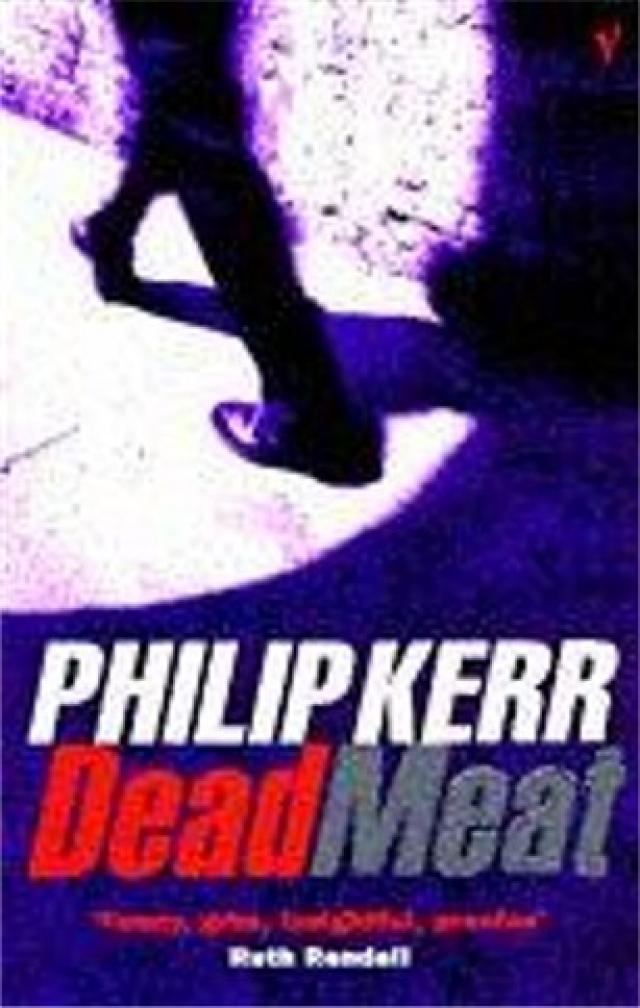
DEAD MEAT
Philip Kerr
About the book
EVERYONE IS GUILTY OF SOMETHING... In comtemporary Russia the old ghosts have been laid to rest, but the stench of corruption is just as strong as ever. Now a top-level Moscow investigator, dispatched to St. Petersburg, is about to discover just how deep the decadence runs--in both the corridors of power and the labyrinth of the human heart. The man from Moscow has been teamed up with Grushko, a palm-reading local detective with Elvis Presley hair. Together they embark on a investigation into the brutal murder of a famous and controversial journalist. To Grushko, an expert in the ruthlessness of the rising Russian Mafia, the killing has all the earmarks of a professional hit. But in the new Russia appearances have almost as little value as the new ruble. Soon the focus of the investigation will fall on the journalist's widow, a pinup beauty whom one detective will find impossible to trust...the other to resist. Author Bio:
For Jane
Acknowledgements
This novel would not have been possible without the help of St Petersburg’s Central Board of Internal Affairs. In particular, there were three senior policemen, General Arkady Kramarev, Colonel Nikolai Gorbachevski and Lieutenant-Colonel Eugene Ygetin who ensured that almost every door was open to me. I was given a police pass, which enabled me to go in and out of the Big House (as they called their headquarters) as I pleased. A police car with a driver and telephone were made available to me on a twenty-four-hour basis and this meant that I was able to take part in several police operations against the Mafia. At the same time several detectives and investigators took the trouble to describe to me many real cases with which they had been involved, as well as inviting me to their homes and extending to me a hospitality that I often found hard to let myself accept. In short, I was presented with a unique opportunity to observe the men of Russia’s anti-Mafia squad and their methods at considerable length.
As well as the men of the Central Investigating Board, thanks are also due in Russia to Nina Petrovna, Stella Starkova and, for her unfailing patience and honesty, Elena Khristotonova. Thanks are due in London to Nicky Lund, Mark Forstater, Nick Marston, Caradoc King, Alison Lumb, Peter Cregeen, Jonathan Powell and Jonathan Burnham.
September 1992
DEAD MEAT
‘Hm, so you want some bread?’ Ivan Ivanovich will ask.
‘What’s wrong with that, sir? I could eat a horse!’
‘Hm. I suppose you want some meat as well?’
‘I’ll be pleased with anything you’re kind enough to give me.’
‘Hm, so meat’s better than bread, is it?’
‘You just can’t be fussy when you’re hungry. Anything’s welcome.’
From ‘How Ivan Ivanovich Quarrelled with Ivan Nikiforovich’, by Nikolai Gogol
A Russian can never resist stories, even the ones he tells to himself.
Lone travellers on the night sleeper from St Petersburg will be well aware of the hazards of sharing a two-berth compartment with a stranger. The Red Express is often filled several weeks in advance and the railway booking office takes little account of the sexes of those whom fate has decided to throw together for eight hours or more. My own travelling companion, a handsome-looking woman with beautiful, muscular legs, must have thought me a very dull fellow. During the first part of our journey her efforts to engineer a conversation were almost unflagging, and in this respect she seemed to have more gambits than Gary Kasparov: spiralling inflation, ethnic conflict, increased crime, the Kuril Islands, the price of bread, even — I think this is right —some nonsense about how placentas from Russian abortions were used to make expensive face creams for Western women. She tried everything to get me to talk short of using a cosh and a bright light.
Most men would have given their thumbs for such an attractive and well connected travelling companion as I had, especially one so obviously keen to talk. Good-looking women are usually cold and distant when you are lucky enough to meet them alone on a train in a two-berth compartment. But my replies were monosyllabic to say the least. Not that I am usually the uncommunicative type; however on this occasion my mind was elsewhere. Sometimes it was racing through the mid-summer’s air and over the flat countryside that lay spread like a vast counterpane outside the window of our carriage. But mostly it was back in St Petersburg with Yevgeni Ivanovich Grushko and the men of the Central Board.
Chekhov says that a storyteller should show life neither as it is nor as it ought to be, but as we see it in our dreams. Dozing in my warm berth that was indeed how it all seemed to me now, for in a sense my story had started on this very train when, several weeks before, I had travelled in the opposite direction, on a temporary attachment to St Petersburg’s Central Investigating Board at the orders of my superiors in Moscow. It was hoped that I might improve my knowledge of how the Mafia worked.
Not that Moscow’s underworld is any less in evidence these days. Far from it. No, it was just that the St Petersburg Central Board, and in particular its most senior detective, Yevgeni Ivanovich Grushko, seemed better able to deal with the Mafia than we were in Moscow. The figures would speak for themselves if I had them to hand. Every man has his own special subject. The shepherd knows more about sheep than the most dedicated of scholars. Grushko knew more about the Mafia than any other policeman in the new Commonwealth of Independent States. But there is a saying that ought to have warned me to be careful of him: beware of a man of one book.
Not that there was much that would have made you immediately wary of him. His face, like his manner, was open and friendly. He wasn’t particularly tall, although he looked fit enough. He wore his grey hair long on top of his head, like the young Elvis Presley, and, when I had known him long enough to become aware of his habits and saw that he combed it very often, I recognised that this was his only personal vanity. Nor was Grushko an unlettered man, as I discovered within a few minutes of shaking his sandpaper-hard hand that first morning we met, on the platform at Petersburg’s Moscow Station.
‘Did you have a good journey?’ he asked, picking my bags off the station platform.
I explained how I had been obliged to share the compartment with an extremely smelly babushka who had snored like a saw for almost the entire journey.
‘Have you been in St Petersburg before?’
‘Not since I was a schoolboy.’
That seemed so long ago, in those early Sputnik-Gagarin days, when it seemed that the Soviet Union was the most impregnable nation on earth. For a moment I was transported back to the same railway-station platform; I was holding my mother’s hand and listening to her explain how we would see the most fabulous palaces in the world, while my father unloaded our bags from the carriage. I did not hear much of what Grushko said for at least a minute or two. When I came out of my reverie he was quoting what Dostoevsky had said about St Petersburg.
‘ “This is the most abstract and intentional city in the whole world,” ’ he said, without a hint of self-consciousness and led me out of the station on to Nevsky Prospekt, where he had parked his Zhiguli.
I said that I had always wondered what Dostoevsky had meant by that particular remark about Leningrad.
‘St Petersburg —it’s an ideal,’ he explained. ‘The product of one man’s will. By the way, never ever call it Leningrad, except in retrospect. That’s all finished now.’
I looked along the length of the broad thoroughfare. It was a warm June day and things could not have looked less abstract. There is an impressive solidity about St Petersburg.
‘Of course, you wouldn’t think it now,’ he said taking a deep, euphoric breath of the early morning air, ‘but this really is a very stupid place for anyone to have built a city. Ice-bound for half the year, although there are some people who say our northern frost is very good for the health. Little more than a swamp when Peter the Great first came. All the stone had to be brought in specially. Thousands of the poor serfs died. That’s why they say St Petersburg is built on bones.’
He opened the boot of the Zhiguli and then squashed my luggage underneath the lid as if he had been crushing the body of one of those poor serfs.
‘Perhaps that’s why there’s so much crime here in Peter,’ he said, offering me a cigarette. ‘All that blood.’
I thought of what the poet Anna Akhmatova had said about how it loves blood, the Russian earth, and for a brief moment I was tempted to offer some intellectual credentials of my own. Instead I said something more banal, about there being crime everywhere these days.
‘Ah, but not like here,’ he said, opening the car door for me.
I had the impression that he was reminding me of the purpose of my visit. After all, I had been sent from Moscow to learn how they dealt with the Mafia in St Petersburg. But what he said next seemed to contradict this thought.
‘Not like in Peter. After all, this is where crime got started. There aren’t many places where there are as many gloomy, harsh and strange influences on the soul of man as there are in St Petersburg. Here, I’ll show you. It’s only a little out of our way.’
He climbed in beside me and started the engine. We drove west along Nevsky for a short distance. The pavements were crammed with people who seemed rather scruffier than their Moscow counterparts, but perhaps that was only because the buildings were more beautiful. We turned north along one of the city’s canals and then he stopped and pointed at the top floors of a yellowing tenement.
‘Up there,’ he said. ‘On the fourth floor. That’s where the student Raskolnikov killed the old woman and
He spoke as if this were one of the more celebrated cases of the day. I looked at the building and found to my surprise that it was too easy to recall the scene from Dostoevsky’s novel as something that had actually taken place. An axe-murder. There was nothing Russians loved to read about in their newspapers more than a good axe-murder. Especially if the murderer happened also to dismember his victims and eat them. It just wasn’t a proper murder without blood. Lots of it.
‘Looks like it might have happened yesterday,’ I observed.
‘Things are a bit like that in Peter. Nothing much has changed since Dostoevsky’s day. The Mafia have taken over from the nihilists. They believe in nothing except themselves and their ability to inflict pain and hardship on others in the name of one false god or another.’
‘There’s only one false god today that commands any real devotion,’ I said. ‘And that’s money.’
‘Not that the students have been entirely forgotten,’ Grushko added. ‘Believe it or not we arrested a student just the other day. A medical student from the Pavlov. You know how he’s putting himself through med. school? As a hired assassin for the Mob. He got himself interested in guns while he was doing his national service in Afghanistan. Became a marksman. We reckon he’s murdered at least ten people.’ He shook his head. ‘Compared to the likes of him, Raskolnikov was a puppy.’
A babushka emerged from the courtyard at the back of the tenement building. A small, dried-up woman of about sixty wearing a threadbare raincoat. To my surprise she was carrying a small strong-box under her arm. Her sharp eyes fixed on our car and she stared at us with hostile suspicion. She might have been the actual moneylender whom Raskolnikov had killed. Grushko noticed her too and nodded.
‘A ghost,’ he said quietly. ‘Peter’s full of them.’
He glanced in the mirror and quickly ran a comb through his well-oiled hair. When he had finished it looked exactly the same. I noticed a strong smell of mothballs on the sleeve of his dark grey jacket.
‘Before we go to the Big House,’ he said, ‘I wanted to get something clear between us.’
I shrugged. ‘Go ahead,’ I said.
He fixed me with a penetrating stare.
‘I’ve been told you’re here because Moscow thinks we have a good record against the Mafia: that you want to look at the way we do things in Peter.’
‘That’s right. It’s an intercity liaison thing. An exchange of ideas, if you like.’
‘Yes,’ he said, ‘I read General Kornilov’s memo explaining your visit. Sounded like bureaucratic shit to me.’
I shifted uncomfortably in my seat.
‘What’s wrong with exchanging a few ideas?’
‘Peter’s a smaller place than Moscow. Rather more provincial, too. Everyone knows everyone else. It’s harder to lose yourself here than it is in Moscow. What would you say if I told you it was as simple as that?’
‘Well, I, er… I’d suggest you were being modest. Look, I’m not here to patronise you. We can learn from each other, surely.’
Grushko nodded, measuring his next remark.
‘Let me be frank with you,’ he said. ‘If you’re here to investigate me and my men, you won’t find anything. I can’t speak for the rest, but there’s no corruption in my department. We’re clean. Have you got that?’
‘I’m not here to investigate you,’ I said coolly.
‘I don’t like spies any more than I like policemen who are getting their paws stroked.’
‘That leaves me out then.’
‘Give me your hand.’
I held out my hand thinking that he wanted to shake it. Instead he turned it over and stared closely at my palm as if intending to read it.
‘You’re not serious,’ I said.
‘Be quiet,’ he growled.
I shook my head and smiled. Grushko scrutinised my hand for almost a minute and then he nodded sagely.
‘Can you really read palms?’
‘Of course.’
‘So what do you see?’
‘It’s not a bad hand,’ he said. ‘All the same, your head line seems to be nearly split in two parallel lines.’
‘And what does that tell you?’
‘This reading is for my benefit, not yours.’
I drew my hand away and grinned uncomfortably.
‘That’s some forensic method you have there. Does it work with the Mafiosi?’
‘Sometimes. Most of them are pretty superstitious.’ He took a last drag at his cigarette and grinned. ‘You wanted to find out how we do things in Peter. Well, now you know.’
‘Great. Now I can get back on the train and go straight back to Moscow to make my report. Grushko’s a great detective because he can read palms. They’ll love that. What do you do for an encore: a little levitation, maybe? Hows about I ask you to find some water round here?’
‘That’s easy.’
Grushko wound down the window and threw his cigarette into the canal. I was soon to learn this particular waterway was called the Griboyedev Canal. Maybe he could sense something in the future at that. How else can one explain the fact that in only a few hours we would be back at that same tenement to investigate the murder of one of Russia’s best-known journalists?
2
I am a lawyer by training. This is common enough among investigators. The job requires a knowledge of criminal evidence and procedure that distinguishes it from that of the detective. It may sound typically pedantic, but as a lawyer I think that in order to understand this story you must have some understanding of the background —the Big House, the Department of Internal Affairs and its various departments and, of course, the Mafia.
Most of what I now know about the Mafia I know from Yevgeni Ivanovich Grushko. Perhaps the origins and modus operandi of the Mafia as described by him were not quite so dry as they appear here, but I have had to paraphrase the contents of many separate conversations that took place over a period of several weeks. Most of what I know about the departments that are included in Internal Affairs is written from an investigator’s perspective and it is perhaps worth noting that a detective could and probably would explain things rather differently.
Every Commonwealth city has its Big House —a building the sight of which encourages people to quicken their step, for it is here that the militia and the KGB have their headquarters. But since this story began almost as soon as I arrived in St Petersburg it seems only right that I should describe this particular Big House as I first saw it, on the morning that Grushko collected me from the railway station.
Near the top of Liteiny Prospekt and close by the south bank of the River Neva, Peter’s Big House is an enormous six-storey building that occupies the whole block between Vionova Street and Kalajeva Street. Presumably there must have been an architect although, as with most of the modern buildings in this country, it is difficult to see how. Imagine two huge squares of cheese (and in Moscow these days, imagining cheese is as near as one actually gets to it) one red, one yellow, lay the first on top of the second and you have an idea of what it looks like. Something forbidden and inhuman anyway, and that I suppose was the whole of the architect’s idea: to render the individual insignificant. This was an impression enhanced by the size and weight of the front door: as tall as a tram and almost as heavy, it would have been hard to enter the Big House without being overawed by the power of the State and those who, theoretically anyway, enforced its laws.
We flashed our identity cards to the militiaman on guard inside the door, ignored the empty cloakroom and crossed an entrance hall that looked as if it belonged to a public swimming baths.
At the top of the first flight of stairs Felix Dzerzhinsky’s head occupied a plinth on his own personal mezzanine. If ever a man was destined for bronze it was Iron Felix who, in 1917 at Lenin’s request, organised the Cheka. In 1923 this became the OGPU that, in 1934, became the NKVD that was the forerunner of the KGB, which will now be disbanded and called something else again. (If this country leads the world in any kind of manufacturing it is surely in the production of abbreviations and acronyms.) Until the Second Russian Revolution of August 1991 there were statues of Iron Felix all over the USSR. Now the only place you were likely still to find him was in the local Big House. Whatever his politics, he was a good policeman.