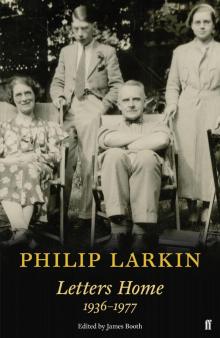
Philip larkin letters to.., p.46
Philip Larkin: Letters to Monica, page 46


32 Pearson Park, Hull
Dearest,
I don’t often write in bed! and shan’t, really, now – I’m not ill: it’s just that I thought I wished I could be in touch with you. Nicer of course if you were here with me. I love the way you prepare very carefully with brush & cream & scent, as if I weren’t there.
I had a dubious hour with Jane Bown, being photographed with ambulances – after The Q., I distrust all these efforts. Much to my annoyance she said Ted wouldn’t cooperate, except to be photographed – this made me feel very commercial and eager. Bah. She was a funny little woman. She carried, but didn’t use, a Rollei: I sneaked a look inside at the lenses & they were filthy. So much for professionals.
I have been doing my jazz article last night & tonight, so that’s off my chest. Also finished reading E. Thomas, for the OB. I picked out about 10 – I’m deliberately assembling much more than I need, to give myself choice later. I still think he’s good. A poem Celandine seemed moving – I’ve never noticed it before. Do you know it?
Darling, I hope you feel better about the lost weekend. I didn’t realise you had things to do when I suggested you came. I expect I shall be with you almost as soon as this, all over you like a dog. I hope the traffic isn’t delaying – I shall have not to be impatient: truly. I suddenly found today I hadn’t licensed my car – am liable to jug, fines, God knows what. It ought to have been done in March!
Well, that was just a word – must settle down. Goodnight, dear bun – much love as always; very tender. […]
2 June 1966
32 Pearson Park, Hull
[…] Have spent the evening reading the first 200 or so pages of TH for the book1 – well, reading and skipping. I have marked a good many, though one or two, that I consider almost too much mine – or yours – I have left unmarked. It’s a strange experience: old TH can tweak the heartstrings more unerringly than anyone, yet I haven’t actually been tearful tonight, as I so often am. Perhaps the best ones are later, or I am insensitive. Of course it brings you close to me, as you always are, dear, though to be close in such a context is rather a bittersweet experience. Aren’t I writing cornily tonight! Perhaps I should scrap this sheet. No, I’ll stuff it in. It’s just that when I read Hardy my thoughts turn to you, in love. Wasn’t that article queer! I’ll be sorry if he really had a reason to be sad. I thought he was good precisely because he saw the sadness of life in the abstract. […]
1 Hardy’s poems for the Oxford Book of Twentieth-Century English Verse.
4 June 1966
32 Pearson Park, Hull
[…] I am putting in the markers thick and fast now – the book would be half Hardy if I had my way. ‘Crocus root’, ‘Hack of the Parade’, ‘Sally I see thee’, ‘Everybody else, then, going’, ‘Pet fowl come to knee’ – they come crowding in. I don’t know how I shall ever sort them out. Do you know ‘An Anniversary’? Page 441. Very powerful. […]
*
Sunday It’s about 1 pm, and I’ve just poured out the Sunday gin. Do you like the photograph? It’s a good example of a novice’s error – exposure geared to the background instead of the subject. It makes you look like something out of Moberly & Jourdain.1 Doesn’t the background look like a different picture, stuck on? ‘I became aware that a rabbit in a flowered dress was looking busily at a bed of lettuces a little way to the right – it wore what appeared to be sunglasses, as a kind of disguise, but these did not impede its swift working. Curiously, when I glanced again in a few minutes, I could discern no rabbit, and no lettuces …’ This is ye onlie trewe coppie, so if you want one, send it back & I’ll have one made. I do: want one, I mean.
Well, dig the Tryphena stuff2 in ye day’s Publick prints. I look forward to seeing the book. Joo think iss troo? as Kingsley’s joke used to run. A lot of it sounds pretty conjectural. Mind you, I’m prepared to consider that TS was the model for SB3, who is really too irritating not to have been a real person, but further than that I don’t go. I do feel they ought to produce more evidence than a family album photograph that the son existed. After all, I’ve seen a photograph of some unknown N Orleans trombonist labelled Kid Ory! But it would be disappointing to me if it were true – first, because I’ve always thought TH a non bastard, & secondly because I should hate him to have some reason for being gloomy – I thought he & he alone saw the inherent misery of life. If it is true I shall have to fall back on Barnes for the decency, & who for the second? Myself, perhaps. Still, there are some odd poems in the Hardy canon – autobiographical stuff one can’t account for. I don’t think I could ever write poems like that – one must make everything clear, present a picture or a story, not mutter about things you don’t want known. I can’t quite swallow that Midnight on the G W is about this son, either. It just isn’t the kind of poem one wd write about someone one knew anything about, do you think so? Hutchinson, 40/-. Awgh. Nice rabbity publisher, anyway. […]
1 In An Adventure (1911), Charlotte Moberly and Eleanor Jourdain claimed to have seen Marie Antoinette while visiting the Palace of Versailles in 1901.
2 ‘Concerning Tryphena Sparks’, in Providence and Mr Hardy by Lois Deacon and Terry Coleman, a book that floated many conjectures about Hardy’s life and relationships.
3 Sue Brideshead.
11 June 1966
32 Pearson Park, Hull
Dearest,
11.20 pm – have just upset a large tumbler of white wine over the carpet – all I had left, too! Awgh! Awwghgh! Have got out the Glenfyddich, or however you spell it, in compensation. I’m sorry you are slaving away at scripts. It must be a foul job. Let’s hope from teaching machines we proceed to examining machines – well, why not? Bloody sight easier to arrange, I’d say: Name the ‘odd man out’ of the following—
Oscar Wilde
E. M. Forster
John Galsworthy
Christopher Isherwood
(Answer: Oscar Wilde, he was b. in Ireland ogh ogh ogh fooled again) […]
Misprint in the CQ proof of my Hardy review1 – Far From the Madding Crows. Dr Pussy thinks, well, yes, they can be very irritating, standing gossiping when you want your next course.
*
Sunday Dull morning; I feel dull, depressed too, I suppose. I read the Hardy book yesterday & it depressed me rather, seeming to show as it does the shortness and sadness of life. There is a lot in it. I don’t know whether to buy a copy for myself – rather dear at 2 quid. Much time is taken in parallelling plots of books with suspected events – Elfrida & Knight & the other chap in A Pair of B. Eyes as Tryphena (not EL, despite the hair & riding), Hardy & Moule, for instance. It’s all rather a tour de force, with little concrete at the centre, but no doubt there is something there. […]
I do look forward to seeing you. I have been very unhappy all this year & still am – all this Hardy stuff seems to underline it. I agree about camels drinking.2 With me it’s rather different – I feel this isn’t natural to me, or kin – I don’t know why we can’t live our lives like everyone else. Reading abt TH binds me to you deeply, yet if the story is true he is just another writer – I find this depressing. Almost like DHL, really! ‘One sloughs one’s sicknesses in books.’ i.e. one retells real events to one’s own advantage ogh ogh. Darling, will you write again? If not, I’ll meet the 4.33 at 6.13 at St P’s. You’ll be in plenty of time. I love you, dear rabbit – Philip
1 L. reviewed Roy Morrell’s Thomas Hardy: The Will and the Way and Carl J. Weber’s Hardy of Wessex: His Life and Literary Career in the Critical Quarterly VIII, 2 (Summer 1966). The review was called ‘Wanted: Good Hardy Critic’, and it later appeared in Required Writing.
2 Monica had written in a letter dated 5 June 1966, from 1A Cross Road: ‘Are you writing to me? As you wrote a fortnight ago, how silly our lives are. Darling, I do feel lonely & wish for you. We had a nice time last weekend, but no, I can’t say I do feel the happier for it; why should I? Well, I suppose I do in that it is one more nice time to add to all our nice times, but it’s over now & that doesn’t make me happy; it isn’t like camels drinking, is it?’
8 October 1966
32 Pearson Park, Hull
I never got a reply from Terry.1 Haw haw.
Dearest,
Buses run lighted down Princes Avenue like school reports. ‘Fair Only.’ It is a misty evening. The flat is full of the smell of another lamb stew, smaller this time, & simpler (no kidney, I found them difficult & revolting to cut). Apart from it being later than I shd like, it’s a nice moment of time.
I was much relieved to get your letter this morning and to know you felt less distressed. I slept very badly last night thinking about it all. I don’t take any credit for this, for really my thoughts were mostly selfish, I suppose – dread of being forced into action. There isn’t any need to make my situation any better-sounding than it is: a self-centred person conducting an affair containing almost no responsibilities with one girl getting mixed up with another, heedless of the feelings of either. Well, not heedless, but not heedful enough to do anything about it, anyway. I suppose one reason I don’t find it easy to talk about it all is that it doesn’t bear talking about, if I’m to keep any self respect. I also find it painful.
The incident in July I half mentioned wasn’t really epoch-making: Maeve suddenly got very cross at my evident preoccupation with you & said she was going to clear out for 6 months, & if I decided I wanted her I could see if she was still available, and in the meantime she wd do what she liked & so on (as far as I can see she does that anyway). I didn’t really respond to this, & she found the separation so upsetting that she called it off, but it has left its mark. Then her holiday came, then mine, then hers again, then you, then this week we really haven’t had any coincident time free. I suppose we are wondering ‘how we stand’. You may wonder why I don’t end it, in my own interest as well as yours. Partly cowardice – I dread the scene. Partly kindness – if I’ve encouraged her to depend on me it seems cruel to turn her away. If she wanted to be free it wd be different. I could lose her completely easier than I could have her half-dependent. And it’s painful in a way to end something that however silly and inconsiderate did at one time seem a different kind of experience from anything hitherto. All the same, I think we are going in that direction. I only hope it can be done friendlily, because we do have to have a lot to do with each other anyway. Never have the Gods of the C. Headings2 been better exemplified: Don’t Touch the Female Staff.
I don’t expect all this seems particularly endearing to you – I say it because I never seem to say anything, & I sometimes think if you knew more you’d worry less.
*
Sunday. Well, I wonder. If I send this, dear, it is because I want to say something to you, & not seem to be trying to pretend the situation doesn’t exist. I wish it didn’t now. I was ashamed on holiday when Maeve’s letter or letters came, not because there was anything especially amorous in them, but for seeming so careless of your feelings & so bloody bad mannered, even. It was incredibly stupid & vulgar of me to spoil our holiday in such a way. I could quite easily have said I didn’t want any letters.
Darling, this seems far from the ‘nice’ letter you ask for: I am at home with you, & think you are delightful and irreplaceable: I hate it when you go, for the dreary failure & selfishness on my part it seems to symbolise – this is nothing to do with Maeve, you’ve always come before her: it’s my own unwillingness to give myself to anyone else that’s at fault – like promising to stand on one leg for the rest of one’s life. And yet I never think I am doing anything but ruin your life & mine. I suppose one shouldn’t be writing letters like this at 44, one ought to have got it all sorted out twenty years ago.
Let me try to write nicely for compensation – dear lovely rabbit, my large white, my lettuce-eater (‘Courage!’ she said, or Courrège I suppose). I ate the lamb stew for lunch: it was simpler than yours, but quite all right. I’m not in much of an eating mood, though. I am persevering with my no-gin & little milk campaign, & have lost about 3 pounds, but don’t see any progress beyond this point. One splendid morning I was down nearly to 13st 7 lbs again, but it didn’t last. How are you getting on? I think of you padding about, leaving the bathroom strewn with powder. The bed continues, but I couldn’t say it was a dream of comfort: dream of your granny. I wake up & lie wretchedly as of yore. I feel quite tired now, sleepy: I really need an after dinner sleep regularly. Are you sleeping all right? […]
1 Arthur Terry, Lecturer and eventually Professor of Spanish at Queen’s University, Belfast.
2 The Kipling poem, ‘The Gods of the Copybook Headings’.
13 October 1966
32 Pearson Park, Hull
My dear,
It’s only with difficulty that I bring myself to lay down C. S. Lewis’s Letters, & write to you. You know I meant to bring them on holiday. They are really most interesting, (a) because of his odd private life (b) because he is an English teacher (c) because he is of our time. By the first I mean only that at an early age – about 25 – he took to living with the mother of a friend of his who had been killed, & her daughter – Mrs Moore – and referring to her as ‘mother’ & the house as ‘home’, although he had a home & a father (not a mother) in N. Ireland. He kept this up till his early 50’s, doing housework & putting up with Mrs Moore, who was not bookish or clever or even particularly agreeable. There is no hint that the daughter came into it. What can have led him into such a strange association?
It’s a nice life, being good at being fond of books. You watch him golloping them down, & getting a living out of it, & finding more books to gollop. I wish I could have done it. I don’t think I really liked books, not old books anyway. I could never feel that Chaucer was as real as the Daily Mail, & so I was never an academic. He became a Fellow of Magdalen at abt 27. The President said a lot of Latin over him (him kneeling on a red cushion & everyone standing round) for abt 5 minutes, then stopped. No one had told him what to do. After a moment he ventured ‘Do fidem’, wch seemed to go down all right. Of course he’d understood ⅔rds of the Latin, but even so I think it was pretty sharp of him. I have got about halfway, just up to 1940: not too much religion so far.
I’m slowly getting to like my bed (perhaps I’m hollowing out a place in it – I don’t think so): I slept beautifully last night till about 7.15 a.m., very good. It isn’t in my nature to like it immediately. As you say, the not-having-to-make-it is a joy.
I got 10 gns for that Urban blues review. Also Fabers sent a 6 months’ a/c up to 30 June – Jill doing poorly, only 70 copies or so sold, TWW doing well, 543 copies, almost 3 a day. In all, 7210 copies (& 3225 in U.S.), total takings about £520, leaving US out. That’s success in poetry. Of course that’s just royalties, not anthology fees. Still. Pardon this excursion into Arnold Bennett land. […]
I have been worrying lest my Sunday letter has antagonised or upset you.1 It was written in some stress. More probably it just repelled you: I’m sorry. These personal letters aren’t really a success. I have said to Maeve that I should like things to be cooler: not much consequence. We are all still too busy to see anything of each other even if we wanted to. Under C. S. Lewis’s influence I feel attracted to the life of the study – I sound like Boswell. Anyway, don’t let it trouble you – it isn’t meant to – and don’t refer to it if you don’t want to. […]
How is the work you weren’t looking forward to, that 2-hour class, for instance? Is it this term? I do hope it isn’t a bother. I look forward to hearing from you, dear: my efforts to bring us closer seem to have had less success than I meant, but you are always very near to me – I am surrounded by so many things you have a part in, & that I can’t see without thinking of you. Even the dear caboc, now nearly gone – how easily it goes! Swiftly comes & swiftly goes. And the bed too: large & meant for your greater ease, mine too of course. I must go to it, with C. S. Lewis. Goodnight, dear. […]
1 i.e., the letter dated 8 October 1966.
30 October 1966
32 Pearson Park, Hull
My dear,
I have put the mauve sheets on the bed, which means it’s a month since you were here & the bed came. They look very pretty – I shall have to wear the mauve pyjamas to match. This has been an odd day: I went ‘in’ in the morning to clear up some work, and after lunch was about to dash off a short note to you when I was seized with a desire to see you – I leapt into the car (at 2.45!) and drove into the greying West. Well, of course, it was all very silly: when I reached Bawtry I realised I had only 26/-& needed lots more petrol – and if by any chance you shouldn’t have been there … It was four o’clock and mists were beginning to gather, so I turned round and came home. It would have meant six hours driving for 2 hours meeting! Yet if I’d had plenty of money I might have persisted. I got back here about a quarter to six, having spent the afternoon driving 100 of the dullest miles in the neighbourhood. A misguided impulse, yet I did want to see you: not about anything, just as a comfort. I wonder if I’d have found you in, if I’d arrived about 5.45? Perhaps you’d have been alarmed at a caller. Shall I try to call in on my way home on Thursday? It won’t be for very long – an hour, perhaps. But I know I shall long to overshoot L’borough and come to see you. Will you be there, about seven, six or seven? Or will you be at some theatrical production?
I feel rather scared these days, of time passing & us getting older. Our lives are so different from other people’s, or have been, – I feel I am landed on my 45th year as if washed up on a rock, not knowing how I got here or ever having had a chance of being anywhere else. Indeed, when I think of being in my twenties, or my thirties, I can’t call up any solid different image, typical & unshakable. Twenties… 1942 to 1951 … Thirties … 1952 to 1961 … Of course my external surroundings have changed, but inside I’ve been the same, trying to hold everything off in order to ‘write’. Anyone wd think I was Tolstoy, the value I put on it. It hasn’t amounted to much. I mean, I know I’ve been successful in that I’ve made a name & got a medal & so on, but it’s a very small achievement to set against all the rest. This is Dockery & Son again – I shall spend the rest of my life trying to get away from that poem. […]
Dearest,
I don’t often write in bed! and shan’t, really, now – I’m not ill: it’s just that I thought I wished I could be in touch with you. Nicer of course if you were here with me. I love the way you prepare very carefully with brush & cream & scent, as if I weren’t there.
I had a dubious hour with Jane Bown, being photographed with ambulances – after The Q., I distrust all these efforts. Much to my annoyance she said Ted wouldn’t cooperate, except to be photographed – this made me feel very commercial and eager. Bah. She was a funny little woman. She carried, but didn’t use, a Rollei: I sneaked a look inside at the lenses & they were filthy. So much for professionals.
I have been doing my jazz article last night & tonight, so that’s off my chest. Also finished reading E. Thomas, for the OB. I picked out about 10 – I’m deliberately assembling much more than I need, to give myself choice later. I still think he’s good. A poem Celandine seemed moving – I’ve never noticed it before. Do you know it?
Darling, I hope you feel better about the lost weekend. I didn’t realise you had things to do when I suggested you came. I expect I shall be with you almost as soon as this, all over you like a dog. I hope the traffic isn’t delaying – I shall have not to be impatient: truly. I suddenly found today I hadn’t licensed my car – am liable to jug, fines, God knows what. It ought to have been done in March!
Well, that was just a word – must settle down. Goodnight, dear bun – much love as always; very tender. […]
2 June 1966
32 Pearson Park, Hull
[…] Have spent the evening reading the first 200 or so pages of TH for the book1 – well, reading and skipping. I have marked a good many, though one or two, that I consider almost too much mine – or yours – I have left unmarked. It’s a strange experience: old TH can tweak the heartstrings more unerringly than anyone, yet I haven’t actually been tearful tonight, as I so often am. Perhaps the best ones are later, or I am insensitive. Of course it brings you close to me, as you always are, dear, though to be close in such a context is rather a bittersweet experience. Aren’t I writing cornily tonight! Perhaps I should scrap this sheet. No, I’ll stuff it in. It’s just that when I read Hardy my thoughts turn to you, in love. Wasn’t that article queer! I’ll be sorry if he really had a reason to be sad. I thought he was good precisely because he saw the sadness of life in the abstract. […]
1 Hardy’s poems for the Oxford Book of Twentieth-Century English Verse.
4 June 1966
32 Pearson Park, Hull
[…] I am putting in the markers thick and fast now – the book would be half Hardy if I had my way. ‘Crocus root’, ‘Hack of the Parade’, ‘Sally I see thee’, ‘Everybody else, then, going’, ‘Pet fowl come to knee’ – they come crowding in. I don’t know how I shall ever sort them out. Do you know ‘An Anniversary’? Page 441. Very powerful. […]
*
Sunday It’s about 1 pm, and I’ve just poured out the Sunday gin. Do you like the photograph? It’s a good example of a novice’s error – exposure geared to the background instead of the subject. It makes you look like something out of Moberly & Jourdain.1 Doesn’t the background look like a different picture, stuck on? ‘I became aware that a rabbit in a flowered dress was looking busily at a bed of lettuces a little way to the right – it wore what appeared to be sunglasses, as a kind of disguise, but these did not impede its swift working. Curiously, when I glanced again in a few minutes, I could discern no rabbit, and no lettuces …’ This is ye onlie trewe coppie, so if you want one, send it back & I’ll have one made. I do: want one, I mean.
Well, dig the Tryphena stuff2 in ye day’s Publick prints. I look forward to seeing the book. Joo think iss troo? as Kingsley’s joke used to run. A lot of it sounds pretty conjectural. Mind you, I’m prepared to consider that TS was the model for SB3, who is really too irritating not to have been a real person, but further than that I don’t go. I do feel they ought to produce more evidence than a family album photograph that the son existed. After all, I’ve seen a photograph of some unknown N Orleans trombonist labelled Kid Ory! But it would be disappointing to me if it were true – first, because I’ve always thought TH a non bastard, & secondly because I should hate him to have some reason for being gloomy – I thought he & he alone saw the inherent misery of life. If it is true I shall have to fall back on Barnes for the decency, & who for the second? Myself, perhaps. Still, there are some odd poems in the Hardy canon – autobiographical stuff one can’t account for. I don’t think I could ever write poems like that – one must make everything clear, present a picture or a story, not mutter about things you don’t want known. I can’t quite swallow that Midnight on the G W is about this son, either. It just isn’t the kind of poem one wd write about someone one knew anything about, do you think so? Hutchinson, 40/-. Awgh. Nice rabbity publisher, anyway. […]
1 In An Adventure (1911), Charlotte Moberly and Eleanor Jourdain claimed to have seen Marie Antoinette while visiting the Palace of Versailles in 1901.
2 ‘Concerning Tryphena Sparks’, in Providence and Mr Hardy by Lois Deacon and Terry Coleman, a book that floated many conjectures about Hardy’s life and relationships.
3 Sue Brideshead.
11 June 1966
32 Pearson Park, Hull
Dearest,
11.20 pm – have just upset a large tumbler of white wine over the carpet – all I had left, too! Awgh! Awwghgh! Have got out the Glenfyddich, or however you spell it, in compensation. I’m sorry you are slaving away at scripts. It must be a foul job. Let’s hope from teaching machines we proceed to examining machines – well, why not? Bloody sight easier to arrange, I’d say: Name the ‘odd man out’ of the following—
Oscar Wilde
E. M. Forster
John Galsworthy
Christopher Isherwood
(Answer: Oscar Wilde, he was b. in Ireland ogh ogh ogh fooled again) […]
Misprint in the CQ proof of my Hardy review1 – Far From the Madding Crows. Dr Pussy thinks, well, yes, they can be very irritating, standing gossiping when you want your next course.
*
Sunday Dull morning; I feel dull, depressed too, I suppose. I read the Hardy book yesterday & it depressed me rather, seeming to show as it does the shortness and sadness of life. There is a lot in it. I don’t know whether to buy a copy for myself – rather dear at 2 quid. Much time is taken in parallelling plots of books with suspected events – Elfrida & Knight & the other chap in A Pair of B. Eyes as Tryphena (not EL, despite the hair & riding), Hardy & Moule, for instance. It’s all rather a tour de force, with little concrete at the centre, but no doubt there is something there. […]
I do look forward to seeing you. I have been very unhappy all this year & still am – all this Hardy stuff seems to underline it. I agree about camels drinking.2 With me it’s rather different – I feel this isn’t natural to me, or kin – I don’t know why we can’t live our lives like everyone else. Reading abt TH binds me to you deeply, yet if the story is true he is just another writer – I find this depressing. Almost like DHL, really! ‘One sloughs one’s sicknesses in books.’ i.e. one retells real events to one’s own advantage ogh ogh. Darling, will you write again? If not, I’ll meet the 4.33 at 6.13 at St P’s. You’ll be in plenty of time. I love you, dear rabbit – Philip
1 L. reviewed Roy Morrell’s Thomas Hardy: The Will and the Way and Carl J. Weber’s Hardy of Wessex: His Life and Literary Career in the Critical Quarterly VIII, 2 (Summer 1966). The review was called ‘Wanted: Good Hardy Critic’, and it later appeared in Required Writing.
2 Monica had written in a letter dated 5 June 1966, from 1A Cross Road: ‘Are you writing to me? As you wrote a fortnight ago, how silly our lives are. Darling, I do feel lonely & wish for you. We had a nice time last weekend, but no, I can’t say I do feel the happier for it; why should I? Well, I suppose I do in that it is one more nice time to add to all our nice times, but it’s over now & that doesn’t make me happy; it isn’t like camels drinking, is it?’
8 October 1966
32 Pearson Park, Hull
I never got a reply from Terry.1 Haw haw.
Dearest,
Buses run lighted down Princes Avenue like school reports. ‘Fair Only.’ It is a misty evening. The flat is full of the smell of another lamb stew, smaller this time, & simpler (no kidney, I found them difficult & revolting to cut). Apart from it being later than I shd like, it’s a nice moment of time.
I was much relieved to get your letter this morning and to know you felt less distressed. I slept very badly last night thinking about it all. I don’t take any credit for this, for really my thoughts were mostly selfish, I suppose – dread of being forced into action. There isn’t any need to make my situation any better-sounding than it is: a self-centred person conducting an affair containing almost no responsibilities with one girl getting mixed up with another, heedless of the feelings of either. Well, not heedless, but not heedful enough to do anything about it, anyway. I suppose one reason I don’t find it easy to talk about it all is that it doesn’t bear talking about, if I’m to keep any self respect. I also find it painful.
The incident in July I half mentioned wasn’t really epoch-making: Maeve suddenly got very cross at my evident preoccupation with you & said she was going to clear out for 6 months, & if I decided I wanted her I could see if she was still available, and in the meantime she wd do what she liked & so on (as far as I can see she does that anyway). I didn’t really respond to this, & she found the separation so upsetting that she called it off, but it has left its mark. Then her holiday came, then mine, then hers again, then you, then this week we really haven’t had any coincident time free. I suppose we are wondering ‘how we stand’. You may wonder why I don’t end it, in my own interest as well as yours. Partly cowardice – I dread the scene. Partly kindness – if I’ve encouraged her to depend on me it seems cruel to turn her away. If she wanted to be free it wd be different. I could lose her completely easier than I could have her half-dependent. And it’s painful in a way to end something that however silly and inconsiderate did at one time seem a different kind of experience from anything hitherto. All the same, I think we are going in that direction. I only hope it can be done friendlily, because we do have to have a lot to do with each other anyway. Never have the Gods of the C. Headings2 been better exemplified: Don’t Touch the Female Staff.
I don’t expect all this seems particularly endearing to you – I say it because I never seem to say anything, & I sometimes think if you knew more you’d worry less.
*
Sunday. Well, I wonder. If I send this, dear, it is because I want to say something to you, & not seem to be trying to pretend the situation doesn’t exist. I wish it didn’t now. I was ashamed on holiday when Maeve’s letter or letters came, not because there was anything especially amorous in them, but for seeming so careless of your feelings & so bloody bad mannered, even. It was incredibly stupid & vulgar of me to spoil our holiday in such a way. I could quite easily have said I didn’t want any letters.
Darling, this seems far from the ‘nice’ letter you ask for: I am at home with you, & think you are delightful and irreplaceable: I hate it when you go, for the dreary failure & selfishness on my part it seems to symbolise – this is nothing to do with Maeve, you’ve always come before her: it’s my own unwillingness to give myself to anyone else that’s at fault – like promising to stand on one leg for the rest of one’s life. And yet I never think I am doing anything but ruin your life & mine. I suppose one shouldn’t be writing letters like this at 44, one ought to have got it all sorted out twenty years ago.
Let me try to write nicely for compensation – dear lovely rabbit, my large white, my lettuce-eater (‘Courage!’ she said, or Courrège I suppose). I ate the lamb stew for lunch: it was simpler than yours, but quite all right. I’m not in much of an eating mood, though. I am persevering with my no-gin & little milk campaign, & have lost about 3 pounds, but don’t see any progress beyond this point. One splendid morning I was down nearly to 13st 7 lbs again, but it didn’t last. How are you getting on? I think of you padding about, leaving the bathroom strewn with powder. The bed continues, but I couldn’t say it was a dream of comfort: dream of your granny. I wake up & lie wretchedly as of yore. I feel quite tired now, sleepy: I really need an after dinner sleep regularly. Are you sleeping all right? […]
1 Arthur Terry, Lecturer and eventually Professor of Spanish at Queen’s University, Belfast.
2 The Kipling poem, ‘The Gods of the Copybook Headings’.
13 October 1966
32 Pearson Park, Hull
My dear,
It’s only with difficulty that I bring myself to lay down C. S. Lewis’s Letters, & write to you. You know I meant to bring them on holiday. They are really most interesting, (a) because of his odd private life (b) because he is an English teacher (c) because he is of our time. By the first I mean only that at an early age – about 25 – he took to living with the mother of a friend of his who had been killed, & her daughter – Mrs Moore – and referring to her as ‘mother’ & the house as ‘home’, although he had a home & a father (not a mother) in N. Ireland. He kept this up till his early 50’s, doing housework & putting up with Mrs Moore, who was not bookish or clever or even particularly agreeable. There is no hint that the daughter came into it. What can have led him into such a strange association?
It’s a nice life, being good at being fond of books. You watch him golloping them down, & getting a living out of it, & finding more books to gollop. I wish I could have done it. I don’t think I really liked books, not old books anyway. I could never feel that Chaucer was as real as the Daily Mail, & so I was never an academic. He became a Fellow of Magdalen at abt 27. The President said a lot of Latin over him (him kneeling on a red cushion & everyone standing round) for abt 5 minutes, then stopped. No one had told him what to do. After a moment he ventured ‘Do fidem’, wch seemed to go down all right. Of course he’d understood ⅔rds of the Latin, but even so I think it was pretty sharp of him. I have got about halfway, just up to 1940: not too much religion so far.
I’m slowly getting to like my bed (perhaps I’m hollowing out a place in it – I don’t think so): I slept beautifully last night till about 7.15 a.m., very good. It isn’t in my nature to like it immediately. As you say, the not-having-to-make-it is a joy.
I got 10 gns for that Urban blues review. Also Fabers sent a 6 months’ a/c up to 30 June – Jill doing poorly, only 70 copies or so sold, TWW doing well, 543 copies, almost 3 a day. In all, 7210 copies (& 3225 in U.S.), total takings about £520, leaving US out. That’s success in poetry. Of course that’s just royalties, not anthology fees. Still. Pardon this excursion into Arnold Bennett land. […]
I have been worrying lest my Sunday letter has antagonised or upset you.1 It was written in some stress. More probably it just repelled you: I’m sorry. These personal letters aren’t really a success. I have said to Maeve that I should like things to be cooler: not much consequence. We are all still too busy to see anything of each other even if we wanted to. Under C. S. Lewis’s influence I feel attracted to the life of the study – I sound like Boswell. Anyway, don’t let it trouble you – it isn’t meant to – and don’t refer to it if you don’t want to. […]
How is the work you weren’t looking forward to, that 2-hour class, for instance? Is it this term? I do hope it isn’t a bother. I look forward to hearing from you, dear: my efforts to bring us closer seem to have had less success than I meant, but you are always very near to me – I am surrounded by so many things you have a part in, & that I can’t see without thinking of you. Even the dear caboc, now nearly gone – how easily it goes! Swiftly comes & swiftly goes. And the bed too: large & meant for your greater ease, mine too of course. I must go to it, with C. S. Lewis. Goodnight, dear. […]
1 i.e., the letter dated 8 October 1966.
30 October 1966
32 Pearson Park, Hull
My dear,
I have put the mauve sheets on the bed, which means it’s a month since you were here & the bed came. They look very pretty – I shall have to wear the mauve pyjamas to match. This has been an odd day: I went ‘in’ in the morning to clear up some work, and after lunch was about to dash off a short note to you when I was seized with a desire to see you – I leapt into the car (at 2.45!) and drove into the greying West. Well, of course, it was all very silly: when I reached Bawtry I realised I had only 26/-& needed lots more petrol – and if by any chance you shouldn’t have been there … It was four o’clock and mists were beginning to gather, so I turned round and came home. It would have meant six hours driving for 2 hours meeting! Yet if I’d had plenty of money I might have persisted. I got back here about a quarter to six, having spent the afternoon driving 100 of the dullest miles in the neighbourhood. A misguided impulse, yet I did want to see you: not about anything, just as a comfort. I wonder if I’d have found you in, if I’d arrived about 5.45? Perhaps you’d have been alarmed at a caller. Shall I try to call in on my way home on Thursday? It won’t be for very long – an hour, perhaps. But I know I shall long to overshoot L’borough and come to see you. Will you be there, about seven, six or seven? Or will you be at some theatrical production?
I feel rather scared these days, of time passing & us getting older. Our lives are so different from other people’s, or have been, – I feel I am landed on my 45th year as if washed up on a rock, not knowing how I got here or ever having had a chance of being anywhere else. Indeed, when I think of being in my twenties, or my thirties, I can’t call up any solid different image, typical & unshakable. Twenties… 1942 to 1951 … Thirties … 1952 to 1961 … Of course my external surroundings have changed, but inside I’ve been the same, trying to hold everything off in order to ‘write’. Anyone wd think I was Tolstoy, the value I put on it. It hasn’t amounted to much. I mean, I know I’ve been successful in that I’ve made a name & got a medal & so on, but it’s a very small achievement to set against all the rest. This is Dockery & Son again – I shall spend the rest of my life trying to get away from that poem. […]