The bookbinder of jerich.., p.1
The Bookbinder of Jericho, page 1


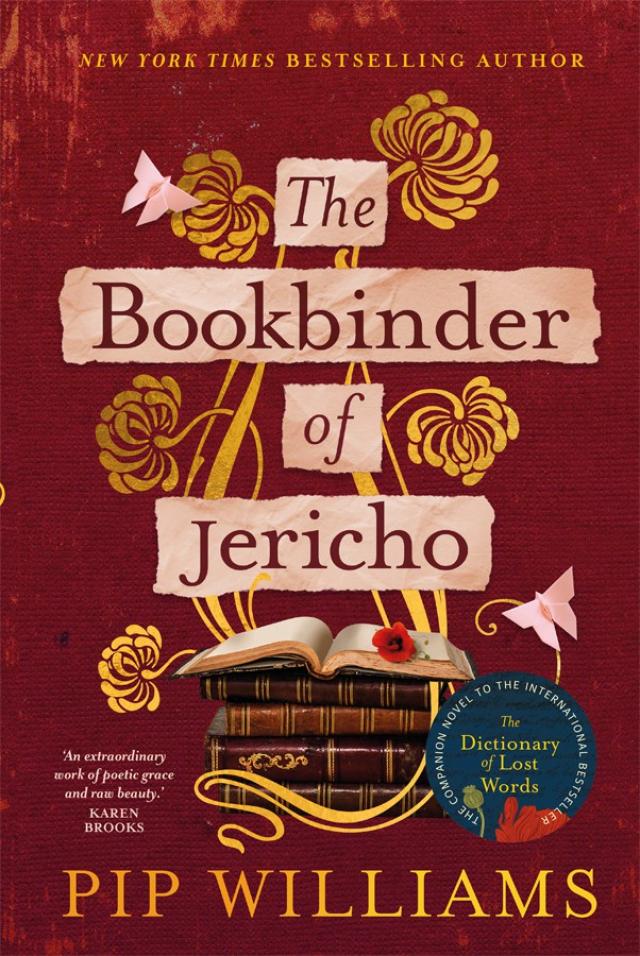
Pip Williams was born in London, grew up in Sydney and now lives in the Adelaide Hills of South Australia with her family and an assortment of animals. She has spent most of her working life as a social researcher, studying what keeps us well and what helps us thrive, and she is the author of One Italian Summer, a memoir of her family’s travels in search of the good life, which was published by Affirm Press to wide acclaim. Her first novel, The Dictionary of Lost Words, based on her original research in the Oxford English Dictionary archives, was published in 2020 and became an international bestseller. The Bookbinder of Jericho is her second novel, a companion to The Dictionary of Lost Words, and again combines her talents for historical research and beautiful storytelling.
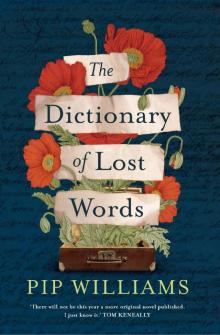
PRAISE FOR THE DICTIONARY OF LOST WORDS
‘From this quirky lexicographical incident Pip Williams has conjured an extraordinary, charming novel … Williams pins a whole, rich life to the page.’ The Times (UK)
‘What a novel of words, their adventure and their capacity to define and, above all, challenge the world. There will not be this year a more original novel published. I just know it.’ Tom Keneally
‘Full of heart and tenderness, heartbreak and joy, love and loss … this is the perfect iso read.’ Herald Sun
‘The debut novelist who’s become a lockdown sensation.’
Guardian Australia
‘This absorbing, quietly revolutionary novel … is deeply, intrinsically kind … A profoundly comforting place to dwell.’ The Age
‘In the annals of lexicography, no more imaginative, delightful, charming and clever book has yet been written.’ Simon Winchester
‘Pip Williams has spun a marvelous fiction about the power of language to elevate or repress … It is at once timely and timeless.’
Geraldine Brooks
‘The biggest treat of The Dictionary of Lost Words is the complexity of a central character who is not easy to classify – a listener with an innate understanding of the life-changing importance of valuing people’s words.’ The Saturday Paper
PRAISE FOR THE BOOKBINDER OF JERICHO
‘I’ve longed to return to Williams’ distinctive blend of riveting historical detail and brilliant women. The Bookbinder of Jericho is everything I wanted and more.’
Toni Jordan
‘The Bookbinder of Jericho is an extraordinary work of poetic grace and raw beauty that will enfold readers in its powerful and moving narrative. A stunning companion to The Dictionary of Lost Words, this book is a classic and another triumph for Pip Williams.’
Karen Brooks
‘After finishing Pip’s beautiful book I had to wander along my shelves, taking my old books out and turning them over to see how they had been stitched together. The Bookbinder of Jericho will teach you things you’ll never forget – not just about how books were made, but who the women were who made them. Rich, deep and fascinating, it’s what all novels should be – a companion for life.’
Tegan Bennett Daylight
‘Heart wrenching and bittersweet, The Bookbinder of Jericho is a lovingly woven story of hardship, longing and hope. Pip Williams writes with great insight and fascinating detail of working-class women, the war effort and World War I refugees. It was such a pleasure to spend time with these completely charming women.’
Mirandi Riwoe
First published by Affirm Press in 2023
Boon Wurrung Country
28 Thistlethwaite Street
South Melbourne VIC 3205
affirmpress.com.au
Text copyright © Pip Williams, 2023
All rights reserved. No part of this publication may be reproduced without prior written permission from the publisher.
ISBN: 9781922806628 (paperback)
Cover design by Andy Warren © Affirm Press
Map and map illustrations by Mike Hall
Author photo by Andre Goosen
Typeset in 12/18pt Minion Pro by Post Pre-Press Group
For my sister,
Nicola
‘Now goddess, child of Zeus, tell the old story for our modern
times. Find the beginning.’
Homer, The Odyssey, translated by Emily Wilson
Before
Scraps. That’s all I got. Fragments that made no sense without the words before or the words after.
We were folding The Complete Works of William Shakespeare and I’d scanned the first page of the editor’s preface a hundred times. The last line on the page rang in my mind, incomplete and teasing. I have only ventured to deviate where it seemed to me that …
Ventured to deviate. My eye caught the phrase each time I folded a section.
Where it seemed to me that …
That what? I thought. Then I’d start on another sheet.
First fold: The Complete Works of William Shakespeare. Second fold: Edited by WJ Craig. Third fold: ventured to bloody deviate.
My hand hovered as I read that last line and tried to guess at the rest.
WJ Craig changed Shakespeare, I thought. Where it seemed to him that …
I grew desperate to know.
I glanced around the bindery, along the folding bench piled with quires of sheets and folded sections. I looked at Maude.
She couldn’t care less about the words on the page. I could hear her humming a little tune, each fold marking time like the second hand of a clock. Folding was her favourite job, and she could fold better than anyone, but that didn’t stop mistakes. Folding tangents, Ma used to call them. Folds of her own design and purpose. From the corner of my eye, I’d sense a change in rhythm. It was easy enough to reach over, stay her hand. She understood. She wasn’t simple, despite what people thought. And if I missed the signs? Well, a section ruined. It could happen to any of us with the slip of a bonefolder. But we’d notice. We’d put the damaged section aside. My sister never did. And so I had to.
Keep an eye.
Watch over.
Deep breath.
Dear Maude. I love you, I really do. But sometimes … This is how my mind ran.
Already I could see a folded section in Maude’s pile that didn’t sit square. I’d remove it later. She wouldn’t know, and neither would Mrs Hogg. There’d be no need for tutting.
The only thing that could upset the applecart at that moment was me.
If I didn’t find out why WJ Craig had changed Shakespeare, I thought I might scream. I raised my hand.
‘Yes, Miss Jones?’
‘Lavatory, Mrs Hogg.’
She nodded.
I finished the fold I’d started and waited for Mrs Hogg to drift away. Mrs Hogg, the freckly frog. Maude had said it out loud once and I’d never been forgiven. She had no trouble telling us apart, but as far as Mrs Hogg was concerned, Maude and I were one and the same.
‘Back in a mo, Maudie.’
‘Back in a mo,’ she said.
Lou was folding the second section. As I passed behind her chair, I leant over her shoulder. ‘Can you stop for a second?’ I said.
‘I thought you were desperate for the lav.’
‘Of course not. I just need to know what it says.’
She paused long enough for me to read the end of the sentence. I added it to what I knew and whispered it to myself: ‘I have only ventured to deviate where it seemed to me that the carelessness of either copyist or printer deprived a word or sentence wholly of meaning.’
‘Can I keep folding now, Peggy?’ Lou asked.
‘Yes, you can, Louise,’ said Mrs Hogg.
Lou blushed and gave me a look.
‘Miss Jones …’
Mrs Hogg had been at school with Ma and she’d known me since Maude and I were newborns. Still, Miss Jones. The emphasis on Ma’s maiden name, just in case anyone in the bindery had forgotten her disgrace.
‘Your job is to bind the books, not read them …’
She kept talking but I stopped listening. I’d heard it a hundred times. The sheets were there to be folded not read, the sections gathered not read, the text blocks sewn not read – and for the hundredth time I thought that reading the pages was the only thing that made the rest tolerable. I have only ventured to deviate where it seemed to me that the carelessness of either copyist or printer deprived a word or sentence wholly of meaning.
Mrs Hogg raised her finger, and I wondered what response I had failed to give. She was going red in the face, the way she invariably did. Then our forewoman interrupted.
‘Peggy, as you are up, I wonder if you could run an errand for me?’ Mrs Stoddard turned a smile on the floor supervisor. ‘I’m sure you can spare her for ten minutes, Mrs Hogg?’
Freckly frog nodded and continued down the line of girls without another glance at me. I looked toward my sister.
‘Maude will be fine,’ said Mrs Stoddard.
We walked the length of the bindery, and Mrs Stoddard stopped occasionally to encourage one of the younger girls or to advise on posture if she saw someone slouching. When we got to her office, she picked up a book, newly bound, lettered in gold so shiny it looked wet.
The Oxford Book of English Verse, 1250–1900. We printed it almost every year.
‘Has no one written a poem since 1900?’ I asked.
Mrs Stoddard suppressed a smile. ‘The Controller will want to see how the latest print run has turned out.’ She handed me the book. ‘The walk to his office should relieve your boredom.’
I held the book to my nose: clean leather and the fading scent of ink and glue. I never tired of it. It was the fres
I walked back slowly between two long rows of benches piled with flat printed sheets and folded sections. Women and girls were bent to the task of transforming one to the other, and I had been given a moment’s reprieve. I started to open the book when a freckly hand covered mine and pushed the book shut.
‘It won’t do to have the spine creased,’ said Mrs Hogg. ‘Not by the likes of you, Miss Jones.’
I took my time walking through the corridors of the Clarendon Press.
Mr Hart had a visitor: her words were escaping the privacy of their conversation. She was young, well spoken, with a faint hint of the Midlands. I lightened my tread so as not to scare the words into silence.
‘And what does your father think?’ asked Mr Hart.
I paused just outside the office door. It was half-open and I could see her fashionable shoes and slim ankles below a straight lilac skirt. A long matching jacket.
‘He was reluctant but eventually persuaded.’
‘He’s a businessman. Practical. He didn’t need a degree to make a success of milling paper. He probably can’t see the point for a young woman.’
‘No, he can’t,’ she said, and I felt her frustration. ‘So I must show him the point by making it worthwhile.’
‘And when will you come up to Oxford?’
‘September. Just before Michaelmas term. I’m coming up to Somerville, so we’ll be neighbours.’
Somerville. Every morning, I imagined leaving Maude at the entrance to the Press and walking across the road and into the porter’s lodge of Somerville College. I imagined the quad and the library and a desk in one of the rooms that overlooked Walton Street. I imagined spending my days reading books instead of binding them. I imagined, for a moment, that there was no need for me to earn an income and that Maude could fend for herself.
‘And what will you read?’
There was an answer on the tip of my tongue, but the young woman stole it.
‘English. I want to be a writer.’
‘Well, perhaps one day we will have the privilege of printing your work.’
‘Perhaps you will, Mr Hart. I look forward to seeing my name among your first editions.’
There was a hush, not uncomfortable, and I knew they were looking at the Controller’s bookshelf, at all the first editions with their pristine leather spines and gold-leaf lettering. The book in my hand asserted itself. I’d almost forgotten why I was there.
‘Give my regards to your father, Miss Brittain.’
‘I will, Mr Hart.’
The door swung open and I had no time to step back, so for a moment we stood eye to eye. Miss Brittain might have been nineteen or twenty, twenty-one perhaps, the same age as me. She was my height and just as slender, and she was pretty, despite her mousy hair. Lilac suited her well, I thought, and I wondered what she might think of me. Pretty, no doubt; everyone said so. Hair as dark as the canal at night and eyes to match, like Ma’s. Though my nose was different: a little too big. I might not have been so conscious of it except I saw it in profile when I looked at Maude.
It was just a moment, but sometimes that’s all it takes – I could see there was something steely in Miss Brittain’s expression: a determination. We could be friends, I thought.
She seemed to know better. She was not rude, but there were protocols. She saw the apron of a bindery girl over a plain brown cotton-drill skirt and a wash-worn blouse, sleeves rolled up to the elbows. She smiled and nodded, then walked away along the corridor.
I knocked on the open door and Mr Hart looked up from his desk. I’d been seven years at the Press and never seen him smile, but one now lingered around the corners of his mouth. When he realised I was not Miss Brittain returned, it retreated. He motioned for me to come in but returned his attention to the ledger on his desk.
My ten minutes had run down, but it was not my place to interrupt. I looked beyond Mr Hart and out the window. There she was, Miss Brittain, crossing Walton Street. She stopped on the pavement and looked up at the windows of Somerville College. She stayed there for some time, and people were forced to walk around her. In that moment, I felt her excitement. She was wondering if one of those windows would be hers. She was imagining the desk overlooking the street and all the books she would read.
And then there was a tightness in my chest. A familiar resentment. Perhaps Mrs Hogg knew the truth of things and I had no right to read the books I bound, or imagine myself anywhere but Jericho, or contemplate for one moment that I could ever have a life beyond Maude. The book started to feel heavy in my hands, and I was surprised I’d been entrusted with it at all.
And then I was angry.
I opened The Oxford Book of English Verse and heard the spine crack. I turned the pages – John Barbour, Geoffrey Chaucer, Robert Henryson, William Dunbar, Anonymous, Anonymous. If they had names, might they be Anna or Mary or Lucy or Peg? I looked up and saw the Controller staring at me.
For a moment I thought he might ask what I thought. But he simply held out his hand for the book. I hesitated and he raised his eyebrows. It was enough. I put the book in his hand. He nodded and looked down at his ledger.
Without a word, I was dismissed.
Chapter One
The paperboys shouted the news all over Jericho; our walk to work was noisy with it. ‘Defend Belgian neutrality,’ Maude repeated. ‘Support France.’ She said it all, just as the paperboys did, over and over.
When we stopped at Turner’s Newsagency to collect our post, the counter was crowded with people buying newspapers.
‘Nothing this morning, Miss Jones,’ Mr Turner said when he finally saw me. I picked up a copy of the Daily Mail and handed over a halfpenny. Mr Turner raised his eyebrows; I’d never bought the paper before. Waste of a halfpenny, Ma used to say. There were always papers lying around at the Press.
Maude scanned the front page as we walked along Walton Street. ‘Great Britain declares war on Germany?’ It was a headline and a question – she was confused by the celebrating of young men and the worry she saw on the brows of their mothers. But was she asking what war would mean for England or what it might mean for us?
‘We’ll be all right, Maudie.’ I squeezed her hand. ‘But some things may change.’ I hoped they would and felt a little guilty, but not a lot. Maude continued to scan the newsprint.
‘Practical hats at popular prices,’ she read aloud. It was her habit, ever since she’d learnt to read. It was a skill hard earned, and although she didn’t care to read a book, she loved headlines and cartoons – words already arranged and ready to use.
We joined the mass of men and women, boys and girls, flowing through the stone arch of the Clarendon Press. We walked through the quad, past well-tended garden beds, the copper beech and grand pond, into the south wing of the building – the Bible side, we called it, though Bibles were now printed in London. Once inside, all the vestiges of an Oxford college gave way to the sounds and smells and textures of industry. We stored our bags and hats in the cloakroom in the bindery, took clean aprons from their hooks and made our way through the girls’ side. The tables were piled high with text blocks in need of sewing, and the gathering bench was arranged with sections ready to be collated into books.
The folding benches were arranged in three long rows with room for twelve women along each. They faced tall, undressed windows, and morning light spilled over quires of flat printed sheets and piles of folded sections from the day before. Lou and Aggie were already in their places at one end of the bench directly under the windows. Maude and I sat between them.
‘What have they given us today?’ I said to Aggie.
‘Something old,’ she said. She never cared what.
‘You’ve got bits and pieces from Shakespeare’s England,’ said Lou. ‘Proof pages. They’ll take you five minutes. Then there’s his complete works to keep you going for the rest of the day.’
‘The Craig edition, still?’
She nodded.