

Call me joe, p.1
Call Me Joe, page 1


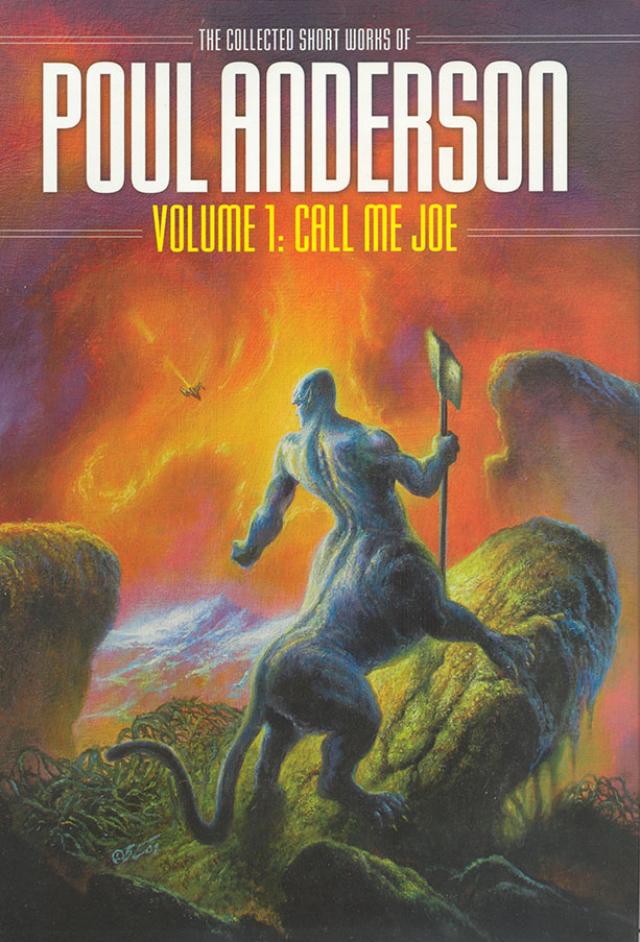
Call Me Joe
Volume One
The Collected Short Works of
Poul Anderson
Edited by Rick Katze and Lis Carey
Call Me Joe is the first of a multi-volume compendium of Poul Anderson’s best works from a writing career that spans over 50 years. As currently planned, the volumes will contain the best of his writing, and include all his Hugo-winning and Hugo-nominated short fiction. A representative sample of Poul’s stand-alone verse is also included.
NESFA Press
Post Office Box 809
Framingham, MA 01701
www.nesfapress.org
info@nesfapress.org
2015
Call Me Joe: Volume One: The Collected Short Works of Poul Anderson
© 2008 by the Trigonier Trust
Edited by Rick Katze and Lis Carey
“Poul Anderson” © 2008 by Greg Bear
Editor’s Introduction” © 2008 by Rick Katze
Dust jacket illustration © 2008 by Bob Eggleton
Dust jacket design © 2008 by Alice N. S. Lewis
All rights reserved. No part of this book may be reproduced in any form or by any electronic, magical or mechanical means including information storage and retrieval without permission in writing from the publisher, except by a reviewer, who may quote brief passages in a review.
NESFA® is a registered trademark of the
New England Science Fiction Association, Inc.
First Hardcover Edition, March 2009
ISBN-10: 1-886778-75-2
ISBN-13: 978-1-886778-75-7
First E-book Edition, October 2015
ISBN-13: 978-1-61037-318-0
Table of Contents
Editor’s Introduction
Poul Anderson by Greg Bear
Call Me Joe Prayer in War
Tomorrow’s Children Kinnison’s Band
The Helping Hand
Wildcat Clausius’ Chaos
Journey’s End Heinlein’s Stories
Logic
Time Patrol The First Love
The Double-Dyed Villains To a Tavern Wench
The Immortal Game Upon the Occasion of Being Asked to Argue That Love and Marriage are Incompatible
Backwardness Haiku
Genius There Will Be Other Times
The Live Coward Ballade of an Artificial Satellite
Time Lag
The Man Who Came Early Autumn
Turning Point Honesty
The Alien Enemy Eventide
Enough Rope
The Sharing of Flesh Barbarous Allen
Welcome
Flight to Forever Sea Burial
Barnacle Bull To Jack Williamson
Time Heals MacCannon
The Martian Crown Jewels Then Death Will Come
Prophecy Einstein’s Distress
Kings Who Die Ochlan
Starfog
Want to read more?
About the Author, Artist, and Publisher
Publication History
Acknowledgments
Praise for the works of Poul Anderson
Editor’s
Introduction
This is the first in a multi-volume collection of Poul Anderson stories. The stories are not in any discernible pattern. I hope to include at least one story from the Pulps in each volume. Future volumes will also contain selected portions of his non-fiction writing on science fiction topics.
In this volume you will find a selection of his earliest works from his first published story, “Tomorrow’s Children”, to “Genius”. which discusses the dangers in social experimentation.
There are the stories of time travel. We meet, for the first time, Manse Everard in “Time Patrol”. Poul wrote many stories about him. In “Wildcat” we are drilling for oil in prehistoric times to feed America’s needs. “The Man Who Came Early” shows us just how far a modern soldier suddenly sent back in time to the era of the Vikings can progress. “A Connecticut Yankee in King Arthur’s Court”, it isn’t. “Time Lag” explores war between two planets, separated by light years and without faster-than light drive.
The near future is represented by “Kings Who Die” showing the effects of war on society and the soldiers who fight. There is “The Martian Crown Jewels” in which some priceless jewelry is stolen from an unmanned spaceship. A Martian detective, who bears a striking resemblance to a 19th century Earth detective who also appeared in “Time Patrol”, solves the problem. “The Alien Enemy” examines the after effects on a colony invaded by an unknown enemy.
“The Double-Dyed Villains”, “The Live Coward”, and “Enough Rope” are three stories describing the adventures of Wing Alak. In his introduction to “The Double-Dyed Villains”, in Astounding Science Fiction John W. Campbell noted that E. E. Smith described one way to run an empire, and that Poul Anderson described another.
We have the far future. The Hugo winning “The Sharing of Flesh” and “Starfog” both of which look at the reintegration of planets into a Galactic civilization after the collapse of empire.
Poul also wrote a huge amount of verse. A small but representative example will be found scattered throughout this volume.
Space considerations prevent a discussion of all the stories in this volume. You will find ideas and concepts in the stories that seem familiar and standard. That is because later writers incorporated the ideas that Poul articulated for the first time.
Rick Katze
November 2008
Poul Anderson
by Greg Bear
In 1962, at age ten, I came across Poul Anderson’s novel The High Crusade in a navy station library in Kodiak, Alaska. The library was well-stocked with science fiction novels and anthologies from the 1950s and 60s, but I remember being bowled over by this lean, elegant, and funny tale, full of unexpected twists and turns.
I followed Poul’s works with respect and admiration for years, but in 1970, his full range and brilliance became even more obvious when I read The Broken Sword and Tau Zero back to back. In 1972, I arranged to have Poul come south to speak at San Diego State College. When asked by a member of the audience (me) what it felt like to write a masterpiece like Tau Zero, he answered, from behind a wall of humility in which I could find no flaw, “Well, it was a good yarn, but really, just another story.” Utterly charming.
The story-tellers we discover in our own golden age of literature fill special places in our lives. They become part of our growing bones and blood, and our gratitude is almost that of child for parent. Ultimately, I was privileged not just to be guided by Poul Anderson’s fiction, but by the man and his family. I was brought into his life as with no other writer. He remains with me as a powerful presence, gentle and kindly, but also uniquely intelligent. His slightly veiled gaze, a paternal generosity of eyelids, seemed at once patient and friendly, but brows and lids could unpredictably vault to high and expressive arcs, revealing startled pale blue eyes. At rest, his face showed pleasantly bowed lips through which he delivered halting but well-formed speech, hands ascribing unbalanced curves in space. Hunched shoulders belied the strength of a man who fought in Society for Creative Anachronism tourneys; his face-folding smile, eyes almost disappearing, went perfectly with the slow rumble of his voice.
He had the gait of a wanderer who could go incredible distances—light years, really—without making a fuss.
Fine European beers were sipped on many afternoons of almost effortless conversation, punctuated by reflective moments of silence as we gathered our wits and reached for new words and fresh thoughts. Karen sat by him, symbiotic; doing embroidery, taking notes, planning trips to other lands for research, laughing and breaking into song at some fond memory of a convention or a filking festival; making sure that receipts were kept and novels were written to reflect the things learned on those journeys, for the tax man’s critical gaze.
Poul’s only enemy, I believe, was the tax man. But if a tax collector had dared show his face at the Anderson door in Orinda, he would have been treated with civility. He might not have been invited to stay or offered a beer, but I think he might have acknowledged having read Poul Anderson…and Poul might have thanked him and wondered what other bitter ironies the Norns had in store.
Poul was a modern skald, heir to the traditions of those who entertained weary Vikings centuries past. He could sing songs sad and happy with equal grace—crack a joke, spin out a yarn, create a wholly convincing world, with no apparent effort. He was an arch-libertarian, yet lived in the gentle and liberal climate of Orinda, near the People’s Republic of Berkeley; reveled in physics and math, yet wrote raucous limericks and rollicking comedies; was a wizard at describing strange aliens, asteroids, and spaceships, yet deft at creating entertaining and convincing human characters...
Some writers you picture sweating and swearing as they plot and compose. Poul I see grinning. This is not to say that Poul’s work is not serious, or that it came easily to him, or that he was not a master craftsman. He was just not the type to self-analyze or complain.
Poul’s first story was published in 1947. His first major fantasy novel was The Broken Sword (1954); the first major science fiction novel, Brain Wave, was published in the same year. (Daughter Astrid also arrived in 1954.) He has since earned more Nebulas, Hugos, and other awards than any mortal fireplace mantle can hold.
As with so many writers in the mid-twentieth century, Poul was mentored by John W. Campbell, Jr., editor of Astounding Science Fiction, later Analog. Poul was not averse to incorporating some of Campbell’s i
His fiction emphasizes the trials, contradictions, and victories of the competent and thoughtful individual. The long and tortuous travels of characters in history fascinated Poul, and he earned a reputation for mastering tales of time travel and alternate realities. Both wings of Poul’s eagle-span—the fantasy and the science fiction—seem to me superior in both spirit and discipline to most of the fiction of its day.
The Broken Sword’s chilly portrait of the relationships between elves and men was published just as the long reign of Tolkien began in the United States, though no doubt Poul and Karen had already read The Hobbit. Poul derived his material from the same sources as Tolkien—the Northern myths, and of course Wagner. But his take was Nordic. The woods are deeper in the far north—darker and colder.
In The High Crusade (1960), Poul dropped a marauding spaceship filled with brutal, cocksure aliens into medieval England. Using his knowledge of both science and history to reverse all our expectations, he created a masterpiece of comic adventure. On his office wall hung an authentic-looking replica of a long sword. Lifting that sword was like reliving history, and brought deep respect for the men who lived and died with such weapons in hand.
He wrote of the Time Patrol; space merchant Nicholas van Rijn; Dominic Flandry of the Polesotechnic League, the furry, mimicking Teddy bears known as Hokas (with good friend Gordon Dickson), and more; all series highly favored by connoisseurs.
Poul made many friends and (to my knowledge) few or no enemies. As a father and grandfather, he projected respect and humor. For Astrid he wrote and illustrated tales of a purple submarine, and for grandchildren Erik and Alexandra, handmade booklets, stories and poems/songs of zoos and sailors. He had a quiet and insightful wit, and a kindly tolerance for his headstrong son-in-law.
He loved to gather with friends and family to listen and talk. Among those friends was French anthropologist Francois Bordes, who wrote French science fiction under the pen name of Francis Carsac. Bordes was fond of teaching folks how to knap flints the old-fashioned way. Poul’s friendship with Jack Vance led to the building of a famous houseboat (Frank Herbert was also an early participant in this project). Jerry Pournelle, another long-time friend, invited Poul to help him sail a boat down the coast from Puget Sound to Los Angeles; they never completed the journey, but were inspected by spyglassing orcas one morning.
Through the mid-1970s, as I was publishing more and more short fiction and writing my first novels, Poul and I corresponded. We swapped science and story ideas. I remember a good debate over whether or not ice would evaporate without ever becoming liquid, in the deep cold of Saturn’s rings. Here I was, contending with a true master, so with sweat on my brow, wild-eyed, I pored over reference books and science texts, and finally quoted figures from tables in the CRC Handbook. Poul kindly conceded I had a point. Later, he told Astrid, when she asked about the science in my novels, that I could be relied upon to know my stuff. No higher praise!
In the early 1980s, Jerry Pournelle helped assemble the Citizens’ Advisory Council on National Space Policy. Poul attended these meetings, and in 1983, I was invited to join this amazing group of writers, generals, scientists, astronauts, and politicians. To this day, the CACNSP meetings are the subject of legend and history. They taught me much of what I know about politics and Washington D.C., and were crucial to the writing of my novel, Eon.
In the 1980s, Poul helped me devise orbits for both Eon and The Forge of God. Karen helped with my history and Greek. Poul and Karen together provided expertise and imagination for many aspects of my work over the decades. I remember a lengthy discussion with Poul and his brother John about the science behind Darwin’s Radio. They helped me hone my facts and arguments, invaluable when exploring deep and controversial topics.
There are so many tales of camping, hiking, visits to Denmark (and especially to Tivoli). Twenty years! Amazing for a true fan of Poul Anderson.
But in 2000, a cloud loomed. Poul was diagnosed with cancer. Despite strong hopes for a reversal, by early 2001, it was obvious he would not survive. Poul and Karen visited our home in Washington state and we held a farewell party, attended by many friends. Shortly after, I visited Poul and Karen in Orinda and shared a lovely summer lunch in the shade on the front lawn. The Orinda house was the scene of so many parties, visits, discussions, debates. This was the childhood home of my wife; Poul and Karen were still here. How could things change? It was impossible to believe that Poul wouldn’t continue to travel and visit and write. But it was not to be. He went into Alta Bates hospital. I last spoke with him by phone. The diagnosis was final.
Astrid flew to Orinda.
In late July of 2001 we alerted people by email that Poul was fading fast. The result was amazing. Within a few hours, a thousand messages poured in from around the world, expressing how much Poul meant to readers and friends everywhere. During his last afternoon, Karen and Astrid read these messages to him as he sat up in bed, drinking a Carlsberg and having a small glass of Jubilaeum akvavit. Poul listened and smiled; it was confirmation of what we already knew. Amazing, and wonderful, this tribute.
And now, for his friends and his readers, for all who love him or will come to love him, NESFA Press is collecting his finest works. If you have yet to read Poul Anderson, you have many adventures and treats in store, with or without long swords, slide rules, or beer.
Skol!
Call Me Joe
The wind came whooping out of eastern darkness, driving a lash of ammonia dust before it. In minutes, Edward Anglesey was blinded.
He clawed all four feet into the broken shards which were soil, hunched down and groped for his little smelter. The wind was an idiot bassoon in his skull. Something whipped across his back, drawing blood, a tree yanked up by the roots and spat a hundred miles. Lightning cracked, immensely far overhead where clouds boiled with night.
As if to reply, thunder toned in the ice mountains and a red gout of flame jumped and a hillside came booming down, spilling itself across the valley. The earth shivered.
Sodium explosion, thought Anglesey in the drumbeat noise. The fire and the lightning gave him enough illumination to find his apparatus. He picked up tools in muscular hands, his tail gripped the trough, and he battered his way to the tunnel and thus to his dugout.
It had walls and roof of water, frozen by sun-remoteness and compressed by tons of atmosphere jammed onto every square inch. Ventilated by a tiny smoke hole, a lamp of tree oil burning in hydrogen made a dull light for the single room.
Anglesey sprawled his slate-blue form on the floor, panting. It was no use to swear at the storm. These ammonia gales often came at sunset, and there was nothing to do but wait them out. He was tired, anyway.
It would be morning in five hours or so. He had hoped to cast an axhead, his first, this evening, but maybe it was better to do the job by daylight.
He pulled a dekapod body off a shelf and ate the meat raw, pausing for long gulps of liquid methane from a jug. Things would improve once he had proper tools; so far, everything had been painfully grubbed and hacked to shape with teeth, claws, chance icicles, and what detestably weak and crumbling fragments remained of the spaceship. Give him a few years and he’d be living as a man should.
He sighed, stretched, and lay down to sleep.
Somewhat more than one hundred and twelve thousand miles away, Edward Anglesey took off his helmet.


