

High treason, p.1
High Treason, page 1


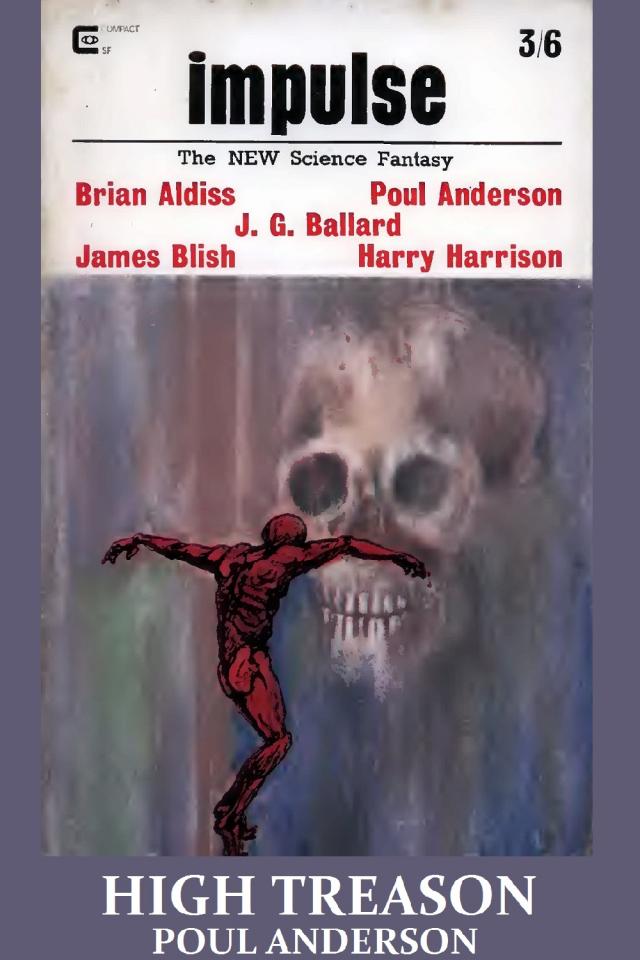
This story, specially written for IMPULSE, was actually started in England whilst Poul and Karen Anderson wen touring after the London Convention.
From : Impuse, March 1966 – Short Story
HIGH TREASON
Poul Anderson
In three hours by the clock they will be here to kill me. The door will crack open. Two noncoms will step through and flank it, in parade uniforms with stunners at the ready. I don’t know whether their faces will wear loathing and righteousness, or that sick pity I have observed on some aboard this ship, but it is certain that they will be pathetically young, because all the enlisted ratings are. Then Erik Halvorsen will stride in between them and come to attention. So will I. ‘Edward Breckinridge,’ he will say like a machine, and proceed with the formula. Not so long ago he called me Ed, and we were messmates, and on our last leave we went on a drinking bout which must by now have become a part of the local mythology. (This was in Port Desire, but next day we flitted down to the sea, which is golden coloured on that planet, and tumbled in the surf and lay on the sand letting sunlight and thunder possess us.) I don’t know what will be in his eyes either. Curious, that one’s closest male friend should be so unpredictable.
But since he was always a good officer, he can be counted on to play his role out.
So can I. There is no gain in breaking the ritual, and ample reason for not doing so. Perhaps I should not even have dismissed the chaplain. With so much religiosity about, as our universe goes down in wreck, I have painted myself more strongly Lucifer by not spending these last hours in prayer. Will my children hear at school. He wasn’t just a traitor, he was a dirty atheist -? Never mind. I am not entitled to a great deal, but let me claim the dignity of remaining myself.
There will also be a kind of dignity in what follows: barbaric, macabre, and necessary. I will march down the corridor between the stiff bodies and stiffer faces of men I commanded; drums will drown the mutter of engines and priest. The inner airlock door will already stand wide. I will enter the chamber. The door will close. Then, for a moment, I can be alone. I shall try to hold to me the memory of Alice and the children, but perhaps my sweat will stink too harshly.
They don’t pump the air out of the chamber in cases like this. That would be cruel. They simply pull the emergency switch. (No, not ‘they’. One man’s hand must do it. But whose? I don’t want to know.) An engine will strain against the atmospheric pressure, one kilogram per square centimetre that we have borne with us, along with salt blood and funny little patches of hair and funny little instincts, all the way from Earth. The outer door will swing. Suddenly my coffin brims with darkness and stars. Earth’s air rejects me. I fly out. The ship resumes hyper-drive.
For me, then, the universe will no longer ever have been.
But I ramble. It was well meant of them to give me this psychograph. The written word lies, the distorted molecules of a thought-recording tape do not. My apologia can be analysed for sincerity as well as logic.
The worlds will be assured that I was at least an honest fool, which could make things easier for Alice, Jeanne, small Bobby who - her last letter said - has begun to look like his father. On the other hand, being no expert in the use of the machine, I will commit more of myself to the record than I like.
Well, keep trying, Ed, old chap. You can always wipe the tape. Though why you should be concerned about your privacy, when you are going to be dead—.
Drusilla.
NO.
Go away. Take back your summer-scented hair, the feel of breasts and belly, the bird that sang in the garden beyond your window, take them back, Alice is my girl, and I’d simply been away from her too long, and no, that isn’t true either, I damn well had fun with you, Dru, my puss, and I don’t regret a microsecond of our nights but it would hurt Alice to know, or would she understand, Christ-Osiris-Baldr-Xipe, I can’t even be sure about that.
Get your mind back to higher things. Like battle. Quite okay to kill, you know, it’s love which is dangerous and must be kept on tight leash, no, now I’m knee-jerking like one of those Brotherhood types. The soldier is akin to the civil monitor, both trained in violence because violence is sometimes necessary for the purposes of society. My problem was, what do you do when those purposes become impossible of attainment?
You fight. The Morwain will not forget either, certain hours amidst the blaze of Cantrell’s Cluster. Part of my defence, remember, Erik Halvorsen? - my squadron inflicted heavy damage on the enemy - but the court martial couldn’t follow such logic. Why did I attack a superior force after betraying a planet… a species? My claim is on record, that in my considered judgement the mission on which we had been ordered would have had catastrophic results, but that something might have been accomplished by striking elsewhere. Be it said, though, here to the ultimate honesty of this machine, I hoped to be captured. I have no more death wish than you, Erik.
And someone will have to represent men, when the Morwain come. Why not myself?
One reason why not, among others: Hideki Iwasaki. (I mean Iwasaki Hideki, the Japanese put the surname first, we’re such a richly variant life form.) ‘Yahhh!’ he screamed when we took our direct hit. I saw the control turret flare with lightnings, I saw him penetrated, through earthquake shudder in the ship and a whistle of departing air that pierced my helmet, my phones heard him scream.
Then darkness clapped down upon us. The gee-field had gone dead too, I floated, whirling until I caromed off a bulkhead and caught a stanchion. My mouth was full of blood, which tasted like wet iron.
As the dazzle cleared from my retinae, I saw the master panel shine blue, emergency lighting, and Hideki outlined before it. I knew him by the number fluorescing on his armour. Air gushed from him, as fast as the tank could replace it white with condensing moisture, mingled with blood in thick separate globules. I thought amidst my pulses, gloriously, why, we’re disabled. Totally. We haven’t gone on to standby control, we’re rudderless in space, the switchover circuits must be fused. We can only surrender. Plug in your jack quick, man, raise Comcenter and order the capitulation signal broadcast. No, wait. First you pass command on formally, to Feinstein aboard the Yorktown , so that the squadron may proceed with its battle. But then you’re out of action. You’ll come home with the Morwain.
Iwasaki’s gauntlets moved. He had tools in them. Dying, he floated in front of the smitten superconductor brain and made a jackleg repair. It didn’t take long. Just a matter of a few connections, so that the standby system could get the order to take over. I should have thought of trying it myself. That I did not, well, yes, I admit that that was my real treason. But when I saw what he was doing, I shoved myself to him, along with Mboto and Ghopal, and lent a hand.
We couldn’t do much. He was the electronics officer. Besides, as for me, his blood drifted across my faceplate and fogged it. But we passed him what he needed from the tool kit. By the blue light, through the black smears, I saw his face a little drained of everything but sweat and will. He did not permit himself to die until he had finished.
The lights came back on. So did weight. And the view-screens. And the audio inductors. We’d have to get along on tanked air until we could shift to the other turret. I looked into space. The stars were thick here, heartlessly brilliant against black, but sharpest was a flash half a million kilometres away. And: ‘ ¡Por Dios!’ cried the evaluation officer, ‘she was a Jango cruiser! Someone’s put a missile in her!’
Turned out the Agincourt had done so. I hear her captain has been cited for a medal. Is he grateful to me?
At the moment, though, I knew only that Iwasaki had resurrected the Syrtis Minor and I must therefore continue to fight her. I called for the medics to come see if they could resurrect him too. He was a good little man, who had shyly shown me pictures of his good little children, under the cherry trees of Kyoto.
But later I heard there was no chance for him. With normal hospital facilities, he could have been hooked into a machine until a new gastro-intestinal tract had been grown; however, warships haven’t room or mass to spare for such gadgets.
I plugged myself back into control. Reports snapped through my ears, numbers flickered before my eyes, I made my decisions and issued my orders. But chiefly I was conscious of a background whine in my phones, blood and a little vomit on my tongue. We were not going to be captured after all.
Instead, we fought free and returned to base, what was left of us.
I wonder if military men have always been intellectuals. It isn’t in their legend. Rather, we think of headlong Alexander, methodical Caesar, Napoleon stumping across Europe, Malanowicz and his computers. But shouldn’t we likewise remember Aristotle, the Julian calender, the Code, the philosophical project? At any rate, when you fight across interstellar distances, for commonwealths embodying whole planetary systems, you have to understand the machines which make it possible; you have to try to understand races as sentient as man, but separated from us by three or four thousand million years of evolution; you even have to know something about man himself, lest minds fall to pieces out yonder. So the average officer today is better educated and has done a good bit more thinking than the average Brother of Love.
Oh, that Brotherhood! I wish they could have sat, dirt and self-righteousness and the whole dismal works, in Colonel Goncharov’s class.
Sunlight slanted across Academy lawns, lost itself among oak leaves, emerged to glance off a cannon which had fired at Trafalgar, and struck the comets upon his shoulders. I sat and worshipped, at first, for he had won the Lunar
‘Gentlemen,’ he said, in that slow, accented Esperanto which was such a joke in our barracks - and he leaned across his desk, balanced on fingertips, and the sun touched his hair also, it was still rust colour, and made shadows in the creases of his face; and, yes, a smell of green (E)arth blew in, with the sleepy noise of a mower somewhere in the middle distance - ‘gentlemen, you have heard a good many fine words about honour, esprit de corps, and service to mankind. They are true enough. But you will not live up to them unless you can see your service in its proper perspective. The Cosmocorps is not the elite of human society, its mission is not the purpose of society, it must not expect the highest material rewards or even the highest honours which society has to offer.
‘We are an instrument.
‘Man is not alone in this universe. Nor is he entitled to every habitable world. There are other races, with their own hopes and ambitions, their own pains and fears; they look out of other eyes and they think other thoughts, but their aims are no less legitimate to them than ours are to us. It is well when we can be friends with them.
‘But that isn’t forever possible. Some of you will explain it by original sin, some by Karma, some by simple mortal fallibility. The fact remains that societies do conflict. In such cases, one must try to negotiate the dispute. And true negotiation can only take place between equals. Therefore equality in the capability of inflicting harm, as well as in other and higher capabilities, is essential. I do not say this is good, I say merely that it is so. You are to become part of the instrument which gives Earth and the Union that capability.
‘An instrument can be misused. A hammer can drive a nail or crush a skull. All too often, armies have been similarly misused. But the fact that you have accepted military discipline and will presently accept commissions does not absolve you from your responsibilities as citizens.
‘ Read your Clausewitz. War is not an end but a continuation of political intercourse. The most horrible disasters of a horrible history occurred when that was forgotten. Your duty as officers - a duty too high and difficult to be included in the Articles -will be to remember.’
I suppose that basically I am a humourless type. I like a joke as well as you do, I rather distinguish myself in my class by my fund of limericks, a poker game or a drinking bout is fun, but I do take some things with a possibly priggish seriousness.
Like this matter of racial hatred. I will no more tolerate that word ‘Jango’ than I would have tolerated
‘Nigger’ or ‘Gook’ a few centuries ago. (You see, I’ve read quite a lot of history. Hobby of mine, and a way to pass the long time between stars.) It was brought against me at the court martial. Tom Deare testified that I had spoken well of the Morwain. They were fair minded men on the board, who reprimanded him and struck his words from the record, but - Tom, you were my friend. Weren’t you?
Let me set straight what happened. Memory gets more total with every sweep of that minute hand. We were on Asphodel for refitting. Once this was the pet hope of every spaceman. Next to Earth herself, perhaps more so for many, Asphodel! (Yes, yes, I know it’s an entire world, with ice caps and deserts and stinking swamps, but I mean the part we humans made our own, in those magnificent days when we thought we had the freedom of the galaxy, and could pick and choose our colony sites.) Mountains shouldering white into a cornflower sky, valleys one dazzle of blossoms and bird wings, the little laughterful towns and the girls… But this was late in the war. You hated to go out after dark, for the enemy held those stars. Most of the towns were already empty, doors creaked in the wind, echoes rang hollow from your footfall in the streets. Now and then a thunderclap rolled, another ferry taking off with another load of civilians for evacuation. Asphodel fell to the Morwain two months afterward.
We sat in a deserted tavern, Tom and I, violating regs by drinking liquor which could not be taken away.
There was nothing else to do. War is mostly hurry up and wait. Sunlight came in, and the same green smell I remembered across an eon, and a dog ran by outside, abandoned, bewildered, hungry.
‘Oh, God damn them!’ Tom shouted into silence.
‘Who?’ I asked, pouring myself a refill. ‘If you mean those officious bastards in QM, I entirely agree, but aren’t you wishing a rather large job on to the Almighty?’
‘This is no time to be funny,’ he said.
‘It’s no time to be anything else,’ I answered. We had just heard about the destruction of the Ninth Fleet.
“The Jangos,’ he said. “The filthy, slimy, slithering, pervert-begotten Jangos.’
“The Morwain, you mean,’ I said. I was rather drunk too, or I would simply have held my peace. But it buzzed in my brain. ‘They aren’t filthy. Cleaner by instinct than we are. You don’t see litter in their cities.
Their perspiration is glutinous, they walk like cats, and they have three sexes, but what of it?’
‘What of it?’ He raised a fist. His features had gone white, except for two fever-spots on the cheekbones.
“They’re going to take over the universe and you ask what of it?’
‘Who says they’re going to?’
‘The news, you clotbrain!”
I couldn’t answer directly, so I said, with that exaggerated consciousness of each single word which comes at a certain stage of drink: ‘Earth-type planets are none too common, they wanted the same real estate we did. Border disputes led to war. Now their announced purpose is to draw Earth’s teeth, just as ours was to draw theirs. But they haven’t said anything about throwing us off the planets - most of the planets - we already hold. That’d be too costly.’
‘No, it wouldn’t. They’ll only need to massacre our colonials.’
‘Would we massacre - what’s the figure? - about twenty thousand million in either case - would we massacre that many thinking creatures?’
‘I’d like to,’ he got out between his teeth.
‘Look,’ I said, ‘forget the propaganda. As the war dragged on, and went badly, we’ve lost all sense of proportion. Suppose they do occupy us?’
“Those tentacled horrors,’ he whispered, ‘under the spires of Oxford.’
Well, for me it would be strangers walking the Wyoming earth where free men once whooped their cattle down the long trail; and for Iwasaki, demon shapes gaping before Buddha at Kamajura; and for Goncharov, if he was unfortunate enough to be still alive, an alien victory monument raised in the holy Kremlin; and on and on, mans-history’s tapestry warped into a shape our dead would never have recognized. But - “They’ll set up a government, if they win,’ I told him, ‘and we’ll have to learn some new ways of thinking. But you know, I’ve studied them, and I met some of them before the war and got pretty friendly, and you know, they admire a lot about us.’
He sat altogether still for a long while, before he breathed, ‘You mean you don’t care if they win?’
‘I mean that we’ll have to face facts… if they win,’ I said. ‘We’ll have to adapt, in order to conserve as much as we can. We could be useful to them.’
That was when he hit me.
Well, I didn’t hit back. I walked straight out of there, into the obscenely beautiful sunlight, and left him weeping. The next day we said nothing about the incident and worked together with stiff politeness.
But he has testified that I want to be a collaborationist.
Alice, did you ever understand what the war was about? You said goodbye with a gallantry which was almost more than I could endure, and the one time in these five years that I have had Earth furlough, we had too much else CENSOR CENSOR CENSOR. But I suspect that to you these imperial questions were simply a thing, like sickness or a floater crash, which could eat your man.
It was raining when last I left. The ground was still dark with winter, here and there a bank of dirty snow melting away. The sky hung low, like some vague grey roof, and threw tendrils of mist round the house.
But I could see quite a distance across this


