

We speak through the mou.., p.1
We Speak Through the Mountain, page 1
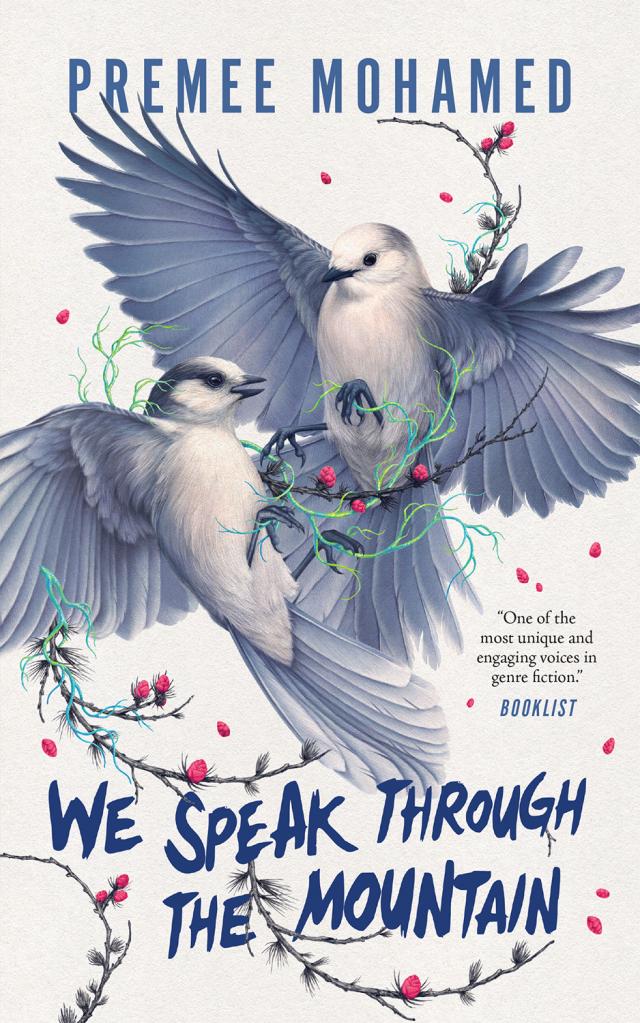


We Speak Through the Mountain
Preemee Mohamed
Contents
Also by Premee Mohamed
Dedication
1.
2.
3.
4.
5.
6.
7.
8.
9.
10.
Acknowledgements
About the Author
Copyright
Also by Premee Mohamed
In This Series
The Annual Migration of Clouds
The Void Trilogy
Beneath the Rising
A Broken Darkness
The Void Ascendant
Collections
No One Will Come Back for Us and Other Stories
Novellas
The Butcher of the Forest
The Siege of Burning Grass
No One Will Come Back for Us
And What Can We Offer You Tonight
These Lifeless Things
The Apple-Tree Throne
Dedication
For Chelsy
1.
We tell the kids, Never travel alone. We tell them, Go where you like. But don’t go alone. We start teaching it in preschool, before we expect them to learn anything else. This is the first thing we want them to take in. And now this.
I am alone. More alone than I have ever been in my life and simultaneously not alone. I travel with the adversary. I carry the infection like a weight and a conscience.
How long have I been climbing tonight? Four hours, five? I wish for numbness. Instead my entire body prickles with perception, as if I am one giant nerve ending, slithering up and up through the rocks. No snow falls but the wind grates and burns. I had this idea
(one of us had this idea)
that ascending would bring me to safety, because it is hard to pursue someone who has the higher ground. I hope I’m right.
I stopped shivering long ago, stopped feeling my bike chafe my shoulder long ago. In the darkness I sense more than see a plateau screened by a thin copse of dead larch, and I crawl into the meagre shelter, luxurious because it is out of the wind. Time to stop for the day.
Tonight I must risk a small fire. For days my life has been this constant patter of mental calculation: this versus that, the dangers of doing and not-doing, the virtually imperceptible increase in safety or not . . . all the same, every few hours I think clearly, I am going to die out here.
No, I won’t. I can’t. I refuse. I refuse.
I’m going to die.
I can’t. I am a multitude.
Firelight dances on the grey stone around me, on the corrugated bark of the trees. I drink in its warmth, sit as close as I can, hungry for heat. It’s funny because I’m feverish and yet I still want more heat. Yes, I know I am. Mom always said you can’t feel a fever in yourself but I know. I feel.
I empty half of my canteen into my all-purpose metal mug so I can stew some dried pork and mushrooms. Usually my big meal is breakfast — fuelling strength to climb. But I threw up my breakfast this morning and climbed anyway. I’m lucid enough to know that was bad. And enough to watch the fire and to watch myself. Luckily.
Since we reached the mountains, the adversary wouldn’t let me climb down into the lakes and puddles to get water. Just would not. Sometimes it let me refill my canteen from a waterfall or a stream, even though these were few and far between compared to the still waters. I began rationally, trying to explain to it that those ponds and lakes were hardly algae-scummed deathtraps, and what if I ran out of water waiting for the next stream? Then I lost my temper. I screamed at it. I accused it of both homicide and suicide. When I left home, I thought we were coming to some kind of rapprochement; now I hate it more than I’ve ever hated anything in my life.
“Why?” says the dead boy across the fire. “It didn’t kill me.”
“Nobody asked you,” I tell him. He’s been showing up more often at night. Voice mushy through his crushed skull, scant bloodied blond hair sticking up like porcupine quills. “You hate what you want to hate, and I’ll hate what I want to hate.”
It’s okay. I know he’s dead. I know he died in the boar hunt that I was in, my first hunt, the one I thought would let me leave home with a clear conscience — and I know the deaths and maimings weren’t my fault, but you’d never know it from the way he talks. He comes and — there he goes. Now it is just the flames again. I wait for bubbles to form in my mug perched on the embers. You have to make sure it’s boiling for at least a couple of minutes to kill off whatever might be in there.
That’s the thing about being alone. That’s why we tell the kids not to go anywhere alone. Because if something happens, no one can help you. And no one can go for help. And no one will know.
What am I doing, for Christ’s sake. Why am I here. What was I thinking . . .
“You wanted an adventure,” my best friend says just behind my left shoulder, as if the stone itself were speaking. I feel it thrum against my back.
I don’t turn. “That wasn’t it.”
“Yes it was. You never had one at home and you thought: I want to be like the kids in the books. I want my own adventure.”
“Shut up.”
“How’s it going, anyway? Is it like the books?”
I’m watching my dinner. Tiny bits of foam are appearing on the flame side; I wrap my hand in the end of my scarf and rotate the mug so it heats evenly. “Yesterday I saw . . . or maybe it was the day before. You weren’t there. I was following my map and I stopped to look down at how much distance I had covered, at the highway down there — and for just a second I was so proud of myself. Because it was so far below me, because the view was so beautiful. And I saw . . . people. Ten or twelve people. I was trying to think of what was odd about them, and then I saw . . . it was all men. Walking along quietly. In a line. And in the middle of the line there was a cart on two wheels, like one of our handcarts but bigger — being pulled by two women. Naked. Bloody. And I stopped moving. I thought: What if I could become part of the rock. I thought if they saw me . . . you already know what was in the cart. You already know it was a cage. I don’t need to tell you that.”
Henryk’s voice says, “Maybe you didn’t see it, Reid.”
“Maybe.”
“Because you’re hallucinating a lot now, you know.”
“I know.”
The men didn’t see me. I waited for a full hour, sweating in motionless silence, feeling every particle of the stone under my fingertips where I had flattened myself to the ground. I hoped I would hear them if they circled around to get me. No one came. I went on. I felt like something had broken irreparably inside my head and I vowed not to think about it again.
I fish my mug out of the fire and eat, pausing now and then to allow a tremor to run through my hands. No sense fighting it; have to let it pass.
“Funny you shouldn’t object to this,” I tell the adversary, which cannot speak. “You know. Letting me eat mushrooms. Isn’t that something like cannibalism? Close enough?”
Henryk’s not wrong about the hallucinations, anyway. I’ve been talking to him, Gabriel, Nadiya, Aldous Wong, the adversary. I hear my mother. I hear my father. I talk back to the birds that shout their alarm calls as I pass. Earlier I could stop myself. Now I can’t.
The thing is, I’ve gone too far to get back on my own, and realistically I can only go forward. The steamcart took me to the edge of Calgary — the fastest I’ve ever moved in my life, initially terrifying but good preparation for when I eventually got going on my bike — and I’ve been on my own from there, waiting for my tracker to go off at the zone marker. I followed every direction the university sent me in my acceptance letter.
I can’t go home; it can’t exist for me any more. I mustn’t think of my past. And while I am here I don’t dare think of the future, either. I am trapped in a small, endless now of darkness and pain and fever and hunger.
Near my head, a whiskeyjack cries out, a startled yelp, then darts across my clearing, for a moment gathering all the light of the flames as if it is a carelessly thrown shard of glass. I’ve never heard one at night before. I stare after it, stupefied in the restored silence. What . . . why . . .
When the rocks begin to patter around me, I still haven’t come to any conclusions, and it’s my body that rises to fight, left hand a fist, right holding my knife, the disease darkening suddenly on my exposed skin like ink, as if it too has gotten up and could simply burst through my skin in a spray of black and blue. For terrible moments we hang in the balance, something inside urging, Don’t, don’t. Lie down and let it happen, and the rest of me shouting, Don’t touch me, don’t come near me, and if you touch my bike I’ll fucking kill you.
Lights fill my vision, but I’m ready for that, and I lunge — freeze — feel the disease lock my muscles in stasis, able only to snarl like a dog at the end of a leash, held in abeyance by some greater weight hauling back on the other end. Not now! Let go! Let me fight! I cannot make sense of the noises I hear, they dance on the edge of meaning but never quite reach it before dissolving into garbled syllables again.
My knife rebounds from something hard, then is snat ched from my hand. Someone kicks out my fire. I release a cry, a brute and wordless sound echoing harshly from the rocks. Fire was my other weapon. Counting on it for animals. These are no animals. Are they. Unless up here they speak.
Something slaps the side of my neck, leaving a strange, cold burn, and my eyes begin to slide closed. Someone else pulls my tracker necklace up and over my head, the little orb sparkling past my face. My last thought as I am swarmed is how best, without a knife, I can solve the problem of my own existence if what I greatly feared has come to pass. If I didn’t outpace that gruesome caravan I saw; if they saw me and hungered for me and these are their hands on me.
Let me tell you. Let me. What we teach the kids if the worst happens. What we tell them about . . . what we . . . because we love them.
2.
I wake gradually, aware at first only that I am coming out of sleep, then walking dazed through the levels and levels and levels of it like a labyrinth. Warmth and dim light, a smell of bad moonshine, something else under it — harsh to the nose. Distant voices. Under my hands, fabric; under my head, something hard but yielding: plastic. That’s familiar at least.
There’s a ceiling above me and even though that’s a good sign I still squeeze my eyes shut and outwait a huge wave of panic, gritting my teeth until it becomes ordinary worry, then confusion, suspicion, and resignation. I am used to waiting things out.
“Reid? How are you feeling?”
The voice gives me something to focus on and the rest of the space snaps into clarity: a curtainless window set in a white wall, a white door with no handle, a grey blanket covering my right leg and tucked under my left, which is bandaged and elevated on a kind of lacy plastic scaffolding.
The owner of the voice is pale, with thinning dark hair and a short beard, dressed in what I guess are the clothes of technological utopia — a seamless blue shirt, lighter blue pants, and a wristwatch with a narrow black strap. I admit I had been imagining something more futuristic. Silver jumpsuits, maybe.
Behind him is someone who has not yet spoken — a tall, broad-shouldered woman with swept-back silvery hair and the calm expression, as well as the hot golden eyes, of a bird of prey. She is dressed in white so that for a second I wonder if her plan was to blend into the wall, as if I would not see her.
How am I feeling? Aside from those animal parts of the body informing me I need to eat and pee and stretch, cautiously optimistic: the fever is gone, or much reduced, and I don’t feel entirely nuts any more.
“I’m fine,” I tell him. “How long did I have that patch on me?”
He chuckles, a little chagrined, letting me score the point. “I’m Dr. Gibson and yes, you’re in the infirmary at Howse. The patch was on you for as long as was needed. Looks like you had a rough time before that, hmm? Getting here?”
Getting here. “Where’s my bike?”
“We put it in your room. It’s safe. It’s safe, please don’t stand up. What happened here, if you don’t mind my asking?”
He’s pointing at my leg with a pen. We both look at it as if we expect it to do something interesting: speak, change colour, blow up.
“Animal bite.”
“Before or after you left home?”
“Before.”
I’m half-listening as he tells me the story of my ankle because I am telling the same story at the same time, from the other side. I fell on the forest floor and (there was dirt under the skin that) the sow snatched me in her jaws because (wounds became infected and the bacteria mobilized into your) we were the enemy, knowing damn well (surprised; you were walking on a hairline) how fragile and small a human is compared to a pig (could have died) and I could have died.
“We cleaned it out and re-sutured it,” he concludes, “and the IV antibiotics are knocking back the infection. The fracture will resolve in a few weeks now that you can keep your full weight off it. It wasn’t very wise to travel with it in that shape. You must have been in a lot of pain.”
“It just felt hot and kind of numb. I knew something was wrong, but . . .” And here I cannot tell him of the early days of the journey astride my precious, resurrected-from-extinction bike, propelling it with my feet till I learned how to pedal and balance properly, the moments of joy and freedom in between the hours of terror and loneliness, how I could not even hear the alarm bells ringing in my bloodstream over the crushing sensation of the mountains first looming over me then closing around me like jaws, how the outer fear was so much greater than the inner, and how my disease did not want me to move one more step every morning, not one more, and how I had to fight it till I thought we would both die in the effort.
I glance up at the woman in white, who’s smiling as if she just heard my entire internal monologue, and she says, “I’m Dr. Cardinal, Reid. I’m the president of the university.”
“Oh. Pleased to meet you. Do you . . . do this for every new student?”
“No, no. I simply heard you came here after, as the good doctor says, a rough time, and I wanted to say in person — I admire your tenacity and determination to reach us. That’s very much in the Howse spirit. Welcome! I hope you’ll soon forget the trip here and focus on more pleasant things.”
“Uh . . . thank you.”
I wait for her to leave after this speech, but she simply folds her arms across her chest and watches me. The president of the university. Surely she has better things to do. I swallow nervously and glance at Dr. Gibson. “Can I see outside?”
“Oh, sure.”
The plastic scaffold looks delicate but is meant to be used as a kind of shoe; I am allowed to limp cautiously around the room, clutching my silky white gown, with the doctor offering his arm in case I fall. Window first. If nothing else, I must see the hemisphere that encloses the dome, which I have been imagining all my life whether I admitted it to myself or not. I picture diamonds, gems, impenetrable geometry set with all the care and dedication of Back Then’s engineering to form an unbreakable barrier no different from the photos of the Mars colonies.
The buildings are subtle, blending precisely into the stone of the mountain, even though I know they can’t be made of stone — they just can’t — it is too disappointing to think of these people, the dome people, building out of stone like cavemen.
Cardinal says, “It may seem like a lot to get used to.”
“No, not really,” I tell her, trying to keep my tone light. I’m annoyed at myself. I turned nineteen in February; I’m no child to be upset that Big Rock Candy Mountain turns out to not be a real place. “I live at a university campus actually. Lived. A big one. This doesn’t look so strange.”
But it does, somehow. Henryk and I have had more than one conversation about this, about architecture and all its coded messages, and how we know — how we have been provided with irrefutable proof — that there was a before, and that we are living in its aftermath. Because we, back home, live in buildings we could never build now. So the reminder is constant rather than intermittent. That the humanity of the cities failed, that there was a schism between the then and the now. Back Then, before the fall, they could have looked at anything and said: We know how to reproduce that. We can do that again. For anything they wished, for anything they saw, whenever they wanted. A skyscraper, a ziggurat, a pyramid, a monument, they had all the knowledge and the resources and the fuel and the labour and the transportation to simply rebuild anything that had come before. We don’t. We can’t. We cannot even repair the buildings on campus any more. That’s how we know there was that rift. That’s how we know a world ended. By what was lost.
My window looks down onto a few buildings and up to fewer, all graceful arches and catwalks, bridges and roundels, everything carpeted with moss, lichen, and tufty bits of grass just beginning to green up. Thousands of windows gather the day’s clouded light. There is no dome. Only mountain and sky.
Dr. Gibson peers down with me, perhaps sensing my confusion or disappointment; or perhaps he just gets this question a lot from new students.


