

The first thousand trees, p.1
The First Thousand Trees, page 1


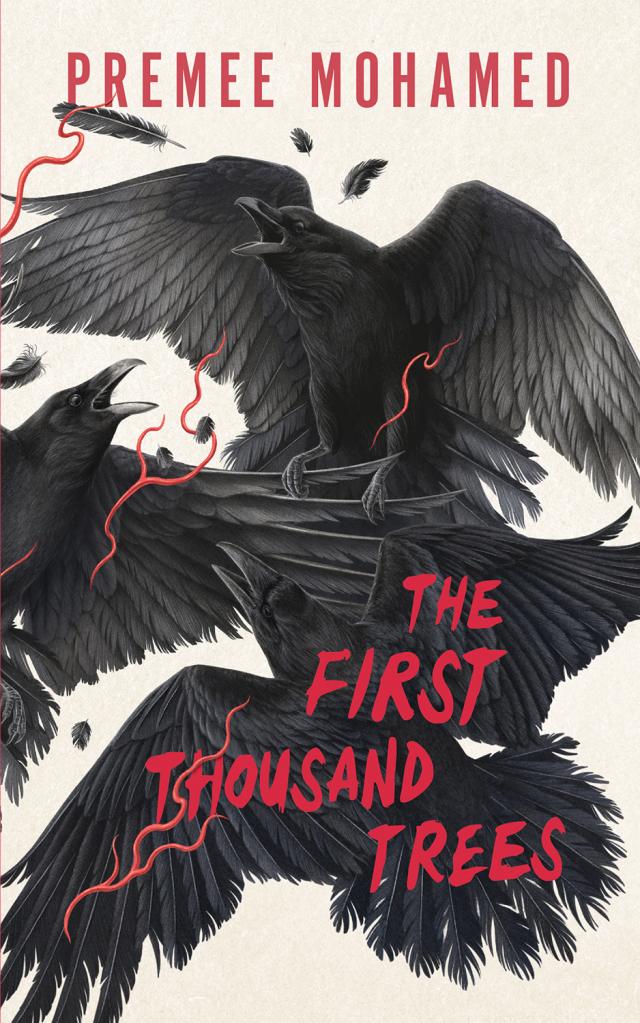
The First Thousand Trees
Premee Mohamed
Contents
Also by Premee Mohamed
Dedication
1.
2.
3.
4.
5.
6.
7.
8.
9.
10.
Acknowledgements
About the Author
Copyright
Also by Premee Mohamed
In This Series
iiThe Annual Migration of Clouds
We Speak Through the Mountain
Novels
Beneath the Rising
A Broken Darkness
The Void Ascendant
The Siege of Burning Grass
Collections
No One Will Come Back for Us and Other Stories
One Message Remains
Novellas
The Butcher of the Forest
And What Can We Offer You Tonight
These Lifeless Things
The Apple-Tree Throne
The Rider, The Ride, The Rich Man’s Wife
Dedication
vFor Kim
1.
1From the moment humanity conceived of gods, we came up with their great punishment: divine transformation. Supposedly, I should say. Allegedly. If you had angered a deity, maybe it would flog or crush or hang or eat you, give you a never-ending and ever-renewing task, blast your lands, blight your crops, strike barren any nearby wombs; or maybe it would say, You are changed.
Man into stag (torn apart). Nymph into pillar of stone (as one does). Man into pine tree. Girl into beautiful white heifer. Or spider or tortoise or mountain or river. Or a monster . . .
“What do I have to do,” I prayed as I walked. “Tell me. Anything. I’ll do it. Only make me a monster too.” I didn’t even know what I was praying to, or why one would pray to it for punishment. In my head, every god I’d ever heard of joined some vast disorganized pantheon that never shrank, only expanded, as I thought of additions.
2That rock I saw yesterday: a god.
Then at night, the raven studying me as I ate: a god.
Today: I woke to the smell of smoke, but I saw clearly and the sun was unobstructed. The presence of a god, the tracks of a god. Theosophical ichnology.
I left a place that did not give a single shit about me and I am searching for a place that might be the same. I hope not. But at least (I tell myself) I will come as a prophet out of the wilderness, because I am unannounced. And a little bit unhinged. It’s been a long walk.
In the distance, a dog began to bark — a big dog or a dog practised at sounding big. Short proud chestful booms echoing like falling masonry. The dog had a message for me. The dog said: I know you are coming.
Hmm. Announced after all.
They came to meet me when my map said I was still hours away. One dog, one man. The dog was even bigger than I had feared — eighty or ninety pounds, camouflaged with thick fur the colour of the burned forest, all char-white and ash-grey and charcoal-black. No collar, no leash. Even before I realized that it was loose, my heart was hammering hard enough to make me lightheaded. Everyone said they can smell fear. Would it attack at the smell? Was it trained to attack?
The man was so lean he looked like he did not outweigh his animal. As I approached he seemed to vibrate with impatience, but he did not walk to meet me. Not that there 3was a protocol or ceremony but that I was the supplicant, I should know my place, I must come to him. His hands were empty and that surprised me, but I supposed he didn’t need to threaten me with a weapon if he had an animal he could control.
Closer to, I saw he was armed — a wrist-thick spear strapped across his back, the stone point rising a full foot above his shoulder. The moment I knew what it was I turned my hands palm out, showing him I held nothing. Out here it did not signify some unbreakable chivalric rule, of course; but it had gotten me this far.
“What do you want?” the man said when we were close enough to talk.
“I’m headed to Sprucedown,” I said.
“The fuck you are.”
In my startled silence, the dog growled, a murmur I felt through the soles of my shoes. I resisted a brief but sickening urge to turn and run, and only managed to restrain myself with the mental image of what would happen if the dog reacted badly to sudden movements. For just a moment I felt again the terrible enormity of the world that overtook me when I least wanted it: the thousands of miles of empty landscape around us, the crumbling road on which we now stood, the punishing sun that did not care about the lack of shade, and the fact that I could be killed here — or could die here — and no one would know except these two.
Please make me a monster. Now, now, now, now. Venomed, fanged, many-limbed.
4I paused and analyzed his sentence: Which word had he emphasized, of the four? The second-to-last, I decided. “I have kin there,” I said. “My uncle Dex. My dad’s brother.”
He frowned. I had thought man, but he might not have even been my age. And I, at twenty, was what they still called a boy back home. But he was quite a bit taller than me, which had given me the false impression of adulthood. Tanned brown skin, shiny black hair, dark eyes. Aside from the spear he wore little else, in deference to the heat: baggy shorts and a vest made of what looked like undyed deerhide, and leather-and-wood sandals. Stuff only the hunters wore back home.
“If that’s so,” he said slowly, “tell me his last name.”
“Mandrusiak. And his brother’s name was Vic. He died five years ago — they both died. My mother and father. Uncle Dex came for the memorial.” The words tasted strange in my mouth. Only five years? It felt like much less and much more, or as if the periods of grief and anger, of confusion and yearning, had run on their own timelines while the rest of my life proceeded along the normal one. Uncle Dex came for the memorial: two shrouded forms and both of us dry-eyed, last of the line, not looking at one another.
Not for the first time did it occur to me that I had come here not even knowing whether Uncle Dex was still alive. Or still here. Or still thought of me as family. I had not written to tell him of my coming.
“My name’s Henryk,” I said.
His expression seemed to suggest the weariness of dealing with another travelling grifter, it said anyone could say anything, 5obviously; perhaps I had ambushed the real Henryk on the road, tortured or tricked him for information, taken his place. I, the impostor, came with ill intent. He’d been fooled before and it had ended in disaster. Never again would he be so trusting. Et cetera.
“You’re alone?” he said.
“I swear.” Look, I wanted to say. My parents are dead, my best friend is long gone and I never expect to see her again. After what I did this spring the people of my home have not turned their backs on me, but they have turned their sides to me and I can no longer see their faces. I am the definition of alone. Plus, your dog would have kept barking if I wasn’t, and you know it.
“You had a map to get this far,” he said. “Give it.”
No point in denying it. I handed it over; he studied it for a long time, his mouth working. I waited for his hand to flash over his shoulder, for the spear to strike me — where? My chest, my throat? Maybe he would use it as a sword. The edge was chipped sharp enough. I was still staring at the spearpoint when he snapped his fingers peremptorily in front of my eyes, making me refocus.
“You still wouldn’t have found it,” he said, wadding the map into the pocket of his shorts. “Anyway, come on. They’ll know if you’re bullshitting or what. Walk exactly where I walk.”
A month ago I left campus, slinking out at the crack of dawn — a fresh and cloudless morning promising an inferno 6of a day. The watchers at the palisades, of which we have few these days, did not challenge me. They’re on the lookout for people invading, not escaping. Escape is not something we do. It’s drilled into us from birth: Stay together, stay safe. Stay in the city, stay with your people, safety in numbers, no safety alone.
Almost I could not believe I had dared to violate every rule I had been brought up with, but at the same time, my fear of staying had finally, and not by much, overcome my fear of leaving. I had no words for what I felt as I passed under the gate for the last time. Nothing describes that level of pain. It was as if I were trying to walk my bones out of my flesh.
At first I moved clumsily with my pack — like an ant trying to manage a twig in its mandibles, constantly overbalancing, stumbling, teetering. I felt like I had to teach myself how to walk again. I had packed everything a city boy imagined would be needed to live on the road, and then some. I made a lot of stupid, heavy choices. Every day I discarded something, and as the load lightened I found myself straightening up to look around properly. And I saw exactly what everyone told me I would see: the remnants of a war zone. And I thought . . .
. . . Listen, you would think over the years my best friend and I would have begun to more closely resemble each other, but I’m nothing like Reid. She lives in an everpresent now, as if she carries a bubble of time around her that extends a few inches in every direction. Her gaze has always been forward, with only the most infrequent glances back over her shoulder: not to check for danger, because she b elieves there can be 7none from the past, but to refill her deep and righteous well of anger. Anger at how we live, at the world we were born into, anger burning clear and bright like a beeswax candle, not the spluttering mess of tallow.
Whereas I’m the type who takes a step, and pauses, evaluating, processing, chewing it over, revolving in place — a living joke about people who can’t walk and think at the same time — and then I reorient and take another step. So I’m often looking back. And I’m often thinking about it.
And yet it was still a shock to discover that my thinking had kind of reified itself into the landscape only a few hours outside of city limits: bombed by the past, obliterated by it and the rubble razed over, everything shattered, processed, and squeezed dry by the last generation who could do so. And the one after that was barely capable of drawing a picture of the war-machine unless they did so with ochre and charcoal on the walls of a cave.
I had stood unmoving for half an hour at the rise of the first meaningful hill, staring at the dried-out land, my mind scoured of every piece of language I knew. When I returned to myself I felt that something small but important had broken inside my head — like a chip of metal off a valve.
As I had walked, I had told myself so often that Sprucedown must be different — not all dust and ruins — it had become more than a mantra, something like a prayer, whispered through cracked lips to the scavenging birds that followed me as I wove my way north. And as things became greener, softer, damper, my prayers only became more fervent. 8I would leave that behind, that . . . that. The world my community had tried to protect us from.
“Keep up,” the boy snarled.
“I am.”
The dog, head practically hip-level to its master, paced him precisely, taking mincing little steps instead of its naturally long stride to do so. I walked behind them, following the spear like a lighthouse. He was right that I wouldn’t have found the place on my own, I realized uneasily. Uncle Dex’s hand-drawn map stopped far short of where we were headed now, and I had already lost track of the twists and turns we’d taken since leaving the highway.
The town — was it a town? I couldn’t tell — was virtually invisible, nestled at the bottom of a bowl whose sideslopes were so gradual that only for a split second, as we approached, could I perceive the dimensions. But it would have been shockingly visible from a bird’s-eye view, with its darkness and its greenness, thinning out in delicate concentric rings around its hidden heart like a drop of ink just fallen into still water. Trees of all kinds, and shrubs and grass and berry bushes with shining leaves stripped clean, and all the strange colours of peat and rush, bog and fen. It didn’t seem possible.
The boy turned off the final gravel road and led us down a near-invisible path between two huge blowsy wild-rose bushes. The low bush soon became fringed with saplings and then real trees, twisted black spruce whose tops met and tangled overhead, the shade singing on my skin like cool water. Around and 9around we trudged, the path thinning and branching, until we spiraled our way into the town.
There were a few dozen buildings, all single storey and apparently all wood — and even after my long walk, during which I’d seen thousands of trees (mainly dead or saplings or both) this seemed stunningly extravagant. Imagine having so much wood you could build with it . . . but they did, and that alone convinced me that this was some kind of promised land.
People wove around one another with wheelbarrows and sacks, tools and baskets, paying us not the slightest attention. I thought of an anthill, the way we think of an anthill as one organism industrious and single-minded, composed of individuals who need no description as individuals because their only qualities were being industrious and single-minded. Even kids — I spotted one little girl, perhaps four or five, struggling proudly with a small wooden wagon brimming with round stones.
The boy gestured me towards one of the buildings, unstrapped his spear from his back, then followed me in.
It was much cooler inside, a cross-breeze moving smartly through the propped-open doors. The smell of woodsmoke was so thick it seemed to overlay everything like a yellow varnish, subtly shifting the shapes and details of table, chairs, shelves, two dogs, a mildly surprised-looking middle-aged man who was not my uncle Dex. His curly white hair framed a perfectly circular bald spot scribbled over with the blue and green marks of Cad, like a child’s drawing.
10“Watch him,” the boy said. “I’m gonna get Beau.” He vanished.
The man stared at me for a minute, then said, “Well, I suppose you’d better sit down.”
I sat where he gestured. “I’m Henryk.”
“Mm,” he said, and proceeded to ignore me for the rest of the wait. Any move I made towards my backpack was met with meaningful noises from one or both dogs, who had stationed themselves across either doorway, so after a few of these attempts I simply sat there and watched the angles of the shadows change outside. I did not want my fear transmitted to them. A fearful dog was one that might attack, not retreat.
It was strange that they had so many dogs here. Back home, nobody had a dog. People tended to avoid anything that even resembled one; the wild dogs in the river valley weren’t some native species but pets that had long ago gone feral. They had banded into huge vicious packs that attacked anything that moved, and turned on their own in bad years. The Red Flags were forever trying to steal visibly unaffected pups to start up their own “clean” breeding operation, but dogs seemed unusually susceptible to carrying and dying of Cadastrulamyces. Every time it seemed like it worked, a few months would pass before the truth came out — and they immediately put the dog down before it could suffer.
My own feelings about dogs aside, I never faulted them for trying. Humanity wouldn’t have gotten where it was without dogs, so surely dogs could only help us in the great rebuilding. 11It was a logical desire. Lots of people had cats, which seemed to have a larger naturally Cad-immune subpopulation, but there wasn’t much you could do with a cat except let it keep vermin levels down.
Seated near the wall, I stayed as still as I could and tried to study the space I was in without moving my head. Back home, I feel like you wouldn’t have known much about me from my own place: definitely someone who lived alone, someone who read a lot, someone who had put a lot of time and anxiety into trying to get backups of things like blankets and lanterns, not someone who said “Oh well” when something broke.
Here, the chaos struck me as a sign of personal covetousness, or maybe I was just being petty and he was the person who held things in common use for the whole town . . . It seemed impossible that one person could have so many things just for himself. A dozen shelves packed not with books but with what looked like carved wooden toys, small paintings propped between them, an enormous copper mould in the shape of a fish hanging above the fireplace, square baskets overflowing with herbs, twigs, small but wickedly sharp–looking arrowheads, wooden pegs from ceiling to floor with things dangling from them: ladles, tongs, knives, axes, brooms, dried gourds, dog collars, iron pans.
“Don’t get any ideas,” the white-haired man murmured, as if I had spoken aloud.
Before I could defend myself, the boy returned, banging his fist on the door jamb near enough to my head that I jumped and nearly overturned my chair.
12“Get up. No — leave the bag.”
“There’s nothing valuable in it,” I said.
“I didn’t ask you. Move.”
I took that to mean, We’ll take what we consider valuable, if we want to take it, and I couldn’t argue with that, nor did it seem the best way of making a good first impression, so I just followed him back out. I had the sensation, fleeting but intense, of being leashed — maybe it was just seeing dogs that made me think of it — but leashed, collared, a feeling of the entire community, even people who had not met me yet, telling me exactly what my role was here. A strange animal in their midst, unquantified, unsummoned, and unwanted.
Beau was a big man, tall and wide and flat so that your first instinct was to stand him in a doorway to see if he filled it corner-to-corner. The threads of his Cad infection were just visible at the neck of his shirt so that they would have appeared to be nothing more than chest hairs unless you were watching them for movement. It had come into the whites of his eyes too, encircling each iris with eerily identical scrawls. His thin, long-sleeved shirt was blue, stitched all over with threads of darker blue in fern fronds, or maybe roots, or maybe something else, as if the shirt too were infected. I had never seen anyone embroider their clothes to look like the disease and I wondered if it was on purpose.


