A little blessing, p.1
A Little Blessing, page 1


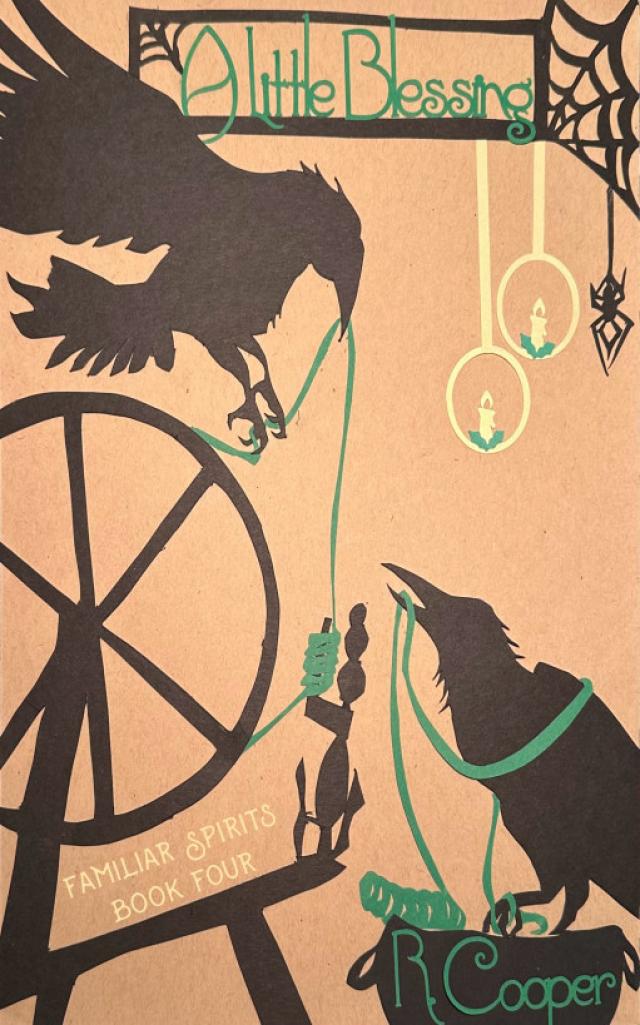
A Little Blessing
Familiar Spirits Book Four
R. Cooper
Copyright © 2022 R. Cooper
ISBN: 9781005838638
Cover Art by Kimieye Graham
Content tags: grief, references to past violent deaths, some social ostracism, mention of homophobia and transphobia, toxic insular group behavior, consumption of alcohol, depiction of depression and burnout, vomiting while sick, service kink, (very) light d/s
Acknowledgments
I like to have the witches be fully aware of how they are viewed in popular culture. But, being a nerd, assumed other people knew the pop culture references my witches were making and so I didn’t do acknowledgements for them in the previous stories.
To amend that, I’d like to say,
Both A Little Blessing and A Little Familiar show love to the movie (based on the play by John Van Druten) Bell, Book, and Candle. (And Pallas was obviously named with the world’s most famous fictional raven in mind.)
Chester is watching the Dolly Parton movie Smoky Mountain Christmas in Holly and Oak. Will’s familiar is named after the daughter on the TV show Bewitched. Piotr obliquely mentions this show as well.
In Nothing More Certain, Ezra is wearing a shirt that also references Bewitched. This time, its best character (Endora). And Emery was watching the old Veronica Lake movie I Married a Witch—which also is referenced in the name of Ezra’s cat familiar.
A Little Blessing also lightly pays tribute to some great fictional wizards, through what had to be child!Lucas’ taste in fiction. He reads The Once and Future King (for Merlin) by T.H. White and quotes Howl’s Moving Castle by Diana Wynne Jones enough that the familiars have picked up on it. The song briefly sung by one of the ravens is from the musical Into the Woods. (Lyrics by Sondheim, the play written by James Lapine.)
All of these are worth a look, if you ever get a chance.
Table of Contents
One
Two
Three
Four
Five
Six
Seven
Eight
Nine
Ten
Eleven
Twelve
Epilogue
The End
One
Robin ran his fingertips over the bare strands on the loom without seeing a single thread. He didn’t have much of the dull, simple pattern left to finish, but he’d caught a glimpse of stormy blues, and a different, more interesting pattern had started in his mind’s eye. The design he was meant to be weaving slipped away in favor of complexity and color, so much color it almost took his breath away; black and grays, yes, but also tempestuous blues, so many of them. Storm clouds of color, but a pillowcase soft enough to use, fine and comfortable and giving. His hands itched with the life in it but touched nothing except the loom and the as yet unused portion of the warp, and then, sadly, the pattern he’d completed so far.
His steadiest customers now were boutique hotels and expensive cabins that catered to the sort of people to go “glamping,” and those people did not seem to enjoy color. Large, uncomfortable pillows and throws in shades of eggshell, ecru, and stone were what were ordered, more often than not, and without much concern for texture.
Robin blinked, but the colors of a midnight cloudburst lingered before his eyes. He’d noticed the unused skeins earlier, found them under piles of other colors in a basket that he’d had no reason to be digging into, and put them on the table although they had no place there. Now they’d pulled him from his work.
He turned his head to frown dizzily at skeins that did not belong on his worktable, colors he was not going to acknowledge because they were not the “rustic, natural” vibes his customer wanted. Robin was tired, obviously, or he wouldn’t have let the skeins call to him from the basket he had probably buried them in months ago. He didn’t even know why he’d dyed them those colors…. If he had. The last few years had been taxing, and it was just as likely that Flora or John had set up that dye batch, or that Phillip had ordered it from one of the small producers in the state for a project that one of the others had been working on, or intending to work on. Robin could not remember the last time he had dyed anything for his own needs, in fact, but maybe that was the late hour.
If it was late.
He looked up toward the windows that lined the rooms converted into the family workroom, pausing in stunned confusion to see the curtains drawn. He’d apparently been working by artificial light only. Even the fire in the fireplace had gone out. The Blessing-Redferne farmhouse had a fireplace in every room, a system that worked better for heating than the furnace and vents installed in the 1960s.
He shivered reflexively to see the dark, long-cold hearth.
Thunder rumbled distantly, likely miles away. It might have rattled the windows of the Storr farm, the nearest neighbor.
Robin shivered again although he wasn’t cold. If it was raining, he’d have to make sure the heat was on in the appropriate rooms, or the fires going. He’d closed the vents in the unused rooms, or meant to, earlier in the fall.
He couldn’t seem to recall doing it, though. Maybe he should check. He probably needed a break anyway. He’d get a snack, check the heat situation, then finish. Working by artificial light alone wasn’t great, but he wanted this done. Then he’d lie down for a while, rest before he made another silly mistake like forgetting to open the curtains.
Robin straightened up, his back popping in a way that would have made Marise cluck over him in concern.
“You’re only a baby, Blessing, too young for that,” Robin said for her, although he would be thirty in the spring.
He shook his head to clear it of clouds and flexed his hands and wrists.
Thunder rolled again, closer and louder.
Robin glared muzzily at the skeins of yarn he did not need and would not use tonight, then, decidedly picked them up and crossed over to the crisscrossing shelves along the long wall. The shelves, made up of old crates and diamond bins from the local wineries, used to be stacked with skeins for the projects the others had going. There was more than enough room for a pesky batch of yarn that was doing its best to get on his nerves.
The floor creaked under his footsteps, the sound softening when he passed over one of the many rugs around or beneath various empty work tables and benches. When the house had first been built, the workroom had been intended as a small sitting room, and then perhaps a library and a parlor. The wide doors between each room had been permanently opened decades ago, however, and all of the furniture had long since been replaced with sewing machines, both treadle and electric, spinning wheels, or various looms.
There was an antique wheel near the fire, on a thick Hutsul wool rug; the rug a gift to his grandmother from a like-minded craft person, years ago. The other wall held racks, some still displaying the yarns that Robin’s older relatives had left there and never picked up again.
He should look it all over, see what condition it all was in.
He shuffled back to his worktable instead, slipping on the exposed hardwood floor and holding onto the tabletop until the wash of black faded from his vision.
“Okay,” Robin said out loud. “I will take a break.” The words cracked, barely making it passed his dry lips. He reached for a mug that wasn’t there; he’d brought no coffee or tea with him in here, either. “Forgetful tonight,” he chided himself, rubbing his eyes with the sleeve of his baggy knitted cardigan.
The clouds remained when he was done, blue-black like coming rain.
Robin ducked at another rumble of thunder, not sure he didn’t hear the patter of water against the walls. He left the unfinished pillowcase and shuffled over to the fireplace. The fire was good and out, must have been for hours.
New logs sat there beside it on the wide stones. Robin had managed that much this morning, gathering wood from his dwindling woodpile. He lifted one oddly heavy log onto the grate, then reached for the matches. Some witches did not need matches. Robin, despite his illustrious, or at least infamous, ancestry, did.
The matchbox was empty.
He gave up and tossed the box onto his worktable before grabbing his phone and leaving the room. The audiobook that had been playing while he worked had ended, perhaps because his phone had died.
Robin slipped a few times on the floor in front of the staircase, even with the rugs to catch him. He must have spilled something earlier. Maybe that’s where his tea had gone and he’d never replaced it. He didn’t stop to deal with the clouds again, nor the hovering dark shape in front of the office doorway.
Inside the office, a small room off the living room and to the side of the front door to the house, he plugged his phone in to charge, then would have sat down for a while among all the stickers and shipping boxes with the Blessing-Redferne logo on them because he hadn’t sat down in hours and his legs were shaky, except the hovering shape continued to hover, so he made his way back down the hall.
The door to the living room was open, giving him a glimpse of overflowing baskets of unfinished projects, the TV and bookshelves, the beat-up armchair and ottoman beneath a reading lamp, and the couch with its back to yet another fireplace. The couch had a pillow on one armrest and a collection of crocheted blankets at the other end where Robin had kicked them off that morning, too hot upon waking.
The shape hovered near that door too.
Robin continued on to stop in the bathroom, abruptly aware of the need to.
Splashing water on his face did not banish the ling
Marise, hanging on the longest of all of them, had teased Robin about his five o’clock shadow since puberty. Robin, fussy even then and still fussy now, was never satisfied with how it looked and inevitably shaved it off. It was a soothing ritual anyway, using the cup and kit his grandfather had given him, old-fashioned though it was. Robin was old-fashioned, probably a consequence of being raised by those in their twilight years. Or maybe he would have been regardless.
The shaving kit was nowhere to be seen in the downstairs bathroom, although Robin’s toothbrush was by the sink, along with a boar bristle brush for his hair. He frowned at his reflection after drying his face, and ran the brush through his short, loose curls once before it stuck in the tangles.
He tugged it free and set it down it by the sink. Then he left the bathroom in search of something to eat.
Actually, he might get a drink first. His throat was as parched as the rest of him, so much so that it burned when he swallowed.
He passed the small tapestry hanging beneath the stairs without looking at it, or at any of the framed vintage photographs around it, or at the crocheted lace on the cabinets and tables down the rest of the front hall. He barely looked up at all, and was grateful for it when he flicked the kitchen light switch and was nearly blinded by the sudden influx of close, brilliant light.
He blinked away stars for several seconds, seconds spent shivering as well, since the kitchen was much colder than the rest of the house without the stove or oven in use, and the tiled floor was mostly bare.
He went to the sink first for a glass of water, taking a careful sip as he peered out the window into the dark of night. There must have been heavy clouds since he couldn’t see the moon or any stars. He couldn’t see much of the yard, either, though some of the smaller sheds and one of the old sheep pens were not far from the back door.
The weather, he remembered belatedly, had been a special concern of late. Amy Parris, the last of her generation with remarkable Sight, had anticipated this and set things in motion with the two kings. But, from what Robin had gleaned, Ravenscroft was not immune to the hazards of the outside world, and even powerful forces like Holly and Oak could not entirely protect them. Robin was certain, though no one had said—not to him, anyway, insignificant as he was—that even the Kings of Winter and Summer were struggling.
They were only human, after all. Coven members often forgot that fact, concerned with their needs and fears. They were right to worry. Ravenscroft had tourists but was still essentially a farming community. But Robin had always thought that those working so hard for them, the kings, the Widow Parris, the marked ones, had worries too, not that the coven seemed to care much.
A bitter thought that his grandmother would have tutted over without actually disagreeing and his grandfather would have stated in much more direct terms. The Blessings and then the Redfernes had originally built this house out here for the acreage and the sheep, but most of them had stayed out here to avoid dealing with town, and coven, matters.
The ones that hadn’t stayed had left the area, never to return.
Robin jumped at a flare of lightning in the distance, revealing thick, rolling clouds. The third storm in as many weeks. Farms would be damaged and that mattered. Maybe the coven was right to be alarmed. Without anyone as strong as Amy Parris to help guide them, they might get desperate.
He dropped his head, staring at the dishes in the sink for several moments before recognizing the bowl he’d used that morning for his breakfast, along with his coffee mug and a spoon. Nothing else. Had he not eaten lunch? Or dinner?
The water in the bowl was clear enough to offer a reflection. Robin blinked away clouds and did not look.
Another shiver ran down his back, strong enough to almost knock him off his feet.
“Tea,” he decided hoarsely. To warm him up. Maybe he’d put in honey to ease his throat.
He filled the kettle, keeping his gaze away from the water pooled in the bottom of the bowl he’d used for his oatmeal. That had taken the last of the oats, Robin remembered finally, as well as the last of the honey.
He sighed heavily but went to the stove to get the water going for his tea.
He opened the cabinet where the more popular tea blends, both blessed and unblessed, were stored, and then several tins that didn’t have enough tea in them to make even a single cup. He left the cabinet open to cross the kitchen to the pantry at the other end. There, he stopped, staring for far too long out of gritty, dry eyes.
There should have at least been some packets of teabags that vendors sometimes sent as gifts or in sample packs to sweeten their offers. He saw no teabags… or much of anything. He considered a jar of pickles so old and unwanted that the date on the label was faded and unreadable, and then the rest of the bare shelves. Salt. He had salt and old pickles and—he double-checked—some confectioner’s sugar.
He wondered if that would dissolve well in tea. Maybe in coffee?
He took it with him as he shuffled back toward the stove, shivering as he went, and set it on the island in center of the kitchen when the weight was too much. At least he didn’t have the urgent press of a Christmas deadline. He hadn’t taken on clients like that in ages. Just commercial stuff these days, rugs and pillow covers for hotels that wanted to be different, but not too different. And personal items for coven members—who didn’t pay and rarely offered. Knitting wasn’t even Robin’s art of choice, although he liked it well enough for side projects. But that was what they usually asked for. Plenty of those in the coven and in town could knit for themselves, but the label of Blessing-Redferne still meant something in some places.
Yule was less about the giving of gifts, although some in the coven still exchanged presents with those who celebrated the other holiday. Robin was not sure for which holiday, if any, Persephone Greysmith had requested a shawl from him. But he liked her, so he had worked on her order first and finished her shawl the day before.
Oh. He had been going to clean up and take the shawl over to the Greysmith house tonight.
Maybe tomorrow.
He rubbed his stubbled cheek, certain he looked ridiculous with it and not sexy as some did. Yes, tomorrow, he’d take it over. Persephone, at least, had offered to pay him for the work. Robin had said no, as was expected, but Persephone remembered the old ways and had promised him some carved cedar statuettes for the closet shelves.
She wouldn’t carve them herself. It would more than likely be done by one of her adopted brothers. Persephone had so far shown little interest in any of the Greysmith trades and lines of work. That was another reason Robin liked her. She worked the front desk at a nail salon in town while she figured out which craft called to her, if any. She and Robin had the bond of the ‘not especially magically gifted in a well-known witch family.’
Persephone was at least out enjoying herself. But Robin wasn't the sort of witch to get a job among the outsiders any more than he was the sort to go play in a storm. He was boring compared to some of his notorious, and often executed, ancestors, on either side of the family. Even if the last few generations had settled down some, or at least learned to keep their idiosyncrasies confined to the farmhouse, Robin was still staid in comparison. No secret lovers. No witch trials. No desperate flights to the New World. No scandalizing small towns on the East Coast before sneaking off again. Not even any college or student protests and arrests like his great-aunt in the ‘60s.
Their Little Blessing, they’d called him since he’d been literally left on their doorstep by his father. Pfft. Robin was nothing like them. All of them far too old to be raising a child his age, some of them with children who had fled the town and coven and never looked back. But maybe that was why they’d been so loving and careful with Robin in what time they’d had.
Marise, not even a blood relation, had died in March, and she’d been the last of them. In the months since, none of the ones who’d left over the years had contacted Robin or shown any inclination to come back.