

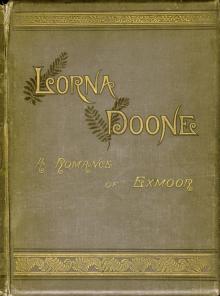
Lorna doone, p.63
Lorna Doone, page 63


Without intending any harm, and meaning only good indeed, I had now done serious wrong to Uncle Reuben’s prospects. For Captain Carfax was full as angry at the trick played on him, as he was happy in discovering the falsehood and the fraud of it. Nor could I help agreeing with him, when he told me all of it, as with tears in his eyes he did, and ready to be my slave thence-forth; I could not forbear from owning that it was a low and heartless trick, unworthy of men who had families; and the recoil whereof was well deserved whatever it might end in.
For when this poor man left his daughter, asleep as he supposed, and having his food, and change of clothes, and Sunday hat to see to, he meant to return in an hour or so, and settle about her sustenance in some house of the neighbourhood. But this was the very thing of all things which the leaders of the enterprise, who had brought him up from Cornwall, for his noted skill in metals, were determined, whether by fair means or foul, to stop at the very outset. Secresy being their main object, what chance could there be of it, if the miners were allowed to keep their children in the neighbourhood? Hence, on the plea of feasting Simon, they kept him drunk for three days and three nights, assuring him (whenever he had gleams enough to ask for her) that his daughter was as well as could be, and enjoying herself with the children. Not wishing the maid to see him tipsy, he pressed the matter no further; but applied himself to the bottle again, and drank her health with pleasure.
However, after three days of this, his constitution rose against it; and he became quite sober; with a certain lowness of heart moreover, and a sense of error. And his first desire to right himself, and easiest way to do it, was by exerting parental authority upon Gwenny. Possessed with this intention (for he was not a sweet-tempered man, and his head was aching sadly), he sought for Gwenny high and low; first with threats, and then with fears, and then with tears and wailing. And so he became to the other men a warning and great annoyance. Therefore they combined to swear what seemed a very likely thing, and might be true for all they knew; to wit, that Gwenny had come to seek for her father down the shaft-hole, and peering too eagerly into the dark, had toppled forward, and gone down, and lain at the bottom as dead as a stone.
“And thou being so happy with drink,” the villains finished up to him, “and getting drunker every day, we thought it shame to trouble thee; and we buried the wench in the lower drift; and no use to think more of her; but come and have a glass, Sim.”
But Simon Carfax swore that drink had lost him his wife, and now had lost him the last of his five children, and would lose him his own soul, if further he went on with it; and from that day to his death he never touched strong drink again. Nor only this; but being soon appointed captain of the mine, he allowed no man on any pretext to bring cordials thither; and to this and his stern hard rule, and stealthy secret management (as much as to good luck and place) might it be attributed that scarcely any but themselves had dreamed about this Exmoor mine.
As for me, I had no ambition to become a miner; and the state to which gold-seeking had brought poor Uncle Ben was not at all encouraging. My business was to till the ground, and tend the growth that came of it, and store the fruit in heaven’s good time, rather than to scoop and burrow like a weasel or a rat for the yellow root of evil. Moreover, I was led from home, between the hay and corn harvests (when we often have a week to spare) by a call there was no resisting; unless I gave up all regard for wrestling, and for my county.
Now here many persons may take me amiss, and there always has been some confusion; which people who ought to have known better have wrought into subject of quarrelling. By birth it is true, and cannot be denied, that I am a man of Somerset; nevertheless by breed I am, as well as by education, a son of Devon also. And just as both of our two counties vowed that Glen Doone was none of theirs, but belonged to the other one; so now, each with hot claim and jangling (leading even to blows sometimes) asserted and would swear to it (as I became more famous) that John Ridd was of its own producing, bred of its own true blood, and basely stolen by the other.
Now I have not judged it in any way needful, or even becoming and delicate, to enter into my wrestling adventures, or describe my progress. The whole thing is so different from Lorna, and her gentle manners, and her style of walking; moreover I must seem (even to kind people) to magnify myself so much, or at least attempt to do it, that I have scratched out written pages, through my better taste and sense.
Neither will I, upon this head, make any difference even now; being simply betrayed into mentioning the matter, because bare truth requires it, in the tale of Lorna’s fortunes.
For a mighty giant had arisen in a part of Cornwall; and his calf was twenty-five inches round, and the breadth of his shoulders two feet and a quarter; and his stature seven feet and three quarters. Round the chest he was seventy inches, and his hand a foot across, and there were no scales strong enough to judge of his weight in the market-place. Now this man—or I should say, his backers and his boasters, for the giant himself was modest—sent me a brave and haughty challenge, to meet him in the ring at Bodmin-town, on the first day of August; or else to return my champion’s belt to them by the messenger.
It is no use to deny, but that I was greatly dashed and scared at first. For my part, I was only, when measured without clothes on, sixty inches round the breast, and round the calf scarce twenty-one, only two feet across the shoulders, and in height not six and three quarters. However, my mother would never believe that this man could beat me; and Lorna being of the same mind, I resolved to go and try him, as they would pay all expenses, and a hundred pounds, if I conquered him; so confident were those Cornishmen.
Now this story is too well-known for me to go through it again and again. Every child in Devonshire knows, and his grandson will know, the song which some clever man made of it; after I had treated him to water, and to lemon, and a little sugar, and a drop of eau-de-vie. Enough that I had found the giant quite as big as they had described him, and enough to terrify any one. But trusting in my practice and study of the art, I resolved to try a back with him; and when my arms were round him once, the giant was but a farthingale put into the vice of a blacksmith. The man had no bones; his frame sank in, and I was afraid of crushing him. He lay on his back, and smiled at me; and I begged his pardon.
Now this affair made a noise at the time, and redounded so much to my credit, that I was deeply grieved at it, because deserving none. For I do like a good strife and struggle; and the doubt makes the joy of victory; whereas in this case I might as well have been sent for a match with a hay-mow. However, I got my hundred pounds, and made up my mind to spend every farthing in presents for mother and Lorna.
For Annie was married by this time, and long before I went away; as need scarcely be said perhaps, if any one follows the weeks and the months. The wedding was quiet enough, except for everybody’s good wishes; and I desire not to dwell upon it, because it grieved me in many ways.
But now that I had tried to hope the very best for dear Annie, a deeper blow than could have come, even through her, awaited me. For after that visit to Cornwall, and with my prize-money about me, I came on foot from Okehampton to Oare, so as to save a little sum towards my time of marrying. For Lorna’s fortune I would not have; small or great I would not have it; only if there were no denying, we would devote the whole of it to charitable uses, as Master Peter Blundell had done; and perhaps the future ages would endeavour to be grateful. Lorna and I had settled this question, at least twice a day, on the average; and each time with more satisfaction.
Now coming into the kitchen with all my cash in my breeches pocket (golden guineas, with an elephant on them, for the stamp of the Guinea Company), I found dear mother most heartily glad to see me safe and sound again—for she had dreaded that giant, and dreamed of him—and she never asked me about the money. Lizzie also was softer, and more gracious than usual; especially when she saw me pour guineas, like pepper-corns, into the pudding-basin. But by the way they hung about, I knew that something was gone wrong.
“Where is Lorna?” I asked at length, after trying not to ask it: “I want her to come, and see my money. She never saw so much before.”
“Alas!” said mother, with a heavy sigh; “she will see a great deal more, I fear; and a deal more than is good for her. Whether you ever see her again will depend upon her nature, John.”
“What do you mean, mother? Have you quarrelled? Why does not Lorna come to me? Am I never to know?”
“Now, John, be not so impatient,” my mother replied, quite calmly, for in truth she was jealous of Lorna: “you could wait now very well, John, if it were till this day week, for the coming of your mother, John. And yet your mother is your best friend. Who can ever fill her place?”
Thinking of her future absence, mother turned away and cried; and the box-iron singed the blanket.
“Now,” said I, being wild by this time; “Lizzie, you have a little sense; will you tell me where is Lorna?”
“The Lady Lorna Dugal,” said Lizzie, screwing up her lips, as if the title were too grand; “is gone to London, brother John; and not likely to come back again. We must try to get on without her.”
“You little”—[something] I cried, which I dare not write down here, as all you are too good for such language; but Lizzie’s lip provoked me so—“my Lorna gone, my Lorna gone! And without good-bye to me even! It is your spite has sickened her.”
“You are quite mistaken there,” she replied; “how can folk of low degree have either spite or liking towards the people so far above them? The Lady Lorna Dugal is gone, because she could not help herself; and she wept enough to break ten hearts—if hearts are ever broken, John.”
“Darling Lizzie, how good you are!” I cried, without noticing her sneer: “tell me all about it, dear; tell me every word she said.”
“That will not take long,” said Lizzie, quite as unmoved by soft coaxing as by urgent cursing: “the lady spoke very little to any one, except indeed to mother, and to Gwenny Carfax: and Gwenny is gone with her, so that the benefit of that is lost. But she left a letter for ‘poor John,’ as in charity she called him. How grand she looked, to be sure, with the fine clothes on that were come for her!”
“Where is the letter, you utter vixen? Oh, may you have a husband!”
“Who will thresh it out of you, and starve it, and swear it out of you!” was the meaning of my imprecation; but Lizzie, not dreaming as yet of such things, could not understand me, and was rather thankful; therefore she answered quietly,
“The letter is in the little cupboard, near the head of Lady Lorna’s bed, where she used to keep the diamond necklace, which we contrived to get stolen.”
Without another word, I rushed (so that every board in the house shook) up to my lost Lorna’s room, and tore the little wall-niche open, and espied my treasure. It was as simple, and as homely, and loving, as even I could wish. Part of it ran as follows—the other parts it behoves me not to open out to strangers: “My own love, and sometime lord,—Take it not amiss of me, that even without farewell, I go; for I cannot persuade the men to wait, your return being doubtful. My great uncle, some grand lord, is awaiting me at Dunster, having fear of venturing too near this Exmoor country. I, who have been so lawless always, and the child of outlaws, am now to atone for this, it seems, by living in a court of law, and under special surveillance (as they call it, I believe) of His Majesty’s Court of Chancery. My uncle is appointed my guardian and master; and I must live beneath his care, until I am twenty-one years old. To me this appears a dreadful thing, and very unjust, and cruel; for why should I lose my freedom, through heritage of land and gold? I offered to abandon all if they would only let me go: I went down on my knees to them, and said I wanted titles not, neither land, nor money; only to stay where I was, where first I had known happiness. But they only laughed, and called me ‘child,’ and said that I must talk of that to the King’s High Chancellor. Their orders they had, and must obey them; and Master Stickles was ordered too to help, as the King’s Commissioner. And then, although it pierced my heart not to say one ‘good-bye, John,’ I was glad upon the whole that you were not here to dispute it. For I am almost certain that you would not, without force to yourself, have let your Lorna go to people who never, never can care for her.”
Here my darling had wept again, by the tokens on the paper; and then there followed some sweet words, too sweet for me to chatter them. But she finished with these noble lines, which (being common to all humanity, in a case of steadfast love) I do no harm, but rather help all true love, by repeating. “Of one thing rest you well assured—and I do hope that it may prove of service to your rest, love; else would my own be broken—no difference of rank, or fortune, or of life itself, shall ever make me swerve from truth to you. We have passed through many troubles, dangers, and dispartments; but never yet was doubt between us; neither ever shall be. Each has trusted well the other; and still each must do so. Though they tell you I am false, though your own mind harbours it, from the sense of things around, and your own under-valuing; yet take counsel of your heart, and cast such thoughts away from you; being unworthy of itself, they must be unworthy also of the one who dwells there: and that one is, and ever shall be, your own Lorna Dugal.”
Some people cannot understand that tears should come from pleasure; but whether from pleasure or from sorrow (mixed as they are in the twisted strings of a man’s heart, or a woman’s), great tears fell from my stupid eyes, even on the blots of Lorna’s.
“No doubt, it is all over:” my mind said to me bitterly: “trust me, all shall yet be right:” my heart replied very sweetly.
CHAPTER VIII.
Some people may look down upon us for our slavish ways (as they may choose to call them), but in our part of the country, we do love to mention title, and to roll it on our tongues, with a conscience and a comfort. Even if a man knows not, through fault of education, who the Duke of this is, or the Earl of that, it will never do for him to say so, lest the room look down on him. Therefore he must nod his head, and say, “Ah, to be sure! I know him as well as ever I know my own good woman’s brother. He married Lord Flipflap’s second daughter, and a precious life she led him.” Whereupon the room looks up at him. But I, being quite unable to carry all this in my head, as I ought, was speedily put down by people of a noble tendency, apt at Lords, and pat with Dukes, and knowing more about the King than His Majesty would have requested. Therefore, I fell back in thought, not daring in words to do so, upon the titles of our horses. And all these horses deserved their names, not having merely inherited, but by their own doing earned them. Smiler, for instance, had been so called, not so much from a habit of smiling, as from his general geniality, white nose, and white ankle. This worthy horse was now in years, but hale and gay as ever; and when you let him out of stable, he could neigh and whinny, and make men and horses know it. On the other hand, Kickums was a horse of morose and surly order; harbouring up revenge, and leading a rider to false confidence. Very smoothly he would go, and as gentle as a turtle-dove; until his rider fully believed that a pack-thread was enough for him, and a pat of approval upon his neck the aim and crown of his worthy life. Then suddenly up went his hind feet to heaven, and the rider for the most part flew over his nose: whereupon good Kickums would take advantage of his favourable position to come and bite a piece out of his back. Now in my present state of mind, being understood of nobody, having none to bear me company, neither wishing to have any, an indefinite kind of attraction drew me into Kickums’ society. A bond of mutual sympathy was soon established between us: I would ride no other horse, neither Kickums be ridden by any other man. And this good horse became as jealous about me, as a dog might be; and would lash out, or run teeth foremost, at any one who came near him when I was on his back.
Now the reaping of the corn, which had been, but a year ago, so pleasant and so lightsome, was become a heavy labour, and a thing for grumbling rather than for gladness. However, for the sake of all, it must be attended to, and with as fair a show of spirit and alacrity as might be. For otherwise the rest would drag, and drop their hands and idle, being quicker to take infection of dulness than of diligence. And the harvest was a heavy one, even heavier than the year before, although of poorer quality. Therefore was I forced to work as hard as any horse could, during all the daylight hours, and defer till night the brooding upon my misfortune. But the darkness always found me stiff with work, and weary, and less able to think than to dream, may be, of Lorna. And now the house was so dull and lonesome, wanting Annie’s pretty presence, and the light of Lorna’s eyes, that a man had no temptation, after supper-time, even to sit and smoke a pipe.
For Lizzie, though so learned, and pleasant when it suited her, never had taken very kindly to my love for Lorna, and being of a proud and slightly upstart nature, could not bear to be eclipsed in bearing, looks, and breeding, and even in clothes, by the stranger. For one thing I will say of the Doones, that whether by purchase or plunder, they had always dressed my darling well, with her own sweet taste to help them. And though Lizzie’s natural hate of the maid (as a Doone and burdened with father’s death) should have been changed to remorse, when she learned of Lorna’s real parentage; it was only altered to sullenness, and discontent with herself, for frequent rudeness to an innocent person, and one of such high descent. Moreover the child had imbibed strange ideas as to our aristocracy, partly perhaps from her own way of thinking, and partly from reading of history. For while from one point of view she looked up at them very demurely, as commissioned by God for the country’s good; from another sight she disliked them, as ready to sacrifice their best and follow their worst members.
Now why should this wench dare to judge upon a matter so far beyond her, and form opinions which she knew better than to declare before mother? But with me she had no such scruple; for I had no authority over her; and my intellect she looked down upon, because I praised her own so. Thus she made herself very unpleasant to me; by little jags and jerks of sneering, sped as though unwittingly; which I (who now considered myself allied to the aristocracy, and perhaps took airs on that account) had not wit enough to parry, yet had wound enough to feel.


_preview.jpg)
_preview.jpg)
_preview.jpg)


