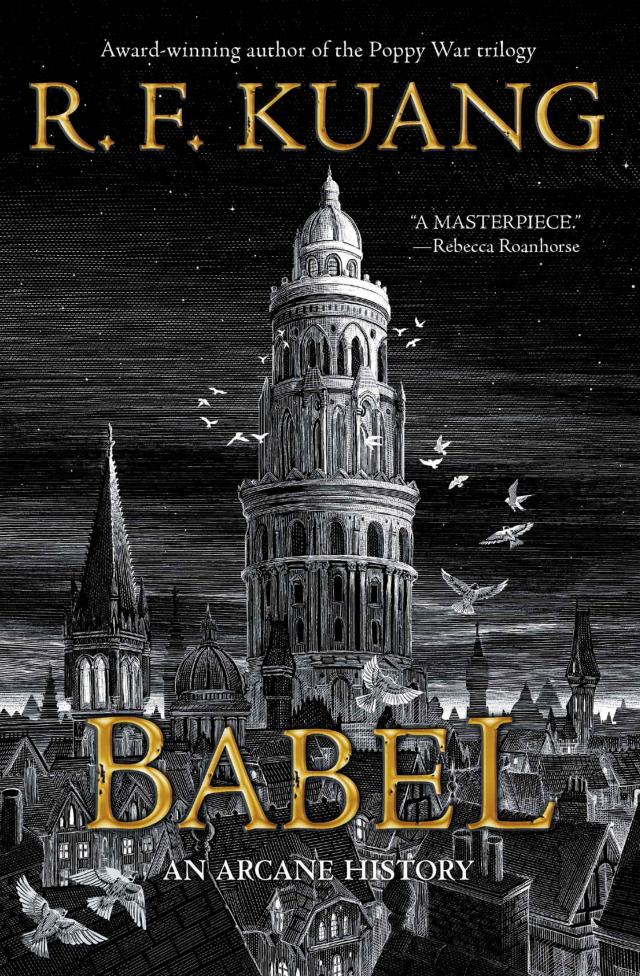
Babel, p.1
Babel, page 1


City of Oxford
Map of Babel
Dedication
To Bennett,
who is all the light and laughter in the world.
Contents
Cover
Title Page
City of Oxford
Map of Babel
Dedication
Author’s Note on Her Representations of Historical England, and of the University of Oxford in Particular
Book I
Chapter One
Chapter Two
Chapter Three
Chapter Four
Book II
Chapter Five
Chapter Six
Chapter Seven
Chapter Eight
Chapter Nine
Chapter Ten
Chapter Eleven
Chapter Twelve
Book III
Chapter Thirteen
Chapter Fourteen
Chapter Fifteen
Interlude
Chapter Sixteen
Chapter Seventeen
Chapter Eighteen
Book IV
Chapter Nineteen
Chapter Twenty
Chapter Twenty-One
Chapter Twenty-Two
Chapter Twenty-Three
Chapter Twenty-Four
Chapter Twenty-Five
Book V
Interlude
Chapter Twenty-Six
Chapter Twenty-Seven
Chapter Twenty-Eight
Chapter Twenty-Nine
Chapter Thirty
Chapter Thirty-One
Chapter Thirty-Two
Chapter Thirty-Three
Epilogue
Acknowledgements
About the Author
Also by R. F. Kuang
Copyright
About the Publisher
Author’s Note on Her Representations of Historical England, and of the University of Oxford in Particular
The trouble with writing an Oxford novel is that anyone who has spent time at Oxford will scrutinize your text to determine if your representation of Oxford aligns with their own memories of the place. Worse if you are an American writing about Oxford, for what do Americans know about anything? I offer my defence here:
Babel is a work of speculative fiction and so takes place in a fantastical version of Oxford in the 1830s, whose history was thoroughly altered by silver-work (more on that shortly). Still, I’ve tried to remain as faithful to the historical record on life in early Victorian Oxford as possible, and to introduce falsehoods only when they serve the narrative. For references on early nineteenth-century Oxford, I’ve relied on James J. Moore’s highly entertaining The Historical Handbook and Guide to Oxford (1878), as well as The History of the University of Oxford volumes VI and VII, edited by M.G. Brock and M.C. Curthoys (1997 and 2000, respectively) among others.
For rhetoric and the general texture of life (such as early nineteenth-century Oxford slang, which differs quite a lot from contemporary Oxford slang),* I have made use of primary sources such as Alex Chalmers’s A History of the Colleges, Halls, and Public Buildings Attached to the University of Oxford, Including the Lives of the Founders (1810), G.V. Cox’s Recollections of Oxford (1868), Thomas Mozley’s Reminiscences: Chiefly of Oriel College and the Oxford Movement (1882), and W. Tuckwell’s Reminiscences of Oxford (1908). Since fiction can also tell us much about life the way it was lived, or at least the way it was perceived, I have also dropped in details from novels such as Cuthbert M. Bede’s The Adventures of Mr. Verdant Green (1857), Thomas Hughes’s Tom Brown at Oxford (1861), and William Makepeace Thackeray’s The History of Pendennis (1850). For everything else, I’ve relied on my memories and my imagination.
For those familiar with Oxford and thus eager to cry, ‘No, that’s not how things are!’, I’ll now explain some peculiarities. The Oxford Union was not established until 1856, so in this novel it is referred to by the name of its predecessor, the United Debating Society (founded in 1823). My beloved Vaults & Garden café did not exist until 2003, but I spent so much time there (and ate so many scones there) that I couldn’t deny Robin and company those same pleasures. The Twisted Root as described does not exist, and as far as I’m aware no pub exists in Oxford of that name. There is also no Taylor’s on Winchester Road though I am pretty fond of the Taylors on High Street. The Oxford Martyrs Monument does exist, but was not completed until 1843, three years after the conclusion of this novel. I’ve moved the date of its construction up just a little bit, all for the sake of a cute reference. The coronation of Queen Victoria happened in June 1838, not 1839. The Oxford-to-Paddington railway line was not laid until 1844, but here it was constructed several years earlier for two reasons: first, because it makes sense given the altered history; and second, because I needed to get my characters to London a bit faster.
I took a lot of artistic liberties with the commemoration ball, which looks a lot more like a contemporary Oxbridge May/Commemoration Ball than any kind of early-Victorian social event. For instance, I’m aware that oysters were a staple of the early-Victorian poor, but I choose to make them a delicacy because that was my first impression of the 2019 May Ball at Magdalene College, Cambridge – heaps and heaps of oysters on ice (I hadn’t brought a purse, and was juggling my phone, champagne glass, and oyster in one hand, and spilled champagne all over an old man’s nice dress shoes as a result).
Some may be puzzled by the precise placement of the Royal Institute of Translation, also known as Babel. That is because I’ve warped geography to make space for it. Imagine a green between the Bodleian Libraries, the Sheldonian, and the Radcliffe Camera. Now make it much bigger, and put Babel right in the centre.
If you find any other inconsistencies, feel free to remind yourself this is a work of fiction.
Book I
Chapter One
Que siempre la lengua fue compañera del imperio; y de tal manera lo siguió, que junta mente començaron, crecieron y florecieron, y después junta fue la caida de entrambos.
Language was always the companion of empire, and as such, together they begin, grow, and flourish. And later, together, they fall.
ANTONIO DE NEBRIJA, Gramática de la lengua castellana
By the time Professor Richard Lovell found his way through Canton’s narrow alleys to the faded address in his diary, the boy was the only one in the house left alive.
The air was rank, the floors slippery. A jug of water sat full, untouched by the bed. At first the boy had been too scared of retching to drink; now he was too weak to lift the jug. He was still conscious, though he’d sunk into a drowsy, half-dreaming haze. Soon, he knew, he’d fall into a deep sleep and fail to wake up. That was what had happened to his grandparents a week ago, then his aunts a day after, and then Miss Betty, the Englishwoman, a day after that.
His mother had perished that morning. He lay beside her body, watching as the blues and purples deepened across her skin. The last thing she’d said to him was his name, two syllables mouthed without breath. Her face had then gone slack and uneven. Her tongue lolled out of her mouth. The boy tried to close her filmy eyes, but her lids kept sliding back open.
No one answered when Professor Lovell knocked. No one exclaimed in surprise when he kicked through the front door – locked, because plague thieves were stripping the houses in the neighbourhood bare, and though there was little of value in their home, the boy and his mother had wanted a few hours of peace before the sickness took them too. The boy heard all the commotion from upstairs, but he couldn’t bring himself to care.
By then he only wanted to die.
Professor Lovell made his way up the stairs, crossed the room, and stood over the boy for a long moment. He did not notice, or chose not to notice, the dead woman on the bed. The boy lay still in his shadow, wondering if this tall, pale figure in black had come to reap his soul.
‘How do you feel?’ Professor Lovell asked.
The boy’s breathing was too laboured to answer.
Professor Lovell knelt beside the bed. He drew a slim silver bar out of his front pocket and placed it over the boy’s bare chest. The boy flinched; the metal stung like ice.
‘Triacle,’ Professor Lovell said first in French. Then, in English, ‘Treacle.’
The bar glowed a pale white. There came an eerie sound from nowhere; a ringing, a singing. The boy whined and curled onto his side, his tongue prodding confusedly around his mouth.
‘Bear with it,’ murmured Professor Lovell. ‘Swallow what you taste.’
Seconds trickled by. The boy’s breathing steadied. He opened his eyes. He saw Professor Lovell more clearly now, could make out the slate-grey eyes and curved nose – yīnggōubí, they called it, a hawk’s-beak nose – that could only belong on a foreigner’s face.
‘How do you feel now?’ asked Professor Lovell.
The boy took another deep breath. Then he said, in surprisingly good English, ‘It’s sweet. It tastes so sweet . . .’
‘Good. That means it worked.’ Professor Lovell slipped the bar back into his pocket. ‘Is there anyone else alive here?’
‘No,’ whispered the boy. ‘Just me.’
‘Is there anything you can’t leave behind?’
The boy was silent for a moment. A fly landed on his mother’s cheek and crawled across her nose. He wanted to brush it off, but he didn’t have the strength to lift his hand.
‘I can’t take a body,’ said Professor Lovell. ‘Not where we’re going.’
The boy stared at his mother for a long moment.
‘My books,†™ he said at last. ‘Under the bed.’
Professor Lovell bent beneath the bed and pulled out four thick volumes. Books written in English, spines battered from use, some pages worn so thin that the print was barely still legible. The professor flipped through them, smiling despite himself, and placed them in his bag. Then he slid his arms under the boy’s thin frame and lifted him out of the house.
In 1829, the plague that later became known as Asiatic Cholera made its way from Calcutta across the Bay of Bengal to the Far East – first to Siam, then Manila, then finally the shores of China on merchant ships whose dehydrated, sunken-eyed sailors dumped their waste into the Pearl River, contaminating the waters where thousands drank, laundered, swam, and bathed. It hit Canton like a tidal wave, rapidly working its way from the docks to the inland residential areas. The boy’s neighbourhood had succumbed within weeks, whole families perishing helplessly in their homes. When Professor Lovell carried the boy out of Canton’s alleys, everyone else on his street was already dead.
The boy learned all this when he awoke in a clean, well-lit room in the English Factory, wrapped in blankets softer and whiter than anything he’d ever touched. These only slightly reduced his discomfort. He was terribly hot, and his tongue sat in his mouth like a dense, sandy stone. He felt as though he were floating far above his body. Every time the professor spoke, sharp pangs shot through his temples, accompanied by flashes of red.
‘You’re very lucky,’ said Professor Lovell. ‘This illness kills almost everything it touches.’
The boy stared, fascinated by this foreigner’s long face and pale grey eyes. If he let his gaze drift out of focus, the foreigner morphed into a giant bird. A crow. No, a raptor. Something vicious and strong.
‘Can you understand what I’m saying?’
The boy wet his parched lips and uttered a response.
Professor Lovell shook his head. ‘English. Use your English.’
The boy’s throat burned. He coughed.
‘I know you have English.’ Professor Lovell’s voice sounded like a warning. ‘Use it.’
‘My mother,’ breathed the boy. ‘You forgot my mother.’
Professor Lovell did not respond. Promptly he stood and brushed at his knees before he left, though the boy could scarcely see how any dust could have accumulated in the few minutes in which he’d been sitting down.
The next morning the boy was able to finish a bowl of broth without retching. The morning after that he managed to stand without much vertigo, though his knees trembled so badly from disuse he had to clutch the bedframe to keep from falling over. His fever receded; his appetite improved. When he woke again that afternoon, he found the bowl replaced with a plate with two thick slices of bread and a hunk of roast beef. He devoured these with his bare hands, famished.
He spent most of the day in dreamless sleep, which was regularly interrupted by the arrival of one Mrs Piper – a cheery, round woman who plumped his pillows, wiped his forehead with deliciously cool wet cloths, and spoke English with such a peculiar accent that the boy always had to ask her several times to repeat herself.
‘My word,’ she chuckled the first time he did this. ‘Must be you’ve never met a Scot.’
‘A . . . Scot? What is a Scot?’
‘Don’t you worry about that.’ She patted his cheek. ‘You’ll learn the lay of Great Britain soon enough.’
That evening, Mrs Piper brought him his dinner – bread and beef again – along with news that the professor wanted to see him in his office. ‘It’s just upstairs. The second door to the right. Finish your food first; he’s not going anywhere.’
The boy ate quickly and, with Mrs Piper’s help, got dressed. He didn’t know where the clothes had come from – they were Western in style, and fitted his short, skinny frame surprisingly well – but he was too tired then to inquire further.
As he made his way up the stairs he trembled, whether from fatigue or trepidation, he didn’t know. The door to the professor’s study was shut. He paused a moment to catch his breath, and then he knocked.
‘Come in,’ called the professor.
The door was very heavy. The boy had to lean hard against the wood to budge it open. Inside, he was overwhelmed by the musky, inky scent of books. There were stacks and stacks of them; some were arrayed neatly on shelves, while others were messily piled up in precarious pyramids throughout the room; some were strewn across the floor, while others teetered on the desks that seemed arranged at random within the dimly lit labyrinth.
‘Over here.’ The professor was nearly hidden behind the bookcases. The boy wound his way tentatively across the room, afraid the slightest wrong move might send the pyramids tumbling.
‘Don’t be shy.’ The professor sat behind a grand desk covered with books, loose papers, and envelopes. He gestured for the boy to take a seat across from him. ‘Did they let you read much here? English wasn’t a problem?’
‘I read some.’ The boy sat gingerly, taking care not to tread on the volumes – Richard Hakluyt’s travel notes, he noticed – amassed by his feet. ‘We didn’t have many books. I ended up re-reading what we had.’
For someone who had never left Canton in his life, the boy’s English was remarkably good. He spoke with only a trace of an accent. This was thanks to an Englishwoman – one Miss Elizabeth Slate, whom the boy had called Miss Betty, and who had lived with his household for as long as he could remember. He never quite understood what she was doing there – his family was certainly not wealthy enough to employ any servants, especially not a foreigner – but someone must have been paying her wages because she had never left, not even when the plague hit. Her Cantonese was passably good, decent enough for her to make her way around town without trouble, but with the boy, she spoke exclusively in English. Her sole duty seemed to be taking care of him, and it was through conversation with her, and later with British sailors at the docks, that the boy had become fluent.
He could read the language better than he spoke it. Ever since the boy turned four, he had received a large parcel twice a year filled entirely with books written in English. The return address was a residence in Hampstead just outside London – a place Miss Betty seemed unfamiliar with, and which the boy of course knew nothing about. Regardless, he and Miss Betty used to sit together under candlelight, laboriously tracing their fingers over each word as they sounded them out loud. When he grew older, he spent entire afternoons poring over the worn pages on his own. But a dozen books were hardly enough to last six months; he always read each one so many times over he’d nearly memorized them by the time the next shipment came.
He realized now, without quite grasping the larger picture, that those parcels must have come from the professor.
‘I do quite enjoy it,’ he supplied feebly. Then, thinking he ought to say a bit more, ‘And no – English was not a problem.’
‘Very good.’ Professor Lovell picked a volume off the shelf behind him and slid it across the table. ‘I suppose you haven’t seen this one before?’
The boy glanced at the title. The Wealth of Nations, by Adam Smith. He shook his head. ‘I’m sorry, no.’
‘That’s fine.’ The professor opened the book to a page in the middle and pointed. ‘Read out loud for me. Start here.’
The boy swallowed, coughed to clear his throat, and began to read. The book was intimidatingly thick, the font very small, and the prose proved considerably more difficult than the breezy adventure novels he’d read with Miss Betty. His tongue tripped over words he didn’t know, words he could only guess at and sound out.
‘The par . . . particular ad-advantage which each col-o-colonizing country derives from the col . . . colonies which par . . . particularly belong to it, are of two different kinds; first, those common advantages which every empire de . . . rives?’ He cleared his throat. ‘Derives . . . from the provinces subject to its dom . . . dom . . .’*
‘That’s enough.’
He had no idea what he’d just read. ‘Sir, what does—’
‘No, that’s all right,’ said the professor. ‘I hardly expect you to understand international economics. You did very well.’ He set the book aside, reached into his desk drawer, and pulled out a silver bar. ‘Remember this?’