Jotnar snare, p.10
Jotnar Snare, page 10
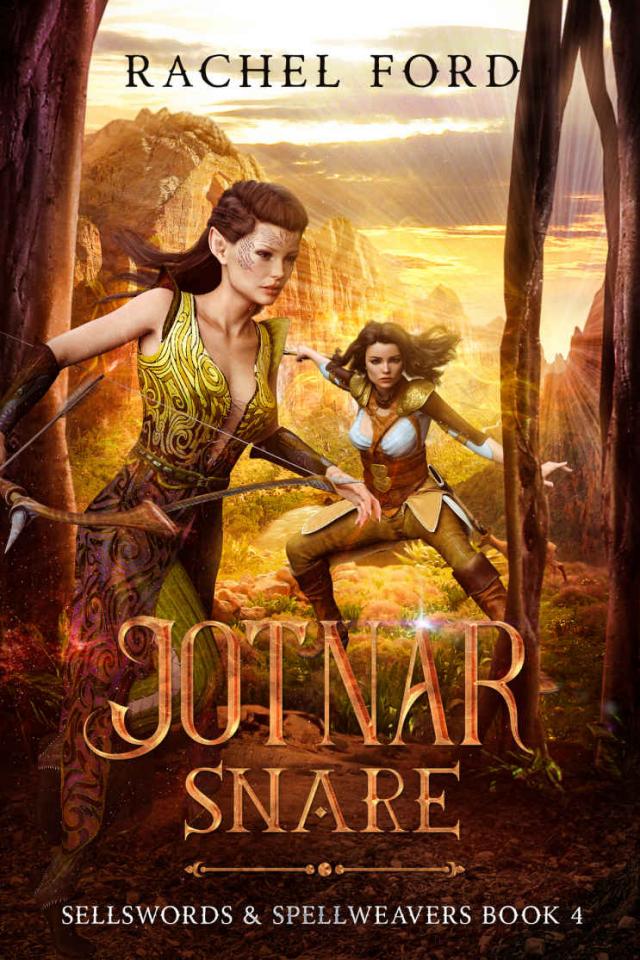
part #4 of Sellswords & Spellweavers Series


The old woman scoffed. “Dwarves? Hang dwarves. No one’s interested in dwarves. I was hoping to see a dragon again, before I die.”
In one of the stranger public relations experiences of my career, I ended up apologizing to the cook that our story didn’t, in fact, involve murderous dragons who meant to devour Little Eerie. She ambled off disappointed, declaring that there was “still time” – time, presumably, for her to see dragons before she died.
We ate, and entertained questions from the rest of the kitchen crew, whose interest in dwarves was more pronounced than their boss’s. We told them what we could, leaving out the more salacious details. We didn’t mention the men in the bone masks, or the wizard who could consume magic, or the invisible dwarven automatons. We told them that the king of the giants had summoned great dwarven craftsmen to his kingdom deep in the mountains, to help him solve a terrible problem.
“And now he needs Aage’s help?”
“That’s right.”
One of the kitchen boys nodded with a grin. “’Course he does, silly bugger. Should have knowed to come here before he went to dwarves.”
“‘xactly. Dwarves don’t know no magic. Not like old Master Aage.”
The cook scowled over at the boys, calling, “Oi, back to work, or I’ll knock your heads.”
The boys scurried off, but only for a while. Soon enough one and then the other returned. And kitchen maids and cook’s aides and serving staff dropped in whenever the old cook turned her back. So our meal took a good deal longer than it should have, even with as much food as we had.
In the end, the cook practically kicked us out of her kitchen. “I’ve got work to do. Meaning no offense to you folks. But these fools of mine won’t stop gabbing. And dinner’s going to be late, and I’ll have the greybeard breathing fire down my back if it is.”
Idun assured her it was all well, and we took our leave. Grethe and Njál took plates with them too. Apparently, they hadn’t yet sated their appetites.
To our dismay, we didn’t get far before Idun’s peers found us. They wanted to know what we’d learned too. So for a while, we were waylaid by university students – and even a few junior instructors, whose prominence didn’t earn them a seat on the council.
We told them what we’d told the kitchen staff, and then we practically raced away from the crowd.
“The council won’t break for hours,” Njál declared. “Probably not until morning. I’d say we’re free to do what we please until we hear from them.”
“That’s a good, hot bath and a long, deep sleep for me,” Grethe decided.
I caught Idun’s eye and winked. “Oh, me too. I’m exhausted.”
She smiled, very subtly. “Me too. Let’s catch up tomorrow, Njál.”
Chapter Fourteen
The problem with a job like ours was that it involved a lot of time on the road. That worked out fine when we traveled alone as a couple. You could make a lot of magic in a tent – no spells required.
But we’d been travelling in company these last weeks, without any time to ourselves. The one night we’d had in a private room in Athvarf, both Idun and I had fallen asleep almost as soon as we stumbled into bed.
So we did bathe like we’d said. But we didn’t sleep until much, much later – not until we’d made up for our lack of privacy, more than once.
Then, laughing and breathless, she settled into my arms, and slept. It took a little longer for me to sleep. But holding her close, listening to the quiet intake and exhale of her breathing, I drifted off too – as happy as could be, with no thought of evil wizards or dark magic anywhere in my mind.
We rose late the next morning, but it was no matter. Njál’s estimate proved very conservative. The council didn’t break by morning. They didn’t even break by midday. They barely emerged, looking something like a group of half-starved cats, before dinner. They ate and went back to their council chambers without so much as a how-do-you-do.
Which worked okay by me. It meant Idun and I could retire early again. Which we did.
The next morning saw the emergence of an even rougher-looking council. They breakfasted and retired – but not before summoning select members of the university, and visitors, to a noon conference.
“I take it you got the invitation?” Njál asked.
Idun nodded. “Me and Liss, and Grethe too.”
He glanced over at the jötnar matron and snorted. “They’ve got no choice there, unfortunately. She’s the one who knows the way.”
She grinned good naturedly. “At least I know something. Which is better than you can claim.”
He lifted a letter. “And yet, I still got an invitation.”
“My gods, things must be more dire here than I thought.”
Idun laughed. “That’s fantastic: that means you’re going to be going with us, Njál.”
“You and I have different definitions of that word, little mage.”
Njál grinned too. But he said, “It’s going to be a punishment. But for the sake of the jötnar, I suppose I have no choice.”
“Are you sure your arch mage isn’t working for Galdursen?”
I groaned. “Odin’s teeth. This is going to be a long trip.”
Njál was right: he was going. So were Aage, and Tanja the witch, and Lucius the elven wizard. And so were Idun and I. “You made first contact with the king of the jötnar. It has been many long years since anyone of our order has had dealings with Athvarf. The king already knows you. So you will continue to act as spokesman of our band, Idun.
“And you will represent Jarl Knut, Liss. We had a rider this morning.” He handed me a letter bearing Knut’s seal. “The jarl wrote me a letter as well. Your instructions are here. But I believe he has granted you wide discretion in this matter to speak on his behalf.”
I nodded and opened the letter. It read,
Liss –
I have had reports from both Fatty and Head Mage Aage about the business with the dwarves and Athvarf. You were right to pursue this. I need to rely on you to continue following up. I have written to the king to tell him what we know already. I know he will want as swift a resolution as we are able to bring, though I do not know if that is at all within our power.
Nor do I know how much it will involve Little Eerie. But insomuch as it does, you are hereby authorized to act in my stead. Please continue to work with Aage and MASIT.
Knut
PS Remember: you’re not a mage. Let the spellweavers do their jobs. Don’t do anything stupid.
I snorted, thinking that he should know me better than that. Then I read the last line.
Or, anything stupider than normal.
And I grinned. Alright then. That’s better. To Aage, I said, “I have my orders, Head Mage: I am to accompany you, and represent Little Eerie in anything that involves the jarldom.”
“Very good. Excellent. Then we all have our assignments. Grethe, would you be ready to head out tomorrow morning?”
“I’m ready to head out now, Head Wizard.”
“Ah. Well, I’m afraid we are not. We must prepare. But if you can remain ready, or be ready by sunrise tomorrow?”
“Of course.”
“Excellent. Then, we will head out at daybreak.”
We did, just as the first rays of sun were peaking over the eastern horizon. Frost covered the courtyard, and our breath came in bright white plumes of condensation. “Winter will be here before you know it,” Idun said with a sigh. “Again.”
“That is how the seasons work,” Njál teased. “At least as far as I understand it.”
“Not all of us,” Lucius said, “are used to your eight months of winter, Journeyman. Some of us are used to seeing the sun for more than a few weeks a year.”
Lucius was an elven mage from the south, visiting as a guest lecturer from his own university. His presence, Idun told me, was as much a testament to Aage’s prestige as anything else. Apparently, this southern mage was one of the greatest spellweaver’s in the world. No one but Aage could have convinced him to come here to teach. We’re very lucky. That’s what she’d told me, though I could say nothing to any of that. I’d seen him cast spells, and he seemed very adept at it; but I was hardly a judge of who might be the best or worst.
What I could say, though, was that Lucius was an exceedingly pleasant person. He had a very elven look to him, with pointed ears, dark hair and olive skin. But the evidence of his elven ancestry extended beyond his features. There was a grace to his deportment and posture that was far too perfect to be human. But his personality was the most striking thing about him. He was genuinely pleasant – so pleasant, in fact, that my initial impression had leaned toward it being artifice. Nothing seemed to ruffle him, and though he would jest and make light, he never took any harsh word to heart. A useful trait, I suppose, for a man of elven descent living in a human world.
“Don’t worry about him,” Grethe said. “Smart ass is the only kind of smart he knows.”
“I’m assuming you’re talking about Njál?” Lucius asked.
“I am.”
“Good. Not that I would take offense to the characterization, of course. But – well, we just met. It usually takes longer than that for people to be fed up with me.”
Grethe laughed. “Well, something tells me we’re going to get along just fine, Mr. Lucius.”
Aage shook his head. “For better or worse.”
“And I’m thinking worse,” Tanja nodded, catching his eye.
I laughed at that. Tanja and I were good friends. We hadn’t always been. I’d suspected her of some nefarious dealings early on, and she’d used her magic to deceive me. But we’d both been wrong about each other, and, realizing that, friendship quickly followed. It helped that we’d saved each other’s lives.
The old woman was not a wizard proper. Not in the legal sense, where she could claim the title, or wear the robes of a wizard. She’d never passed wizarding classes or graduated from a university. But she knew as much about magic as the best of them – and more than many. After our work together on the necromancer case, Arch Mage Aage had convinced her to bring her unique brand of magic to the university.
Rumor – and my own personal observation – linked her and the arch mage romantically. But, of course, I’d never confirmed that with her. Moments like this one, though, and the glance that passed between them, convinced me that I had hit the mark.
Grethe laughed, declaring that her time with the greybeard had made Tanja as ornery as him. Aage frowned at that. “Greybeard? Whom do you mean, madam?”
“Oh, no one you’d know, Arch Mage, of course.”
“Oh.”
“Uptight fellow. Smart as a whip, but no sense of humor.”
Aage harrumphed. “Sounds like a good man with a sensible head on his shoulders.”
Our first few minutes together as a party rather set the tone for the rest of our journey. After the first day, Aage threatened to turn the next person who spoke into a pillar of stone. By the second, he’d escalated his threats to fire.
He didn’t do any of that, of course – neither immobilizing nor incinerating us, or anything else beyond an icy and withering gaze. Still, the banter clearly wore on him. He wasn’t quite humorless, but he was the head of the university – and as such, he’d grown accustomed to a degree of sobriety and earnestness that was very much missing in our little band.
Which, I suppose, was understandable – from his perspective, and ours. He was Arch Mage Aage. People didn’t make frivolous comments in his presence. But we were on our way to the adventure of a hundred lifetimes. Who in human memory, or the memory of the university, had been summoned to the secretive kingdom of the mountain giants, to save them from a magic-eater?
I had the sense that a hint of professional rivalry fueled the excitement. After all, these spellweavers had been called in – if not directly – to solve a problem neither the greatest minds of the jötnar nor the finest smiths of the dwarves could solve. The fact that King Fymir hadn’t directly called them, but rather had figured out a loophole to summon them, only egged them on. Here was a chance to prove themselves, and to show up those who had doubted them; to prove the greatness of the university, and to assert the mastery of her mages.
Grethe, I knew, had no part in any of that. She didn’t care who saved her people. She had no stake in the egos of wizards, be they of her own land or of the university. But she had worked with the wizards of the university, and she did have faith in their abilities. Humans had saved her life, and nearly taken it, too. She knew there was strength to be found in the mortal races, and ingenuity and cleverness – and goodness, along with the wickedness. Galdursen, that mysterious being who ensnared evil men to do his bidding, that mage that grew his own strength from the power of other mages, needed to be defeated. By mortals or immortals, men or giants; it didn’t matter which.
I found myself growing more curious about our strange foe the more I heard of our party’s eager conversation. No one knew who – or what – Galdursen was. King Fymir had made that plain enough. He’d intimated that he did not believe he was one of the jötnar. But he couldn’t say for sure. No one could, for no one had seen him and lived to tell the story.
No one even knew for sure that the Magic-Eater was a man at all. Galdursen might in fact be a Galdurdater – sorcery’s daughter, not sorcery’s son. Or perhaps we were not dealing with a creature of flesh and blood at all. Perhaps this was some manner of sprite, or some wicked phantasm. Perhaps it was neither male nor female at all. Maybe it just was.
How do you kill a phantasm? That, I supposed, depended on the phantasm. Silver or enchanted weaponry usually did the trick. But would enchanted weaponry only empower a Magic-Eater?
And then there was the business of where the Theurgist had come from, and why. Fymir insisted they knew nothing at all about the being – not who, not what and not why.
But was that really true? Or was that the story a king of a secretive people living in an invisible mountain hideout would tell strangers? If Fymir did know more than he let on, how much more?
I posed these questions to Grethe a few days into our trek, and she listened quietly, and nodded her head. “The idea has crossed my mind, I will not deny it. I can say nothing as to its validity, I’m afraid. I am not in the king’s inner circle, you understand. I am neither a wielder of spells nor any kind of politician. I run errands for the king when I am in the area. I earn coin and shelter.
“But I wander more than I stay put, Liss. I am a daughter of Athvarf, but I am as much a citizen of your world as it. As much, and as little. I do not know the secrets of your world, or my own. I only know what others choose to tell me, or what I see for myself. And I have seen nothing to answer your question.”
Chapter Fifteen
The weather worsened as we traveled, but in the company of so many mages, we barely felt it. A protective bubble kept away the wind and snow and warmed the biting cold until the day seemed as mild as spring. The only thing we had to deal with was the snow underfoot – and that parted for Grethe as before.
We passed the old foundations, and a few towers, and a great deal of new snow. We did not, though, pass any metal men. That rather surprised me. We saw several of the dwarven contraptions on our descent, and I had anticipated seeing some on our return.
“They must be on patrol elsewhere,” Grethe said. “It may be that there has been trouble since our departure, and they were needed to monitor some other border.”
“I very much look forward to seeing them,” Lucius declared.
“You and me both,” Aage agreed.
“You will need rings like ours first,” I said.
The old wizard nodded. “Perhaps. Or perhaps I may be able to replicate the effect.”
I didn’t point out that he’d already missed the towers. It seemed impolitic. Who, after all, willingly annoys a wizard like Aage? So I just kept walking.
Until I took a step, and searing heat shot through my body. I tried to jump backward, away from the source of – whatever the hell I’d just run into. But I couldn’t move. My muscles seemed to have frozen solid, even as my skin burned. I could barely scream. “Trap. It’s a trap.”
Which is exactly what it was. The words had only just left my mouth when a band of thralls appeared – stepping out from behind tree trunks and boulders, and even popping out of banks of snow.
Grethe had been in the lead, and she, like myself, seemed unable to move. But I heard the rest of our party scrambling into action. Arrows whizzed past us, and antler clad men rushed forward.
I strained against my magical restraints. Pain blazed in me with the motion, as if every movement sent fire through my muscles. But I kept pulling; and in a minute, I broke free. Whether my escape was a product of my own efforts, or if whoever had set the trap was too distracted to maintain it, I didn’t know.
I took a long step backward and surveyed our surroundings. I saw at least two dozen thralls, all of them attired the same as the first ones I’d met – their faces and clothes painted white, with skulls and antlers on their person. The wizards were busy raining down every kind of magical attack they could. Fire and lightning fell from the sky. The earth trembled underfoot, and the heavens rumbled.
“No magic,” I shouted. “It won’t harm them.”
Idun had drawn her blade. “She’s right: use your weapons.”
I turned now to Grethe, who was still stuck fast. Shit. She was one of the only members of our party who didn’t rely on magic in her day to day. We needed her.
I glanced around again, searching for some way to reach her, to try to free her without getting myself stuck again.
My eyes rested on a dead thrall. He held a dark stone orb of some kind. He lay in a pool of crimson blood, all running from the spear that had pierced his throat. I glanced around until I saw another thrall, holding the same kind of orb. Unlike the dead man, though, his dark orb glowed with a fiery orange hue.
I nocked an arrow, and let it fly. It closed the distance between us in the blink of an eye and hit the thrall just below the collarbone. Not a great shot, since it was too high and too far to the right to hit his heart or any vital organs. But being skewered on a wooden shaft is surprisingly effective – whether it hits organs or not.