

Thomas greanias atlant.., p.24
Lords of the Shadows, page 24
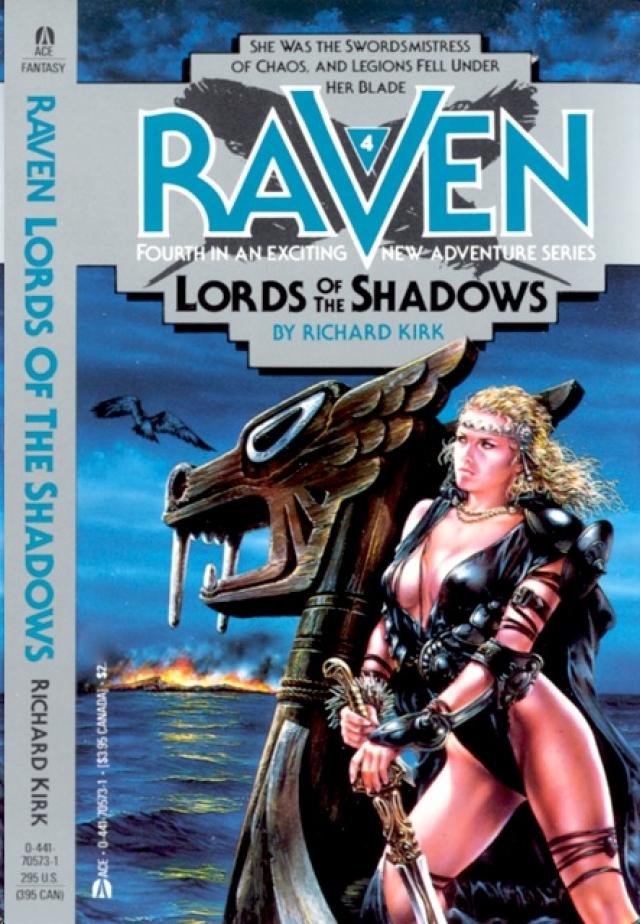
part #4 of Raven Series


Captured!
Spellbinder was a whirling point of darkness in the circle of his oppressors, his blade gleaming bright, then bloody, as it struck at the tribesmen. Raven, as she frantically parried the blows that rained upon her, saw the warlock lift one hand to emit some spell upon his attackers. He screamed and a bright light irradiated the chamber about him; his sword flew off into the darkness of a recess, his face burned bright red, and smoke rose from where he stood. “Not again!” he cried, and staggered backwards.
Shocked for an instant, Raven felt her own blade turned down and smashed from her hand. Her arms were taken, her body bent back so that her belly was exposed; a warrior, grinning with triumph, gently placed the point of his sword against her navel and prepared to disembowel her…
Raven
Lords of the Shadows
Richard Kirk
For Rog Peyton, fan, friend, barbarian
“Envy not the man who chooses to die, nor pity him; in death he may have found a greater way of life.”
—Jaarl, High-priest of Kharwhan
Prologue
Thick snow covered the forested hills and winding valleys of the frozen land, and piled high against the crumbling walls of the ancient fort. It drifted deep and unbroken against the walls of the lodge and stable alike, and only the curling wraiths of smoke, rising from small, dark holes in the white-blanketed hummocks on the ground, told where people huddled for warmth in this most bitter of winters.
The lakes were frozen, so hard and strong that a man could ride across them in his iron mail, on a horse clad from muzzle to tail in the heavy bronze trappings of war. At this time of year, between the storms of snow and ice, all that scampered on the land was white: small sleek animals darted from snowburrow to snowburrow, so fast, so invisible, that only the keenest hunters could forage abroad and return successful.
It was a miserable and bitter time, a time made worse when riders were seen on a distant ridge, moving south, men wrapped against the cold and armoured against attack.
The men of the fort froze inside to think of an enemy so close, and them helpless in the drifts; and so they huddled about the log fires and drank warm wine and ate the thin stew that was all their meagre stores would allow.
They listened to stories, and dreamed of more heroic times when the wind had howled with the screams of war and the writhing cries of the dying.
Now there was one among them, a stranger, an old man, white of hair, sallow of skin, thin of arm, reedy and aged in his voice and his demeanour. Dressed all in rags, wrapped thick and tight against the winter’s chill, he had stumbled blindly towards the fort, waist deep in snow, near death from cold and starvation. But he had not died. The warmth of the lodge, the sustenance the warlord had unbegrudgingly forced upon him: all this had helped to raise the fading spirit that had, it seemed, carried him across a hundred lands and a hundred years.
He clutched a broadbladed sword, its hilt all worked in gold and bronze, and topped with a green jewel that burned bright in the fire-glow; one wrinkled hand rested upon this blade, clutching and compulsive, the other was bandaged and kept out of sight; he listed to song and story, and leaned closer to the fire whenever the shutters rattled with wind and the eaves creaked beneath the weight of snow.
When at last he was called upon to account for himself, to earn his food and drink with a story or a tale of old, he smiled thinly, almost ironically, and looked about the unshaven, ragged faces, breathed deep the smoky, sweaty smell of the lodge, and raised a finger to his lips to bring silence and to simulate the sound of a wind, blowing brisk and cold through a haunted valley.
Listen!
There was a time when these lands shook and echoed to the din of swords clashing and beating on round iron shields, a time when every valley was loud with the rattle of armoured men racing across the land like the shadows of clouds. There was a time when every river and every valley was a tribe, when every hill was a fortress, when every tree bent with the wind of men riding past to war and every free rock was carved with the emblem of a champion. There was a time when these lands shone brighter than the sun with the radiance of warriors’ steel, when they were prouder than a black hulled barque with its red canvas swelled before a sea breeze. There was a time when every river was red with the blood of noble men, when every ford was marked by the bones of one who had fallen there, when every cave was the place of rest of a champion who had gone there to die, mortally wounded in his search for honour.
This was the time of one called Raven, a Swordsmistress, whom others knew as the Chaosbringer: she who brought death with every casual sweep of her steel blade, this blade which still I carry, for she is the blade and the blade is her, and she is buried in it as sure as if her body lay within its fabric.
How can I begin to tell you what has occurred in these lands in the years since time of the Chaosbringer? How can I tell you how many mountains have crumbled to the sea, how many lakes have turned dry and spat out their fish like one dying of the plague? How can I fill your blind hearts with an image of that great battle that had been ordained when men were still grubbing things, without minds, without souls; that battle where each blade turned in upon itself and none there were who could swear to who or what he was, save Raven, who was the cause of it all, and the reason for it all, and the answer to it all. Raven, who was the reason for every fleck of snow that falls upon your land today, and keeps you cold, and on your toes, and battling to survive and to change and to grow.
How can I tell you of these things without you laughing and crying, and applauding as if I were some bard, boasting and bragging the feeble deed of a feeble man, turning nothing into something, creating a legend out of the mud.
And yet she is a legend, Raven, a story on the tips of a thousand tongues, though I have never heard a story of her that comes close to reminding me of how it truly was to ride with her, her golden hair streaming behind her, her link mail bright, her sword a blur of shape. To fight alongside her was to draw in some force of life from her, to find inspiration and a new courage. Many there were who knew of this…Lifebane, and Silver, and the knight of Tywah, Garan na Vohl.
And yet mortal she was, able to bleed, to weep at the death of a friend, to die herself.
Perhaps, then, I shall tell you of how she first came to these very lands, in pursuit of a shadow, and how her own shadow left them…
One
“It is ill done which is differently done, when the dawn breaks from the North and birds fly through the earth. Resolve to step across these things and seek the sword behind the shadows.”
from The Ritual of the Eyes—Ogonors
The Ghost Isle of Kharwhan burned in the long night, fiercer and more furious than even the fire peaks of the Southern Wastelands. Flames licked to the very stars, and all across the churning seas the conflagration was a wall to progress, a barrier of destructive heart to those who would go further.
And yet…
The burning Isle emitted no heat, none that could be felt upon the faces of the sea-beaten men of Kragg who watched those flames; nor did the fire emit light, so that the dark-hulled wolfship was a shadow in the blackness of night, tossed on the growing swell of the ocean with but a single torch to show its existence in this mystical part of the world. The great yellow and green sail, with the Eye of the All Mother watching the blazing lands ahead of them was half-furled now, and limp in the strangely breezeless night. The waters rolled and broke hard and relentless against the prow and the tarred strakes of the sleek vessel, but this was nothing compared to the storms the men of Kragg were used to.
So dark was the night, despite the illusory light of the flaming wall, that Guayne Targda had difficulty in picking out the faces and shapes of his men. The Kragg captain, whose rieving fortunes were for the moment suspended as he escorted the fiercesome Swordsmistress to this most desperate of Isles, searched the dark for a sign of his passenger. As his gaze wandered about the deck, he made out the slim shape of his voyager, this Raven, and he walked across to her. “There is not a man of Kragg who would fear to sail those flaming seas,” he said boldy. “Illusion they are, and death they may be; but Lifebane would sail them, and I am his equal in courage, if not in strength or swordarm.”
The woman turned to peer hard at the riever. Her face should have been as bright as day in that unnatural flame, and yet it was in shadow; only the torch on the prow cast a flickering excuse for light across her features; even so Targda was unnerved by her, stirred by her looks.
“Aye,” said Raven. “Gondar said you were a man to trust, and I trust you as I would trust that sea-beast himself.” She grinned. “Which is saying little, but is at least saying something.”
They looked towards the Ghost Isle. Targda said, “Do we sail, then?”
“Not yet,” replied Raven, and Guayne Targda sensed the uncertainty in her. “The flames make me uneasy. As you say, they may be illusion, but illusion can conceal a stark reality that would kill us all. Without Spellbinder I feel unnerved. I cannot judge this perilous journey as I would like.” She reached her hand ton rest on Targda’s arm, a gentle and yet a strong touch; a touch of friendship, and one of reassurance. Her eyes gleamed beneath her cowl. “Bear with me, Captain. A while to think, an hour to assess.”
“My Lady,” said the sea-raider, bowing slightly, forcing himself to an unusually courteous mode of behavior. “My ship is yours, my life is yours. I’ll not abandon her for you, but I’ll sail into the mouth of Death River if you wish it. I have the taste for action, and the belly for adventure.” He grew more canny. “But I sense our visit here is more for education than bounty.”
“True,” said the woman, and laughed, her eyes bright, beautiful in the torchlight. “Gondar cannot hold his tongue, I see that now more clearly than ever. But since we are here together we must share our reasons.” Raven tossed back her cowl and massaged the back of her neck. Her hair shimmered godl in the halflight and Targda smelled the sweetness of her flesh, the smell of soaps and unguents, the womanly smell that stirred his loins, made the blood beat hard in his body.
He would not lay a finger on this woman, not for the whole sea. He was well aware that his head would roll before he knew the satisfaction of her belly; he was well acquainted with Raven’s prowess as Swordsmistress and warrior. And yet he would love to lay with her, to taste the sweat from her body, and know the womanly side of her, know how a device of war behaved as a device of love.
The hour of dawn was run from the stern deck before Raven could confide her reasons for being so close to Kharwhan, and Targda looked towards the east where the sea was alive with colour. A brisk wind rocked the wolfship. Raven reached for support against the railings, and as she did so her cloak blew free of her; the dazzling sun made fire of the mail armour she wore and of the cruel-bladed sleeve-shield that encased her arm, raised now to shade her eyes from the hurtful light.
She watched the east, but she did not watch the sun.
Targda knew that she sought the bird, the great black bird that was her companion and with which she seemed to share some unspoken confidence that baffled the sea-riever. Long days back the bird had flown away, leaving its mistress alone aboard the black-hulled vessel. It had sorely concerned the woman, and each dawn she sought its sleek shape riding the winds back to her.
At length Raven walked towards the prow, mounting the narrow steps to rest lightly against the carven figurehead of a sea-beast that led this wolfship into battle, or plunder. Targda walked beside her, a shambling, over-muscled figure, conscious of the sea-salt that caked his hair and clothes, of the lined and leathery skin that was his special clothing. Next to this sleek skinned woman he felt like some different species; forty years of facing into the storms had aged him twice that much, had hardened him on the surface, and left him vulnerable beneath.
How proud this Raven…how self-assured.
She watched the great wall of silent flame and Guayne Targda gazed at the cascade of her golden hair, the bronze circlet, with its wrought gold decoration, no more brilliant than the curls of golden hair that she had kept so free of dulling edge of sea and wind.
Armoured she was, for she seemed almost reluctant to leave her body free to wind and sun; a bright mail shirt, slung loose across the thin cotton shift that kept the cold of the iron from the warmth of her skin. She wore a leather garment about her waist that was drawn tight between her legs, leaving her long legs free for the running or kicking, of battle. Knee high boots of dulled Yr leather were worn low about her ankles in the fashion of the Kragg seafarers and about her waist was tied a metal belt, flexible links of steel sewn tight to the leather. She wore her sword slings here, and a dirk of Tirwanian steel that she preferred to strap to her thigh. Her sword was below decks; tales of the death that could be inflicted upon those who touched its green jeweled pommel were sufficient to render it safe from the plundering hands of Targda’s wolves. Her only weapons were her throwing stars: beaten from thrice-forged steel, sharpened with a whetstone from the iron mountains themselves, shaped by men who knew the fickleness of wind and flight so that they could skim and dance towards their target, these stars were Raven’s surest weapon, and her deadliest.
She turned, sensitive of Targda’s scrutiny, and her blue eyed gaze met him level, met him hard. But her face softened, the angry mask of the warrior, so swiftly painting ice about her eyes and lips, melted with equal swiftness and she smiled, her breath sweet in his senses.
“Lust not,” she said lightly. “Subtlety conquers even hearts of stone, whilst rape wins death swifter than a spring shower.”
Targda grinned and slapped his thigh. He removed his horned helmet and spat into the leather lining, the sign of apology.
“The All Mother knews what evil lies in the heart of the wolf, and what sadness. A life upon the tarred decks of a wolfship, watching an endless horizon for frightened vessels, seeing nothing part before us but the sea, a potent but fatal lover…it makes a weather-beaten rogue think of the whispering breezes of Lym and the quiet lives of pleasure of those who live in the Altanate, far east of here.”
“Aye,” said Raven, and looked away from the Captain. There was something of regret in her voice. “I know pleasure in many forms, and fear, and boredom…and there are times when I would return to Ishkar and think no more of vengeance and weapon mastery, and Chaos, but only of silks and sweet wines, and a life of ease lived out with a man of ease.” She glanced uncomfortably at the seawolf, who watched her with the coarse puzzlement of his kind. He knew nothing of Chaos, but he knew much of the mercenary weapon masters, and he knew too of this woman’s abuse at the hands of the foul Weaponmaster Donwayne. She had sought him long and hard to avenge that rape, and had thrice destroyed him in the process. Now, perhaps, the poison was sucked from her soul. But Targda knew that she would avenge herself with equal ferocity on any many who abused her again.
He said quickly, “It is no use dwelling on what might have been. Better to dwell upon your fear, for your fear strikes apprehension into me and into my crew. They sense there is something amiss. We should have sailed long before.”
Raven said sharply, “You mock at fear Targda, but think of what you are—a pirate, and not a particularly wealthy one. Abuse of caution makes you act incautiously. You know well how to plunder, but never how to exploit.”
“My Lady…”
“Silence!” Her eyes were angry as she stared at him, her skin white, all softness gone. “When the mind knows fear, it is well to act cautiously…apprehension is the best warning we have; it can guard the body against foolish acts.”
Targda shrugged and tossed back his woolen cloak so that he could rest his hand arrogantly on the great curved sword he carried, a Xandronian scimitar pillaged from a slave ship bound for Lym that had seen the seabed before it had even smelled the perfumes of the Altanate. “If my mind knows fear I would as soon put it to sleep with a potent draught of Saran wine. Let the body know the pleasure of war.”
Raven laughed. “I cannot deny that you are an old and strong man, proof it would see that such a way of courage works. But I think you will one day wake your sleeping and cautious mind to find it separated from your brave and incautious body—separated through the neck!”
Before he could retort there was a cry from the decks, and turning Raven saw a near naked sailor pointing his arm out to the west, to where the wall of flame grew indistinct and distant.
She followed the cry and saw what had excited the men of the ship. Birds! Several great winged seabirds, flying through the flames as if unaware of the existence.
Raven was delighted. “Make sail, Targda. I believe we have seen our way through this wall of fear.”
“It is nought but illusion,” grumbled the seawolf. “We should sail straight through it.” But he turned and bellowed orders, and the great sail was unfurled and roped to catch the wind. The sea anchor was raised and the wolfship leaned hard as she found the air, then scudded westwards, to where the langorous seabirds ploughed onwards to the north.
Here, as they grew close, they saw the flame was broken, a gateway through the fire leading to a misty land beyond.
Without a moment’s pause Targda took the wolfship through that narrow channel; as he did so he used a rope sling to toss the carcass of a pig into the flames—the animal’s body singed and was consumed with explosive energy and a final belch of purple smoke that made every man aboard fall silent. They had come close enough to finding out the deadly powers of these silent flames. They were not to know the reason that they had not been plunged incautiously through the wall. Raven touched a finger to her nose as Targda scowled and shrugged.


