

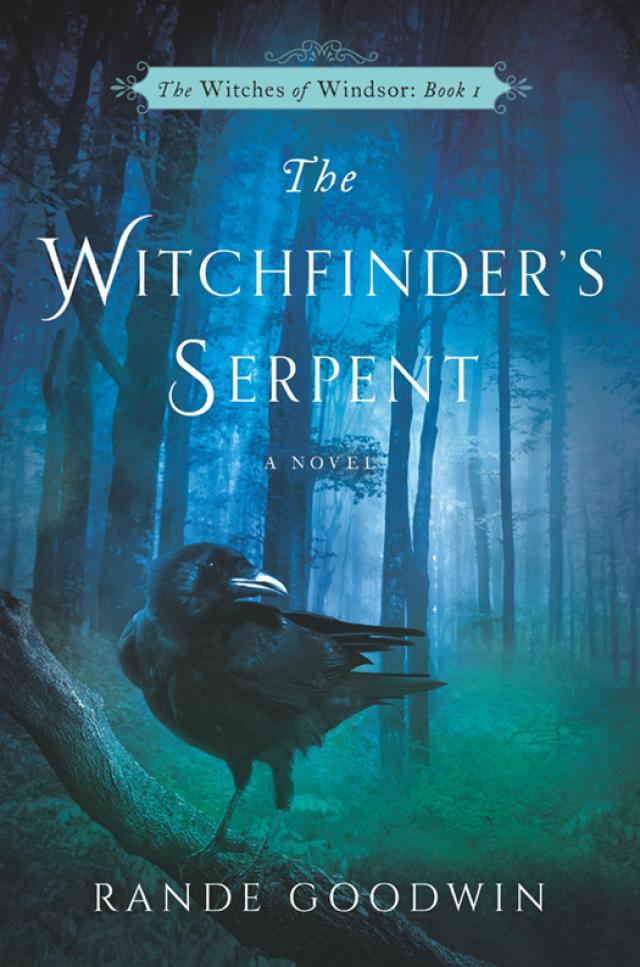
The witchfinders serpent, p.1
The Witchfinder's Serpent, page 1


This book is a work of fiction. Names, characters, businesses, organizations, places, events, and incidents are either a product of the author’s imagination or are used fictitiously. Any resemblance to actual persons, living or dead, events, or locales is entirely coincidental.
Published by Greenleaf Book Group Press
Austin, Texas
www.gbgpress.com
Copyright © 2023 Rande Goodwin
All rights reserved.
Thank you for purchasing an authorized edition of this book and for complying with copyright law. No part of this book may be reproduced, stored in a retrieval system, or transmitted by any means, electronic, mechanical, photocopying, recording, or otherwise, without written permission from the copyright holder.
Distributed by Greenleaf Book Group
For ordering information or special discounts for bulk purchases, please contact Greenleaf Book Group at PO Box 91869, Austin, TX 78709, 512.891.6100.
Design and composition by Greenleaf Book Group and Mimi Bark
Cover design by Greenleaf Book Group and Mimi Bark
Cover image used under license from ©Shutterstock.com/Superstar
Publisher’s Cataloging-in-Publication data is available.
Print ISBN: 979-8-88645-090-3
eBook ISBN: 979-8-88645-091-0
To offset the number of trees consumed in the printing of our books, Greenleaf donates a portion of the proceeds from each printing to the Arbor Day Foundation. Greenleaf Book Group has replaced over 50,000 trees since 2007.
Printed in the United States of America on acid-free paper
23 24 25 26 27 28 29 30 10 9 8 7 6 5 4 3 2 1
First Edition
For my girls:
Beth, Sarah, and Emily
The devil is precise; the marks
of his presence are definite as stone.
—Reverend John Hale, Arthur Miller’s The Crucible
CONTENTS
PROLOGUE: The Witch of Ipswich
1: A New Home
2: The Indictment
3: Angry Ducks
4: The Execution
5: The Forbidden Room
6: The Serpent and the Girl
7: Alse Young and The Discovery of Witches
8: Crow, Wolf, and Fawn
9: Witches and Warlocks
10: The Protection Spell
11: The Windsor Witch
12: The Witchfinder General
13: Pet Sematary
14: The Shad Derby
15: The Drowning
16: The Abduction
17: Mr. Flufferton Returns
18: The Witchfinder’s Letter
19: Crafting the Bottle
20: Never Trust a Witch
21: Fish and Lobster
22: Unfair Expectations
23: The Funeral
24: Goodbye
25: Time Is Up
26: Corvin and Mr. Black
27: The Abandoned Theater
28: Confrontation
29: Hope
AUTHOR’S NOTE
ACKNOWLEDGMENTS
ABOUT THE AUTHOR
Prologue
THE WITCH OF IPSWICH
Rushmere Heath on the Eastern Outskirts of Ipswich, Suffolk, England, September 1645
Matthew Hopkins, the well-respected and highly sought-after Witchfinder General, sat atop his horse, making his way slowly toward the gathering of spectators. It was unusually chilly for early September. In addition to the tall capotain hat, with its flat top and narrow brim, he wore his woolen cape to the proceedings—and though he suspected he wouldn’t need it much longer, for the time being at least, he was thankful to have brought it along.
Taking a deep breath, he scanned the area, excitedly taking in the view. Open grassland sprawled in all directions, its greenery baked brown by weeks of summer sun. Patches of cheerful pink and purple heather broke through the drab landscape, flouting the onset of autumn. Off in the distance, a platform had been constructed, a heavy, wooden pole erected at its center. It was this structure that filled him with exhilaration—this and the impressive throng of people surrounding it.
They were all here because of him. He was the one to extract the confession from old Mary Lakeland. No one else had been able to do so—the crone had proven to be a tough nut to crack.
“Nice job, Hopkins,” said Justice John Brandling as he rode past. The man was one of the judges who had prosecuted the Lakeland case. Bailiff Richard Pupplet rode alongside him.
Hopkins nodded to each of the men in turn as they hurried on ahead. Brandling was one of the officials set to preside over the execution—and no normal execution it would be. Due to the charges to which she had been found guilty, Mary Lakeland was to be burned at the stake—not hanged in the manner of most witches. This was a first for Hopkins—of all the women he had dealt with in East Anglia, no others had been set ablaze for their crimes.
His success in this case would only bolster his reputation, he knew. He would be even more highly sought after—and he and his partner, John Stearne, would be able to charge top rates for their services. Mary Lakeland had certainly made him work for the confession, however. For a time, he had wondered if she would outlast him, if she would be the first subject to endure all his interrogation techniques without breaking.
They had stripped the old woman naked and used a witch-pricker to hunt for a witch’s mark. There had been no confession, even though her seventy-year-old skin was awash with discolorations and blemishes—any of which could have been placed there by the devil himself. They had beaten and starved and deprived her of sleep, to no avail. They had bound her cross-legged and left her that way for more than a day. Not even the cramping and discomfort of that experience had broken her. Finally, they had forced her to march naked, back and forth, hour after hour, until her strength had waned, and her bare feet had bloodied a path on the hard stone floor of her cell.
Eventually, she had collapsed. The thin skin of her knees tore as they struck the rough surface, and her bruised body came to rest in an ungraceful heap at the witch hunter’s feet.
“Mother Lakeland,” he had said. “You are a stubborn one—are you finally ready to confess?”
He had taken the low moan, emanating from deep within her throat, as the affirmation he sought.
“Do you admit to being a witch? Did you in fact use witchcraft to murder your own husband?”
He was rewarded with another moan. The old woman’s eyelids fluttered weakly in her semiconscious state.
The interrogation continued in this manner—and before long, Mary Lakeland had confessed to each and every one of her sins to the complete satisfaction of Hopkins and the two witnesses he had arranged to have present. In the end, the court had found her guilty, and she had been sentenced to death. It had been the crime of murdering her husband that had escalated the severity of her charges from felony to petty treason, thus warranting the uncommon execution by fire.
And soon, he thought excitedly as he approached the milling crowd on this cool September morning, old Mother Lakeland, the evil witch of Ipswich, will be burned at the stake.
The men were hoisting the unconscious woman’s body by the time he had arrived, securing it firmly to the stake with heavy chains. Dressed in a simple white gown, Mary Lakeland’s wrists and ankles had been bound with rope. A noose had also been tightened about her throat—an indication that she had already been choked into unconsciousness as a gesture of mercy. In all likelihood, the noose, with the aid of the smoke and hot gasses from the pyre, would bring death by suffocation before the worst of the flames reached the woman’s flesh.
Bundles of sticks and brush had been piled high around the small platform, intermingled with heavier pieces of dried timber and branches. Hopkins noticed that other items of scrap had been stacked around the base of the construction as well—weathered sections of wooden fencing, fragments of broken furniture, and other flammable objects that had no doubt been added by enthusiastic onlookers.
Shortly, Justice Brandling appeared. After giving a summary of Mary Lakeland’s crimes, he signaled for the execution to begin. Four men with torches approached, each one choosing a different cardinal point around the pyre. As one, they touched fire to kindling, and the towering heap of wood began to burn.
In moments, Hopkins could feel heat radiating from the bonfire. The blaze spread far more quickly than the witchfinder had expected, stoked, perhaps, by the cool morning breeze. Mary Lakeland’s limp body hung unmoving, partially suspended above it all, the flames dancing about her legs.
Suddenly, her gown caught fire and it, too, began to burn. The glowing hot conflagration traveled swiftly up her body, leaving scorched and blistering skin in its wake. It reached her hair. The long gray locks burst into flame, fluttering loosely about her shoulders.
It was then that Hopkins heard the collective moan from the crowd. He watched in horror as Mary Lakeland’s burning head shifted, her now-open eyes widening in terror, a silent scream issuing from her swollen, useless windpipe. Her body began to twitch as she struggled weakly, uselessly against her bonds.
Several members of the crowd turned and fled in that moment, having seen enough. The witch fell still as the flames grew taller, and before long, the smell of cooked flesh permeated the air. Soon, Hopkins decided that he, too, had seen enough. Although the pyre and witch’s body would burn for some time, there was no doubt in the witchfinder’s mind that Mary Lakeland was dead. His job here was done. It
Chapter 1
A NEW HOME
Windsor, Connecticut, May 2019
“Where’s Aunt Celia off to so early this morning?” asked Nate Watson as he and his brother sat finishing their breakfast. The hum of a vehicle could be heard outside, getting softer by the moment. Partially eaten bowls of Lucky Charms cereal sat on the table before them. It was Marc’s morning to make breakfast, and Nate’s younger brother knew how to prepare exactly one meal.
“No idea,” replied Marc, brushing a strand of unruly hair from his eyes. He smiled and hopped to his feet with far too much energy for a Wednesday morning. Collecting his dishes, he carried them to the sink. “I haven’t seen her yet today. I’ll wash these dishes after school.”
“Sure thing,” said Nate. He watched his brother, dressed in Gryffindor pajamas that seemed to be growing shorter by the day, head up the back stairs to get ready for school.
People frequently told Nate how much he looked like his brother. They shared the same shade of light brown hair and blue eyes, traits inherited from their father. Nate had a couple of pounds and inches on his brother, but Marc was catching up fast.
Nate eyed the brown cardboard box that sat on the counter. This morning he brought it up from the basement where it had been sitting since the day he and his brother arrived. It was all that remained of their father’s life, and the idea of rummaging through it threatened to unearth emotions that he fought so hard to keep buried. He had to remain strong for his brother’s sake—but he didn’t want to postpone it any longer. Doing so, he felt, would be insulting to his father’s memory. The idea that a man’s life could be reduced to the contents of one musty box seemed so unfair.
Kenneth Watson raised his boys alone after the death of his wife, Lynne, who had been struck by a bus just five years after the young couple had married. For the ten years that followed, it was just the three of them. Then last summer, after a long battle with lung cancer, he too died. Nate and his brother found their lives turned upside down. They were passed from home to home for several weeks as family acquaintances pitched in to put roofs over their heads until permanent arrangements could be made. Their father’s lawyer arranged the sale of their Upper West Side New York City apartment and all its contents, except for the brothers’ clothing and the one medium-size box of items some unknown person had determined to be their dad’s most important personal effects.
It was a difficult and sobering period for the two of them. Nate was fourteen, and he was suddenly forced into the role of protector and counselor for his brother, who was two years younger. Nate felt a huge responsibility. They were powerless as they watched their father’s health decline, and Nate wasn’t sure he had it in him to properly care for Marc.
He wouldn’t have to do it alone, fortunately. He remembered that moment in the lawyer’s office, nine months ago, when he and Marc first met their Aunt Celia.
“We’re going where?” Marc asked.
“You’re going to live with your father’s sister in Connecticut. Her name is … Celia,” said the lawyer, glancing at a sheet of paper in front of him. “Your father made his wishes clear in the will. It took me some time to iron out the details.”
“But our father never mentioned anyone named Celia—are you sure?” asked Nate.
“Quite sure,” he said before lifting the telephone receiver and pressing a button. “It all checks out—Ms. Feldman, please send her in.”
“But we’ve never met her. What if we don’t want to go with her?” asked Marc, glancing at his brother.
“I’m sorry,” said the lawyer. “It’s all been arranged. I’m sure you’ll get along just fine.”
A well-dressed woman entered the office. She seemed old to Nate—not grandmother old, but older than their father, at least. She wore her blond hair in a tight bun. A pair of glasses with black frames—the kind that came to funny points at the temples like you saw in old TV shows—sat perched on her nose. A large red stone hung suspended from a gold chain around her neck.
“Hello, boys,” she said. “You can call me Aunt Celia. Please gather your things. We have a bit of a drive ahead of us.”
And that was that. Nate and his brother followed Aunt Celia out of the lawyer’s office to the car that was parked out front on East 42nd Street. The car was light blue and old-fashioned. Nate found out later it was a 1957 Chevy Bel Air, which despite its age looked brand-new and was spotless inside. Someone had loaded their suitcases into the car, placing the box of their father’s possessions in the front passenger seat.
The boys climbed into the back, and soon they were on their way. As they drove through the city, Nate watched the familiar buildings and landmarks pass by on either side. He felt sad not knowing when (or even if) he would ever see them again. Leaving Manhattan, they passed through the Bronx before entering Interstate 95, heading north. The exciting hustle and bustle of the city behind them, the brothers settled in for the trip ahead.
“Your father cared very much for you two,” said Aunt Celia after about an hour of silence. “I’m pleased to be able to offer you a home.”
Nate and Marc exchanged glances.
“He, um—he never told us about you,” said Nate, unsure of what else to say.
Aunt Celia chuckled in response, an unexpected yet nonthreatening laugh. She said nothing further.
Marc smacked Nate’s leg with the back of his hand and discreetly raised both palms in a what-was-that gesture.
Nate just shrugged. He wasn’t sure what to make of the brief exchange.
A while later, they passed through the city of Hartford. The highway wound past the cluster of office buildings downtown. It may have been the capital of Connecticut, Nate thought, but compared to New York City, it didn’t seem like much.
“We’re nearly there, boys,” said Aunt Celia.
Ten minutes later, they arrived in Windsor, an old New England town on the Connecticut River. Nate gazed out the window as they left the highway. They passed houses of varying ages, shapes, and sizes. Many of them were set far back from the road, nestled in the trees. He was surprised at how spread out everything was and how well tended the lawns were. It occurred to him that he had never seen this much greenery in his life. He also noticed the lack of traffic and noise. It was nothing like the Big Apple. Nate wondered how he would be able to sleep without all the familiar sounds of the city.
They soon pulled up in front of a large, old house that looked to Nate to be at least ten times the size of their apartment in New York. It was three stories tall and made of brick, with a big wraparound porch in front. Aunt Celia got out of the car, turning around to face them as they struggled to take in their new surroundings.
“You boys collect your things and come inside,” she said. “I’ll show you to your rooms and you can unpack. Dinner is at five o’clock. We’ll discuss the rules of the house at that time.” Aunt Celia climbed the wide wooden front steps onto the porch and unlocked the massive oak door. She disappeared inside.
“Is it me, or is she strange?” asked Marc, wrinkling his forehead.
“It isn’t you.”
The brothers hopped out of the car and studied their surroundings in awe. The spacious, neatly manicured lawn stretched from the driveway, past the front of the house, and around the far side. Colorful flower beds surrounded the porch, its overhanging roof set atop thick, round, white pillars.
“This place is gigantic!” said Marc, eyes wide.
Nate nodded. It sure is, he thought.
They gathered their suitcases from the trunk and headed for the house. As they mounted the steps, Nate realized they had left his father’s box in the car. Setting his suitcase on the porch, he turned to his brother.
“Hey, you go on ahead,” he said. “I forgot the box—I’ll get it and be right in.”
“OK,” said Marc, grabbing Nate’s suitcase with his free hand. “I’m going to take this with me so you aren’t tempted to run off and leave me here.” He smiled.
“That would never happen,” said Nate, mussing his brother’s hair with one hand. He watched for a moment as Marc went inside the house.


