

Redstonesf 04, p.1
The Vanishing of Rose B., page 1


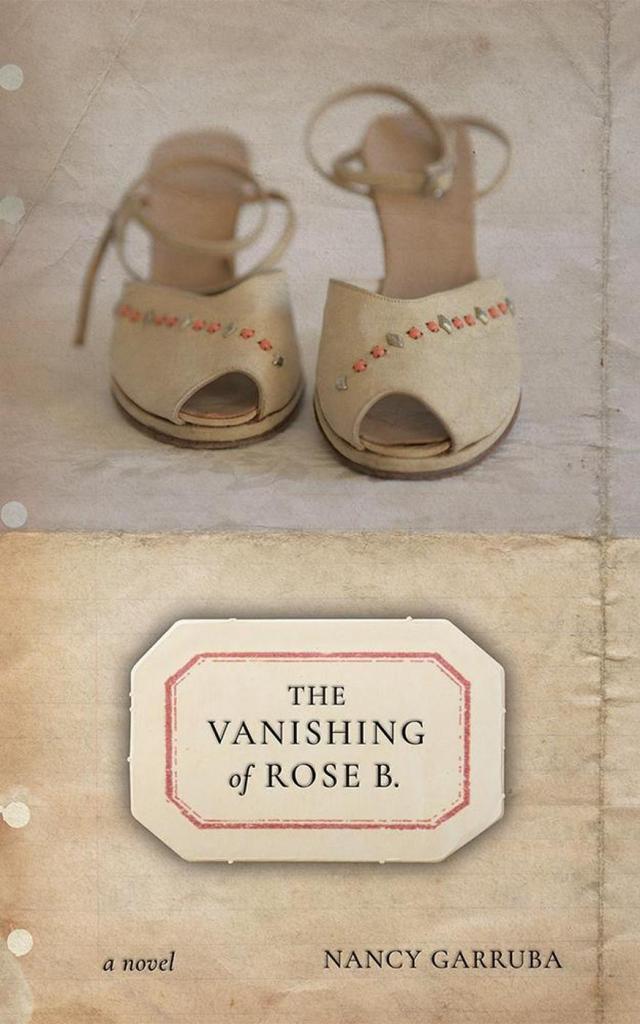
The Vanishing of Rose B.
Nancy Garruba
Published by Serving House Books, 2025.
The Vanishing of Rose B.
Copyright © 2025 Nancy Garruba
First Edition
All rights reserved. No part of this book may be reproduced or transmitted in any form or by any means, electronic or mechanical, including photocopy, recording, or any information storage and retrieval system, without prior permission from the publisher or author (except by reviewers who may quote brief passages).
This book is a work of fiction. Any references to historical events, real people, or real places are used fictitiously.
Paperback ISBN: 9781947175778
Library of Congress Control Number: 2025945830
Cover design by Gretchen Sanders, studio e2
Author portrait by Ella Pennington
Exterior formatting by Jacob Arms
Produced in the United States
Published by Serving House Books
Lawrence Landing Company
Raleigh, North Carolina 27609
www.servinghousebooks.com
SERVING HOUSE BOOKS
Table of Contents
Title Page
Copyright Page
FIVE DAYS
...
...
....
...
....
One Evening
One Afternoon
Acknowledgements
THE AUTHOR
FIVE DAYS
...
I FOUND MYSELF on Mercy Street, on my way to the old house. It was quiet and I was alone, wondering who, what kind of people, what kind of family might be living there. The white Ford was parked in front, and the garden looked the same—a few faded daffodils, the hedge that never filled in. The glider was still in its place on the porch, where we’d go to read when the weather was good, the green paint badly chipped.
I continued to the park and the elm, both so close to the house, and the park wall high enough that we could stand on top and brace ourselves against the tree, and peer through the windows. I did that again—climbed to the top of the wall. I was hoping to see Rose, hoping she’d walk through the living room, maybe come to the windows. To adjust the blinds. Run a dust cloth over the sills.
It was late afternoon, four o’clock more or less. Storm clouds were moving in—dark, ominous clouds. I felt a stab of anxiety and wanted to run—run fast—as if I were a child again, I was frightened. But then the door opened and a girl—no—let’s not say a girl—let’s say a young woman—very young—a young woman walked out. She walked to the glider and picked up a book, and I saw that it was you, Claire—it was you.
You were wearing your recital dress. Navy linen, with two kick pleats in front that ran from the waist to the hem. The inside of the pleats was a robin’s-egg blue. We were so tired of being twins, and of Rose wanting us to dress alike. And as if that weren’t enough—of looking like younger versions of herself. But Rose would beg. One last time girls, please!
Always one last time, one last time.
We’d just turned thirteen. You’d found a picture of a dress in a magazine and I liked it as much as you. Rose hired Mrs. Lipari, the seamstress who lived on Lincoln Avenue—for some reason we always called it The Avenue. Mrs. Lipari worked in a tiny room behind her kitchen. Bolts of fabric in the corners. Walls lined with spools of thread of every imaginable color. Rose commenting on how orderly that room was, how immaculate that kitchen. Shiny white stove and refrigerator. Cabinet windows sparkling, cups and glasses in order. Not a smudge, not a drop of grease anywhere. Mrs. Lipari hunched over her machine, sparse black hair, bit of a bald spot. Gold-rimmed glasses. Gold basket earrings. Her daughter would lead us through the front rooms and Mrs. Lipari would hear us walk through the kitchen, know we were standing in the doorway, but she wouldn’t look up until she’d finished sewing her seam. Then she’d smile, a slow, broad smile, teeth perfectly straight, perfectly white. Aunt Ella was upset that Mrs. Lipari was making our dresses, remember? She wanted to make the dresses herself, but Aunt Ella needed a pattern and Mrs. Lipari didn’t, Mrs. Lipari could replicate any dress from a picture. She made one dress of navy linen with pleats of robin’s-egg blue, and the other of avocado green linen with lemon-yellow pleats.
You in your navy dress with pleats of robin’s-egg blue walked from the door to the glider and picked up a book. I tried to see the cover, wanted to see what book you were reading, but it was impossible. You held the book tight against your chest as you peered over the porch railing and you didn’t see me. Or pretended not to. Then you turned, walked inside and closed the door.
And I remembered that we’d switched dresses before the recital. We were the same size, and you had ordered the avocado green, but later you decided that you liked the navy more than the green, and if I didn’t mind . . .
It was a day in early April when we walked to Mrs. Lipari’s—you, Rose and I—to pick up the dresses. And that day, I’m quite sure, was one day before the day we walked home from school alone, without Rose, because Rose had said that morning that she’d go straight from the office to Miss Bloom’s, to pick up her new hat, the very same hat I’m wearing now, and when she came home that evening wearing this hat, this pink pillbox—
—Frances—stop!—okay? Let’s call it quits why don’t we?
She comes out from behind the camera—
This setup isn’t working, she says. Anyway, I’ve had enough for one day.
Her face is flushed. She takes off her glasses, wipes them with a corner of her shirt.
Besides, she says, that’s not the kind of story I thought you’d be telling. Not at all what I thought you’d be telling.
Every weekday morning for nine years we left the house on Mercy Street—Rose, Claire and I—at 7:50 precisely, to walk to school and the bus stop. Rose would see Claire and me through the school doors, then cross the street and wait for the bus that would take her downtown and to the office.
Rose, Rose: How the name suited her, implying as it does a furled beauty and stillness. Useless qualities, however, for the challenges she faced.
Aunt Ella would be waiting when school let out. She’d walk us to our grandparents’ house at the corner of The Avenue and Mercy. We’d do our homework there and wait for Rose. When Rose arrived the three of us would walk home.
When we turned thirteen we were allowed to walk home from school alone. We’d practice our instruments—I played violin, Claire piano—then start dinner.
One morning, after Rose had given us her instructions—Take the potatoes from under the counter at 5:30—not the sweet potatoes but the Idahos—and peel and cube them and put them on to boil; I moved two steaks from the freezer to the fridge before we left the house, put them on a pan, they should be defrosted by then, with some salt and a few slices of garlic, and put them under the broiler at 5:45; make a salad with lettuce, radishes and cucumbers—she said she’d be home later than usual, because after work she’d be going to Miss Bloom’s. Her new hat was ready. She planned to wear the new pink pillbox to our upcoming recital. Along with the light woolen pink coat she was wearing that day. The very same hat and coat I wore for the setup this morning, when I posed for Claire.
Two weeks ago Claire called to ask if I’d come home to help her sort through our mother’s things. We were coming up on one year. I dislike going home, nevertheless I felt I should spend some time with Claire. Not to mention that our mother saved almost everything she ever owned and I didn’t like the idea of Claire cleaning out her things all alone. I’d already mentioned that the office was slow—it usually is in August. And Peter would be there to mind things, should something come up. Claire knew all that. I said I’d come home for five days.
She was very pleased, that was clear. Nothing else was discussed.
Then yesterday, as we’re driving home from the airport, catching each other up on work, hers and mine, Claire tells me that she’s begun to photograph our mother’s clothes, and her jewelry, and all the many other things she’d collected over the years.
I have a vague memory of her previously mentioning this project, but the memory evaporates instantly. Instead, I ask if her new photos are similar to her other tableaux. Claire creates beautiful still lifes—large, complex arrangements of bones and leaves, and fruits and vegetables. They take up entire walls, like tapestries. She can spend entire days composing them before she begins to shoot.
No, she says. These new images are smaller. Simpler. You’ll see. I’ve been taping them to the walls.
Then we’re at home, standing on the front porch and while Claire turns the key in the lock I have a flashback of our mother doing the very same thing, Claire and I behind her, waiting to go into the house. Seconds later, Claire and I are standing in the hall, across from the gaudy faux-gilded mirror I detest, except now of course we’re without Rose, and Claire says, Isn’t it strange, Frances, that in certain ways you and I somewhat resemble each other, but you still look so much like Mom and I don’t?
I don’t answer. Nothing sets me more on edge than to hear that I’m the image of our mother—and there Claire goes again, as she often does, raising the ghosts of old tensions. Tensions between Claire and me, and Claire and me and Rose. Regarding who’s more like whom, and how that translates into how a woman should be. Into what makes a good wife. What makes a good daughter.
When we were small girls and teenagers, Claire and I strongly resembled our mother. But a
It’s also true that Claire and I still resemble each other. Some people see it, others don’t.
I turn away from the mirror. I take off my jacket and walk to the closet to hang it, angry that my hands are beginning to tremble and trying to hide it. It’s then that I notice the photos she’s mentioned—of our mother’s dresses, her suits, her wedding gown—they’re on the walls of the living room. As I proceed upstairs to the bedrooms, Claire follows me and I see more of these photos—our mother’s jewelry, the china and silver—they line the walls of the hall. We walk into my old bedroom—more photos. Her hats, purses, shoes—they’re what I see as I sit at my old desk, writing this.
I study these photos with Claire standing next to me. Neither of us says a word. Whereas Claire’s other images are dense with detail, these images are spare, distilled. With an odd, almost eerie quality. As if they were documents of a person who’s gone missing. Which is, I suppose, what they are.
I say, They’re beautiful, Claire. A bit haunting, too, I think.
She says, Come downstairs with me, Frances. There are things I want to show you.
We go down to her studio, then into a side room where she’s laid out many of the things I’ve just seen in the prints on the walls. Dresses draped over chairs. Coats hanging from windows. Hats perched on shelves and candlesticks. Jewelry pinned to the walls. Light from the windows refracted on the china and silver. Rose’s wedding gown spread across an old divan—swirls of ivory satin against faded pink brocade. The room’s an image of excess, a complex arrangement of all the effects—all the artifacts, you could say—of our late mother.
You’ve already gathered all her things, I say.
Yes. Her closet’s empty, Claire says.
You didn’t wait for me.
No. Once I started sorting, and taking pictures—
You couldn’t stop.
Right. That’s how it turned out.
I’m not surprised. When Claire’s wrapped up in a project she forgets things she’s said and planned, things she’s promised. Regardless, I think, there must still be a lot of work to do. But then she says there’s something else, something larger she’d like my help with.
Frances, I know you’re not fond of sitting for me, but I’ll ask anyway. I’d like to make a few portraits of you as Rose. Would you pose for me? Would you pose for me in Mom’s clothes?
I say nothing. She continues. Says it’ll be an experiment. That the idea came to her as she was photographing the clothes, the idea being to create portraits of our mother using me as a stand-in.
As she’s saying all this my eye catches sight of the pink pillbox—it’s perched on a candlestick—and I remember a day with Claire just this past April, when she came to visit me in Los Angeles. Her second visit only, in the forty years I’ve lived there, despite my many invitations. She always had a reason as to why she couldn’t leave home. Either one of our parents wasn’t feeling well, or one of her students was having a crisis.
She’d come for a week. One afternoon we went shopping in Silver Lake. We were walking past a vintage clothing shop when she noticed a pair of wedge-heeled sandals in the window, and said they looked like a pair our mother once had. Could we go in? Once inside we faced the usual riches—or trash, depending on your point of view—and Claire began to forage. Claire’s addicted to second-hand stores. Plus the clothes were vintage 50s and 60s, styles popular with our mother and her friends. Claire went off to a corner to examine some purses and I stayed by the door, near a collection of hats. Cloches. Derbies. Spectators. Alongside a navy spectator, a pink pillbox—and I remembered the pink pillbox that our mother once wore. Wore once, and only once, I believe.
It was a day in April then as well, and Claire and I had just turned thirteen. We’d gone home from school and tried on our new recital dresses with the kick pleats. Our father was the first to come home, then a bit later our mother walked through the front door wearing the pink pillbox. That’s where the memory ended, that afternoon in LA.
Claire paid for an old clutch at the back of the shop and then joined me at the front, where I pointed out to her the pillbox. I asked if she remembered that Mom had had one just like it. She said she hadn’t remembered it until rediscovering it recently, while going through our mother’s clothes and hats, and had begun to think she should photograph them, meaning the clothes and hats. That was the first and only time she’d mentioned this project of hers. She then went on to talk about other things and we never talked about this project again.
I say, Claire, what would you do with these portraits? These portraits of me as Rose?
We’re still standing in the room off her studio.
She says, I don’t know. I can’t see that far ahead. I just feel I need to do it. It could be that what I have in mind isn’t feasible. I don’t know. Anyway, Frances, you don’t need to give me an answer right away. But will you think about it?
Yes, I say, I will think about it.
I return to my room and unpack, all the while thinking about that evening in April when we had just turned thirteen and our mother came home wearing her pink pillbox for the first time. It became the basis of the story I tried to tell in our first photo session today.
My memory of that evening has appeared and vanished in odd moments ever since that afternoon in Silver Lake, and until now I haven’t had the time, or the will, to question why. But now I remember what happened that night. At least most of it. Claire also remembers. She must. I’m sure it’s why she cut me short in our session.
Which is why over breakfast this morning I tell Claire that I’ll pose in our mother’s clothes, but on one condition, that I want to talk while I pose. I say that I want to tell stories while dressed in our mother’s clothes.
She wants to know what kind of stories.
I say, Stories about us. About Rose, and Claire, and Frances. It’ll be an experiment for me as well. You know, Claire, it’s been a long time since I’ve written much of anything.
She accepts my proposal. Says she’ll be using her view camera, and that it takes about an hour for her to frame the image and take light readings, and adjust the focus, so yes, I can talk while she does those things. But when she’s ready I’ll need to be quiet, she says, and follow whatever directions she gives me.
I climbed down from the wall by the elm. Rose was no longer at 33 Mercy, I understood that. I walked past the house, up to the corner, turned left, and went south on The Avenue, storm clouds behind me.
I was searching for Rose. Needing to see and touch Rose.
I walked past all the places that were once part of our walk to school and the bus stop. The grocery store that sold homemade ice cream. The tiny branch of the public library where you and I spent summer afternoons. Past squat two-story houses jammed together like jelly candies, like toy things. I remembered moving past the same places ten years earlier, in the cortege, on the way to his funeral—Lou’s funeral, our father’s funeral—you, Rose and I in the lead car, thinking: A new chapter, a new beginning for Rose.
I saw no one as I walked, and no one was in the center of town when I arrived. I thought Rose might be at Miss Bloom’s, but finding Miss Bloom’s wasn’t easy. I remembered the general location but the area had changed, the windows now boarded up, and whatever signage remained—Shoes, Cigars, Ladies’ Lingerie, China and Silver—mere fragments of gold. But then I saw Bloom Millinery, European Imports and Custom-Made, the shop’s two windows aglow with hats of straw, felt, and silk, in pulsating shades of green, yellow and blue, arranged at various heights on Art Deco metal stands. Pillboxes. Turbans. Berets. Cloches. Toques. Why aren’t you wearing a hat, you should be wearing a hat—Rose’s mantra for you and me. She wore hats everywhere. Simple hats to the office, fancier ones to church on Sunday, and to weddings and funerals. She’d brought me here once. But not you. You must have stayed back with Aunt Ella. You must have been sick. You had many illnesses and the picture of you in bed with Ella hovering over you, Ella at your beck and call, bringing you plates of toast and glasses of juice, swabbing your forehead with cool washcloths—all that came to mind and I remembered just how envious I used to be of you, always getting so much more attention than I from Ella and Rose.


