How like a god, p.1
How Like a God, page 1


Contents
Cover
Title Page
Leave us a Review
Copyright
A
I
B
II
C
III
D
IV
E
V
F
VI
G
VII
H
VIII
I
IX
J
X
K
XI
L
XII
M
XIII
N
XIV
O
XV
P
XVI
Q
Acclaim for the Work
of REX STOUT…
“Rex Stout is one of the half-dozen major figures in the development of the American detective novel.”
—Ross Macdonald
“Splendid.”
—Agatha Christie
“[Stout] raised detective fiction to the level of art. He gave us genius of at least two kinds, and a strong realist voice that was shot through with hope.”
—Walter Mosley
“Those of us who reread Rex Stout do it for…pure joy.”
—Lawrence Block
“The story has everything that a good detective story should have—mystery, suspense, action—and…the author’s racy narrative style makes it a pleasure to read.”
—New York Times
“One of the most prolific and successful American writers of the 20th century…The writing crackles.”
—Washington Post
“Practically everything the seasoned addict demands in the way of characters and action.”
—The New Yorker
“One of the master creations.”
—James M. Cain
“You will forever be hooked on the delightful characters who populate these perfect books.”
—Otto Penzler
“Premier American whodunit writer.”
—Time
“The man can write, that is sure.”
—Kirkus Reviews
“One of the brightest stars in the detective and mystery galaxy.”
—Philadelphia Bulletin
“Unfailingly wonderful.”
—San Francisco Chronicle
“Dramatic and credible.”
—Boston Globe
“Rex Stout is as good as they come.”
—New York Herald Tribune
“Unbeatable.”
—Saturday Review of Literature
“What a pleasant surprise for Stout fans…an unexpected treasure from one of the grand masters of mystery.”
—Booklist
He became suddenly aware that his hand was again in his overcoat pocket, closed tightly over the butt of the revolver. His hand came out and the revolver with it, and he stood there with his forearm extended, the weapon in plain sight, peering around, downstairs and up, like a villain in a melodrama. If the door of the landing had at that instant opened and one of the art students had appeared, he would probably have pulled the trigger without knowing it.
His hand returned to his pocket and then came out again, empty, and sought the railing as he mounted another step, and another, and then stopped once more.
Oh you would, would you, he said to himself, and he felt his lips twist into a grimace that tried to be a smile. No you don’t, you don’t go back now, this time you go ahead, if it’s only to point it at her and let her know what you think she’s fit for.…
SOME OTHER HARD CASE CRIME BOOKS YOU WILL ENJOY:
SEED ON THE WIND by Rex Stout
JOYLAND by Stephen King
THE COCKTAIL WAITRESS by James M. Cain
THE TWENTY-YEAR DEATH by Ariel S. Winter
BRAINQUAKE by Samuel Fuller
EASY DEATH by Daniel Boyd
THIEVES FALL OUT by Gore Vidal
SO NUDE, SO DEAD by Ed McBain
THE GIRL WITH THE DEEP BLUE EYES by Lawrence Block
QUARRY by Max Allan Collins
SOHO SINS by Richard Vine
THE KNIFE SLIPPED by Erle Stanley Gardner
SNATCH by Gregory Mcdonald
THE LAST STAND by Mickey Spillane
UNDERSTUDY FOR DEATH by Charles Willeford
A BLOODY BUSINESS by Dylan Struzan
THE TRIUMPH OF THE SPIDER MONKEY by Joyce Carol Oates
BLOOD SUGAR by Daniel Kraus
DOUBLE FEATURE by Donald E. Westlake
ARE SNAKES NECESSARY? by Brian De Palma and Susan Lehman
KILLER, COME BACK TO ME by Ray Bradbury
FIVE DECEMBERS by James Kestrel
THE NEXT TIME I DIE by Jason Starr
LOWDOWN ROAD by Scott Von Doviak
FAST CHARLIE by Victor Gischler
NOBODY’S ANGEL by Jack Clark
DEATH COMES TOO LATE by Charles Ardai
INTO THE NIGHT by Cornell Woolrich and Lawrence Block
LEAVE US A REVIEW
We hope you enjoy this book – if you did we would really appreciate it if you can write a short review. Your ratings really make a difference for the authors, helping the books you love reach more people.
You can rate this book, or leave a short review here:
Amazon.com,
Amazon.co.uk,
Goodreads,
Barnes & Noble,
Waterstones,
or your preferred retailer.
A HARD CASE CRIME BOOK
(HCC-164)
First Hard Case Crime edition: June 2024
Published by
Titan Books
A division of Titan Publishing Group Ltd
144 Southwark Street
London SE1 OUP
in collaboration with Winterfall LLC
Copyright ©1929 by Rebecca Bradbury, Chris Maroc, and Liz Maroc, renewed 1957
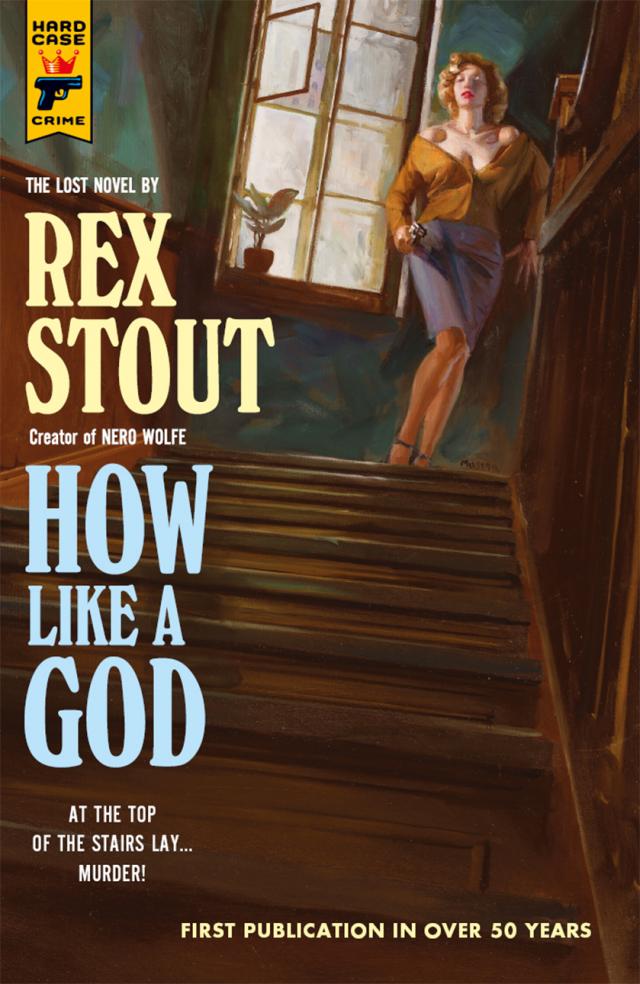
Cover painting copyright © 2024 by Ricky Mujica, from reference by Robert Maguire
All rights reserved. No part of this book may be reproduced or transmitted in any form or by any electronic or mechanical means, including photocopying, recording or by any information storage and retrieval system, without the written permission of the publisher, except where permitted by law.
This book is a work of fiction. Names, characters, places, and incidents either are the products of the author’s imagination or are used fictitiously, and any resemblance to actual events or persons, living or dead, is entirely coincidental.
Print edition ISBN 978-1-80336-486-5
E-book ISBN 978-1-80336-487-2
Design direction by Max Phillips www.signalfoundry.com
Typeset by Swordsmith Productions
The name “Hard Case Crime” and the Hard Case Crime logo are trademarks of Winterfall LLC. Hard Case Crime books are selected and edited by Charles Ardai.
Visit us on the web at www.HardCaseCrime.com
HOW LIKE A GOD
A
He had closed the door carefully, silently, behind him, and was in the dim hall with his foot on the first step of the familiar stairs. His left hand was in his trousers pocket, clutching the key to the apartment two flights up; his right hand, in the pocket of his overcoat, was closed around the butt of the revolver. Yes, here I am, he thought, and how absurd! He felt that if he had ever known anything in his life he knew that he would not go up the stairs, unlock the door, and pull the trigger of the revolver.
She would probably be sitting in the blue chair with many cushions, reading; so he had often found her. He shivered so violently that he almost lost his balance as his foot found the next step.
His mind seemed suddenly clear and intolerably full, like a gigantic switchboard, with pegs in all the holes at once and every wire humming with an unwonted and monstrous burden. A vast intricacy of reasons, arguments, proofs—you are timid and vengeless, you are cautious and would be safe, you would be lost even if safe, you are futile, silly, evil, petty, absurd—he could not have spoken in all his years the limitless network of appeals, facts, memories, that darted at him and through him as his foot sought the third step.
He heard them all.…
I
You are timid and vengeless.
When you first saw that word you were in short pants and numberless words in the books you read were strange and thrilling. Many of them have long since been forgotten, many more have lost their savor. To become common and flat is sadder than to disappear; but this word has escaped both fates through the verses you wrote, using it in the first line of each stanza. Afraid of your father’s and mother’s good-natured criticism, you showed them only to Mrs. Davis, the Sunday School teacher.
“Vengeless,” she said, “is not used for men and women, only for impersonal things like time and tides.”
That was before she invited you to her house in the afternoon, but already she was smiling at you. You were mortified at having misused the word and tore the verses up.
That was timid, and you hated yourself for it without really knowing it. You were always hating yourself without knowing it; the tiniest spark was enough to set off that firecracker. Jane, who had the trick of being aware of things before they quite happened, was always on to you, not unkindly, but that kindness could crush you. Did Jane know that? Years later she did, of course, with Victor and her children, and her friends and committee meetings, but at raw and gawky twelve, just outgrown her dolls, did she already mysteriously know what she was doing to people ? She would be peeling potatoes and would turn to your mother:
“Better give Billy a cookie; he’s done something in school.”
“Let me alone,” you would almost whimper. Then your mother, with that pretense of equality which you resented without understanding why:
“Don’t you want to help your sister do the potatoes?”
You always intended to refuse the cookie, but you never did. Come to think of it, there was no reason why you should; but it always seemed a surrender. In youth the sources of ignominy were everywhere, or you more tenderly felt them.
The most blatant and poignant timidity of those young Ohio days was when, with the boys down on the lot below Elm Street of a summer afternoon, you would try to steal second base. Why in the name of god did you ever try it? That was peculiarly not your dish, you always knew that and yet forever you tried it. There were three moments of agony: do I go on this pitch? Just that one instant too long on the decision, the bad delayed start—but the running was splendid. You could run. The slide, torture, whether headfirst or hook. A kicked face or a turned ankle? The essential wild precise plunge. You knew what was required, but you didn’t have it. There you were, a yard away from the base, with the ball on you, and from all sides the friendly triumphant jeers. If Jane had been there doubtless she would have offered you a cookie, and you would have killed her.
Oh, that!
But during this period that vague and oppressive timidity had its usual seat at home, at the little house on Cooper Street. Probably its unknown focus was Jane, for your father and mother were from first to last nebulous and ill-defined; they seemed to float around you; and your other sisters and brothers existed only as pestiferous facts, hardly yet as persons. Larry was only five, and Margaret and Rose were being born or at least scarcely out of the cradle.
How easy to see now that that house meant Jane. There was the time, somewhat later, that you stumbled into the bathroom with a bleeding nose, bruised souvenir of a visit of the lime-kiln gang to peaceful Cooper Street, and found there your mother and Jane, both naked, one fresh from the tub, the other just getting in. It was a dilemma. Outside was the carpet, not to be bled on; here was your imminent pain. They helped, somehow, hurriedly; Jane handed you a towel, or was it your mother? It was an exciting and confusing experience, and the memory is blurred. There was throughout a portentous embarrassment, even after your mother got a robe around her. Jane didn’t bother. That night the pink living skin you saw behind closed eyelids was Jane’s; also the other nights; never your mother’s. Timidity? You shrank from the warmth that crept tingling into your own skin at the forbidden memory. You at once invited it and denied it. Not so would Jane have done! Was she embarrassed that day? You wondered about that ceaselessly, until the dignity of new juices and new purposes drove it underneath.
With your father there was timidity too, but as you see now perfumed with contempt. Not even you could have been really timid with that little herring of a man who meant invariably well and went around with the air of one who is always expecting to hear a bell ring. There is not more good will in all heaven than he carried in his heart; The first dream you dreamt that was in touch with reality came when his business and his health lost step together and you were shocked and pleased to find yourself taken seriously as a member of the family.
“Bill, it’s up to you,” said your father, after your mother’s tears were dried and the younger children had been sent from the room. “Doc’s crazy. I’ll be at it again in a month. You’re nineteen, and big enough to handle two real drug stores, let alone that little hole in the wall. Nadel can do the prescriptions, and, with all the afternoons and Saturdays you’ve had there…”
“He can’t do it,” said Jane, home for the summer from Northwestern. No, she was through then, and was teaching Latin in the high school like a goddess waiting at a railroad station for a train. Anyway, “He can’t do it” was what she said, and when you grunted protest she added:
“You know you can’t, Bill. It’s not your line, and anyway you’re too young and it’s not fair. I’m the one for it, and Dad will have to let me.”
Your father, curiously persistent, had Mr. Bishop come in and empowered you to sign checks, but no one was fooled by that empty symbol except your mother. The summer dragged endlessly, with the intimate and inane activity of the leading drug store of a growing town. You resented Jane bitterly as she competently kept patent medicine salesmen where they belonged while you mixed ice cream sodas and washed the glasses; and by July you found it almost impossible to talk to her. It was just then that Mrs. Davis went to Cleveland—ah, you still wonder, how much of that did Jane know? At all events, the whole world was dark. But your father, to the pleased but professionally discomfited surprise of Doc Whateley, pulled on his trousers again, “slightly disfigured but still in the ring” as the editor of the weekly Mail and Courier put it, and you went off for your second year at college.
That was the year that saw your legend created and made you a man of mark. You have never understood that episode, especially not when you were acting it; it was an astonishing contradiction of all timidities and inadequacies; what would have happened and where would you be now if Mrs. Moran had not done your washing and sent little Millicent to fetch it, and deliver it, twice a week? It was on her second or third visit that you noticed her and became intensely aware that that pale child was handling the things you had worn. It was indefinable and incredible; she was exactly ten, half your own age, pallid and scarcely alive, barely literate; but as she calmly and silently rolled up your soiled shirts she did something wise and terrible. There was no action in it, no gesture, not even a look, certainly not a caress; there was really nothing, and yet it was a profound and suggestive impertinence. At the time you were aware of nothing but an inexplicable discomfort. You twisted in your chair; your body needed moving and you got up and opened the door for her.
“I’ll come back Friday,” she promised.
It must have been three months later that there happened to be a crowd in your room when she came; by then you were always making sure to have candy for her and to be always there when she arrived. That day you didn’t want to give her the candy with the other fellows present, and without even a glance she somehow let you know that she understood perfectly and sympathized.
When she had gone somebody remarked that it was a pity that so young and delicate a child had to carry bundles around.
“Oh, that little bitch,” said Dick Carr, known as the Mule. “Nothing’s going to hurt her. She’s got a nasty line.”
Two or three protested in the name of innocent childhood. No one seemed to see you trembling.
“You’re nuts.” The Mule spat a rich tobacco brown. “She used to come for my stuff, but I changed over to the Chink. Honest, I was afraid. Hell, Bill, she might seduce you.”
Without willing it you were on your feet and advancing on him. “Carr, you’re a dirty low-down skunk.”
The words weren’t so bad, among friends, but your tone and attitude made them gasp. The Mule, a seasoned halfback with nothing left to prove, was contemptuously surprised but undisturbed.
“My god, you aren’t tilting your little lance for her, are you, Bill?”
Blindly you slapped him in the face and as he leapt out of his chair a dozen restraining hands clutched him. Here of course tradition stepped in, not only of dear old Westover, but also of all the manly centuries. Time and place were discussed and courteously agreed upon. There wasn’t a lot of excitement because it was taken for granted that the Mule would hit you once and then watch you bleed.
It was agreed afterward that no one could adequately describe that encounter. The Mule certainly did hit you and you certainly bled; but long after you were logically extinct, with your face a mass of pulp and your ribs trying to escape by way of your backbone, you still poked your bruised fists somehow at that gigantic shape which must be annihilated before you went down to stay. You were not aware of either weariness or pain, though you did think that surely all the time in the world had been used up. Probably now the Mule could easily have given you the coup de grace, but he seemed to be sick of it. Perhaps aware at last that his real opponent here was something that had no blood to lose, and that to knock you down again was pointless.
You were held, finally, not only from combat but also from falling, while the Mule stood panting, wiping his face with a handkerchief, his undershirt splotched with dirt and blood not all yours; and when you had been half led and half carried back to your room you collapsed utterly. Late that night, too gone to move, you lay and watched your admiring visitors eat the candy you had bought for little Millicent.