Rex stout nero wolfe 0.., p.13
Rex Stout - Nero Wolfe 06 - Some Buried Caesar, page 13
part #6 of Nero Wolfe Series


When I got to the veranda they were seated in a group in the wicker chairs and McMillan was telling Osgood, “We all want it cleared up and that’s why Pratt and I came over here. Waddell will be along pretty soon. Someone had an idea, it doesn’t matter who, after Caesar was found dead, and we thought it was only fair to tell you about it before it is followed up. If you want to know why I came to tell you … I came because everybody else was afraid to. It’s Waddell’s job, or Sam Lake’s, not mine, and it will be up to them to investigate it if they decide to, but they asked me to come and discuss it with you first. Pratt offered to come, but we knew how far that would get and it might even lead to some more violence of which we’ve had plenty, so I came, and he came along with what I would call good intentions … he can tell you—”
Pratt began, “The fact is, Fred—”
“My name’s Osgood, damn you!”
“All right. Take your name and stick it up your chimney and go to hell.”
Osgood ignored him and demanded, “What do you want to discuss, Monte?”
“About Clyde,” McMillan said. “You’re going to be sore naturally, but it won’t help any to fly off the handle. The fact is that Clyde was in that pasture. What for? Waddell and Sam Lake, and Captain Barrow of the state police, admit that Nero Wolfe’s reconstruction of it is possible, but it’s hard to believe, and one reason it’s hard is that if somebody did all that, who was it? That’s chiefly what has them stumped.”
“Not unique,” murmured Wolfe.
“Do you claim the bull killed him?” Osgood demanded.
“I don’t claim anything.” McMillan lifted his sagging shoulders. “Don’t get me wrong, Fred. I told you I came to see you because the others, except Pratt, were afraid to. I don’t claim anything. What they say is this, that the main difficulty with supposing that Clyde climbed into the pasture himself was to try to figure what for. I said myself this morning that it was dumb as hell for anybody to imagine that he went in there to get the bull, because that would have been plain crazy and Clyde wasn’t a lunatic. What could he have intended to do with him? You can’t hide a bull in a barrel. But when Caesar was found dead of anthrax … it was Captain Barrow who suggested it first as a possibility … that might account for Clyde entering the pasture. As you know, anthrax can be communicated subcutaneously, or by contact, or by ingestion. If Caesar was fed something last night, something that had been activated … well …”
Involuntarily I hunched forward and drew my feet under me, ready to move. Frederick Osgood was stiff, and his eyes glassy, with cold rage. His chronic scowl had been merely funny, but he didn’t look funny now. He said in a composed and icy tone:
“Look out, Monte. By God, look out. If you’re suggesting that my son deliberately poisoned that bull …”
McMillan said gruffly, “I’m not suggesting anything. I’ve told you I came here as a messenger. The fact is, I wanted to come, because I thought you ought to be warned by a Mend. Waddell’s attitude, and Captain Barrow’s, is that it was you who insisted on an investigation, and if there is any part of it you don’t like you’ve got yourself to thank for it. Anyhow, they’ll be here any minute now, with the idea of finding out where Clyde had been the past few days and whether he had access, or could have had access, to any source of anthrax.”
“Anybody who comes here—” Osgood had to stop to control his voice “—with that idea can go away again. So can you. It … it’s infamous.” He began to tremble. “By God—”
“Mr. Osgood!” It was Wolfe, using his sharpest tone. “Didn’t I warn you? I said annoyance, intrusion, plague. Mr. McMillan is perfectly correct, you have yourself to thank for it.”
“But I don’t have to tolerate—”
“Oh yes you do. Anything from inanity to malevolence, though I doubt if we’re dealing with the latter in this instance. I don’t know Captain Barrow, but I can see Mr. Waddell, like a befuddled trout, leaping for such a fly as this in all innocence. It is amazing with what frivolity a mind like his can disregard a basic fact—in this case the fact that Clyde was not killed by the bull. I entreat you to remember what I said about our needing Mr. Waddell. It is really fortunate he’s coming here, for now we can get information that we need without delay. If first you must submit to an inquiry which you regard as monstrous, you will do so because it is necessary. They represent authority … and here they are, I suppose …”
There was a sound of wheels crunching gravel, and a car swung into view on the drive and rolled to a stop at the foot of the veranda steps. First out was a state cossack in uniform, a captain, looking grim and unflinching, and following him appeared the district attorney, trying to look the same. They came up the steps and headed for the group.
I missed that battle. Wolfe got up from his chair and started off, and, seeing that he had his handkerchief in his hand, I arose and followed him. With a nod to Waddell as we passed he went on, entered the house, stopped in the main hall, turned to me and told me to wait there for him, and disappeared in the direction of the library. I stood and wondered what was causing all his violent commotion.
In a few minutes he came back looking disgruntled. He frowned at me and muttered, “Entirely too fast for us, Archie. We are being made to look silly. We may even have been outwitted. I got Mr. Bennett on the telephone, but drew a blank. Did you bring a camera along?”
“No.”
“After this always have one. Take a car and get over there. Someone there must have a camera—the niece or nephew or Miss Rowan. Borrow it and take pictures of the carcass from all angles … a dozen or more, as many as you can get. Hurry, before they get that fire started.”
I made myself scarce. It sounded fairly loco. As I trotted out to where Osgood’s sedan was still parked, and got in and got it going, my mind was toying with theories that would account for Wolfe’s sudden passion for photography, but I couldn’t concoct one that wasn’t full of holes. For instance, if all he wanted was to have it on record that the bull’s face was comparatively clean, why pictures from all angles? I devised others, wilder and more elaborate, during the four minutes it took to drive to the highway and along it for a mile to Pratt’s place, but none was any good. At the entrance to the drive a state cop stopped me and I told him I was sent by Waddell.
I parked in the space in front of the garage, alongside the yellow Wethersill standing there, and jumped out and headed for the house. But I was only halfway there when I heard a call:
“Hey! Escamillo!”
I turned and saw Lily Rowan horizontal, lifted onto an elbow, on a canvas couch under a maple tree. I trotted over to her, telling her on the way:
“Hullo, plaything. I want to borrow a camera.”
“My lord,” she demanded, “am I such a pretty sight that you just have to—”
“No. This is serious and urgent. Have you got a camera?”
“Oh, I see. You came from the Osgoods. Oh, I knew you were there. It’s that yellow-eyed Nancy—”
“Cut it. I tell you I’m serious. I want to take a picture of the bull before they get their—”
“What bull?”
“The bull.”
“Good heavens. What a funny job you have. No one will ever take another picture of that bull. They’ve started the fire.”
“Goddam it! Where?”
“Down at the other end …”
I was off on the lope, which may have been dumb, but I was in the throes of emotion. I heard her clamoring, “Wait! Escamillo! I’m coming along!” but I kept going. Leaving the lawn, as I passed the partly dug pit for the barbecue, I could smell the smoke, and soon I could see it, above the clump of birches towards the far end of the pasture. I slowed to a trot and cussed out loud as I went.
There was quite a group there, 15 or 20 besides the ones tending the fire. I joined them unnoticed. A length of the fence had been torn down and we stood back of the gap. Apparently Hickory Caesar Grindon had had a ring built around him of good dry wood, in ample quantity, for there was so much blaze that you could only catch an occasional glimpse of what was left of him between the tongues of flame. It was hot as the devil, even at the distance we were standing. Four or five men in shirt sleeves, with sweat pouring from them, were throwing on more wood from nearby piles. The group of spectators stood, some silent, some talking. I heard a voice beside me:
“I thought maybe you might get around.”
I turned for a look. “Oh, hello, Dave. What made you think I’d be here?”
“Nothin’ particular, only you seem like a feller that likes to be around where things is goin’ on.” He pinched at his nose. “I’ll be derned if it don’t smell like a barbecue. Same smell exactly. You might close your eyes and think he was bein’ et.”
“Well, he’s not. He won’t be.”
“He sure won’t.” Silence, while we watched the flames. In a little he resumed, “You know, it gets you thinkin’, a sight like that, derned if it don’t. A champion bull like that Caesar bein’ burnt up with scorn. It’s ignominious. Ain’t it?”
“Absolutely.”
“Yes it is.” He pinched his nose again. “Do you read pohtry?”
“No. Neither do you.”
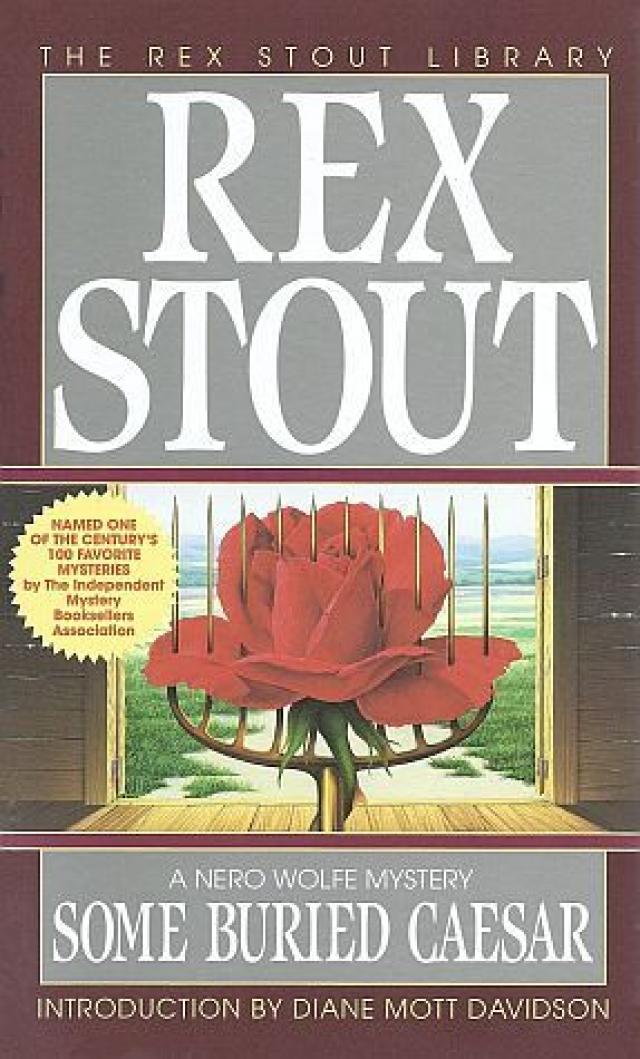
“The hell I don’t. A book my daughter give me one Christmas I’ve read twenty times, parts of it more. In one place it says ‘I sometimes think that never grows so red the rose as where some buried Caesar bled.’ Of course this Caesar’s bein’ burnt instead of buried, but there’s a connection if you can see it.”
I made a fitting reply and shoved off. There was no percentage in standing there getting my face roasted and I wasn’t in a mood to listen to Dave recite poetry.
Up a ways, near the gate through which we had carried the canvas with its burden the night before, Lily Rowan sat on the grass holding her nose. I had a notion to stop and tell her with a sneer that it was only a pose to show how sensitive and feminine she was, since Dave’s olfactory judgment had been correct, but I didn’t even feel like sneering. I had been sent there on the hop with my first chance to get a lick in, and had arrived too late, and I knew that Nero Wolfe wouldn’t be demanding a snapshot of a bull just to put it in his album.
Lily held her hands out. “Help me up.”
I grabbed hold, gave a healthy jerk, and she popped up and landed flat against me; and I enclosed her with both arms and planted a thorough one, of medium duration, on her mouth, and let her go.
“Well,” she said, with her eyes shining. “You cad.”
“Don’t count on that as a precedent,” I warned her. “I’m overwrought. I may never feel like that again. I’m sore as the devil and had to relieve the tension somehow. May I use your telephone? Mr. Pratt’s telephone.”
“Go climb a tree,” she said, and got her arm through mine, and we went to the house that way, though it is a form of intimacy I don’t care for, since I have a tendency to fight shy of bonds. Nor did I respond to the melting quality that seemed to be creeping into her tone, but kept strictly to persiflage.
Caroline was on the terrace, reading, looking even more under the weather than she had that morning, and I paused for a greeting. I didn’t see Jimmy anywhere. Lily went with me to the phone in an alcove of the living room, and sat and looked at me with a corner of her mouth turned up, as she had the day before. I got the number of Osgood’s place, and was answered by a maid, and asked for Wolfe.
His familiar grunt came: “Hello, Archie.”
“Hello. Hell all haywire. They already had the fire started and it’s like an inferno. What can I do?”
“Confound it. Nothing. Return.”
“Nothing at all I can do here?”
“No. Come and help me admire stupidity.”
I hung up and turned to Lily: “Listen, bauble. What good would it do if you told anyone that I came here to take a picture of the bull?”
“None whatever.” She smiled and ran the tips of her fingers down my arm. “Trust me, Escamillo.”
Chapter 12
An hour later, after eight o’clock, Wolfe and I sat in the room that had been assigned to him upstairs, eating off of trays, which he hated to do except at breakfast. But he wasn’t complaining. He never talked business at meals, and was glad to escape from his client. Osgood had explained that his wife wouldn’t appear, and his daughter would remain with her, and that perhaps it would be as well to forego service in the dining room altogether, and Wolfe had politely assented. His room was commodious and comfortable. It was a little chintzy, but one of its chairs was adequate for his bulk, and the bed would have held two of him. It might have been supposed that the kitchen would be sharing in the general household derangement, but the covered dishes of broiled lamb chops with stuffed tomatoes were hot and tasty, the salad was way below Fritz’s standard but edible, and the squash pie was towards the top.
Osgood’s collision with Waddell and Captain Barrow had been brief, for it had ended by the time I got back. The captain was collecting fingerprints from everyone who had been at Pratt’s place the night before, without disclosing how dire his intent might be, and since Wolfe had already obliged I figured I might as well. After he had got my ten specimens collected and marked and put away in his little case, he had announced that he was ready for a call on the foreman of the stock barns, and at Wolfe’s suggestion Osgood and McMillan had accompanied him, and Pratt had departed for home, which left Wolfe and me alone with District Attorney Waddell.
Waddell was glad to cooperate, he said, with Fred Osgood’s representative. More than willing. He had pursued, and intended to pursue, the investigation without fear or favor. No one had a supported alibi except Lily Rowan and me. They had left the dinner table before 9 o’clock. Wolfe had gone upstairs to read. Pratt had gone to his desk in the room next to the living room to look over some business papers. McMillan had been shown to a room upstairs by Bert, and had lain down with his shoes off for a nap until 1 o’clock, at which time he was to relieve me on guard duty. He had slept lightly and the sound of the shots had awakened him. Caroline had sat on the terrace for a while and had then gone to the living room and looked at magazines. Jimmy had been on the terrace with his sister, and when she left he had remained there, and sat and smoked. He had heard our voices, Lily’s and mine, as we had followed the pasture fence on our tour, especially as we encountered the briar patch, but remembered no other sounds above the noise of the crickets and katydids. Bert had helped with the dinner dishes until 10 o’clock and had then sat in the kitchen and listened to the radio, with his ear glued to it because it had to be kept pianissimo. Dave Smalley—Waddell knew all about his having been fired by Clyde Osgood—Dave, on parting from me at a quarter to 9, had gone to his room in a wing of the garage building, shaved himself, and retired. Wolfe demanded, “Shaved?” in incredulity, and got the explanation Dave had given, that he always shaved at bedtime because he was too hungry to do it before breakfast, and after breakfast there was no time.
So far as that went, Waddell conceded, anyone could have done it. When you went on and asked why anyone would have done it, that was different. There was no one there with anything like a decent known motive to murder Clyde Osgood unless you wanted to make an exception of Dave Smalley, but Dave was harmless and always had been. Say someone had caught Clyde sneaking in there after the bull. If it had been Pratt, he would have simply ordered him off. If it had been Jimmy, he would have socked him. If it had been McMillan, he would have picked him up and thrown him over the fence. If it had been Dave, he would have yelled for help. If it had been Goodwin, who was guarding the bull, of course he didn’t know.…
“I’ve explained,” said Wolfe patiently, “that the murder was planned. Did you examine the bull?”
“I looked at him, and so did Sam Lake and the police. There was one splotch on his face and a little caked on his horns, but not much, he had rubbed most of that off. A bull likes to keep his horns clean.”
“What about the grass around the hose and the pick handle?”
“We sent the pick to Albany for laboratory inspection. There were a few, kind of clots, we found in the grass, and we sent them too. We won’t know until tomorrow.”
“They’ll report human blood, and then what? Will you still waste time blathering about Clyde approaching the bull with a meal of anthrax, and the bull, after consuming it, becoming resentful and goring him?”
“If they report human blood that will add weight to your theory, of course. I said I’d cooperate, Wolfe, I didn’t agree to lap up your sarcasm.”
“Pfui.” Wolfe shrugged. “Don’t think I don’t understand your position, sir. You are fairly sure there has been a murder, but you want to leave a path open to a public pretense that there was none, in case you fail to solve it. You have made no progress whatever toward a solution and see no prospect of any, and you would abandon the attempt now and announce it as accidental death as a result of malicious trespass, but for me. You know I am employed by Mr. Osgood, who may be obstructed but not ignored, and you further know that I have the knack of arranging, when I do make a fool of myself, that no one shall know it but me.”
“You make …” Waddell sputtered with anger. “You accuse me of obstructing justice? I’m the law officer of this county—”
“Bah! Swallow it, sir! You know perfectly well Clyde Osgood was murdered, and you descend to that gibberish about him poisoning that bull!” Wolfe halted abruptly, and sighed. “But there, I beg your pardon. I have forfeited the right to reproach even gibberish. I had this case like that, complete—” he showed a clenched fist “—and I let it go.” The fist popped open.
“You don’t mean you know the mur—”
“I mean I was lazy and conceited. You may quote that. Forget my dispraise, it was beside the point; you do your best. So do I. That’s the devil of it: my best wasn’t good enough this afternoon. But it will be. Drop all notion of filing it as an accident, Mr. Waddell; you may as well close that path, for you won’t be allowed to return by it …”