

Eerie legends, p.1
Eerie Legends, page 1


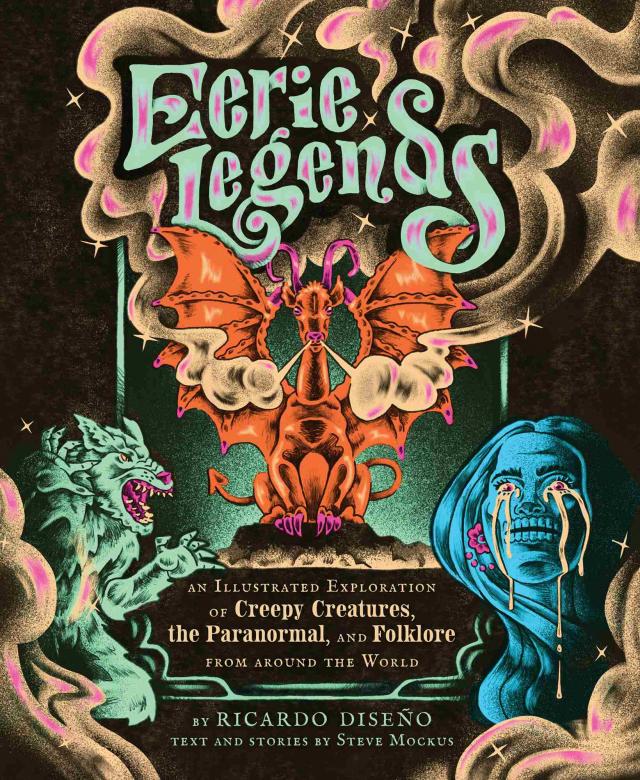
Artwork copyright © 2024 by Ricardo Diseño.
Text copyright © 2024 by Chronicle Books LLC.
All rights reserved. No part of this book may be reproduced in any form without written permission from the publisher.
Library of Congress Cataloging-in-Publication Data
Names: Diseño, Ricardo, author, illustrator. | Mockus, Steve, author.
Title: Eerie legends : an illustrated exploration of creepy creatures, the paranormal, and folklore from around the world / by Ricardo Diseño ; text & stories by Steve Mockus.
Description: San Francisco : Chronicle Books, [2024]
Identifiers: LCCN 2024009376 | ISBN 9781797229393 (hardcover ; alk. paper)
Subjects: LCSH: Folklore. | Tales--Cross-cultural studies.
Classification: LCC GR74 .D57 2024 | DDC 398/.4--dc23/eng/20240414
LC record available at https://lccn.loc.gov/2024009376
ISBN 978-1-7972-2939-3 (hc)
ISBN 978-1-7972-2940-9 (epub reflowable)
ISBN 978-1-7972-3586-8 (epub fixed-format)
ISBN 978-1-7972-3585-1 (kindle)
Design by Neil Egan and Liz Li.
Chronicle Books LLC
680 Second Street
San Francisco, California 94107
www.chroniclebooks.com
For Gabe, Adrian, Noah, Emma & Christian. Don’t forget you are capable of anything. You are loved.
—R.D.
For Sandy, Ali, Alex, and Jake. And for Jody!
—S.M.
Introduction
BANSHEE
BETTY AND BARNEY HILL ABDUCTION
CATACOMBS OF PARIS
EL CHUPACABRA
ENFIELD POLTERGEIST
FLYING DUTCHMAN
HEADLESS HORSEMAN
LA ISLA DE LAS MUÑECAS
JERSEY DEVIL
JORŌGUMO
KRAMPUS
LA LECHUZA
LESHY
LA LLORONA
LOAB
LOCH NESS MONSTER
LOVELAND FROGS
AL MADAM
MAN-EATING TREE
MOTHMAN
NURE-ONNA
ONRYŌ
PESTA
A PISADEIRA
PONTIANAK
EL SILBÓN
SKUNK APE
SLENDER MAN
VAMPYR
WEREWOLF
WINCHESTER MANSION
WINDIGO
ZOMBI
Further Reading, Listening, and Viewing
About the Artist
About the Writer
THESE CREATURES EXIST to the extent that we believe in them, or want to believe in them.
Why would we want to do that?
It’s more colorful to believe in a world where they might exist. We can use them to tell stories about who or where or what we are, what we’re afraid of, what we want. They can get to a truth that’s not literal, describing uncanny possibilities that make sense to us alongside things that we think we know.
They can embody something terrifying, and by giving it an explanation and specificity, make it somehow easier to reckon with, or at least to comprehend. Sleep paralysis is a creature that sits on your chest after overindulgence. The plague comes for us in the form of a figure at your doorstep, wielding a rake or a broom. You don’t want to see her at all, but if you do, hope she has the rake.
They are also useful warnings. It’s one thing to caution kids against playing along bodies of water, but something else to ask them to imagine creatures rising out of the depths or stalking the shoreline, waiting to take them away. Okay, sure, you should be good so Santa will bring you presents. But if you’re not, what if you should expect a demon to stuff you in a sack and bundle you off to hell?
When vengeful, as in the case of La Lechuza and the pontianak, these creatures can act against terrible people in ways that might not be available to us as still-humans without supernatural agency. Our sympathies may also lie with the banshee, whose blood-curdling screams are actually an agony of empathetic mourning as she prepares a human soul for its passage into the afterlife.
They can also serve as symbols of regional and cultural pride. We can visit the Mothman Museum in Point Pleasant, West Virginia; admire his statue; and buy a hoodie. Swing by the Skunk Ape Research Headquarters off Highway 41 in southern Florida (they will also sell you a hoodie, or a set of skunk ape finger feet). Take in a hockey game played by the New Jersey Devils and take home a jersey with a devil-horn-and-tail logo. El chupacabra: fearsome livestock menace, and a pop culture symbol of the outsider quality foisted on Puerto Rican citizens of the United States. (T-shirts also available.)
But mainly: Scary stories are fun. There’s the catharsis of facing fears; the what-if electricity of imagining something menacing, malevolent, or weird from a safe(?) distance; and storytelling opportunities to share in collective folklore. It’s what’s kept some of these creatures and their tales alive for centuries, and what conjures new residents of our strangely haunted spaces. [Loab has entered the chat.]
The group of soldiers is warming themselves around a fire within the safety of the tree line when they hear the skull-shaking wail. Its tone rises, doubling, tripling in volume. Their bodies curl inward, sound waves pressing the air in around them, their gloved hands no protection for their ears. It’s her. In chaos they disperse into the forest, trying to distance themselves from their fate in tomorrow’s battle, and from each other, each one tainted by hearing the sound of death, either forewarned or foretold. They will discover which soon enough.
THE BANSHEE IS OFTEN MISUNDERSTOOD. Her hallmark is a terrifying screaming, shrieking, and wailing, but her intent is to help those who hear her prepare for an imminent death—not to bring about that death.
In some folktales she is a free-roaming harbinger of doom, but in her most classic iteration the banshee is an ancestral spirit closely associated with a specific, landed Celtic family. In her life either she had transgressed or been dealt a terrible fate, and ever after she appears to members of her family clan when their deaths approach. Her purpose is to prepare them, and help their spirits pass from this world into the next—just as hers for now cannot. Sometimes she appears to the person who is about to die. Sometimes she appears to other family members to warn of the impending death of a relative. It’s said she will stay in this role as long as any of the family retain their ancestral land.
In appearance she’s either old or young, with long hair that is either red or gray. Her eyes are bloodshot from her agonized cries.
She is the ghostly manifestation of the keening or wailing woman, a figure who plays an important role in traditional Irish religious and cultural rites around death. These women would give voice to and physically manifest grief for families when a loved one passed away, also with the goal of helping the spirit transition. Their fee would generally put their services beyond the reach of any but the wealthy, and their death-related spiritual power and otherness also feed into aspects of banshee mythology.
She knew it was time before she saw the specter floating outside the window. Before the screaming.
Hello, Emma. You’re welcome in, always.
She knows the figure from the painting, which has hung in the main hall for hundreds of years. In the portrait, Emma stands elegantly beside her husband, who sits in a chair. Their two boys are in front of them, playing with a taxidermic bird while the family hound looks up at her husband. All long dead.
Hovering at the bedside now, Emma’s face is raw as her throat-shredding scream gives voice to the chemotherapy and radiation that has left the woman in the bed feeling burned and hollowed. The time the treatment had bought her is now at an end.
She wonders if this is how Emma appeared to her parents, grandparents, and great-grandparents when they passed. She remembers her grandmother setting a place for Emma at dinner, in the last days when she felt she’d had enough. She remembers as a child seeing the wide-eyed horror of her uncle in his last moment, his skepticism overturned by shock and fear.
She calls her daughter in New York.
Do you see her?
I do.
Is there time for me to fly in? I can get—
I don’t think so.
I love you.
Once her daughter has sold the estate, she wonders if Emma will be freed of this place with none of them left on the land. How she must suffer, feeling these deaths. Her eyes are wet, blood-rimmed, empathetic, pleading. Miserable.
We can rest now, she says to Emma, closing her eyes. As her awareness recedes, she hears the screams as a lullaby.
I told Betty to look out—and the object was still around us. I could feel it around us.… When I got in the car, it had swung around and so it was out there. I—I know it was out there. Yeah, it’s out there. But I don’t know where.… Ohhh, those eyes! They’re in my brain! Please can’t I wake up?
THE ABDUCTION STORY OF BETTY AND BARNEY HILL—perhaps the most famous of its kind—begins on the night of September 19, 1961, as the couple are driving home after spending their honeymoon at Niagara Falls and in Montreal. They notice a strangely moving, multicolored light in the sky that seems to be following them. They stop and get out of the car several times to have a better look. Betty sees a row of windows along the side of the glowing pancake shape. Through a pair of binoculars, Barney sees figures moving within, and a ladder or ramp descending from the object. Alarmed, they hurry to get back into the car, only to hear an ominous electronic beeping sound coming from behind them.
When they emerge from a mental haze, they find they have driven about 35 miles south of the site of their encounter. When they finally arrive home, they discover they’ve inexplicably lost about two hours of time. They feel clammy, and have strange sore spots on their bodies. There is mysterious wear on some of their clothes. Their watches have stopped. There are magnetized circular marks on the trunk of their car.
Though they are unsure of what happened and worry about publicly sharing this strange encounter, they do describe it to Betty’s sister. They then privately report it to the air force, as well as to a member of the National Investigations Committee on Aerial Phenomena, who finds their story credible.
Later, under hypnosis, they recover lost details. They recall being taken inside the ship by humanoid aliens with gray skin and wide black eyes. They are asked to partially undress and are examined. The aliens are friendly, speak English telepathically, and even joke around, although there is a scary moment with a needle. The visitors stress that they mean no harm.
It’s only when an intrepid news reporter learns details of the case and publishes an article titled “UFO Chiller: Did THEY Seize Couple?” that their story becomes an international sensation, making them the first people to report an abduction, and establishing “the grays” as the most frequently encountered alien type.
The light is tracking him. There’s no question about it now. Every time he looks up it’s a little closer, a little brighter.
It’s late, and he notices now that he’s not too far from where Betty and Barney had their strange encounter. They’d confided in him after church. His father served in the air force, and they wanted to know if his father had ever mentioned anything similar. He could tell that when he said no, they’d been hoping for a different answer.
Not really because he wants to, but because he feels it’s a thing he must do, he pulls the car off the highway. As he drives down a dirt road, he can see a glow through the trees ahead, the light having settled into a clearing. The short men lead him up the ramp and inside the disc-shaped, many-windowed craft. Betty and Barney had not described the inside of the ship, and he hadn’t thought to ask—there was so much to wonder at otherwise. He sees now that the primary material of the ship—the floors, the walls, and the doors—glows with an inner light. He’s led to a room with a central table.
Asking aloud if he should undress, he hears that he should, Please.
Asking, so you speak English?, he hears, We are not speaking English.
He wonders about the uniforms, which seem nearly recognizable, Earthly. Worn for his benefit?
The table is neither warm nor cold. It has deep grooves and perforations. He’s trying to fix details to memory. He’ll be able to confirm the Hills’ account.
Will this hurt? He tries just thinking this.
Black almond eyes look into his. I’m afraid it might. A gray hand lifts a long blade.
His eyes widen as the other gray hand of the surgeon passes over his face and stills his muscles. He thinks a neuron-flash of words: no wait no hurt no.
Yes, he hears. That was Phase One.
The blade gleams.
This is Phase Two.
The bones of six million souls lie beneath the streets of Paris. Relocated from horrifically unsanitary overcrowded cemeteries, the remains were transferred in the Napoleonic era to a vast underground ossuary, where they lie silently, but perhaps unquiet. It’s said that if you roam the labyrinthine tunnels at night, the voices of the dead may persuade you to wander ever deeper, to die lost below, and to leave your bones to join the others.
CREATED TO SOLVE A PUBLIC HEALTH CRISIS, the Catacombs of Paris were envisioned from the beginning with an air of theatricality. Only one of its two hundred square miles is open to the public, but that portion is marked by aesthetically arranged towers of skulls and femurs, quotes and poems about death, sculptures of buildings carved into the limestone walls by a quarry worker, and the phrase “Arrete! C’est ici l’empire de la mort” (“Stop! Here lies the empire of death”) chiseled over the entrance.
Among the legends of death and disappearance in the catacombs, there’s at least one very real instance documented and memorialized. A worker at a nearby hospital, Philibert Apsairt, went missing after he entered and wandered the ossuary in 1793 while it was still under construction. His body was discovered eleven years later in 1804. His remains have been preserved in a tomb where they were found, in an off-limits gallery.
Another tale involves the early 1990s discovery of an abandoned video camera, found by a group of cataphiles exploring restricted areas. The video (easily findable online) shows a man recording in the forbidden tunnels, encountering weird noises, freaking out, and dropping the camera. Did he die down there, never to be found? Was the clip created to air on a TV show about scary places? We may never know.
It is unfortunate that he didn’t read the sign posted near the entrance. By the time he sees the second sign (attention, ne touchez pas les os), he is already holding a skull in one hand and a femur in the other. His French is bad. In fact, it will never get any better. But the skull and crossbones graphic on the sign makes his transgression clear.
The skull in his hand is light, surprisingly light. He’s heard about the lightness of bones and their strength, but it is another thing to understand this by touch. The bones are covered with a fine grit. Dust. Something else.
When is he going to have another chance to hold a skull in his hand? Hopefully never. After tossing it up and catching it, he puts it back on one of the bone piles, sorted by type.
Even without eyes, the skull seems to be looking at him. He can feel all the skulls looking at him.
How strong is this femur? Could he crack it? He looks around. With his hands on the far ends of the shaft he strains to snap it, but nothing. Again, but nothing. All-in now, he crouches and brings the middle of the femur down on one upraised knee as hard as he can. Crack. It’s in two.
At first, he thinks he is hearing an echo. From around the darkened bend, the bone-on-bone sounds continue, aggregating, growing louder. As the bone-thing comes at him from around the corner, he has just enough time to wonder what is holding it together before it is upon him. Now he will learn how much force it takes to snap his own bones.
They prowl on two legs, or four. Their skin is leathery, or scaled, with patches of fur, or quills. They may have bat-like wings. Their eyes are red or black, with a paralyzing gaze. Always with razor-sharp fangs and claws. And they crave fresh blood: from goats, sheep, pigs, chickens, cows. You.
OUR TALE BEGINS IN THE PUERTO RICAN VILLAGE of Moca in February 1975. Over the next several months, dozens of farm animals are found dead, seemingly drained of blood, punctured and clawed. Early theories include the weird work of a Satanic cult, or space aliens lured to Puerto Rico after the construction of the giant Arecibo telescope. An explanation arrives in the form of a creature that a local man claims to have fought off, and which shares some of the features that will feed later chupacabra descriptions, including creepy wings, claws, and fangs. The creature is dubbed El Vampiro del Moco.
We pick up in 1995, in the Puerto Rican town of Canóvanas, where something is killing farm animals and pets in a Vampírico fashion. This time, an eyewitness account provides an extremely detailed description of the bloodthirsty monster. So specific that author Benjamin Radford (Tracking the Chupacabra) is able to match it to the creature Sil in the movie Species, released just months earlier. Designed by the Swiss artist H. R. Giger, Sil is certainly a creature that haunts the imagination.
But something is killing the town’s animals, and it becomes a story of international fascination (it’s now that comedian Silverio Pérez is credited with coining the term chupacabra). Sightings spread throughout Central and South America, Mexico, and the southern United States. Some “chupacabra bodies” are even discovered, but they turn out to be dogs or coyotes disfigured by mange.
There have been no reports of human deaths attributed to the chupacabra. Yet.


