

The dividing line, p.1
The Dividing Line, page 1


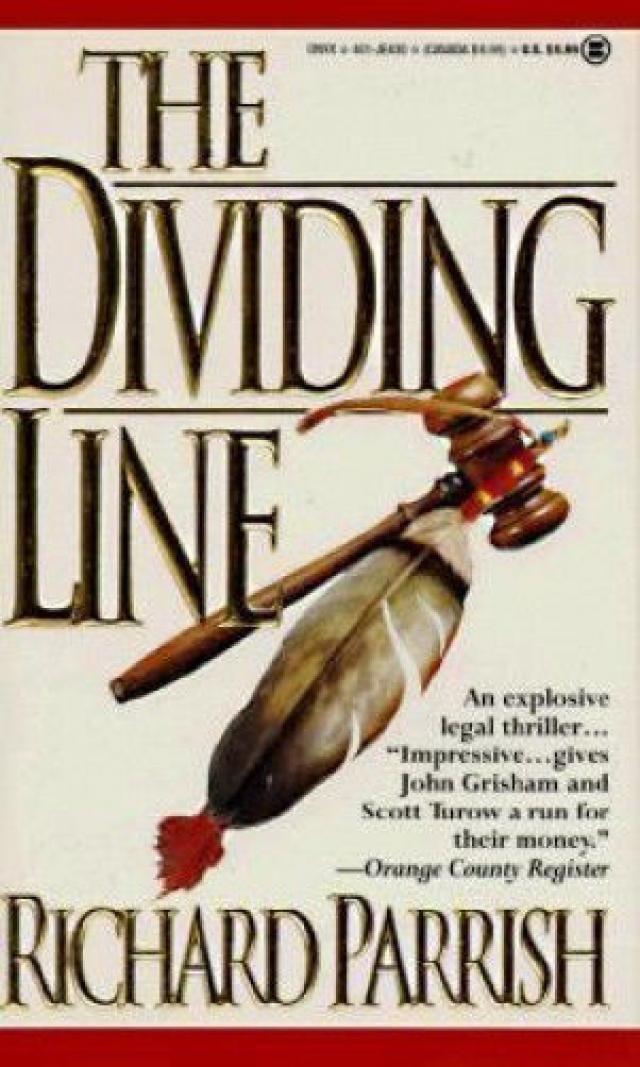
THE DIVIDING LINE
Richard Parrish
First published by
Onyx Printing
January 1994
The crimes are ugly—not your ordinary killings. First, three kids are found in an irrigation ditch, and within days, a dead nun is discovered. All were brutally raped and murdered. Brooklyn-born attorney Joshua Rabb, who became the lawyer for the Bureau of Indian Affairs in Tucson, Arizona, after barely surviving World War Il, is obsessed with learning the savage motives for such unspeakable violence. Although he’s teetering on an emotional precipice himself—his wife dead, two children to raise alone—these horrific events give him the shove and stamina he needs to defend an innocent and powerless Indian man arrested for the killings. To keep ahead of the prosecution, Joshua digs deep into layer upon layer of deceit and corruption, moving dangerously closer to shocking secrets—and a killer. But who in this vast reservation and its bordering locales would be capable of such murderous extremes? With his life on the line, as well as the lives of his children and the woman he has come to love, Joshua Rabb is about to learn the lethal answer…
“ABSORBING…A BRISK, TIGHTLY PLOTTED LEGAL THRILLER — COURTROOM DRAMA.”
—Publishers Weekly
“Compelling…richly atmospheric.”
—Booklist
“Vivid…expertly blends intrigue and courtroom drama…a hard-to-put-down novel.”
—Tulsa World
Dedicated to
Stewart (“Sandy”) Richardson
and
Joshua Ben Parrish
and, of course,
to Pat
Haud ignara mali, miseris succerere disco.
—Virgil
CHAPTER 1
They drove toward Tucson through tiny desolate towns which all looked the same, mere dots on the map, a couple of ramshackle slumpblock buildings, a faded yellow-wood railway office, two gas pumps in front of a tumbledown tin shed with a broken red Coke machine next to it. The droopy little towns had oddly bold names, like Beaumont and Corpus Christi and Lordsburg, and the most incongruous of all was a pustule of a place, debouched from a flat, vast, rocky moraine, with just a railroad crossing and a rickety clapboard shed, named Garden of Gethsemane. They drove quickly through the Garden, fearing that the car might break down and that they would have to spend even one extra minute here. They had the dismal feeling that they looked like Okies from The Grapes of Wrath, two water bags hanging from the steaming radiator cap of the wheezing mud-splattered De Soto, a spare tire roped to the top of the car.
As they neared Tucson, they waited anxiously for the harsh terrain to soften, to ameliorate, and they expected to see handsome cowboys in great felt hats with shiny silver concho belts and big blue steel Colt .44s strapped to their hips, and menacing Indians covered with red-and-black-and-white stripes of war paint, dressed in loincloths and carrying lances adorned with scalps and eagle feathers. They looked right and left for sprawling ranches with elegant black stallions and huge herds of brown-and-white-spotted cattle grazing on abundant pastures of emerald rye grass. That was the Wild West they had become familiar with from the movies. My Friend Flicka and Stagecoach and Arizona. But they didn’t see any of that as they drove into Tucson in June 1946. They only saw an occasional skinny jackrabbit in an endless expanse of heat-shimmering desert and prickly pear cactus and ocotillo and ragged mesquite trees and straggly clumps of famished sagebrush, all bent under a fierce, scalding, relentless sun.
Tucson was a hot, dry, dusty little nothing of a town. There were no cowboys, there were no Indians; there weren’t any cows or horses or stagecoaches. There were only burnt sienna dogs with lolling ocher tongues curled up beside parboiled pink people sitting on parched wood porches, hiding from the sun, swatting mosquitos and horseflies and drinking beer or Coke or lemonade and wiping their faces with soiled red handkerchiefs.
The Book of Genesis said that God had created the world and the sun and the moon and the stars, the heavens filled with birds, the seas teeming with fishes, and the dry land upon which flourished all of the fruit-bearing trees and over which crept the reptiles and the wild animals and the cattle of the fields. And the king of all creation was man, for to man God gave the privilege of subduing the earth and wielding dominion over the fish in the sea and the birds of heaven and every living thing that moved upon the land.
But in this country, mere man had dominion over nothing. The story told in Genesis seemed to belong to another place, a greener, cooler, sweeter, gentler place. Here it was the sun that was the subduer of the earth and all that was thereon. It bore down pitilessly, cracking the land, parching the trees and the shrubs and the cactus and the wildflowers, subduing with its ferocity the reptiles and wild animals and the cattle of the fields. And especially man. No man could stand unshielded in the relentless, dazzling, scorching furnace of the afternoon sun. The sun demanded that all living things wilt before its fierce countenance, for here it was God, tangible, fearsome, essential, not some ephemeral, elusive spirit like the disembodied God of the Bible. The sun god had to be cajoled so it would not remove its life-sustaining warmth from man, and placated so that it would not destroy him. For in this place the sun was king of all creation.
Their pants and the backs of their sweaty shirts stuck to the cracked leather seat of the De Soto when they parked and got out of the car in the center of Tucson. They knew it was the center because it was the only four blocks with buildings higher than one story. The tar from the asphalt streets boiled up in little black bubbles like sand crab holes on Brighton Beach. They ate chicken fried steak at Georgette’s Diner next to Johnny Gibson’s Barber Shop. Then they went for a tour of their new hometown. Ronstadt’s Hardware was across the street, with big posters on the windows advertising all the equipment you need for your vegetable harvesting and the latest in insecticide sprays to keep the weevils off your cotton. On one corner was Penney’s Catalogue Showroom, and on the other was a department store named Levy’s. In the windows were female mannequins in light cotton housedresses and male ones in beige-and-gray-twill work pants and shirts.
“Fancy place,” Joshua mumbled.
Hanna nodded grimly. Only Adam still appeared to cling to a shred of the enthusiasm with which they had left Brooklyn. He looked with hope at his father, waiting for a word of assurance.
Joshua was broad through the shoulders and tall, and his square jaw and deep-set eyes were just a little gaunt. His eyes were bright blue and gentle under heavy brows, and his forehead rose straight up to a widow’s peak. His short-cropped dark brown hair was limp and straight, moist from perspiration in the intense afternoon heat, and flecked with just a touch of gray over his ears and at his temples. He had the look of a scholarly, good-humored man, big and lean, who had become pale and solitary from years of being cooped up in a musty library. He was dressed in black wing-tips, black wool slacks, and a starched white long-sleeved dress shirt, limp and wrinkled and sweat-stained from hours on the highway in the boiling car. The cuff of his left sleeve was safety-pinned to the yoke of his shirt, since his left arm was gone from just below his shoulder. His skin was too light to protect him from the desert sun, and he looked like he had just become aware of it and was concerned because he knew that his children were also too pallid for this place.
Hanna was fourteen years old and looked like her mother. She was dressed in tan shorts and a white cotton halter top and brown suede sandals. She had mink brown curly hair and pellucid gray-hyacinth eyes and a porcelain delicacy that was one of her mother’s special gifts. But her face was troubled. Her life had changed abruptly, overnight, and she stared at the ugly mannequins wearing the cheap clothes in the shop window. Why couldn’t everything be like it once was?
Before Daddy had gone off to the war, he was a big, handsome man. Women had always glanced at him, even when they were with other men. But when they picked Daddy up at the veterans hospital last year, he was thinner than he’d been when he left three years before, and his rich chocolate brown hair was flecked with a little gray, and he sometimes used a cane and limped a little with his left foot. And he didn’t have a left arm. But it wasn’t just those things that made him seem so different. It was his eyes.
His crystal blue eyes that had always sparkled with humor and warmth were now just lusterless shards of colored glass, ink dense, melancholy. And the saucy youthful grin was gone. When he smiled at her and kissed her, she saw that his eyes didn’t brighten up and gladden his whole face like before the war. He just kept on looking sad. He looked her up and down and nodded approvingly and pursed his lips and said that she was growing up and would soon look just like Mommy. Then his eyes kind of misted up. Mommy had been dead for over a year, but the thought of it still made him blink back his tears.
Daddy rarely smiled anymore, and then only with his cheeks. He looked sad all the time. Hanna and Adam slept in twin beds in the spare bedroom, and Hanna could hear her father telling Grandma and Grandpa stories about a concentration camp. When they were whispering in the living room, and Hanna was supposed to be sleeping, she could sometimes hear Daddy talking about what he had seen, how many helpless people the Germans had shot and starved and gassed and burned up in ovens.
And Daddy coughed all of the time now, a hacking deep cough that sounded like a gunshot in a barrel and burned his throat. The doctors at the veterans hospital told him that he must go to a warm dry climate. Brooklyn weather was giving him a chronic bronchial irritation, and since he had an injured lung he had to be very carefu l. Arizona was a great place, the doctors said. The veterans hospitals in Phoenix and Tucson were where the army was sending vets with tuberculosis and asthma and other lung ailments, because the climate was genuinely therapeutic.
Hanna didn’t want to leave her friends and especially the sloe-eyed boy with strawberry blond hair who sat behind her in homeroom. They had gone under the boardwalk at Brighton Beach, and he had kissed her and brushed his trembling fingers over her swimsuit top, and she had never felt this way about a boy before. But she knew deep inside that Daddy needed to get away, or he would get sicker, much sicker. So she said, sure, why not? And tried to look like she meant it. But now she was sorry that she hadn’t stayed in Brooklyn with Grandma and Grandpa. Tucson sure wasn’t like in the movies. When would Daddy get cured and have enough of this crummy place so that they could go back home?
They got back in the car. The steering wheel was fitted with a special shifting device that made it possible to drive with only one hand. Adam sat in the backseat staring gloomily out the window at passing cholla cactus and creosote bushes and tumbleweeds. His mood had soured in the moments since the reality of Tucson had fully dawned on him. He was eleven years old and looked like his father’s son, with the same shaped face and eyes and straight brown hair and already broadening shoulders and long legs. He wore a T-shirt and baggy blue cotton trousers with an elastic waist. He had on a pair of black Keds sneakers, the laces untied and loose.
Joshua studied the directions that he had received in a letter and drove south out of downtown Tucson on Sixth Avenue past the Veterans Administration Hospital, three miles to Valencia Road, then west just over two miles to Indian Agency Road. The asthmatic De Soto stirred up puffs of hot dust like smoke signals from the dirt roads. The Bureau of Indian Affairs was in a hundred-year-old sprawling adobe building with a flat roof and tiny windows. There were four much smaller adobe houses strung southward down the road like a sulky quartet of dingy offspring.
Edgar Hendly, the head of the Bureau of Indian Affairs, was a rotund little man with a dyspeptic frown permanently etched onto his bulbous, florid face. Despite the heat he wore a rumpled gray wool suit and once-white dress shirt and stained black silk tie. There were wide sweat patches under his arms. He had an oddly effeminate mannerism of continually smoothing his few wisps of gray hair over his sweat-glistening bald pate, like a vain actress nervously petting her coiffure with fluttering fingers.
Joshua stood with him in front of the bureau, and the short, heavy man looked him up and down. “I didn’t know about all this,” Hendly said wanly, pointing at Joshua’s arm and the cane he held in his right hand. “You able to work?”
“I’m able.”
“This is pretty rough country out here,” Hendly said, his voice trailing off. “You shoulda told me.” He looked away and shook his head with a mixture of anger and embarrassment.
“I’m able.” Joshua’s voice was strong, insistent.
“What happened to ya anyway? Ya got pretty bad bunged up.”
“What the hell’s the difference?” Joshua jutted his chin out. “I can do the work.”
Mr. Hendly studied his defiant, angry eyes and shrugged. “What the hell,” he mumbled. He rode with the Rabbs down to their new home, the last of the four adobe houses. Hanna and Adam looked around inside in shocked silence. It was tiny, a kitchen and living room and three miniscule bedrooms. On the side of the house, fifty or sixty chickens cackled gratingly inside a bedraggled wire coop.
“White Rocks,” Mr. Hendly said, pointing with evident pride at the chickens. He seemed oblivious to the nauseating stench which hung thickly in the air.
Hanna was almost catatonic. She had gone, in less than two weeks, from an eleven-story apartment building on bustling Brighton Beach Avenue, with all the store signs in Yiddish and a soda shop with chocolate phosphates and a beautiful beach out the back door and Coney Island about a mile down the boardwalk, to this, the most dreary horrible little mud shack she had ever imagined. In fact, she had never imagined that people lived in places like this. She held protectively onto Adam’s hand, and they stood in the front yard next to their father while Mr. Hendly babbled on in that funny Western accent.
They walked across the rutted dirt road in front of the house to an irrigation ditch about fifteen feet wide and ten feet deep. The water was less than a foot deep in the bottom, a muddy ten-foot-wide rivulet, and the overweight sun and stinging hot wind bludgeoned the tiny wavelets into a million silvery dagger points. Evaporating water shimmered up in a nacreous mist that pinkened everything up to about five feet over the ditch and then dissipated into the dazzlingly clear, burning air.
“This is the northern boundary a the San Xavier Del Bac Papago Indin Reservation,” Mr. Hendly said. He paused a moment and his voice became grave. “There was a body floatin in that there ditch just two days ago. A thirteen-year-old Papago girl. Ya might hear some folks say that she didn’t drown, that she was murdered, strangled prob’ly. But don’t ya pay no heed to such fool talk. Nobody’s ever gonna be able to prove it no how. And how could ya ever find the killer on the reservation, ten thousand Indins that won’t hardly even talk to a white man, let alone turn in one a their own. Anyway, as long as them greasers just kill each other, they ain’t no danger to us.”
He looked at the Rabbs and smiled, revealing tobacco-stained teeth. But it was a troubled smile, as though he were trying to convince himself that what he said was true. Hanna’s eyes widened in fright. She looked from her father’s drawn face to the nervous, forced smile that the BIA superintendent gave her, and she could hardly keep from bursting into tears. Mr. Hendly took a pack of Camels out of his shirt pocket. He gestured toward Joshua, and Joshua shook his head. Hendly lit a cigarette and inhaled deeply.
He looked gravely at Hanna and Adam. “Don’t you kids be a goin onto the reservation, you hear me now? That’s the Indin Nation, and white folks ain’t welcome over there.” He etched a boundary line in the dust with the toe of a scuffed brown wing-tip. “Most a them people got nothin to do but drink all day and get mean. They’re poor as all hell—oops, sorry for my sharp tongue, little lady, but mind good what I tell ya.”
Hanna was only half hearing Mr. Hendly’s words now. She felt dazed, lost. And he talked with such a funny thick Western accent, like Gabby Hayes. Except what he was saying wasn’t so funny, not so funny at all. She was scared of this place.
Mr. Hendly pointed across the half-mile-long barren field on the other side of the irrigation ditch. “That there church yonder is the mission a Saint Francis Xavier. It was built in seventeen ninety-six by Jesuits from Spain. The monks gradually converted all a the Papago Indins to Catholicism, but ya cain’t never cleanse all the paganism outta them greasers.
“The dry bed a the Santa Cruz River runs about a quarter mile east a the mission yonder.” Mr. Hendly pointed. “There used to be a whole lot a water in it, but now farmers up north a us here draw most of it off to irrigate their fields. That sprawl of a dozen or so ocotillo and brush houses with mud and grass roofs is the center of the village of Bac, meanin ‘by the waters.’ The Papagos call it Wahk, This branch a the Pima Indians has been here by the Santa Cruz River for centuries, livin on prickly pears and saguaro fruit and a few skinny cows and farmin beans. Which is why they’re called Papagos, ‘bean people.’ Them people are all fat ‘cause they live on tortillas and beans fried in pig lard, and they stink like the devil ‘cause they only got one set a clothes and never heard a takin a bath. The smart ones go through sixth grade at the mission school yonder”—he pointed again and took a long drag on his cigarette”—and then they stop their schoolin. Don’t need much book learnin to pick cotton and dig ditches and drink mescal till their eyeballs are floatin. They don’t want nothing to do with us neither. And you sure don’t wanna end up a floatin in that there water. So just mind you stay on this side a the irrigation ditch and leave them people alone.”
He frowned and shook his head. Then he ground the cigarette butt into the dirt with his shoe.


