Galatea 2 2, p.1
Galatea 2.2, page 1


Richard Powers
* * *
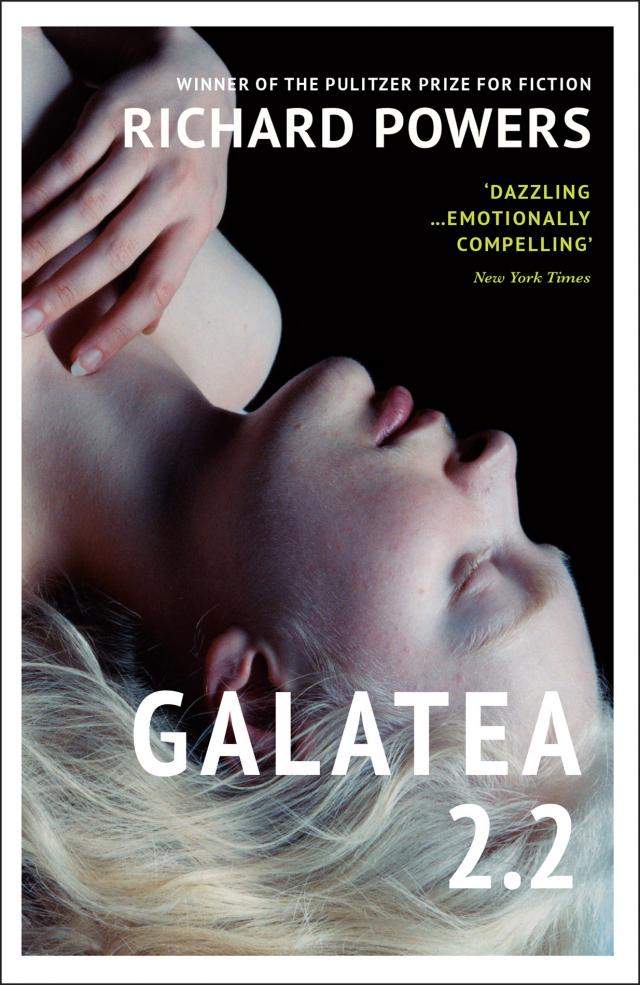
GALATEA 2.2
Contents
Galatea 2.2
About the Author
Richard Powers is the author of twelve novels, including The Overstory (winner of the Pulitzer Prize for Fiction and shortlisted for the Man Booker Prize), Orfeo (longlisted for the Man Booker Prize), The Echo Maker and The Time of Our Singing. He is the recipient of a MacArthur grant and the National Book Award, and has been a four-time NBCC finalist. He lives in the foothills of the Great Smoky Mountains.
ALSO BY RICHARD POWERS
Three Farmers on Their Way to a Dance
Prisoner’s Dilemma
The Gold Bug Variations
Operation Wandering Soul
Gain
Plowing the Dark
The Echo Maker
The Time of Our Singing
Generosity: An Enhancement
Orfeo
The Overstory
The brain is wider than the sky,
For, put them side by side,
The one the other will contain
With ease, and you beside.
The brain is deeper than the sea,
For, hold them, blue to blue,
The one the other will absorb,
As sponges, buckets do.
The brain is just the weight of God,
For, heft them, pound for pound,
And they will differ, if they do,
As syllable from sound.
—EMILY DICKINSON
IT WAS LIKE so, but wasn’t.
I lost my thirty-fifth year. We got separated in the confusion of a foreign city where the language was strange and the authorities hostile. It was my own fault. I’d told it, “Wait here. I’m just going to change some money. Check on our papers. Don’t move from this spot, no matter what.” And chaos chose that moment to hit home.
My other years persist, like those strangers I still embrace in sleep, intimate in five minutes. Some years slip their chrysalis, leaving only a casing to hold their place in my sequence. Each year is a difficult love with whom I’ve played house, declaring, at each clock tick, what it will and won’t put up with.
My thirty-fifth trusted no one. As soon as I said I’d only be a moment, it knew what would happen to us.
Thirty-five shamed me into seeing that I’d gotten everything until then hopelessly wrong. That I could not read even my own years.
At thirty-five, I slipped back into the States. I did not choose either move or destination. I was in no condition to choose anything. For lack of a plan, I took an offer in my old college haunt of U. The job was a plum, my premature reward for a portfolio that now seemed the work of someone else.
I thought the year a paid leave of absence. A visiting position, where I might start again with the recommended nothing. House, meals, office, expenses, and no responsibilities except to live. I clung to the offer without too much reflection.
In fact, I had nowhere else to go. I couldn’t even improvise a fallback.
It had to be U. U. was the only town I could still bear, the one spot in the atlas I’d already absorbed head-on. I’d long ago developed all the needed antibodies. When you take too many of your critical hits in one place, that place can no longer hurt you.
Nothing else remotely resembled home. Time had turned my birthplace into an exotic theme park. I could not have gotten a visa to live where I’d grown up. And I’d just spent the last seven years in a country that seemed exile already, even while I’d lived there.
But U. I could slink back to, and it would always take me. We were like an old married pair, at exhausted peace with each other. I did school’s home stretch here, learned to decline and differentiate, program and compose. U. was where I took Professor Taylor’s life-changing freshman seminar. Twelve years later, a stranger to the town, I passed through to watch Taylor die with horrific dignity.
U. was the place where I first saw how paint might encode politics, first heard how a sonata layered itself like a living hierarchy, first felt sentences cadence into engagement. I first put myself up inside the damp chamois of another person’s body in U. First love smelted, sublimated, and vaporized here in four slight years.
I betrayed my beloved physics in this town, shacked up with literature. My little brother called me here to tell me Dad was dead. I tied my life to C.’s in U. We took off from U. together, blew the peanut stand to go browse the world and be each other’s whole adulthood, an adventure that ended at thirty-five. The odds were against this backwater having anything left to throw at me.
Since my last trip back, I’d achieved minor celebrity status. Local Boy Makes Good. I’d never get my name on the city-limits sign. That honor was reserved for the native Olympic legend. But I now had the credentials to win a year’s appointment to the enormous new Center for the Study of Advanced Sciences. My official title was Visitor. Unofficially, I was the token humanist.
My third novel earned me the post. The book was a long, vicarious recreation of the scientific career I never had. The Center saw me as a liaison with the outside community. It had resources to spare, the office cost them little, and I was good PR. And who knew? A professional eavesdropper with a track record might find no end of things to write about in an operation that size.
I had no desire to write about science. My third novel exhausted me for the topic. I was just then finishing a fourth book, a reaction against cool reason. This new book was fast becoming a bleak, baroque fairy tale about wandering and disappearing children.
Even I could not fail to see the irony. Here I was, crawling back to the setting I had fictionalized in my sprawling science travelogue. The University put me up in a house, the seventies equivalent of the barracks where the hero of my book had lived on his arrival in town. Beyond a lone bed and desk, I left my rooms unfurnished, in my character’s honor.
I bought a second-hand bike, perfect for the stretch from my house to the Center. The research complex had sprung up since my last visit. A block-long building in a town the size of U. cannot help but make a statement. The Center’s architecture laid irony upon irony. It was a postmodern rehash of Flemish Renaissance. In the Low Countries, I’d lived in post-war poured concrete.
The Center had been built by an ancient donor couple, two people archaic enough to get through life still married to each other. They reached the end of that shared existence with nothing better to do with the odd fifty million than to advance advanced science. I don’t know if they had children, or what the kids were slated to get when the folks passed away.
U. got a warren of offices, computer facilities, conference areas, wet and dry labs, and an auditorium and cafeteria, all under that jumble of Flemish gables. The small city housed several hundred scientists from assorted disciplines. Thankless Ph.D. candidates did the bulk of the experimental drudge work, supervised to various degrees by senior researchers from all over the world.
Work at the Center divided into areas so esoteric I could not tell their nature from their names. Half the fields were hyphenated. Creative play spilled over borders, cross-pollinating like hybrid corn in heat. Talk in its public spaces sounded like a UN picnic: excited, wild, and mutually unintelligible. I loved how you could never be sure what a person did, even after they explained it to you.
Most attention converged on complex systems. At the vertex of several intersecting rays—artificial intelligence, cognitive science, visualization and signal processing, neurochemistry—sat the culminating prize of consciousness’s long adventure: an owner’s manual for the brain. With its countless discrete and massively parallel subsystems, the Center seemed to me a block-wide analog of that neuronal mass it investigated.
The Center and two dozen similar places here and abroad would decide whether the species would earn its last-minute reprieve or blow the trust fund the way it intended. The footrace would photofinish here, as life came down to the wire. Biochips, seeded to grow across the complexity threshold. Transparent man-machine interfaces. Control of protein folding. High-def, digital contrition.
The building teemed with job descriptions: theorists, experimentalists, technicians, magicians. Someone here had a probe attached to every conceivable flicker. One wing swarmed with scientists who proclaimed their transcendence over engineering. Another housed engineers who didn’t even acknowledge the distinction. What one floor banished bred like mold in a nearby quarter.
The Center was big. So big I lost my office twice in the first month, the way you lose a rental in an airport parking garage. Sheer size was the Center’s chief virtue. Even the embarrassment of talking to the same colleague twice faded in a place so huge. In such an expanse, I hoped, one year would be too brief for me to be of any but passing interest to anyone.
What’s more, the complex opened onto virtual space, through a spreading network backbone. I had an office with my name on the door, and a computer cabled into the world web. No one suspected that I had no research group, that I could not tell a field-responsive polymer from a spin glass. I came and went in awful freedom, a complete impostor.
I found the dress-up weirdly pleasant, knowing I could go home nightly to a house both empty and rented. For a long time, I must have been aspiring to just this. Immaculate and cold-booted, a resident alien. Just passing through the old alma mater.
The Center had much to recommend it. Its doors knew me from a distance. They clicked open at the command of an infrared pass card that I didn’t even need to take out of my wallet. I flipped backside to sensors, mandrill style. Anyo
The parabolic front foyer concentrated sound. I liked to stand at the focus and hear the rush of my own breath, the throb of blood coursing through my veins. I listened to my body’s roar, sounding for all the world like a message left on an answering machine by someone who died later that day.
I tinkered at my new novel, ticking at the machine keys with my door closed and the fluorescent lights doused. My office reveled in state-of-the-art, clean-room efficiency. The perfect place to tuck my millennial bedtime story in for the night. I‘d click a radio button on my screen and eighteen months of work waited for me by the time I hiked upstairs to the network laser.
I browsed the world web. I fished it from my node on a building host that served up more megabits a second than I could request. By keying in short electronic addresses, I connected to machines all over the face of the earth. The web: yet another total disorientation that became status quo without anyone realizing it.
The snap of a finger, a satellite uplink, and I sat conversing with a mainframe in my old coal-mining ex-hometown seven time zones away. I could read the evensong schedule from off a digital valet in Cambridge, download Maurya painting, or make a Cook’s tour of New Zealand. In seconds, I could scroll through dinner menus in languages I could not even identify. From my chair in the virgin Center, I revisited every city I’d ever spent time in and hundreds I would never get around to visiting in this life.
The town had been knitted into a loose-weave, global network in my absence. The web seemed to be self-assembling. Endless local investigations linked up with each other like germs of ice crystal merging to fill a glass pane.
The web overwhelmed me. I found it easier to believe that the box in Pakistan I chatted with was being dummied up in the other end of the building. I didn’t know how my round-the-world jaunts were being billed, or if they were billed at all.
For a while, I felt a low-grade thrill at being alive in the moment when this unprecedented thing congealed. But after weeks of jet-setting around the hypermap, I began to see the web as just the latest term in an ancient polynomial expansion. Each nick on the time line spit out some fitful precursor. Everyone who ever lived had lived at a moment of equal astonishment.
The web had been a long while in linking up. It, too, was just a stopgap stage in a master plan drawn up on the back of the brain’s envelope. A bit of improvised whittling, forever a step shy. A provisional pontoon in that rough pencil sketch for final triumph over space and time.
I explored the world’s first network in embryo. After days of disappearing children, I spent my nights playing in the greatest virtual sandbox yet built. I’d stumbled upon a stack of free travel vouchers. I put up in U., but I resided elsewhere. I thought: a person might be able to make a life in all that etherspace.
Each day produced new improbabilities. I searched card catalogs in Kyoto or book reports from Bombay. German soccer scores and Alaskan aurora sightings filled my office e-mail pouch.
I eavesdropped on international discussion groups, ongoing, interactive Scheherazades that covered every imaginable theme from arms control to electronic erotica. Notefile threads split and proliferated in meiosis. Debates flowed without beginning or end, through tributaries and meanderings, responses to responses to responses. Inexhaustible protagonists from every time zone posted to the continuous forum a dozen or more times a day.
Alone in my office, blanketed by the hum of the Center, I felt like a boy happening onto a copy of the Odyssey in a backwater valley library. I wanted to rush out into the hall and announce my each discovery. But who could I tell? Those lonely souls who stood most to gain would only shake their heads, dazed, locked out on every level. Those who had the wherewithal to see what the fuss was about had already habituated to the inconceivable.
Advanced science, of course, profited enormously from the web. The groups at the Center could now read journal articles months before they hit print. The data Autobahns had no speed limit. They plunked one in front of any results on earth before you could read the “Connect.” Researchers peered into colleagues’ labs on other continents, in real time. They shared data in 3D, as they gathered it.
On all sides of my cubicle, experimenters scoured the nodes. The net reduced duplication of effort and helped pinpoint crucial results they otherwise might have missed altogether. Instant telemessaging produced an efficiency that fed back into steeper invention. And invention accelerated the universal link-up.
But the longer I lurked, the sadder the holiday became. People who used the web turned strange. In public panels, they disguised their sexes, their ages, their names. They logged on to the electronic fray, adopting every violent persona but their own. They whizzed binary files at each other from across the planet, the same planet where impoverished villages looked upon a ballpoint pen with wonder. The web began to seem a vast, silent stock exchange trading in ever more anonymous and hostile pen pals.
The web was a neighborhood more efficiently lonely than the one it replaced. Its solitude was bigger and faster. When relentless intelligence finally completed its program, when the terminal drop box brought the last barefoot, abused child online and everyone could at last say anything instantly to everyone else in existence, it seemed to me we’d still have nothing to say to each other and many more ways not to say it.
Yet I could not log off. My network sessions, all that fall, grew longer and more frequent. I began to think of myself in the virtual third person, as that disembodied world-web address: rsp@center.visitor.edu.
How long could I show up at the Center and produce nothing of use to anyone? The productivity problem. The pure-research problem. The inspiration, the blind-trust problem. I could drift without limit and still not be reprimanded. I had the year gratis. I might do nothing but prime the pump, rest and recharge, and still I would not ruffle so much as a mite’s mood where it camped out on the eyelash of the emergent digital oversoul.
I MEANT TO milk the new book for as many weeks of touch-up as I could get away with. Past that point I tried not to speculate. Three times before, the end of a long project had kicked off the start of another. I’d mastered the art of surviving narrative whiplash. No reason, in theory, why I couldn’t regroup again. Go on and work forever.
But this time felt different. This time, after I paid my Pied Piper account, nothing waited for me on the far side of story’s gaping mountain. Nothing but irremediable Things As They Are.
What little diversionary work remained I dragged out for all it was worth. Two Kbytes of new text or four of reasonable revision honorably discharged me of the day. Beyond that, I could indulge my remaining hours in good faith. A page and a half freed me to go and do as I liked.
Mostly, I liked to haunt the Center after hours. At night, the building thinned almost to empty. The community of night research emitted a sober thrill. The handful of sallow, animated faces at that hour could not help but be there. Their inquiries had them hooked, as levered to the intermittent payoffs as their lab animals. They piloted the halls, feverish, close to breakthrough, indifferent to clock time. They weaved from lab to lab in directed distraction, eyes combing every visual field but the corridors down which they moved.
Except for these addicts of the verifiable, I had the place to myself. That alone was worth coming in for: fifty million dollars of real estate filled with several hundred million in instruments, boxes that glowed with subdued purpose, abandoned like an electronic Rapture. No one could have a more profound sense of history than a night custodian of such a building.
Night brought open-endedness to the place. Through the machine on my desk, I could disappear down the coaxial rabbit hole to any port of call. I had a phone I could dial out on but which never rang. I had a white board and bright pastel markers that wiped off without a trace. I amused myself by writing out, in different colors, as many first lines of books as I could remember. Now and then I cheated, verifying them on the web.
These nights were dead with exhilaration. Like battening down in the face of a major maritime storm. All I could do was stock the mental candles and wait.