

Voice of the victim, p.1
Voice of the Victim, page 1


Praise for Rick Ludwig
"Rick Ludwig has done it again! With Voice of the Victim, Ludwig expands his universe of clever detectives and intriguing mysteries with a hard-hitting examination of the past and how it shapes us into who we become. A beautiful, fast-paced novel you should pick up today!”
RJ Johnson, author of The Twelve Stones
"Ludwig brings this crime-fiction reader full circle from the Hawaiian Islands to the Italian Coast and back again. He has not only created believable characters and complicated crimes, but also he’s introduced me to a detective I hope resurfaces in the future. "
Elaine Gallant, author of The 5th C
“An auto accident destroys Detective Sergeant Keone Boyd’s roadster, plunging him into and unexpected realm as he grapples with a suspect’s alternate reality and unexpected plot twists. this is not your typical investigation. Eyes of the Beholder is a gripping read that leaves you wondering what comes next.”
Kenneth Andrus, author of Arctic Menace (for Eyes of the Beholder
"If you're yearning for a page-turning tale of suspense and skulduggery, look no further. If you're hoping for some crackling dialogue and vivid descriptions, you'll find them here. And if you’re yearning to go that land of myth and mystery in the middle of the Pacific, let Rick Ludwig take you. Along with the beauty, he'll show you the dark side of paradise. Don't miss it.”
William Martin, New York Times-bestselling author of The Lincoln Letter (for Pele’s Fire)
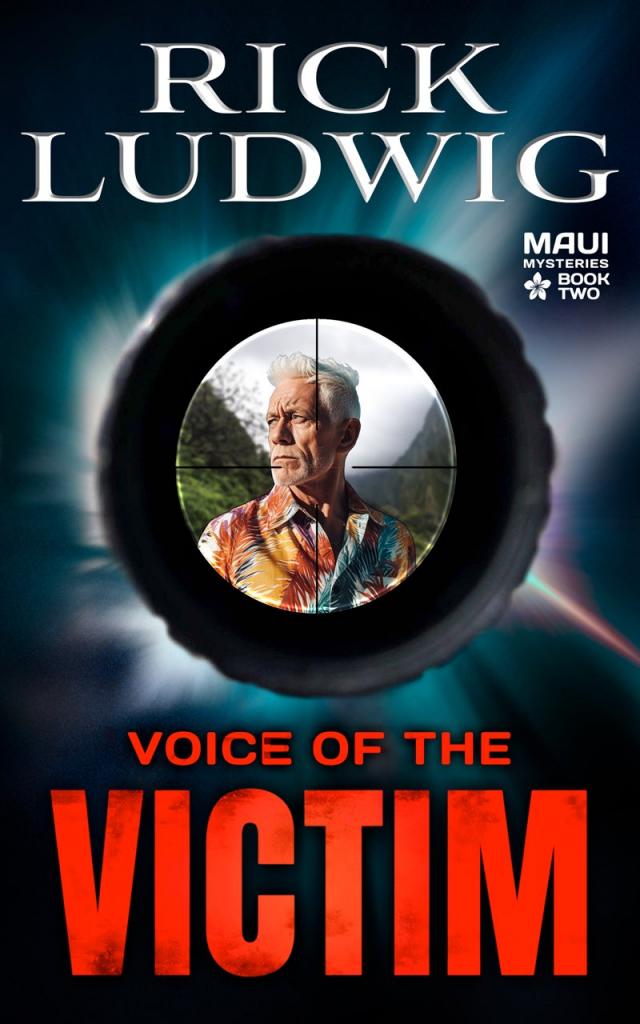
Voice of the Victim
Maui Mysteries
Book 2
Rick Ludwig
Copyright © 2023 by Rick Ludwig
All rights reserved.
No part of this book may be reproduced in any form or by any electronic or mechanical means, including information storage and retrieval systems, without written permission from the author, except for the use of brief quotations in a book review.
For Jennifer
Contents
A Note on the Spelling of Hawaiian Words
Prologue
I. A Whole New World
Chapter 1
Chapter 2
Chapter 3
Chapter 4
Chapter 5
Chapter 6
Chapter 7
Chapter 8
Chapter 9
Chapter 10
Chapter 11
Chapter 12
Chapter 13
Chapter 14
Chapter 15
Chapter 16
Chapter 17
II. The World of Yesterday
Chapter 18
Chapter 19
Chapter 20
Chapter 21
Chapter 22
Chapter 23
Chapter 24
Chapter 25
Chapter 26
Chapter 27
Chapter 28
Chapter 29
Chapter 30
Chapter 31
Chapter 32
Chapter 33
Chapter 34
Chapter 35
Chapter 36
Chapter 37
Chapter 38
Chapter 39
Chapter 40
III. The World of Yesterday—Out of Order
Chapter 41
Chapter 42
Chapter 43
Chapter 44
Chapter 45
Chapter 46
Chapter 47
Chapter 48
Chapter 49
Chapter 50
Chapter 51
Chapter 52
Chapter 53
Chapter 54
Chapter 55
Chapter 56
IV. The Worlds of Fantasy and Tomorrow
Chapter 57
Chapter 58
Chapter 59
Chapter 60
Chapter 61
Chapter 62
Chapter 63
Chapter 64
Chapter 65
Chapter 66
Chapter 67
Epilogue
Acknowledgments
About the Author
A Note on the Spelling of Hawaiian Words
After moving to Maui, I learned a great deal about the history and culture of the Hawaiian Islands. I respect this ancient and vibrant culture and have tried to reflect this in everything I’ve written in this beautiful place. But I am neither a native Hawaiian nor a speaker of the language. Though I have learned a few phrases that I am not too embarrassed to speak aloud, I faced a challenge in spelling Hawaiian words.
Two characters are used in proper Hawaiian spelling that may be unfamiliar to those new to the language. These are the ʻokina and kahakō.
The ʻokina can be approximated by an apostrophe but is an actual consonant and represents a glottal stop. It may occur at the beginning or in the middle of a word and changes the pronunciation and meaning of words. An example familiar to many non-Hawaiians is the name of the island Lānaʻi (Lah-nah-ee), which is very different from the word for a veranda or covered patio, lanai (Lah-nigh). Throughout the novel I have used a reversed apostrophe to represent this important consonant.
The kahakō indicates vowel length, which changes meaning and the placement of stress. In other languages it is referred to as a macron and represented by a line over a vowel. An example of how these can impact meaning in a Hawaiian word is the word kāne (kaa-nay) which means male, while the same word without the kahakō, kane (ka-nay), means skin disease.
In this trilogy, I have elected to use both the ʻokina and kahakō. I apologize to Native Hawaiian readers for my other limitations.
I have also attempted to use the standard method for distinguishing non-English words, using italics for the first occurrence of such words, except for place names.
Another characteristic of the islands is the common use of pidgin in friendly banter. I have learned that there are subtle differences between the pidgin used on each of the Hawaiian Islands. What I have tried to capture, on occasion in this novel, is probably closest to the pidgin I heard on Maui. I have tried, phonetically, to capture the essence of this joyful and constantly evolving language as I heard it spoken. Born from the desire of each wave of immigrants to this lovely place to communicate with each other, despite vastly different native tongues, Hawaiian pidgin is an essential component of daily life here in paradise. One very common aspect is a tendency to end most sentences with, yeah? It’s kind of like ending a sentence on the mainland with, right?
Prologue
How’d I ever get so lucky?
The shooter slogged through the `Īao stream to a spot where he could climb out onto rocks instead of mud. He scaled the hillside to a lone palm tree that provided an excellent vantage point, quietly climbed to the crown of fronds, and created a sniper’s nest. Despite concern that the target might decide to move, he carefully prepared the site, assembled his weapon, and assumed a supported and balanced position.
The valley was so lovely and quiet at sunset. The rifle’s noise suppressor would prevent anyone left in the park from hearing the shot. He could see the target with his naked eyes. The man with short grey hair in a flowered aloha shirt stood calmly on a raised area on the far side of the stream. Gazing through the scope, he lined up a kill shot. The target turned away from the stream to gaze at the stunning green expanse of the `Īao Needle. This change in position determined a new location for the bullet, the base of the man’s skull.
Though exhausted from the frantic scramble up the stream, the hillside, and the tree, the shooter concentrated on drawing a slow, deep firing breath. The squeeze on the trigger was also slow and gentle. The only sound, a pfutt, thanks to the noise suppressor. Handling the recoil, he looked back through the scope to see the figure fall to the ground. Mission accomplished.
BLAM . . . Blam . . . blam.
The sound of the single shot reverberated off the valley walls.
What the hell?
The shooter hadn’t made that noise. Who had?
Swinging his head in a slow arc, he saw the bushes move on his side of the stream. A small form fell out, juggling a smoking rifle a lot like his.
What’s he doing here?
Part One
A Whole New World
“There are worlds beyond worlds and times beyond times, all of them true, all of them real, and all of them (as children know) penetrating each other.”
P.L. Travers
Chapter One
Sunday, July 7, 2013, 6:50 p.m. HST
Detective Lieutenant Tony Alcala slumped in his chair. He was down two detectives and crime on Maui showed no sign of taking a holiday. That damn Loftus case. He never wanted to hear about it again.
A knock on the door snapped him out of his reverie. He sat up straight and wiped the worry from his face before he growled, “Come on in.”
Detective Sergeant Keone Boyd, all six foot seven, two hundred seventy-five pounds of him, took a hesitant step into the office. “Hi, boss.”
“You’re on vacation.” Tony shot back, then smiled. “But since I’m unlucky enough to be your friend, come on in. Where’s Julie?”
“Unloading my cruiser.”
Tony could tell something was troubling his friend. Never one to beat around the bush, he said, “What’s your problem? Why does a man about to leave on a multi-week cruise of the Mediterranean look like he just swallowed bile?”
Keone hesitated.
“Spill, Big Guy. What’s eatin’ you?”
“I visited Sam Loftus in the Molokini wa
Oh shit.
“Dr. Drayton was there, observing his catatonic patient. Even that scientist, Dr. Hasselbach, stopped by.”
“Sam’s lost it, eh?”
“I saw a shell of the man I knew but with a faint smile on his face. I found myself hoping he made it back to his imaginary universe, if only in his mind.”
“Hold onto that thought and let the rest go.” Tony grew increasingly uncomfortable with this topic.
“I think Hasselbach may have acquired a touch of crazy, too. You don’t think dementia could be contagious, do you?”
“Hell, no. Hasselbach’s a friggin’ astrophysicist. Those bastards are born on the edge. Look what happened to his assistant. He’s in the same nut shop as Sam.”
“Actually, no. They released Dr. Carvell three days ago. Hasselbach says Brad’s given up studying the multiverse. Gonna teach at UH Maui College next term.”
“Good. That multiverse crap can warp your mind” Tony paused, hoping Keone would change the subject.
Keone took the hint. “Anyway, how are you doing, boss?”
“Shitty. I’m understaffed, up to my ass in alligators, and now I’ve gotta waste my time taking a rogue detective and his wife to the airport.”
“I appreciate what you did for me. And I’m truly sorry to leave you short-staffed.” Keone paused. “But I’ve got a suggestion.”
“Oh boy. Here it comes.” Tony leaned back in his chair.
“What?” Keone looked like a giant kid caught with his hand in a cookie jar.
“I don’t know yet. But I’m not gonna like it.”
“Julie’s adamant that I completely forget about this place while we’re gone, so I have to talk fast, before she comes in.”
“You used up most of my goodwill during the Loftus case.”
“I know, but this isn’t about me. It’s about Sergeant Beyers.”
“Beyers? She’s the only one to come out of the Loftus case looking good. She was decorated for her work—unlike you. Why would she need my help?”
“She’d kill me if she found out I told you.”
“Told me what?” For a man of few words, Keone was sure taking a long time to say something.
“She deserves a break. She’s always wanted to be a detective. And I think she’d make a damn good one. But you don’t need to take my word for it. Why don’t you assign her to CID, while I’m gone?”
Tony was skeptical, and it must have showed.
“It could be temporary. Like you said, with me away and Kulima gone for good, you’re understaffed.”
“What’s her background?”
“Local girl. Got her bachelor’s degree in Criminal Law and Society from UC Irvine before joining the Maui PD. Currently halfway through her masters in CL&S online. And she’s passed the detective exam.”
“Who suggested that route to her?” Tony had a pretty good idea of the answer.
“I didn’t even meet her until she was in her senior year. Gave a talk and did some recruiting at UCI for the LAPD. Since we were both from Maui, she felt comfortable talking story with me. Later we worked together when I transferred to MPD.”
“Look, Keone. She has a fulltime job in Hana. I doubt her CO would let her take a temporary assignment over here without a good reason. Besides, the few weeks you’re gone is hardly enough time for me to evaluate her.”
“True. But I wanted to put a bug in your ear before I left. We really could use Ange here, Tony.”
“I’ll look at her record and if the opportunity ever arises to bring her over for an evaluation, I’ll consider it.” Tony stood, ending the conversation. “Let’s get you and your bride to the airport.” A smile creased his face as he glanced passed Keone’s head to Julie, who promptly bopped her new husband on the top of that head.
“No more talking, or even thinking, about work, Mister Boyd. You’re a married man, now. You must focus entirely on your loving bride.”
“I know. Julie. But—”
“No buts. We’re officially on our honeymoon. Lieutenant Alcala and the MPD will have to manage on their own for a few weeks.” She glanced at Tony. “It’ll help them realize how much they need their best detective.”
Neither Keone nor Alcala risked a word.
“Look,” she said. “I’ve been more than accommodating. I agreed to let you drop off your department car on the way to the airport. I agreed to let this overgrown cub scout take us to our flight. But I won’t allow police static to interfere with the most important time of our new life together.”
Tony spent the entire drive to the airport telling the lovebirds about his own romantic Greek Island tour ten years before. Before his marriage went to hell.
At the airport Keone unfolded his bulk from the back seat while Tony jumped out and transferred their luggage to a cart. “Aloha, you two. Enjoy yourselves.”
“We plan to,” Julie said, before planting a kiss on Tony’s cheek. “Thanks for never doubting Keone, or me.”
Keone ambled over, brushed past Tony’s outstretched hand, and encircled him in a bear hug.
“Ouch. That hurts. Just get outta here. And have one great time, Big Guy.”
As he watched them walk arm in arm to the Agriculture Inspection station, Tony thought, Beyers, eh? Wouldn’t hurt to glance at her file.
His radio beeped and announced, “Shooting in ʻĪao Valley State Park. One man down. See ranger in parking lot.”
There’s never been a shooting in the park.
“Unit one-kilo-two responding to shooting in ʻĪao Valley.”
Alcala hit lights and siren and sped away from the airport, grilling the dispatcher for more information.
Chapter Two
Angela Beyers looked forward to spending the next week at home. She spent most of each week in Hana and saw too little of their cozy home in the hills above Lāhainā on weekends. But this week she had training at the local division, so she could commute from home.
Her roommate and best friend, Linda Carroll, was a part-time real estate agent, part-time insurance agent, and full-time graphic artist. Neither could have dreamed of buying such a place on their own salaries. But their combined income, coupled with a foreclosure, an auction, and a terrible storm that kept other bidders away, made it happen. Technically they weren’t equal partners since Linda put up the full down payment, but they shared the monthly payments and other expenses equally. Despite Linda’s protests, Angela was nibbling away at her part of the down payment a little each month.
“Why are you doing this?” Linda griped as Angela handed her this month’s check. “This place appreciates in value every day. We can settle up after we sell—if we ever do.”
“Older places here can also de-preciate. I won’t let you carry all the risk.”
“Damn it, Ange. You look at everything so much like . . .”
“Like a crime I’m investigating? I guess I do. I always consider the possible ways something can go south on me.”


