Judgment day, p.1
Judgment Day, page 1
part #2 of Holy War Series
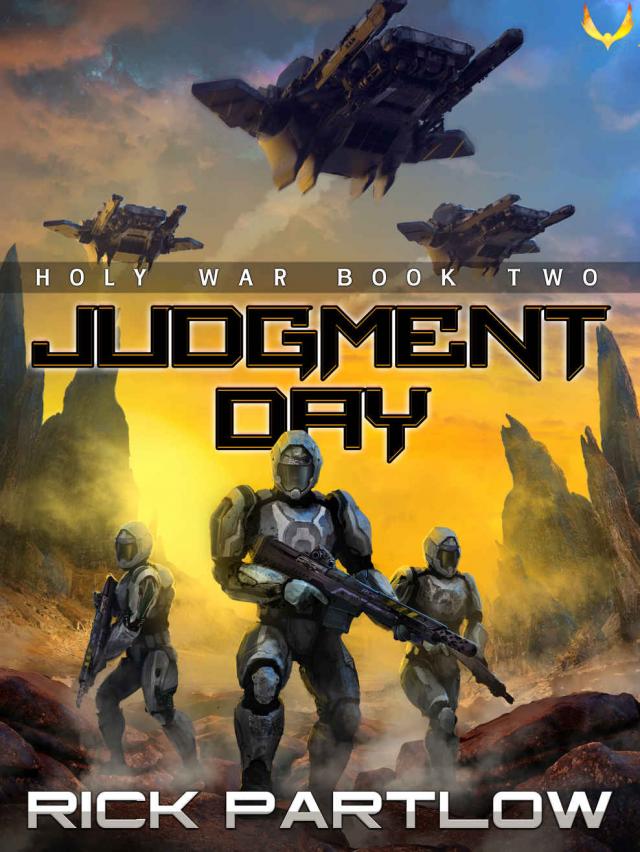


JUDGMENT DAY
©2021 RICK PARTLOW
This book is protected under the copyright laws of the United States of America. No part of this publication may be reproduced, stored in a retrieval system, or transmitted, in any form or by any means, without the prior permission in writing of the publisher, nor be otherwise circulated in any form of binding or cover other than that in which it is published and without a similar condition including this condition being imposed on the subsequent purchaser. Any reproduction or unauthorized use of the material or artwork contained herein is prohibited without the express written permission of the authors.
Aethon Books supports the right to free expression and the value of copyright. The purpose of copyright is to encourage writers and artists to produce the creative works that enrich our culture.
The scanning, uploading, and distribution of this book without permission is a theft of the author’s intellectual property. If you would like to use material from the book (other than for review purposes), please contact editor@aethonbooks.com. Thank you for your support of the author’s rights.
Aethon Books
www.aethonbooks.com
Print and eBook formatting by Steve Beaulieu.
Published by Aethon Books LLC.
Aethon Books is not responsible for websites (or their content) that are not owned by the publisher.
This book is a work of fiction. Names, characters, places, and incidents are the product of the author’s imagination or are used fictitiously. Any resemblance to actual events, locales, or persons, living or dead is coincidental.
All rights reserved.
Contents
Also in the Series
Prologue: Brigantia
Chapter 1
Chapter 2
Chapter 3
Interlude: Brigantia
Chapter 4
Chapter 5
Interlude: Brigantia
Chapter 6
Chapter 7
Chapter 8
Interlude: Brigantia
Chapter 9
Chapter 10
Chapter 11
Chapter 12
Chapter 13
Chapter 14
Interlude: Aphrodite
Chapter 15
Chapter 16
Chapter 17
Chapter 18
Chapter 19
Chapter 20
Interlude: Tan Kin
Chapter 21
Interlude: Tan Kin
Chapter 22
Interlude: Tan Kin
Chapter 23
Interlude: Tan Kin
Chapter 24
Chapter 25
Chapter 26
Chapter 27
Chapter 28
Chapter 29
Chapter 30
Chapter 31
Epilogue
Thank you for reading Judgment Day
More In Sci-Fi
ABOUT Rick Partlow
Also in the Series
GENESIS
JUDGMENT DAY
REVELATION
Prologue: Brigantia
Sweat poured into Johann Brugger’s eyes, and he made no move to wipe it away. If Dak had drilled one lesson into him over the last few months, it was staying still. Movement attracted attention. The thermal canvas could hide his heat signature from the Tahni sensors, but their motion detectors would pick up anything that didn’t match the motion of the wind through the canyon. He hadn’t seen any camera drones, but that didn’t mean there weren’t any around.
It feels weird, sitting out here in broad daylight. We should be doing this in the dark.
It sounded like a good idea, but the Tahni wouldn’t be patrolling out here at night. They moved in the day and shut themselves away inside their reinforced shelters when the sun went down, tucked back behind their weapons emplacements. It made it easier for the resistance to move around at night, but attacks would have to come in the obscene glare of daylight. Which meant hours spent half-buried under sand and gravel through the chill of the high desert night and into the escalating heat of the summer morning, which meant peeing in his pants and getting eaten alive by bugs.
Did we bring the bugs with us, or were they here already?
Because if they’d brought them along in the first colony ships, then he was pissed at the Commonwealth Colonial Authority for slipshod quarantine procedures. But if they’d been here already, then he was pissed at God for making all the living planets they’d found so similar that the bugs still had a taste for human. Well, God or whoever. Some people had crazy ideas about the ancient aliens who’d left them the map of the jumpgate system, thought that these “Predecessors” had built the gates and terraformed all the habitable planets, but he didn’t buy it. If there’d been ancient aliens behind all of this, why wouldn’t they have put the damned Tahni inside a cage instead of giving them the keys to the kingdom and setting them loose on the galaxy?
Johann whispered a curse at the rising heat baking the ground where he’d rested for hours. It would get even hotter as late morning turned to noon and the star crept higher in the sky. Johann kept wanting to call it “the sun,” and people kept correcting him. The sun was back in the solar system, something you’d see from Earth, if you were lucky enough to live outside the megacities, to live somewhere above ground where you could see it at all. The primary star here was a string of letters and numbers no one bothered to remember. The locals called it Arvernus, though Johann didn’t know the origin of the name.
There. The scrape of tires on the gravel road. No engines. Out here in the colonies, the settlers used alcohol-fueled internal combustion engines because they were easy and cheap to fabricate, but the Tahni were ecologically conscious. Only electric motors and battery power for their armored vehicles. Still far away, he thought, though it was hard to tell in this canyon, where the sounds echoed unpredictably. He’d been hiking here once, with Franz.
The thought of Franz was a scourge across his soul. He’d managed to go three days without thinking about him, about the last time he’d seen Franz, about how Franz had been sitting next to him in the truck one second and then he’d been gone, his head blown off. Johann had avenged the man a dozen times, but it hadn’t dulled the pain.
A click in his ear bud was the signal, the briefest one they could get away with. Dak was telling them there was one minute until the vehicles were in the killing zone. The Tahni didn’t have enough air support to accompany every patrol, but still every insect buzz was an assault shuttle to Johann, waiting overhead like a bird of prey to swoop down on them the instant they made a move.
He’d tried to convince himself he didn’t care if he lived or died, but it was a harder sell than he’d imagined. He moved this time, but just barely, fingers closing around the stock of his rifle. He’d never shot a gun before he and Franz had arrived on Brigantia, and certainly never thought he’d be waiting in an ambush with a military assault rifle. He snugged the buttstock of the weapon into his shoulder, the solidity of the rifle a comfort.
It was, he knew from rote memorization drummed into him during training sessions with Dak and the other senior militia leaders, an M-89 10mm rifle, selective-fire, caseless ammunition, electric ignition. Obsolete for at least twenty years, the rifles had been issued to the Brigantia colonial constabulary, the heaviest weapons available on the planet. Not nearly enough, but the best they had, and if he hadn’t proven himself one of the best shots in the militia, it would have been issued to someone else.
It wouldn’t penetrate the armor of the Tahni vehicles, though. That was going to be up to Dak. Because among the myriad other unlikely talents their commander had was the ability to mix up one mean improvised explosive device.
“Fire in the hole!”
Dak had yelled it, because at this point, the Tahni were going to know they were here. It took every bit of self-control Johann had not to throw off the thermal cover as the words rang in the air, but they’d trained this until he could have repeated the instructions backwards and forwards.
Stay under cover until after the big bang.
And it was a big bang. Four of them going off simultaneously ten meters below him, where the road cut through the pass, blasted itself by explosives six years ago when the first ships had come through the wormhole. The first landers had begun bringing down construction crews to build the first city, Gennich, and build the roads out to the ocean and up through the high desert plateau to the grasslands beyond. These charges were nowhere near as destructive or as technologically advanced as those, but they were enough. Pressure throbbed like a pulse beat in his sinuses, squeezed at his chest and hammered at his ears, the roaring inside his head almost enough to drown out the patter of debris, the crash of metal as it ended its short flight back where it began, on the sand and gravel.
Now was the time. He knew it before he heard the first shot, and he tossed aside the camouflage cover, coming up to a knee, eyes slitted against the blinding rays of the system’s primary star. The scene below imprinted itself into his thoughts like a single frame captured from a video. Two light-armored vehicles, the sort the Tahni had brought down with them on their cargo shuttles, alien and yet also familiar because form followed function. Instead of a torus, their tires were casters, like Johann had seen on the bottom of heavy furniture pieces, and while it looked awkward and impractical, it had worked for them for however long they’d had motor vehicles, so who was he to tell them different? It added the element of the alien to the sloped wedge of their shape…or it had.
& nbsp; The casters and their axles were blown off the front end of both of the vehicles, only smoking, ragged gaps in the metal where they used to be, and the angular nose, once a clean, sharp wedge, was mangled and charred. The road was torn up as well, two-meter-deep craters dug out of it from the detonations, the front ends of the two armored vehicles collapsed into them. Smoke and dust billowed around the scene, twisted by the oven-hot winds, and Johann only had glimpses through it of the wrecked armored cars.
But he knew what would happen next, knew the first instinct of the Tahni soldiers, because he’d seen it before. They’d been worried, the first time they’d tried this, that the Tahni would play turtle, duck inside their shells and call for help, count on their armor to save them knowing the colonists couldn’t have heavy weapons. Oh, Dak did have a plan for that, something involving homemade, shaped charges they would plant on the roofs of the cars, but that would have meant militia fighters charging down at the vehicles while the Tahni fired those godawful guns at them, would have cost a lot of lives.
But the Tahni were recklessly aggressive, almost dismissive of the human settlers, as if the act of being conquered had somehow made them lower forms of life. It had cost them before, and it would this time too. The rear doors of the armored cars burst open and Tahni troopers scrambled out, the first of them normal infantry, wearing light armor and carrying carbines fitted with a liquid nitrogen cooling jacket. Johann had played around with captured models. It was an interesting design, using conventional propellant for the rounds but suspending them in the barrel with an electromagnetic field sort of like a turbo boost. The bullets were tiny, 4mm he thought, but they were ungodly fast and anyone they hit was going to be in a world of hurt. He wanted one, but they hadn’t collected enough ammo and spare parts to make issuing them practical.
Maybe after today. He settled the optical sight of his rifle over the chest of one of the Tahni soldiers and touched the trigger. Recoil battered his shoulder, the rough caress of the only lover he was interested in, and the Tahni tumbled backwards. It was a kill, he knew. The 10mm penetrators worked on their light armor, though just barely. On what came next, it was useless.
He heard them before he saw them, the clomp-clomp-clomp of their heavy steps on the metal ramps of the armored cars. They reminded Johann of the pictures he’d seen of gorillas, their shoulders impossibly broad, the backpack built into their suits giving them a hunched-over look. Their armor was brown-and-tan camouflage, the visors of their faceplates tinted to opacity against the ravages of the primary, and their weapons were impossibly, ridiculously large, miniature coilguns shooting tantalum darts that could slice through one side of him and out the other.
Powered exoskeletons, that’s what Dak had called them, but Johann had started referring to them as trolls. Maybe it was a northern European thing, but that was how he saw them, some ancient monster, otherworldly, bent on destruction and so very hard to kill.
He shot at them, knowing it was a waste of time, knowing he’d just be inviting return fire, but also knowing it was his job. The rounds were tungsten-core, armor-piercing—at least theoretically—but they merely left shallow divots in the chest and shoulder plates, marring the camouflage pattern but not coming close to penetrating the heavy carbon-boron honeycomb material. The muzzle of a KE gun swung toward him and Johann swore, throwing himself flat.
Tantalum darts moving too fast for him to see smacked into the rock face just centimeters over his head, three thousand meter per second someone had told him, though he had no way to test that. He wore an open-faced helmet even more ancient than his rifle, but all it would have done against the hypervelocity darts would have been to keep his head in the same basic shape while the interior turned to liquid. Bits of rock clicked off the high-impact plastic of the helmet, a constant rain of debris for long seconds that seemed to stretch into infinity, but then died away suddenly as the fire shifted.
Johann dared to raise his head above the edge of the escarpment, just a split-second glimpse until he was sure no one was trying to draw him out, waiting until he was stupid enough to stick his face up again and eat a slug. But the enemy had shifted fire to positions farther down the canyon and Johann pulled his rifle into position again, swapping out the mag by rote motions, practiced over and over at the camp during endless hours of training.
A conventional infantry trooper darted out from behind cover, trying to move up behind the squad of trolls, and Johann killed him. It felt like nothing. Would it feel different with a human? Or had he simply seared that part of his conscience away with a hot iron and it would never bother him again?
It would work either way. Another burst into the back of a troll helmet. Thinner armor there. Still wouldn’t penetrate, but it would damned sure annoy. The troll swiveled in place and Johann was ready to duck down again, but he didn’t have to. The squad of Tahni had moved far enough forward, stepped into the trap. They didn’t see it because their helmet sensors were scanning the road in front of them, not the rocks above and behind them.
Fougasse was the technical term. A hole dug in the rock, filled with explosives and projectiles. In this case, it was filled with homemade explosives behind a load of jellied gasoline, and when it went off, it was as if a fire-breathing dragon had decided to toast himself some trolls for lunch. It didn’t destroy the things, of course. They wouldn’t have been much use if they weren’t fireproof. But it distracted the hell out of them, and that was enough.
Sniper rifles cracked, loud and sharp enough to be heard over the roaring of the fire, over the ringing in his ears from the multiple explosions. The trolls didn’t fall. Johann wouldn’t have been able to tell they’d been hit at all if they hadn’t simply stopped in place, their joints frozen with no living mind to tell them where to go. Those faceplates were necessary, because the Tahni didn’t trust electronic sensors to tell them the whole story about what was going on around them. They wanted the option to use their eyes, what Dak had referred to as the Mark One Eyeball, to see for themselves. And what they saw was a high-velocity, solid-core slug right between their eyes, courtesy of the very best hunters on the planet, firing the best long-range game rifles to be had.
A couple of the trolls at the rear of the formation managed to get turned around, running for cover in a toddler’s stiff-legged, loping gait, still afire, the burning napalm clinging stubbornly to their metal and composite armor. Their faces were toward him now, only eighty or ninety meters away, and Johann took the time to aim for those visors, hosing a long burst at the lead troll.
He did not, he decided, hit the Tahni inside the armor, at least not fatally. The polycarbonate visor was too thick for that. Instead, what the rounds managed to do was crack the faceplate…and allow that heat and fire inside the helmet. The Tahni screamed, and Johann could hear it through the broken faceplate, high-pitched and ululating. Armored hands waved in the air, slapping at flames they couldn’t reach, and Johann wanted to smile, but the expression would have taken too much effort. He shifted aim to the next troll, but was interrupted when someone tried to kill him.
The turret. He’d been stupid, forgotten the turret on top of the armored car. To be fair, he’d had reason. The gunner hadn’t done anything in the last ten seconds, forever in a firefight, long enough for Johann to lose track of him, to think he’d run out of the car along with the others and been killed. But he hadn’t. He’d stayed at his position and now he’d found a target. Johann.
If the KE gunfire had been withering, the coilgun fire from the turret was devastating, chopping the rock face behind him into thin sheets. Razor-sharp slivers ripped at his sleeves, not quite piercing the tough material, debris burying him as he curled into a fetal position around his rifle, praying to a God he didn’t believe in that someone else would notice his position and take out the gun.