Doubt on a limb, p.1
Doubt on a Limb, page 1


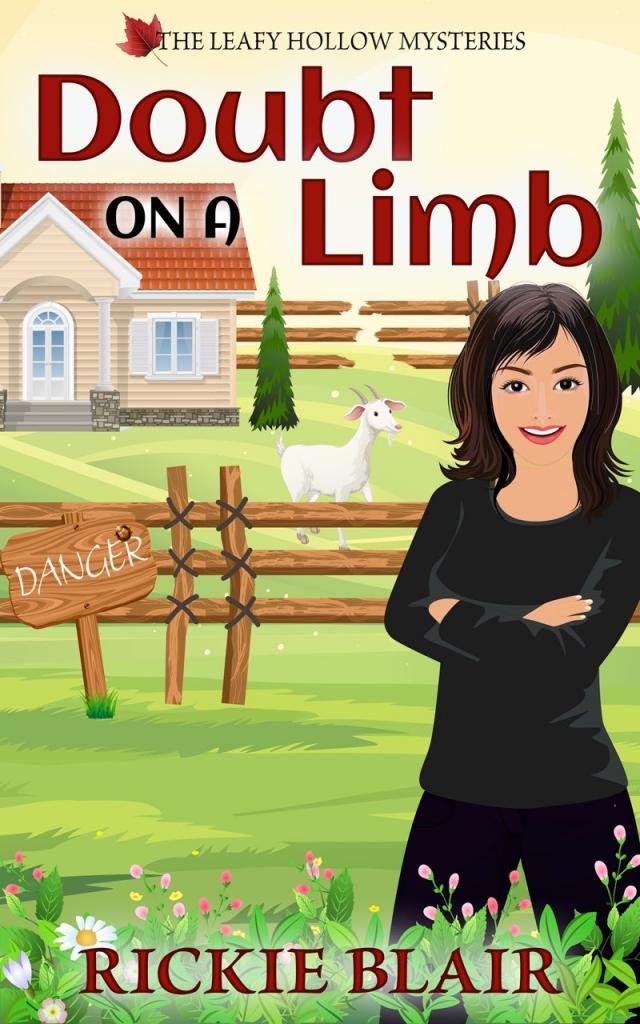
Doubt on a Limb
The Leafy Hollow Mysteries, Book 8
Rickie Blair
DOUBT ON A LIMB
Copyright © 2020 by Rickie Blair.
Published in Canada in 2020 by Barkley Books.
* * *
All rights reserved.
The use of any part of this publication reproduced, transmitted in any form or by any means, electronic, mechanical, photocopying, recording or otherwise stored in a retrieval system, without the express written consent of the publisher, is an infringement of the copyright law.
* * *
This book is a work of fiction. Names, characters, places and incidents are products of the author’s imagination or are used fictitiously. Any resemblance to actual events or locales or persons, living or dead, is coincidental.
* * *
ISBN-13: 978-1-988881-14-0
* * *
To receive information about new releases and special offers, please sign up for my mailing list
at www.rickieblair.com
* * *
Cover art by: www.coverkicks.com
Contents
Chapter 1
Chapter 2
Chapter 3
Chapter 4
Chapter 5
Chapter 6
Chapter 7
Chapter 8
Chapter 9
Chapter 10
Chapter 11
Chapter 12
Chapter 13
Chapter 14
Chapter 15
Chapter 16
Chapter 17
Chapter 18
Chapter 19
Chapter 20
Chapter 21
Chapter 22
Chapter 23
Chapter 24
Chapter 25
Chapter 26
Epilogue
Also by Rickie Blair
About the Author
Chapter 1
Herbert Eubanks plunged the black PVC pipe into the septic tank and held it steady as liquid pulsed up the three-inch plastic tube. From there, it traveled into the hose that snaked through the yard and out to his pumper truck in the driveway. It was a task he’d done countless times, in hundreds of rural backyards. There was no reason to think today’s job would be any different.
But it was different.
For one thing, this split-level house had three-and-a-half baths. The tank he was emptying wasn’t big enough for a house of that size. And certainly not up to code.
He’d been inside the house and knew it well—another reason why this job was different. It had one of those “great rooms,” a home office, and four bedrooms—or five, depending on what you considered a bedroom. For his part, Herbert would never have slept in the basement room, because it had no windows. But then, it wasn’t used for sleeping, as he knew. Hence the locked door.
While the pump on his tanker continued its work, he glanced around at his surroundings.
The sweeping, pristine lawn—punctuated with well-tended perennial beds and gracefully pruned trees—contrasted sharply with the weedy expanse of the garden next door. If you could call it a garden, he thought. More like a barnyard, really. From somewhere came the bleating of goats, an unlikely pastoral note in such a polished neighborhood. He smiled to himself. That was another advantage to his job. The odor of a well-maintained septic tank was nothing compared to the aroma of a freshly manured field.
The bright sun promised a hot day, but this early in the morning it was so cool that he’d thrown on a jacket before leaving his one-bedroom walkup in the village.
The landlady had handed him a cup of coffee when he came down the stairs.
“Just to get you going,” she said cheerily, holding it out with wizened fingers.
There was a reason why she was that friendly, he knew. And it had been a stroke of genius on his part.
With a smirk, he pulled up the pipe and tapped it against the side of the opening. Then he carried it out to the driveway and left it on the ground. He would uncouple the hose and loop it onto the carriers on the tanker’s side after he closed the septic tank lid.
But he had something else to do first.
Kneeling at the two-by-three-foot opening, he leaned over to reach in a gloved hand. There should be an attachment on the roof of the tank, beside the lid. His fingers scrabbled over the rough surface until they hit something solid.
Ah—there it was. Grunting, he reached another few inches, until his arm had plunged in up to the shoulder, to rip off the plastic bundle. Almost there.
A shrill voice sounded behind him. “You bastard.”
Herbert twisted his head to look behind him. He frowned.
“What do you want?” he snarled.
“I warned you.”
Herbert, groping for the bundle, gave an exasperated snort before turning his head to concentrate on his task. “Bugger off,” he said.
He barely felt the blow that killed him.
Herbert Eubanks toppled, head first, into the septic tank.
Chapter 2
When Zara Price telephoned to beg my help in a “matter of life and death,” I assumed she was exaggerating. How could a middle-aged hobby farmer whose elderly mother sold homemade jam to tourists possibly become embroiled in a matter of life and death? Especially one that required the intervention of budding detective Verity Hawkes?
In truth, I was still getting used to the idea that anyone might consider me a budding detective. I’m a relatively recent resident of Leafy Hollow, a picturesque village nestled at the foot of the Niagara Escarpment in southern Ontario. After arriving as a twenty-eight-year-old widow a year earlier, I had revived a failing landscaping business acquired from my secretive aunt. I’d also acquired a best friend, a nineteenth-century cottage, a handsome fiancé, and an inexplicable habit of stumbling over dead bodies.
All welcome surprises.
Except the bodies, of course. Although, come to think of it, the fiancé component had also required some adjustment on my part. After spending two years crippled by grief and anxiety attacks, it was not something I ever expected to happen. Apparently, lightning can strike twice.
And now I’d been gifted with a potential new client for my fledgling investigation agency. Putting the past out of my mind, I strove to concentrate.
“Is it your mother?” I asked Zara in hushed tones. “Has something happened?” For one awful moment, I speculated that one of Mrs. Price’s gingham-topped confections was suspected in a possible poisoning.
It could happen, I knew. Samantha Price—Sam to her friends—was a little…let’s say scatter-brained. Recently, for instance, her famous sour-cherry jam had turned out a bit salty. Salty enough that it could have preserved cod in the pioneer days.
The resulting scene was etched in my memory.
It had been a week earlier, after Sam had transformed the first crop of the season into luscious berry-red jam. Lorne Lewins, my unfailingly polite landscaping assistant and dedicated foodie, had spit out a sample mouthful with such force that it sprayed Mrs. Price’s hand-painted apron. I had stared, horrified, at the red splatters on the cheery farmyard scene.
“Oh dear,” she said, wiping down her apron with age-spotted hands.
While Lorne spluttered an apology and turned as red as the jam with embarrassment, I dug into the jar with a plastic sample spoon and lifted it to my lips.
We had been standing at Mrs. Price’s farm-side stand, under her sign—also hand-painted—You’ll Relish Our Homemade Jam, after Zara had waved us down on the road. When I lowered the driver’s side window of my Pepto-Bismol pink Coming Up Roses truck, she came over to speak to us. “You and Lorne must try mother’s sour-cherry jam, Verity,” she said, pointing proudly to the stand’s tiered rows of jars. “It’s a new batch.”
The jams stood at the end of a gravel driveway that led to the two-story brick farmhouse shared by Zara and her mother. It had been a working farm at one time. I remembered stopping on the roadside as a child to pat the silky foreheads of Guernsey cows as they looked up from grazing the fields to poke their heads over the wooden fence.
Over the decades since, those fields had been sheared away—sold to developers. The cows were gone, too. All that remained of livestock was a tiny herd of goats in a pen behind the house. Pets, I assumed, because Zara was a dedicated vegan.
Meanwhile, the subdivisions and monster homes were closing in on either side. I wondered how much longer the two women could hold them off.
Cautiously, I tested a bit of jam on the tip of my tongue. Grimacing, I handed back the jar. “I’m not much of a cook…” That was an understatement. “But I think you used salt instead of sugar.”
Mrs. Price took the jar to stare at it, apparently baffled. “I wondered why it wouldn’t set.”
Behind her, Zara was hastily plucking jars from the stand and plunking them into a cardboard box. She tucked in the top flaps and shoved the box under the table with one foot, looking embarrassed.
“Was it a new recipe?” I asked her mother, trying to smooth over the awkwardness. “Something you were trying for the first time?”
“Oh no,” she said with a shake of her head. “I’ve been making cherry jam for, let’s see…” She counted on her fingers. “…near on seventy years. Never had a problem before.” She leaned in with a conspiratorial air. “That strange man was here earlier. He must have tampered with it.” She grumbled under her breath. “Always racing up and down the road in that blue car of his.” She tilted her head, looking confused. “O
Zara ran a hand through her graying hair, looking exasperated. “Mom—”
“No harm done,” I countered. “Let’s forget about it.”
But I was confused. Who was this strange man? Was he a figment of her imagination—or real?
“Spicy corn relish?” Mrs. Price had asked, breaking into my thoughts with a jar in one hand and a fresh sample spoon in the other. “Wonderful with toast and tomatoes.”
But now, as I drove to their farmhouse to review Zara’s “life and death” case, I recalled that incident a week ago with the salt. Her mother could have added something—if not poisonous, then merely inedible—to her jam without realizing it.
Still, how bad could it be? A little indigestion, most likely. People can be dreadfully picky.
Which meant I was unprepared for the scene that unfolded when my landscaping truck crested the hill before Zara’s hobby farm. I halted the truck to take it in.
Police cars lined the road, a van with Leafy Hollow Animal Services stenciled on its side had pulled up alongside the police cars, and two uniformed constables were unspooling yellow caution tape around the sprawling, split-level house next door to Zara’s farm.
Flashing lights drew my attention to my rear view mirror. An ambulance was coming up the road behind me. No siren, though. I pulled over onto the shoulder and turned off my engine, watching as the ambulance drove past and into the driveway of Zara’s neighbor. It wasn’t moving fast, and no one hopped out when it stopped. It couldn’t be a medical emergency. But why would an ambulance…
Uh-oh. My throat constricted.
Someone was dead.
I vaulted out of my truck to head for the nearest police cruiser. The officer behind the wheel was making notes on a clipboard.
He put it aside to lower the window when I tapped it with a knuckle.
“Verity. Nice to see you again.”
Having a police detective as a fiancé meant I was on first-name terms with most of the force. This came in handy for a fledgling investigator. “You, too, Fred. What’s going on?”
He looked grim. “You know I can’t—”
I leaned an elbow on the window frame. “It’s only between us.”
He looked dubious.
“You know Jeff will tell me later anyway.”
He sighed. “We don’t know what happened. Not yet. Forensics is here.”
“But there’s a body?”
“Yes.”
I sucked in a breath. “It’s not Mrs. Price, is it? Samantha?”
Fred looked surprised. “No. It’s not a woman.” He studied his clipboard. “Herbert Eubanks is the name.”
I tried to remember who lived next to Zara. I’d seen him once, during a visit to the Prices’ farm. He’d been strolling around his garden with a coffee mug in his hand. He was middle-aged, physically fit, hair not entirely gray, with an air of reserve. I noticed a certain frostiness in the way he greeted Zara’s friendly wave. Then she muttered something under her breath that was decidedly unfriendly, and I assumed it went both ways. Neighbors can be very trying.
But he wasn’t called Herbert Eubanks. I would have remembered that.
“Is it the homeowner?”
Shaking his head, Fred pointed wordlessly up the road. I followed the direction of his finger. A red tanker truck was parked in the driveway of the split-level. From where I stood, only the back end was visible. I moved over a few steps in order to read the writing on the side of the tank.
Eubanks’ Septic Services
We’ll Take Care of It!
Pointing to the truck, I mouthed a query over my shoulder at Fred. That guy?
He nodded, then resumed checking off paperwork boxes.
I had promised to address Zara’s problem ASAP. But there was no harm in making a quick stop at her neighbor’s to see why it was the focus of so much attention. A natural death wouldn’t draw a response like that.
With a brief wave to Fred, I crossed the road and started up the driveway. The split-level house was new, with elegant trimmings of slate stone and gray-stained wood. On the left, three large windows, ten feet high, marked the main room. I suspected its peaked roof sheltered a cathedral ceiling. The front door, its solid wood panels stained a trendy blue-gray, was set back under a portico in the middle. On the right, white wooden shutters were closed over two smaller windows—probably a den or home office.
Behind that, the slate-tiled roof rose and dipped to overlay a series of dormer windows on the second floor. As I came to the end of the driveway and rounded the corner of the house, the vista opened up into an expansive garden of at least an acre, with shade trees, manicured perennial beds, and stone pathways. The roof swooped down to cover a one-story sunroom that spanned the back of the building. Pink and white climbing roses wrapped the pergola that sheltered a flagstone patio and fire pit.
Despite the flowers, the backyard was definitely not smelling of roses. Sniffing, I noticed a sharp tang in the air. Earthy, perhaps.
Three people in blue disposable jumpsuits were bent over a spot in the backyard about ten feet from the house. I recognized one as the coroner, Dr. Rajit Bakshi, “a lovely man” who was fond of Renaissance poetry, according to our local librarian. I assumed the other two were members of the forensic team. All three blocked my view. When one of them moved aside, I gasped.
Two motionless shins, ending in a pair of scuffed running shoes, stuck straight up from the ground. The rest of the body was—
I clapped a hand over my mouth as I made the connection.
Herbert Eubanks had fallen to his death in the septic tank he’d been hired to empty.
I turned away, feeling faintly ill and wondering if I could simply slink off and pretend I’d never been there, when a woman screamed my name.
“Verity! Over here!”
The forensic crew turned in my direction. So much for a silent getaway. I tossed them a feeble smile.
“Stand back, Verity,” called Dr. Bakshi before returning to his work. He looked peeved. Must be having a bad day.
“Verity!” came the woman’s voice again. I turned around.
Zara Price was waving wildly from her side of the fence. I trotted over.
Before I could reach her, a chest-high gray blur thundered past, nearly knocking me off my feet.
I barely had time to regain my breath before two police officers swooped past, also at a run.
“Stop it,” one yelled. “It’s heading for those—”
“Look out!”
Too late.
The blue-suited forensic team scattered as the gray and white animal bounded toward them, head lowered. With impressive form, it leapt into the air, clearing the upturned, booted legs sticking up from the tank with room to spare.
The gazelle-like animal landed on the other side, did a quick feint to elude a startled officer, then headed for the road.
One of the pursuing officers ran into one of the forensic crew, who toppled against the other two. The entire group hit the ground in a tangle of arms and legs.
“Bloody hell!” yelled Dr. Bakshi as he fought to extricate himself. “What the bloody hell is that bloody goat doing now? Why doesn’t someone stop the bloody thing?”
Our normally unflappable coroner was decidedly flapped today.
“Oh dear,” Zara called behind me. “I warned them not to get Waffles riled up.”
I walked over, choking out a response. “Waffles?”
“My billy goat. He’s a wether—a castrated ram. You’ve met him.”
“Have I?” Mentally, I reviewed my former visits to Zara’s hobby farm, recalling that she had introduced me to all of the goats milling about in their pen. Sadly, I had no memory for faces.