

Entering fire, p.1
Entering Fire, page 1


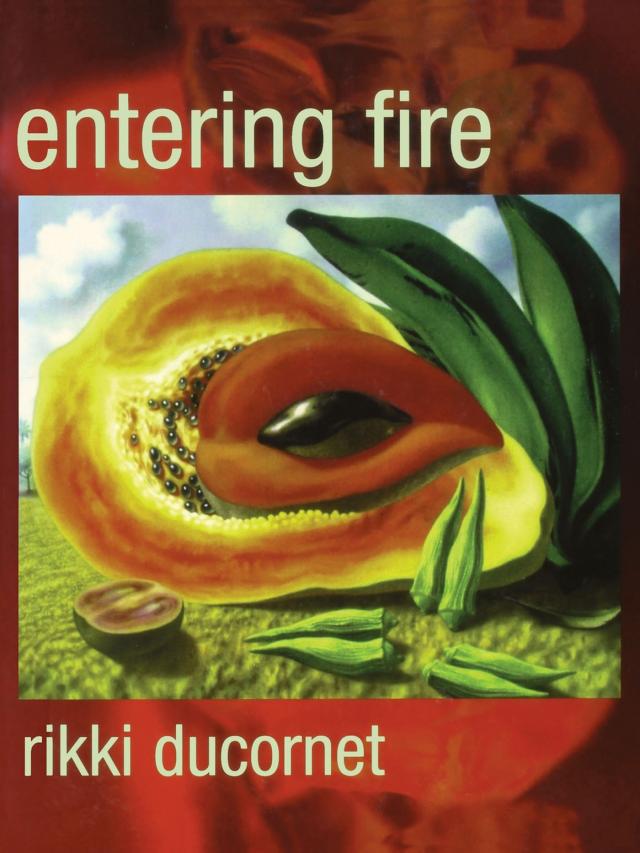
entering fire
entering fire
rikki ducornet
city lights
san francisco
© 1986, 1987 by Rikki Ducornet
Cover art by Ramón Alejandro
Cover design by Rex Ray
Book design by Elaine Katzenberger
Typography by Harvest Graphics
Library of Congress Cataloging-in-Publication Data
Ducornet, Rikki, 1943–
Entering Fire.
Reprint. Originally published: England: Chatto & Windus, Ltd., 1986
I. Title.
PS3554.U279E5 1987 813’.54 87-15830
ISBN 0-87286-355-7 (pbk.)
City Lights Books are available to bookstores through our primary distributor: Subterranean Company, P. O. Box 160, 265 S. 5th St., Monroe, OR 97456. Tel: (541)-847-5274. Toll-free orders (800)-274-7826. Fax: (541)-847-6018. Our books are also available through library jobbers and regional distributors. For personal orders and catalogs, please write to City Lights Books, 261 Columbus Avenue, San Francisco, CA 94133, or visit us on the World Wide Web at: www.citylights.com.
CITY LIGHTS BOOKS are edited by Lawrence Ferlinghetti and Nancy J. Peters and published at the City Lights Bookstore, 261 Columbus Avenue, San Francisco, CA 94133.
For Jean-Yves and Mary-Jane
ACKNOWLEDGEMENTS
I wish to thank orchidologists Messieurs Vacherot and Lecoufle and Monsieur Pierre Fradin for their passionate and precise descriptions of the cloning process; Christian Laucou for trusting me with his rare copies of Ananké’s Hel!; Pierre Sabourin for books and for orchids; my father for giving me the coveted History Of Coca by Mortimer; Wendy for the Manuel d’exercices de style, 1858 (the book which provided for Virginie’s conversation); and above all Guy, as ever.
AVANT PROPOS
‘The incomparable clavichord of Marie Antoinette stood like a trophy in the middle of the room. It was heartbreaking to see it in the house of Jews.’ Les Rothschild, Anonymous, 1894
‘There’s always a little Jew squatting in the corner, jeering and touching himself.’ Les Beaux Draps, L.-F. Céline, 1941
‘BA-HEL … BAL … BEL … BALTIQUE, ALBANY, BÔ (PO), Lybie etc.’ Hel! Visions préhistoriques, Ananké, 1928
‘When afraid, the Jew is really very charming.’ Testament d’un antisémite, Eduard Drumont, 1881
‘May I have the floor?’ Senator McCarthy, Army McCarthy Hearings, 1954
‘You understand … It’s Fairyland.’ Féerie pour une autre fois, L.-F. Céline, 1941
CONTENTS
EMERGENCIES OF THE IMAGINATION
ENTERING FIRE
THE COLOUR OF COPULATION
FIRST EMBRACE
CESTE PIERRE EST VEGETALE
THE TWO-HUNDRED-METRE BATTERY
THE SPIRIT OF MERCURY
BUTTONS AND THE BLUE MAN
PALACES OF REVENGE
ENEMIES AND EGG-HEADS
TREASURE OF TREASURES
ON BEAUTY
IGNATZ AND KRAZY KAT
EXEMPLARY CAVALIERS
HAPPY BIRTHDAY, MARÉCHAL!
SIDE SHOW
A CUCKOLD OF HISTORY
FATAL ERRORS
MARTA STRADA
A LETTER FROM SEPTIMUS
EMERGENCIES OF THE IMAGINATION
Septimus de Bergerac
P’pa, although a de Bergerac, a Frenchman and married to my mother, had a Chinese concubine. He brought her back from a voyage to Peking in the spring of 1881. M’man took one look at the woman’s tiny, cloven hooves and swollen belly and before fainting shouted, ‘Kremlin and Vatican!,’ the only curse she knew. The infidel’s name was Dust.
M’man, a valiant Frenchwoman and an honour to her race, accepted the situation. To question P’pa’s decisions was beyond her wildest imaginings. Indeed, M’man was an exemplarily virtuous woman and had no imagination.
A shadow, more echo than flesh, Dust kept to her room. It stank of the skeletons of sea-moths she kept in a basket beneath her bed. She broke off pieces of this refuse for steeping, and drank the noxious broth.
Pauvre Maman! She had been sired by a Grenier de Fourtou, a founding member of the Anti-Semitic League of France. A weaker woman, a woman less devoted to loyalty and peace, would have gone insane. Sharing one’s roof with a Chinawoman is quite as bad as sharing it with a Rothschild. At death’s door she confided to me that before P’pa had left for China to study kiwis (or was it lychees?) they had shared but seven chaste nights. And that, having conceived me upon his return, she never slept with him again. M’man’s name was Virginie: Virgo! Vis! Virtu!
Dust was given the maid’s quarters and the maid removed to the attic where she grew despondent. She was replaced by a sallow, ill-tempered wench whose skin and soul were thicker. Mademoiselle Parfait did not mind draughts. And when Dust went insane (hers is a weak race, inbred since the times of tohubohu stewing, so to speak, in its own primal juices) P’pa tumbled with that dour sow up in her pigsty. Often I would hide beneath the stairs and listen to their heavy breathing. Half frozen with cold and loathing, I would slither back to my bed and like a little lizard curled within a crack, weep and pray for M’man.
The first week Dust spent rolled up in a curtain. She explained as best she could to P’pa that she wanted First Wife to know that she, Dust, was less than an insect, a species of larva.
As her feet were the size and shape of the tiny paper boats Mademoiselle Parfait set afloat in my bath, Dust could walk only with the help of two ebony canes. The minutes of my young life were counted by their barbaric drumming on the ceiling overhead. And as I sit on the floor looking at the forbidden photographs that P’pa has brought back from his travels, their thump, thump hammers each image into the tender surface of my mind. The heavy, cerise volume, Mademoiselle Parfait teases, is bound in human skin, and the raised rosebud centred on the cover in a wreath of leaves is a human nipple. She continues: ‘Your P’pa has visited many strange and savage lands where the livers of bull elephants and the shrunken heads of little boys are mere currency, like coins’.
The photographs in P’pa’s album are hideous and they are True. That they are True cannot be doubted. Perhaps I owe my astonishing precocity to them—without false modesty, I have always been something of a genius. (I am, by the way, the author of The Rothschild Plot—a work which has had undeniable impact upon contemporary French History.)
Back to P’pa’s album. I turn the thick pages, the colour of bone, encrusted with the monstrous visions of naked savages and savage punishments. The cannibals of Dahomy stand in the city of Ouida (known to the ancients as Juda—these creatures are descended from one of the lost tribes of Israel) hugging sacks of human meat, like medieval Jews on their way to market. There are photographs of the truncated crooks of Tonkin and of child whores hanging from their feet in the pleasure palaces of Peking, of nude New Caledonians with rags tied to their foreskins. Dust’s thump, thump, thump stabs my ribs like the finger of a cannibal rabbi. Or is it the merciless staff of Father Time I hear ticking and tocking?
In the fall of 1881, the Chinese trollop gave P’pa a son; or rather, the foul fermentations and stinking incubations of an infamous heredity produced my half-brother who, despite the fact that his mother was no larger than a doll, and that my father was himself a small man, even for a Frenchman, grew to be unusually tall and broad and who, from infancy, I despised. He was fifteen when Dust died of influenza and was reduced by fire to a thimbleful of oily ashes. He became so wild that the following year while P’pa was in the Amazon chewing coca, M’man sent him from the house. Two years later he was arrested in Le Havre for the murder of Lady Aurora, the English prostitute. She had been beaten to death with a blunt instrument, perhaps a cane. The descriptions of the affair were as numerous as the newspapers reporting it. Misogynist I have often thought of this violent murder with satisfaction as if I had committed it myself. Yes, I envy my enormous, slant-eyed brother for having had the audacity and the imagination to perpetrate the mad act that I have not dared commit except by proxy or in fantasies imposed upon public women—preferably yellow, Arab or Semite, whose smell of cheap soap and powder, whose every mole, scar and hair I despise as passionately as I crave. In the act I have murdered thousands. It is fortunate for men like myself that for money there are many who will allow themselves to be beaten black and blue with a hairbrush. Yet I have on occasion been slapped and once even spat at by an animal who, despite base blood and even baser calling, had not yet sold her pride. These few, very few, angry and vain beasts are the only members of the sex (except, évidemment, M’man) for whom I have felt, mingled with loathing, an emotion that might possibly begin to approach what some men call admiration. I am thinking in particular of a Jewess, her red hair framing her face like a hoop of fire, who dared kick me in the chest with a small, satin-slippered foot. That instant of pain and shock, as the sharp heel thumped against my startled heart, was an instant—the only instant—that I believe I might have felt tenderness.
Yet, I have never admired anyone (apart from M’man) except—and isn’t it odd, for when I think of him even now I lose sleep—that hated half-brother whom M’man neglected to have baptized and to whom Dust gave the name Chên-Yen: True Man.
Mine is a life punctuated by an incessant thump, thump. And now that I’ve a cane myself—having lost the use of a leg to syphilis (God damn the gypsy whores and their hook-nosed Semite pimps!)— it amuses me no end, I assure you, to jab and stab along my own chosen paths.
&nb
True Man was born shortly after (he held onto the foetal state for fifteen months like a giraffe) and, although he was born later, he was from the start, bigger. At one year he was walking (he learned holding on to his mother’s canes), when I was forever sitting in M’man’s lap. True Man was the first to talk. By the time he was twelve months old, he could carry on a conversation with his mother in Chinese and with Mademoiselle Parfait in French. Tongue-tied at three I could barely stutter, but by then I could walk. P’pa had an obvious preference for his Mongol cub who strutted proudly in pants at a time when I was still dragging my diapers.
We were put together in the freshly painted nursery. There Dust spent the odd hours of the day and M’man the even (but for meals when we were fed by the dour Mademoiselle Parfait). M’man read us the fairytales of Perrault from a dainty, faded blue book which had been her own, and Dust, her pygmy shoes brushing my cheek, True Man hanging from her neck, recited the revulsive inventions of her homeland in a baffling jabber. These True Man translated, much to my humiliation. I should not have listened—they might well have infected my brain: feudal tales of insatiable Mongol murderers; of embalmed Emperors and rivers of mercury; of an imperial cadaver that stank so shockingly it was bedded down in a half ton of salt fish.
We were never alone. Mademoiselle took us out for tonic walks and severely chaperoned our games. I have a memory that nags like a rotten tooth. I had been locked in the cellar for naughtiness. True Man came home from a pony ride in the Jardin du Mail, smelling of hay, pistachio ice-cream dribbled all over his chin. It was the first time I ever bit anyone.
I never did understand Dust. I was ‘First Wife’s Son,’ and ‘Older Son’; she bowed reverently before me—even when I was a toddler—and punished me whenever she had the chance. In turn, M’man punished True Man. Dust was a pincher, an ear-twister and a penis-tweaker; M’man favoured dark corners, the cellar and cold baths. Their punishments were maddening and incessant. True Man once said that our childhood lasted one thousand years. And, if I was green with envy, he was yellow with bile.
Like the Jews, the Chinese have the ways of Bedouins. Before she expired of the influenza that made off with eighty people in the winter of 1896, Dust went mad. Her madness seized her one summer’s day as she sat in her dank room gazing out of the open window. The air was so still and heavy, it did nothing to dissipate the nauseous odours of mummification that hovered about her like a fog. Dust pointed to M’man’s favourite tree—a lime—and shrieked that it was plotting against her life. And if, when excited, republicans wave their flags, freemasons their ignominious bric-à-brac and Jews their stocks and bonds, Dust, dwarfed in her midnight blue longevity garment, her face powdered deathly white, waved her canes: ‘Thlashing devils!’ She scribbled her nightmares on triangles of red paper and gave them to True Man to burn; she attempted to transfer her fears to a cricket she kept in a comb-box and her spiritual agony to a spider that lived over the door. The simplest tasks—mending a garment, plucking her eyebrows, washing her crippled feet—exposed her to danger. She tickled her nostrils with a feather and sneezed, expulsing malignant influences. She took to sleeping beneath her bed, her longevity robe stained and clotted with filth, clutching to her heart a silk purse which contained the Devil knows what. And when she could sleep no more, she spent the long nights fumbling in the dark after headless chickens, the spirits of snakes and goblins, swatting at scorpions and jinn. Again she screamed. Mademoiselle Parfait did not see the warlocks clinging to the ceiling like flies, even when one hit her with a turd. But she agreed to bring opium from the pharmacy. Dust grew quiet and stopped eating. M’man prayed to the Virgin Mary. And one night Dust saw a spirit wearing a yellow apron and chewing betel. She recognized the royal executioner. The Guilty Head!’ she raved. The Guilty Head is cut!’ She saw True Man’s neck marked with the executioner’s red spittle. True Man had not yet committed his crime, yet somehow Dust knew all about it. Ravaged by fever, within a week she was dead. M’man took the crushed-leather missal, decorated with a cross of diamond powder, which had belonged to P’pa’s mother, and gave it to the priest to be burned along with the body. Privately she jubilated. Because Dust was Chinese, she could not be buried in the cemetery. Mademoiselle Parfait spilled the ashes — in which the diamond powder could be seen shining—into the Loire. To this day I cannot eat river fish; nor can I hear the word ‘yellow’ without succumbing to a fit of evil temper. Indeed I cannot say ‘Chinese’ without biting my tongue.
And now I will make a confession: I have despised my father from the instant I understood the impossible situation he had imposed upon M’man. And I fantasize that I was not fathered by the greasy, barrelchested bigamist, but, rather, by Monsieur Kindergarten the masseur, although this is ridiculous. I look nothing like Monsieur Kindergarten and have inherited everything in cruel caricature from P’pa: the bulbous nose like a Dutchman’s, and puffy eyes, the cheeks like putty, the coarse, untameable hair and so on. Whereas Monsieur Kindergarten is all Elegance: svelte, sure-footed and as muscular as Atlas. Yet I persist in my little fairytale that the masseur is my papa, and I have learned to mimic that springy gait, that genial buoyancy, that impressive something or other which smacks of Health and Dependability.
Monsieur Kindergarten was an important feature in my young life, more for what he evoked than for what he was. His was a shadowy figure, and swiftly passing. Always discreet and always on time, he slipped into M’man’s chamber each afternoon at four o’clock. I knew she lay upon her bed like a bride or a corpse, clothed only in a sheet and expectancy.
I like to think that once, as M’man lay palpitating beneath his fingers, Monsieur Kindergarten had slipped judiciously in; that his silent torrent had rushed her grotto like a storm, that the blind comet breaching the moon of M’man’s molten ovum was to become me. But all this is, hélas, impossible. For when Monsieur Kindergarten came into my life, I was already seven years old, and the inexorable pattern of my birth and life set down forever. And if I have learned to imitate the man’s walk and manner, his fingers still elude me—fingers as muscular as a bull’s neck and capable of scaling a perpendicular mountain of ice. I hasten to add that, although my fingers are as weak as husked clams, I am as white as he. My skin like putty, my bulbous nose and barrel chest—ugly as they are—are white.
1888 is the year Monsieur Kindergarten enters our lives and the year P’pa leaves for South America. When she learns of his decision, Dust slams her forehead against his boots—a shocking sight. M’man passes out, spilling the potted plants, and Mademoiselle Parfait runs for salts. I should explain that P’pa’s wanderlust frittered away M’man’s dowry and his own inheritance—the fortune accumulated by his grandfather in the salt mines of French Morocco. M’man’s head hot in my lap, my hatred egging me on, I ask: Why? The cad’s pretentious answer: ‘A man must prove himself worthy of Paradise.’
That night he came into the nursery and attempted to justify himself. True Man sat as if seduced or hypnotized; perhaps he was merely confused. I listened with loathing to fables of spiders the size of cauliflowers and lily pads the size of parlours and knew P’pa was mad.
‘The Equator,’ he lied, ‘is a wall of solid gold bricks. I am on my way to Eden.’
Eden! P’pa left us for a sewer the size of a planet. A jungle where everything, even shit, shines in the dark. Just dreaming of it had robbed him of his precarious senses. He raved on, attempting to turn our heads with a sack full of mystical garbage. Thank God I was a born sceptic and sniggered at his lunatic fancies … He suggested that the world would one day be a gigantic eye—like the eye of a fly—covered from pole to pole with the junk lenses and trick mirrors of astronomy. He pretended that the Universe is a web floating on a breeze, the galaxies and nebulae but dew sparkling in its filaments.


