

The strange inheritance.., p.1
The Strange Inheritance of Leah Fern, page 1


Also by Rita Zoey Chin
Let the Tornado Come: A Memoir
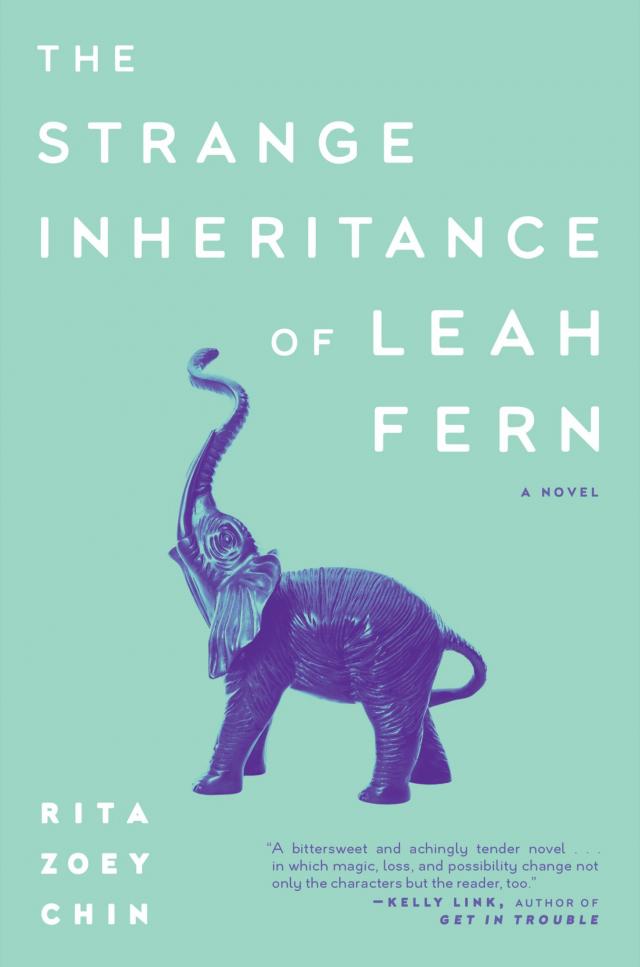
The Strange Inheritance of Leah Fern
First published in 2022 by Melville House
Copyright © Rita Zoey Chin, 2022
All rights reserved
First Melville House Printing: October 2022
Melville House Publishing
46 John Street
Brooklyn, NY 11201
and
Melville House UK
Suite 2000
16/18 Woodford Road
London E7 0HA
mhpbooks.com
@melvillehouse
ISBN 9781612199863
Ebook ISBN 9781612199870
Library of Congress Control Number: 2022938608
Book design by Patrice Sheridan, adapted for ebook
A catalog record for this book is available from the Library of Congress
a_prh_6.0_141032876_c0_r0
FOR C.E.
Contents
Cover
Also by Rita Zoey Chin
Title Page
Copyright
Dedication
Chapter One
Chapter Two
Chapter Three
Chapter Four
Chapter Five
Chapter Six
Chapter Seven
Chapter Eight
Chapter Nine
Chapter Ten
Chapter Eleven
Chapter Twelve
Chapter Thirteen
Chapter Fourteen
Chapter Fifteen
Chapter Sixteen
Chapter Seventeen
Chapter Eighteen
Chapter Nineteen
Chapter Twenty
Chapter Twenty-One
Chapter Twenty-Two
Chapter Twenty-Three
Chapter Twenty-Four
Chapter Twenty-Five
Chapter Twenty-Six
Chapter Twenty-Seven
Chapter Twenty-Eight
Chapter Twenty-Nine
Chapter Thirty
Chapter Thirty-One
Chapter Thirty-Two
Chapter Thirty-Three
Chapter Thirty-Four
Chapter Thirty-Five
Chapter Thirty-Six
Chapter Thirty-Seven
Chapter Thirty-Eight
Chapter Thirty-Nine
Chapter Forty
Chapter Forty-One
Chapter Forty-Two
Chapter Forty-Three
Chapter Forty-Four
Meanwhile…
Acknowledgments
The moon laid a blazing finger on our bodies,
And drew us into the dark waters.
The black waves reached for us—
She lifted us gently.
The waves broke into points of fire against our bodies
And fell back—
She sang to us, rocking,
“Sleep, sleep!”
But all the fire of the moon-path was in our bodies—
We could not sleep.
—Marguerite Zorach, “The Moon Rose”
In this life, you’ve got to use all of your forces.
In this life, you’ve got to use all of your senses.
—Ekova, “Temoine”
(Farmakit Extended Remix)
ONE
HILDA, SOUTH CAROLINA, 1999; BLAZING CALYX CARNIVAL, 1984
Leah had imagined it for years, the way some girls imagine the ordered rituals of their weddings—the dress, the march, the ordained officiant, the declarations, the dance, the toss, the waves goodbye before crossing that threshold—but here, in her dark iris velvet dress, in her small candlelit apartment in the tiny town of Hilda, South Carolina, where Mozart’s Requiem in D Minor was moving toward its crescendo and the beat-up ebony grandfather clock she’d lugged home from a roadside sale was gonging through the hours, she was the sole officiator and attendee of this, the grand ceremony of her last breath.
Why not Mozart? This was a celebration, after all, one deserving of a timeless and lofty orchestration. Though this day, April 4, 1999, marked Leah’s twenty-first birthday, it was not her birth she was celebrating. Having lived more than half her life feeling penned in by the impenetrable wires of solitude, weighted by the kind of shapeless helplessness only the abandoned know, she felt powerful now to claim her own death, to schedule it on her own watch, her own grandfather clock as it were. What she didn’t know yet was that her plans were about to be undone by a more powerful force.
There was no one to say goodbye to. She had never made friends in the small town of Hilda, though at first she tried. Shortly after her mother left her there, in the care of the saintly-patient Edward Murphy, who would become, through a peculiar marriage of force and kindness, a father to Leah, she was invited to the house of fellow second-grader Cynthia Lewis, in whose flouncy bedroom Leah unveiled her most prized possession by lifting it from its wrapping in one theatric sweep of the arm: a fox skull she’d found in a field. Her eyes gleamed as light touched the bone, but before she could tell Cynthia and her friends about how beautiful she thought it was, how amazing that its jaw still hinged open and shut, one of the girls said “Ew,” and that was followed by a series of yucks and additional ews, along with tears from Cynthia Lewis, who begged her to “put that dead thing away,” and finally Cynthia’s mother, who suggested Leah go back home and find something else to share with her new friends, something not dead. But death hadn’t scared Leah then, and it didn’t scare her now.
She held nothing back on this day, moving through her death rituals with a rapt intensity, not unlike the way Mozart’s quill must have moved through each of his compositions, all the notes now mounting in their urgency alongside the whole of her collected days, which had coalesced here to form a swiftly moving current that would carry her out to an unknown sea. She had initiated the ceremony by lighting the two red candles Edward Murphy had once given her for Christmas. “Smell ’em,” he’d urged excitedly as she pulled them from their wrapping. “Just like cinnamon!” That year she’d given him a new Mozart album to add to his record collection, the same album she was now blasting through her apartment. He had been attempting to branch out from the reliable rock classics to something “more cultured,” as he put it, but now it was completely her own.
When Edward Murphy died and she had to move out, she took the candles from their small dining table, wrapped them in tissue paper, and stowed them on the top shelf of the nearly bare pantry in her new apartment. They had never been lit. But now they flickered dangerously, leaping toward her each time she came wildly gesticulating past, then threatening to go out. She had never moved this way before—all body, flinging herself back and forth through the small space of her living room, her arms darting up erratically, painting invisible pictures in the air, as if to finally answer every question about her sanity that had ever been lodged in her direction by the various small-towners who wondered why, even in the thickest heat of South Carolina summer, she always wore black. Why those heavy combat boots? Perhaps more than anything, people wanted to know “what on God’s green earth” she was doing wearing that “ridiculous” nail-studded belt and collar. “You’ll poke someone’s eye out with your neck!” said Dr. Hammershire, the local dentist who found his comment so amusing that he repeated it every time he saw her.
As she came thrashing again past the candles, a loosened flame herself, even her hair, ink black, shaved close on the right side, spiked longer on the left, seemed to be participating, each barb moving like its own baton, conducting along with Mozart on the fringe of abandon. She couldn’t remember dancing before. She couldn’t remember being so sure of anything.
The rituals, long-planned in a thoughtful order, had begun at 4:44 that morning with the lighting of the two red candles and would continue for one full rotation of the earth, one sunrise and one sunset, twenty-four hours that she would peel each minute from with Herculean intent. She’d chosen this time not only because her birthday fell on the fourth day of the fourth month but also because the number four struck her as whole—four chambers of the heart, four ventricles of the brain, four elements, four seasons, four winds, four principal phases of the moon—and she wanted to close her life feeling like she, too, was whole.
After lighting the ceremonial candles, Leah recited aloud Mary Oliver’s “Sleeping in the Forest,” which Edward Murphy had first read to her when she was a child. “Your mama was nuts about Mary Oliver,” he’d told her. “She was carrying this beat-up old book of hers in her purse when we met.” It had been almost fifteen years since Leah had heard her mother’s voice, though she could still conjure it from fifteen birthdays before, her sixth birthday, the last one she would spend with her mother.
* * *
It was april 4, 1984, in the Alabama fields of the Blazing Calyx Carnival, and Leah had just blown out the six candles adorning a chocolate-covered mound of fried dough. Her wish was the same wish she wished each time she saw the first star appear in the sky: to meet a real live elephant. “Did you wish for elephants again?” her mother asked, tapping her cigarette agai nst the rim of the ashtray. Leah plunged her fingers into the melted chocolate. She didn’t answer because Perilous Paul had told her that you should never tell a wish if you want it to come true. Her mother reached across their little fold-up table and stroked Leah’s cheek. Her eyes went shiny as they sometimes did when she felt what she called “a little love spell” coming on. “When you were born,” she said, “right here, in this very trailer, I had no idea what to call you. You were such a sensitive baby. I could tell right away you were different.” Leah watched the tip of her mother’s cigarette glow orange as she pressed it between her lips and was mesmerized by how the cigarette changed before her eyes, just like one of her mother’s magic tricks. “You were always looking around with those big eyes of yours as if you already knew everything there was to know, secret things. And you never wanted to sleep. That summer, when you were only a few months old, you’d stay up all night just looking, not making a sound. And I thought of a legend I once read about, how if you find the seed of a fern in bloom on a midsummer night, you get special powers.”
“Powers?” Leah asked, pushing a handful of dough into her mouth.
“You become invisible, and then only will-o’-the-wisps can see you.”
“Will-o’-the-wisps?”
Jeannie nodded slowly for emphasis. “Yep, that’s right. Will-o’-the-wisps. Spirits made of light. And when you find them, they lead you to hidden treasures that no one else can see.”
“What kind of treasures?”
“I don’t know,” said Jeannie, pulling hard enough on her cigarette to make it crackle. Her voice crackled, too, when she exhaled. “You’ll have to tell me when you find the seed.”
Leah smiled. “I’ll take you with me,” she said, “to the treasure.”
“Nah, I’ll always be just a person,” she said pensively, tapping her ash and looking out at a distance Leah couldn’t see. “But you, Miss Fern, are different. That’s why you’re not named after a person. You’re named after magic.”
“Did your mama name you Jeannie Starr because she knew you’d be a magic star?”
Leah’s mother stubbed her cigarette out in a small orange ashtray. “My mama never knew anything about me.”
“Why not?”
She reached for Leah’s face again but stopped midway, as suddenly as if something had bitten her hand. “You just eat your sweets, okay? That was a long, long time ago.”
Leah thought for a moment. “Do I have a dad?” she finally asked.
Leah’s mother laughed the kind of laugh that isn’t really a laugh. “Ah, your daddy,” she said, “could have been any one of a few handsome cowboys.”
* * *
—
Later that day, Leah’s two favorite friends—Her-Sweet, the Bearded Lady, and the Rubberband Man, the carnival’s contortionist—arrived bearing gifts. Her-Sweet presented Leah with a book called The Almost Anything You Might Ask Almanac, and the Rubberband Man unveiled a crystal ball with a wooden stand, thereby tapping Leah on the top of her head with one spindly finger and declaring her The Youngest and Very Best Fortuneteller in the World. Leah didn’t know if he was serious or joking, but she liked the way the sphere turned everything upside down when she peered into it.
Jeannie bent down to get her own look inside the crystal. “I keep telling you, I think she’s too young,” she said, exhaling a fresh stream of cigarette smoke that swirled over the crystal.
But the next day, the Rubberband Man sat Leah down in a tent at a small round table adorned with her new crystal ball and a white egg timer. Four black pillar candles burned on slim wooden tables, one in each corner of the tent. From a small cassette deck Romani music played in the background, while on a poster on the wall opposite Leah, an elephant charged toward her. Jeannie had sent her off that morning wrapped in one of her magic capes—a diaphanous crimson silk edged with purple velvet and silver sequins—that hung to the floor on Leah. “You’re gonna tell people their fortunes,” the Rubberband Man explained as they walked toward the tent, while Leah tripped every few steps on the velvet edge of the fabric. “With those eyes of yours, and those smarts, people will listen to anything you say.”
Leah fidgeted in her dazzling cape. “But I don’t know what to say.”
“Tell ’em something about themselves. Whatever you feel.”
“What if I don’t feel anything?”
“Then tell ’em one of your stories. Or tell ’em something that might happen to ’em—best to make it nice, though. Or just tell ’em something you know.” And as he stepped out of the tent, he turned back. “Just do what comes natural. And remember, hit the timer when they sit down!” Within seconds she could hear the Rubberband Man’s voice rollercoastering outside the tent. “Step up, step up! Get your fortune told by the World’s Youngest and Very Best Fortuneteller! This six-year-old marvel will blow your mind!”
She went along with the Rubberband Man’s idea not because she understood what she was supposed to be doing, or even what a “fortune” really was, but because she loved him. What she loved most, besides his gentle nature and his smooth bald head, which always smelled faintly of cloves, was that being with him was like opening a treasure chest filled with mysterious things. Sometimes the mysteries came when he pointed up at the night sky and described event horizons or when he talked about the phenomenon of frog rain or when he showed her a phantom inside a piece of quartz: “If you look into the crystal,” he showed her, holding it up to the light, “you can see how it’s grown. You can see the ghost of what it used to be.” But other times the mysteries glowed inside him, still unrevealed, and Leah liked simply knowing they were there.
“It’s love, I tell ya. It’s all love!” he sang. “This child will enlighten you! She will enliven you! She will resurrect you!” And with that, Leah’s first client, a soft-bellied woman in a shirt patterned with peacock feathers, entered the tent. Leah pressed the button on the timer the way the Rubberband Man showed her, but she had no idea what to do next. So she sat calmly, radiant in her mother’s crimson, and watched the woman. The woman, who appeared to be in her sixties, stood at a distance, holding up one skeptical eyebrow.
“Would you like to sit down?” Leah asked.
The lady smoothed the fronts of her slacks in flat, measured strokes. “I don’t really believe in this,” she started. “And look at you. Such a wee thing. You should be off playing hopscotch, not sitting here pretending you know things you don’t know.”
Leah touched the top of the crystal ball nonchalantly with her fingertips. “I’m not pretending,” she said. “I know a lot of things.”
“Like what?” asked the woman. She took a few steps toward the table. “What do you know?”
Leah clasped her hands on the table. “I know about elephants.”
“What do you know about elephants?”
“Pretty much everything. I know their herds are led by females.” Leah scratched her forehead. “They’re called cows.”
“Cows, huh? I didn’t know that. The woman took another step toward Leah. “What else do you know?”
“I know you didn’t tell the truth.”
“I beg your pardon?” The woman stepped back and folded her arms across a row of peacock feathers.
“When you said you don’t believe. That wasn’t true.”
The woman half exhaled, half laughed. “How do you know that?”
“I don’t know.”
“So you don’t know?”
“No, I know. I just don’t know how I know,” Leah corrected.
“You have pretty eyes. Do you know that?”
“Do you want to sit down?” Leah asked again, reaching her hand out in a sweeping gesture, the way she’d seen her mother do when she invited someone onto the stage before sawing them in half.
“All right.”
The lady approached the empty chair and lowered herself onto the flimsy seat without taking her eyes off Leah. “So, what do you know about my future?”
Leah knew a lot about elephants, about their diet and behavior, about how their bodies worked. She knew a little about magic tricks, mainly that the trick is to make people look where you want them to look, not where they want to look. She knew how to read books meant for older children, including science books. She knew that sprites are patterns of red lightning over thunderheads and that snowflakes form from specks of dust. She knew that birds evolved from dinosaurs, that we’re made from the explosions of stars, and that one can make a smoke bomb for a magic show by combining sugar, baking soda, and potassium nitrate. She knew how to count to one hundred in Spanish, and she knew her mother was the most beautiful woman in the carnival. But what any of that had to do with her own future, let alone the future of this now eager-eyed stranger sitting across from her, she didn’t know. So Leah simply asked the woman to put her hands on the crystal ball.


