

Georges marvelous medici.., p.1
George's Marvelous Medicine, page 1


Do not try to make George’s Marvelous Medicine yourselves at home. It could be dangerous.
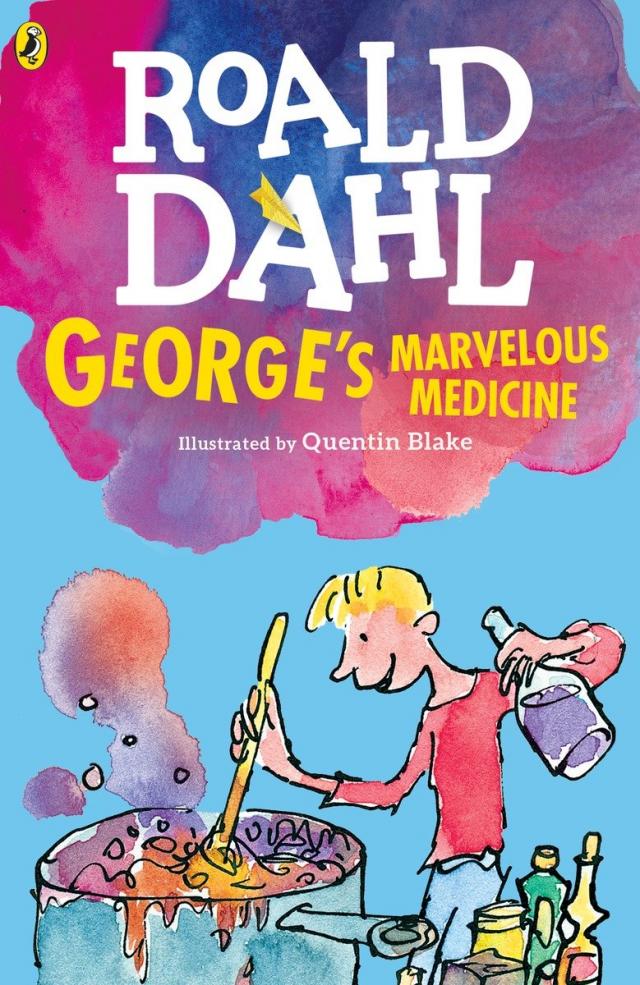
George is alone in the house with Grandma. The most horrid, grizzly old grunion of a grandma ever. She needs something stronger than her usual medicine to cure her grouchiness. A special grandma medicine, a remedy for everything. And George knows just what to put into it. Grandma’s in for the surprise of her life—and so is George, when he sees the results of his mixture!
Puffin Books by Roald Dahl
The BFG
Boy: Tales of Childhood
Charlie and the Chocolate Factory
Charlie and the Great Glass Elevator
Danny the Champion of the World
Dirty Beasts
The Enormous Crocodile
Esio Trot
Fantastic Mr. Fox
George’s Marvelous Medicine
The Giraffe and the Pelly and Me
Going Solo
James and the Giant Peach
The Magic Finger
Matilda
The Minpins
The Missing Golden Ticket and Other Splendiferous Secrets
Revolting Rhymes
The Twits
The Vicar of Nibbleswicke
The Witches
The Wonderful Story of Henry Sugar and Six More
This book is
for doctors everywhere
PUFFIN BOOKS
Published by the Penguin Group
Penguin Young Readers Group,
345 Hudson Street, New York, New York 10014, U.S.A.
Penguin Group (Canada), 90 Eglinton Avenue East, Suite 700,
Toronto, Ontario M4P 2Y3, Canada (a division of Pearson Penguin Canada Inc.)
Penguin Books Ltd, 80 Strand, London WC2R 0RL, England
Penguin Ireland, 25 St Stephen’s Green, Dublin 2, Ireland (a division of Penguin Books Ltd)
Penguin Group (Australia), 707 Collins St., Melbourne, Victoria 3008, Australia
(a division of Pearson Australia Group Pty Ltd)
Penguin Books India Pvt Ltd, 11 Community Centre,
Panchsheel Park, New Delhi-110 017, India
Penguin Group (NZ), 67 Apollo Drive, Rosedale, Auckland 0632, New Zealand
(a division of Pearson New Zealand Ltd)
Penguin Books, Rosebank Office Park, 181 Jan Smuts Avenue,
Parktown North 2193, South Africa
Penguin China, B7 Jaiming Center, 27 East Third Ring Road North, Chaoyang District, Beijing 100020, China
Penguin Books Ltd, Registered Offices: 80 Strand, London WC2R 0RL, England
First published in the United States of America by Alfred A. Knopf, Inc., 1982
Published in Puffin Books, 1991
Reissued in this edition by Puffin Books, a division of Penguin Young Readers Group, 2007
Text copyright © Roald Dahl, 1981
Illustrations copyright © Quentin Blake, 1981
All rights reserved
THE LIBRARY OF CONGRESS HAS CATALOGED THE PREVIOUS PUFFIN BOOKS EDITION
UNDER CATALOG CARD NUMBER: 91–53034
ISBN: 978-1-101-65299-2
Except in the United States of America, this book is sold subject to the condition that it shall not, by way of trade or otherwise, be lent, re-sold, hired out, or otherwise circulated without the publisher’s prior consent in any form of binding or cover other than that in which it is published and without a similar condition including this condition being imposed on the subsequent purchaser.
The publisher does not have any control over and does not assume any responsibility for author or third-party Web sites or their content.
Version_3
Contents
Grandma
The Marvelous Plan
George Begins to Make the Medicine
Animal Pills
The Cook-up
Brown Paint
Grandma Gets the Medicine
The Brown Hen
The Pig, the Bullocks, the Sheep, the Pony and the Nanny Goat
A Crane for Grandma
Mr. Kranky’s Great Idea
Marvelous Medicine Number Two
Marvelous Medicine Number Three
Marvelous Medicine Number Four
Goodbye, Grandma
Grandma
“I’m going shopping in the village,” George’s mother said to George on Saturday morning. “So be a good boy and don’t get into mischief.”
This was a silly thing to say to a small boy at any time. It immediately made him wonder what sort of mischief he might get into.
“And don’t forget to give Grandma her medicine at eleven o’clock,” the mother said. Then out she went, closing the back door behind her.
Grandma, who was dozing in her chair by the window, opened one wicked little eye and said, “Now you heard what your mother said, George. Don’t forget my medicine.”
“No, Grandma,” George said.
“And just try to behave yourself for once while she’s away.”
“Yes, Grandma,” George said.
George was bored to tears. He didn’t have a brother or a sister. His father was a farmer, and the farm they lived on was miles away from anywhere, so there were never any children to play with. He was tired of staring at pigs and hens and cows and sheep. He was especially tired of having to live in the same house as that grizzly old grunion of a grandma. Looking after her all by himself was hardly the most exciting way to spend a Saturday morning.
“You can make me a nice cup of tea for a start,” Grandma said to George. “That’ll keep you out of mischief for a few minutes.”
“Yes, Grandma,” George said.
George couldn’t help disliking Grandma. She was a selfish grumpy old woman. She had pale brown teeth and a small puckered-up mouth like a dog’s bottom.
“How much sugar in your tea today, Grandma?” George asked her.
“One spoonful,” she said. “And no milk.”
Most grandmothers are lovely, kind, helpful old ladies, but not this one. She spent all day and every day sitting in her chair by the window, and she was always complaining, grousing, grouching, grumbling, griping about something or other. Never once, even on her best days, had she smiled at George and said, “Well, how are you this morning, George?” or, “Why don’t you and I have a game of Snakes and Ladders?” or, “How was school today?” She didn’t seem to care about other people, only about herself. She was a miserable old grouch.
George went into the kitchen and made Grandma a cup of tea with a teabag. He put one spoon of sugar in it and no milk. He stirred the sugar well and carried the cup into the living room.
Grandma sipped the tea. “It’s not sweet enough,” she said. “Put more sugar in.”
George took the cup back to the kitchen and added another spoonful of sugar. He stirred it again and carried it carefully in to Grandma.
“Where’s the saucer?” she said. “I won’t have a cup without a saucer.”
George fetched her a saucer.
“And what about a teaspoon, if you please?”
“I’ve stirred it for you, Grandma. I stirred it well.”
“I’ll stir my own tea, thank you very much,” she said. “Fetch me a teaspoon.”
George fetched her a teaspoon.
When George’s mother or father was home, Grandma never ordered George about like this. It was only when she had him on her own that she began treating him badly.
“You know what’s the matter with you?” the old woman said, staring at George over the rim of the teacup with those bright wicked little eyes. “You’re growing too fast. Boys who grow too fast become stupid and lazy.”
“But I can’t help it if I’m growing fast, Grandma,” George said.
“Of course you can,” she snapped. “Growing’s a nasty childish habit.”
“But we have to grow, Grandma. If we didn’t grow, we’d never be grown-ups.”
“Rubbish, boy, rubbish,” she said. “Look at me. Am I growing? Certainly not.”
“But you did once, Grandma.”
“Only very little,” the old woman answered. “I gave up growing when I was extremely small, along with all the other nasty childish habits like laziness and disobedience and greed and sloppiness and untidiness and stupidity. You haven’t given up any of these things, have you?”
“I’m still only a little boy, Grandma.”
“You’re eight years old,” she snorted. “That’s old enough to know better. If you don’t stop growing soon, it’ll be too late.”
“Too late for what, Grandma?”
“It’s ridiculous,” she went on. “You’re nearly as tall as me already.”
George took a good look at Grandma. She certainly was a very tiny person. Her legs were so short she had to have a footstool to put her feet on, and her head only came halfway up the back of the armchair.
“Daddy says it’s fine for a man to be tall,” George said.
“Don’t listen to your daddy,” Grandma said. “Listen to me.”
“But how do I stop myself growing?” George asked her.
“Eat less chocolate,” Grandma said.
“Does chocolate make you grow?”
“It makes you grow the wrong way,” she snapped. “Up instead of down.”
Grandma sipped some tea but never took her eyes from the little boy who stood before her. “Never grow up,” she said. “Always down.”
“Yes, Grandma.”
“And stop eating chocolate. Eat cabbage instead.”
“Cabbage! Oh, no, I don’t like cabbage,” George said.
“It’s not what you like or what you don’t like,” Grandma snapped. “It’s what’s good for you that counts. From now on, you must eat cabbage three times a day. Mountains of cabbage! And if it’s got caterpillars in it, so much the better!”
“Ouch,” George said.
“Caterpillars give you brains,” the old woman said.
“Mummy washes them down the sink,” George said.
“Mummy’s as stupid as you are,” Grandma said. “Cabbage doesn’t taste of anything without a few boiled caterpillars in it. Slugs, too.”
“Not slugs!” George cried out. “I couldn’t eat slugs!”
“Whenever I see a live slug on a piece of lettuce,” Grandma said, “I gobble it up quick before it crawls away. Delicious.” She squeezed her lips together tight so that her mouth became a tiny wrinkled hole. “Delicious,” she said again. “Worms and slugs and beetley bugs. You don’t know what’s good for you.”
“You’re joking, Grandma.”
“I never joke,” she said. “Beetles are perhaps best of all. They go crunch!”
“Grandma! That’s beastly!”
The old hag grinned, showing those pale brown teeth. “Sometimes, if you’re lucky,” she said, “you get a beetle inside the stem of a stick of celery. That’s what I like.”
“Grandma! How could you?”
“You find all sorts of nice things in sticks of raw celery,” the old woman went on. “Sometimes it’s earwigs.”
“I don’t want to hear about it!” cried George.
“A big fat earwig is very tasty,” Grandma said, licking her lips. “But you’ve got to be very quick, my dear, when you put one of those in your mouth. It has a pair of sharp nippers on its back end and if it grabs your tongue with those, it never lets go. So you’ve got to bite the earwig first, chop chop, before it bites you.”
George started edging toward the door. He wanted to get as far away as possible from this filthy old woman.
“You’re trying to get away from me, aren’t you?” she said, pointing a finger straight at George’s face. “You’re trying to get away from Grandma.”
Little George stood by the door staring at the old hag in the chair. She stared back at him.
Could it be, George wondered, that she was a witch? He had always thought witches were only in fairy tales, but now he was not so sure.
“Come closer to me, little boy,” she said, beckoning to him with a horny finger. “Come closer to me and I will tell you secrets.”
George didn’t move.
Grandma didn’t move either.
“I know a great many secrets,” she said, and suddenly she smiled. It was a thin icy smile, the kind a snake might make just before it bites you. “Come over here to Grandma and she’ll whisper secrets to you.”
George took a step backward, edging closer to the door.
“You mustn’t be frightened of your old grandma,” she said, smiling that icy smile.
George took another step backward.
“Some of us,” she said, and all at once she was leaning forward in her chair and whispering in a throaty sort of voice George had never heard her use before. “Some of us,” she said, “have magic powers that can twist the creatures of this earth into wondrous shapes.…”
A tingle of electricity flashed down the length of George’s spine. He began to feel frightened.
“Some of us,” the old woman went on, “have fire on our tongues and sparks in our bellies and wizardry in the tips of our fingers.…
“Some of us know secrets that would make your hair stand straight up on end and your eyes pop out of their sockets.…”
George wanted to run away, but his feet seemed stuck to the floor.
“We know how to make your nails drop off and teeth grow out of your fingers instead.”
George began to tremble. It was her face that frightened him most of all, the frosty smile, the brilliant unblinking eyes.
“We know how to have you wake up in the morning with a long tail coming out from behind you.”
“Grandma!” he cried out. “Stop!”
“We know secrets, my dear, about dark places where dark things live and squirm and slither all over each other.…”
George made a dive for the door.
“It doesn’t matter how far you run,” he heard her saying, “you won’t ever get away.…”
George ran into the kitchen, slamming the door behind him.
The Marvelous Plan
George sat himself down at the table in the kitchen. He was shaking a little. Oh, how he hated Grandma! He really hated that horrid old witchy woman. And all of a sudden he had a tremendous urge to do something about her. Something whopping. Something absolutely terrific. A real shocker. A sort of explosion. He wanted to blow away the witchy smell that hung about her in the next room. He may have been only eight years old, but he was a brave little boy. He was ready to take this old woman on.
“I’m not going to be frightened by her,” he said softly to himself. But he was frightened. And that’s why he wanted suddenly to explode her away.
Well…not quite away. But he did want to shake the old woman up a bit.
Very well, then. What should it be, this whopping terrific exploding shocker for Grandma?
He would have liked to put a firecracker under her chair, but he didn’t have one.
He would have liked to put a long green snake down the back of her dress, but he didn’t have a long green snake.
He would have liked to put six big black rats in the room with her and lock the door, but he didn’t have six big black rats.
As George sat there pondering this interesting problem, his eye fell upon the bottle of Grandma’s brown medicine standing on the sideboard. Rotten stuff it seemed to be. Four times a day a large spoonful of it was shoveled into her mouth, and it didn’t do her the slightest bit of good. She was always just as horrid after she’d had it as she’d been before. The whole point of medicine, surely, was to make a person better. If it didn’t do that, then it was quite useless.
So-ho! thought George suddenly. Ah-ha! Ho-hum! I know exactly what I’ll do. I shall make her a new medicine, one that is so strong and so fierce and so fantastic it will either cure her completely or blow off the top of her head. I’ll make her a magic medicine, a medicine no doctor in the world has ever made before.
George looked at the kitchen clock. It said five past ten. There was nearly an hour left before Grandma’s next dose was due at eleven.
“Here we go, then!” cried George, jumping up from the table. “A magic medicine it shall be!
“So give me a bug and a jumping flea,
Give me two snails and lizards three,
And a slimy squiggler from the sea,
And the poisonous sting of a bumblebee,
And the juice from the fruit of the jujube tree,
And the powdered bone of a wombat’s knee.
And one hundred other things as well
Each with a rather nasty smell.
I’ll stir them up, I’ll boil them long,
A mixture tough, a mixture strong.
And then, heigh-ho, and down it goes,
A nice big spoonful (hold your nose)
Just gulp it down and have no fear.
‘How do you like it, Granny dear?’
Will she go pop? Will she explode?
Will she go flying down the road?
Will she go poof in a puff of smoke?
Start fizzing like a can of Coke?
Who knows? Not I. Let’s wait and see.
(I’m glad it’s neither you nor me.)
Oh Grandma, if you only knew
What I have got in store for you!”
George Begins to Make the Medicine
George took an enormous stewing pot out of the cupboard and placed it on the kitchen table.
“George!” came the shrill voice from the next room. “What are you doing?”
“Nothing, Grandma,” he called out.
“You needn’t think I can’t hear you just because you closed the door! You’re rattling the pots and pans!”
“I’m just tidying the kitchen, Grandma.”
Then there was silence.
George had absolutely no doubts whatsoever about how he was going to make his famous medicine. He wasn’t going to fool about wondering whether to put in a little bit of this or a little bit of that. Quite simply, he was going to put in EVERYTHING he could find. There would be no messing about, no hesitating, no wondering whether a particular thing would knock the old girl sideways or not. The rule would be this: Whatever he saw, if it was runny or powdery or gooey, in it went.


