Danish dynamite, p.22
Danish Dynamite, page 22
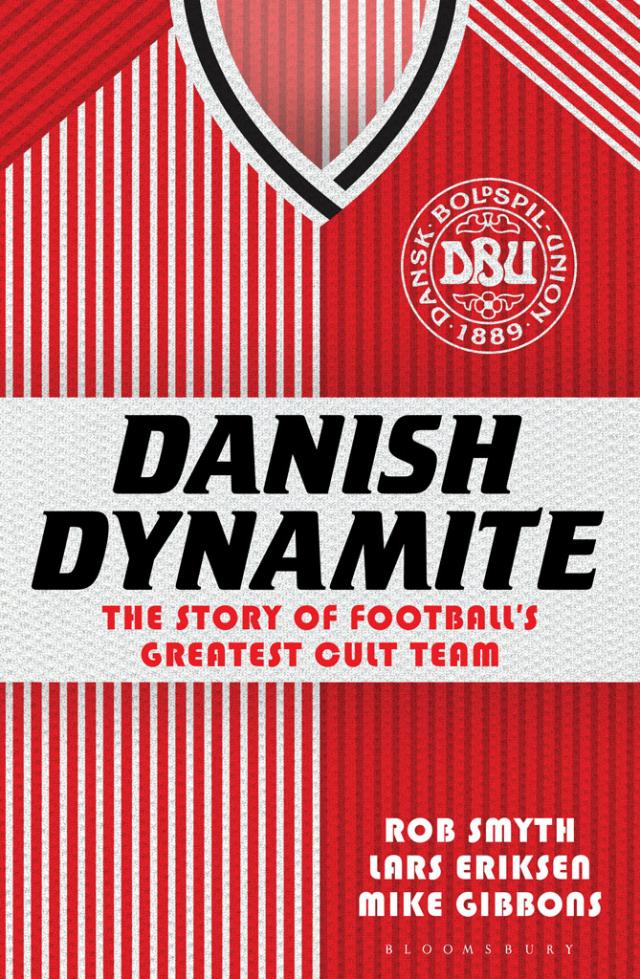


Time has not been kind to the fashion sense of anyone from the eighties and this is clearly one area where the Danish team cannot compete with the Dutch. The long hair and love beads that the Dutch players sported regularly come back in and out of fashion but it’s safe to assume there will be another Ice Age before the thick moustaches and cock-rock mullets paraded by Piontek’s squad are deemed even close to acceptable again. The shirt from Mexico is the one acceptable item from the era – it is far more popular now than when it was first launched just before the World Cup – and the fact that the almost identical Southampton version (albeit with their own badge, and Draper Tools splashed across the chest) isn’t as sought-after by the memorabilia geeks of football speaks volumes. As iconic as the design might be it would be worthless without its association with the Danish players who wore it.
Morten Olsen was asked how a group of players who individually earned their living at Europe’s most ruthless clubs could collectively play with such joyous abandon for their national side. ‘When we come together to play for Denmark football becomes our hobby again,’ he told a throng of international reporters in Mexico. ‘A happy thing to do together, like when we were all young boys.’ The innocence in that statement from Denmark’s most experienced player reveals both their huge appeal and also the root of their downfall.
Their overly attacking style of play was always a double-edged sword and ultimately the one they died by, a cinematic ending but not the happy one. The numbing defeat in Querétaro was a fitting conclusion to their story, pouring forward with an almost childlike naivety in that final half-hour only to be repeatedly picked off by a savvy Spanish team. It was magnificent but obviously doomed, yet their refusal to compromise on their principles only served to make them seem even more human.
They stayed true to themselves right up until the end, an increasingly rare quality that everyone desires but few actively try to develop, and worth more than any trophy. Long after the medals have been handed out and the tournaments have been condensed into a short collection of memories, that is the detail that stays with everyone who saw them. To the victors went the spoils. The glory went to Denmark.
Chapter 21
When we should have been world champions
Danish Dynamite isn’t cult in Denmark; it’s culture. The players, the manager, France and Mexico all share a place in the national consciousness. When a DJ on national radio introduces a song from 1986 as ‘the year when we should have been world champions’ no listener is left in doubt. When Michael Laudrup signs a deal with Swansea, a Danish tabloid uses the headline THAT’S GENIUS, THAT – the same words Svend Gehrs famously said when Laudrup danced his way through the Uruguayan defenders in Mexico. The Dynamite vernacular has become shorthand for a nation.
Gehrs’s co-commentator Tommy Troelsen summed it up before the match against the Soviet Union on Constitution Day in 1985: ‘It’s nice for all the fans that we now have a team which we can support and which we can call our own, as opposed to earlier when we had to adopt favourites from other places.’ The Danes still call that team their own; they call them heroes. Many people have an easier time listing the starting XI against USSR or Uruguay than the one that played in the most recent international.
Some of these names – Laudrup, Frank Arnesen, Søren Lerby – still play their part in international football. After an unsuccessful stint as manager of Bayern Munich in the early nineties, Lerby started a meat exporting business before he became a players’ agent. Arnesen, his old friend from Fremad Amager and Ajax, has roamed the higher echelons of club football at Tottenham, Chelsea and Hamburg. The image of cheeky Frankie Boy has been supplanted by that of a top-level executive who made his name by discovering the likes of Ronaldo and Ruud van Nistelrooy.
Morten Olsen went on to manage Ajax, but eventually returned home to oversee a new generation of Denmark players. He holds one of the most remarkable records in football; in 2009 he became the first person ever to reach one hundred games for his country as both player and manager. Allan Simonsen also served as international manager – for the Faroe Islands and then Luxembourg – before returning to club football in Denmark. He also appeared on ‘Vild Med Dans’, the Danish version of Strictly Come Dancing (“What’s there to sell out of as a 60-year-old?” Simonsen told Ekstra Bladet).
For others, life after football started a long time ago. Klaus Berggreen, the Dottore, learned more in Italy than just football. He used his business degree and Italian fashion connections to set up a women’s clothing label (the name, Piro, links two of his Italian clubs, Pisa and Roma). Jens Jørn Bertelsen, who for so many years provided high-risk cover in Piontek’s squad, is back working in the insurance business where he got his apprenticeship. He also ran a group of high-street steakhouses for seventeen years. ‘I’m no wizard in the kitchen’, says Bertelsen, ‘but the desire was there to make it in the business world.’ He still socialises with John Lauridsen and Ole Kjær but doesn’t lace up his boots when the old boys’ team in Esbjerg – the ‘fat bellies club’ – take to the pitch.
Ivan Nielsen might be football’s only European Cup-winning plumber. When he is interviewed for this book he sits on an upturned black plastic bucket in a garage in Copenhagen’s Amager district. ‘Ivan and Thomas Nielsen VVS’ reads the lettering on the breast pocket of his blue jumper, where he keeps his cigarettes and glasses. He gets up, pats his paunch and runs a finger over the moustache. His fellow defensive bouncer Søren Busk – who these days sells footballs as director of the Danish sports company Select – has now shaved off sneglen (the snail), but Nielsen’s trademark ’tache is going nowhere. It has only got the chop once since he was seventeen, but when his wife remarked how much younger it made him look Nielsen immediately grew it back. His bowl-cut has also stood the test of time, but the weary eyes and lived-in face tell the story of a man who has done many a hard day’s work – many sour metres, in the words of his old friend Busk – on and off the field.
After ending his international career, Nielsen returned to club football in Denmark. He won the championship with FC Copenhagen in 1993, but after two short stints as manager with smaller clubs there was nothing. ‘At one point after football I was so sick and tired of coming home and doing nothing. I couldn’t keep doing it. I couldn’t do it.’ Instead he turned to the trade he had been taught before his football career and launched a plumbing business with his son Thomas.
In 2002, Nielsen attended the funeral of John Eriksen. His former Denmark and Feyenoord team-mate suffered from dementia and died at the age of forty-four. Jesper Olsen and Per Røntved both suffered brain haemorrhages in the years after their Denmark careers. Olsen’s recovery was quick – ‘One of those lucky things I suppose’ – while Røntved used his fearless tenacity to battle through four years of rehabilitation after part of the left side of his body was paralysed. The accident happened in 1984 after a playful skipping rope contest at his summer house. Twenty years later, Røntved hit a hole in one at his local golf course. Today, his eyes light up and the stories flow as he watches YouTube highlights from his Denmark games.
The memories of Idrætsparken, Wembley and Neza are a long time ago. But only if you measure it in terms of years. Firserholdet (the eighties team) were inducted into the Danish Football Hall of Fame in 2009, an event which has effectively turned into an annual reunion party where Denmark’s golden generation enjoy another third half and kick around memories of old times. Two years after the team’s induction, Sepp Piontek was back on the podium as one of two individuals honoured. The other was Røntved. Richard Møller Nielsen died at the age of 76 in February 2014, a few weeks before he was due to receive his award.
That Danish football wanted to bestow on Piontek an individual recognition of his achievements is as much about the results on the pitch as it is a tribute to his transformational effect on the country to which he moved. ‘The German who made us be Danes’ read the strapline on a 1990 biography by the writer Knud Esmann. Piontek was greeted in 1979 with a mixture of fear, awe, stereotypes and respect. He ruffled the feathers of the Establishment and unlocked the potential that the Danes were too blinded by old habits to realise. Not only did he bring them the results, he did it in a breathtaking manner that made the rest of the world hold them in the highest regard. The Danes took Piontek to heart and vice versa. Even when he quit their national team he never left them.
Piontek’s fingers race across a red tablecloth in between coffee cups, spoons and dictaphones as he relives the highlights of a career that has been defined by an ability to mine footballing success in a barren landscape. ‘There are no expectations,’ Piontek says of his career choices. ‘If you build them up, you’ll be the king.’ He managed chaos and voodoo in Haiti, ignited the dynamite in Denmark and has widely been credited with transforming the fortunes of Turkey. Even if Turkey’s biggest international results were recorded in the years after Piontek’s departure, his three years as manager laid the foundation and tapped into a potential that, just like the one he found in Denmark, had been unfulfilled.
Piontek managed clubs in Turkey and Denmark, but had to pack away the pipe after suffering a coronary thrombosis. He scaled down his career but didn’t shy away from a challenge when he took on a coaching job with Greenland, even if their football association had no money to pay him. Instead, the seafood company Royal Greenland came by his house in Denmark every three weeks and let him fill his freezer with lobster which usually ended up on the queen’s dinner table. Twenty-five years on from Baby Doc’s money machine, Piontek was once again paid in damp wages.
In recent years he has divided his time between public-speaking engagements and helping out a small lower-league football team; if his right knee allows, he fits in a round of golf on the neighbouring course. It’s thirty-five years since he first arrived in Denmark and he still calls it his home. He realised he was never going to leave the country after marrying his wife Gitte in 1988. ‘I feel fine about being in Denmark,’ says Piontek. ‘People are nice to me and they haven’t forgotten the eighties so I couldn’t have it any better. The only thing that annoys me is the high car prices and that we have to pay so much in tax.’
Piontek has been trying to convince his good friend Preben Elkjær to spend some time at his summer house in Turkey; their family holidays together have included trips to the Indian Ocean. Their lasting friendship would have been the most unlikely storyline in 1979, but it is because of that common ground between the German yin and Danish yang that Piontek and his players edged closer throughout the eighties. ‘We needed somebody,’ said Elkjær. ‘Not only us, but Danish football needed somebody who was really professional, who took things seriously, who also taught the DBU how to conduct business.’
After a stint managing the club Silkeborg, Elkjær learned how to conduct business the hard way when he became head of an ambitious new sports TV channel. The channel shut down within a year, but Elkjær stuck to the screen. Together with Brian Laudrup, Jan Mølby and Per Frimann, he has been part of an all-star line-up that presents Champions League coverage in Denmark.
One of Elkjær’s most prized pieces of memorabilia is not from the world of football. It’s a framed photograph depicting a young boy standing in a refugee camp in Goma. The boy is wearing a 1986 Denmark shirt with the name Elkjær on the back. The picture was taken by the Danish photographer Henrik Saxgren who posted it to Elkjær. ‘It’s a very strong photograph,’ says Elkjær. ‘It’s a beautiful photograph.’
The shirt in the photograph is a replica. It even has the wrong number – nine – printed on the back. It wouldn’t fetch much on eBay. Elkjær thinks it must have been a charity donation. ‘Somebody got tired of Elkjær and thought: what can I do with this shirt?’
Back on the Isle of Man Dave Bignell’s friends from football weren’t tired of Elkjær. Some of them specifically asked to be seated at his table for the wedding. There were guests who probably couldn’t tell the difference between one table name and the other, and were happy as long as they got a good view of the bride and groom. For those who had stayed up those late nights in 1986 or still had the old VHS tapes, the names on the tables were shorthand for one of the greatest stories football ever told.
Bibliography
Andersen, Jens, Frankie Boy, People’s Press, Copenhagen, 2008
Ankerdal, Steen, Landsholdet, Aschehoug, Oslo, 2006
Ankerdal, Steen, Lassen, Kurt, Sloth, Peter Chefen, Ekstra Bladet, Copenhagen, 2009
Bartram, Jan, Løb for livet, Aschehoug, Oslo,1998
Boisen, Axel, Christian Mohr Boisen and Henrik Nordskilde, Laudrup – et fodbolddynasti, Lindhardt og Ringhof, Copenhagen, 2008
Elkjær, Preben, Guldkjær, Aller, Copenhagen, 1985
Elkjær, Preben, Målkjær, Aller, Copenhagen, 1980
Elkjær, Preben, Mit liv som Elkjær, Politiken, Copenhagen, 2012
Ellegaard, Lasse, Fodbold er ikke for de stumme, Gonzo, Copenhagen, 1986
Esmann, Knud, Sepp, Hovedland, Gjern, Denmark,1990
Freddi, Cris, Complete Book of the World Cup, HarperSport, London, 2006
Gandil, Johannes, Dansk Fodbold, DBU, Copenhagen 1939
Jakobsen, Joakim, Tynd luft, Gyldendal, Copenhagen, 2008
Jørgensen, Palle ‘Banks’, Landsholdets 2198 spillerprofiler, Tipsbladet, Copenhagen, 2004
Jørgensen, Palle ‘Banks’, Landsholdet – i medgang og modgang, Tipsbladet, Copenhagen, 2000
Krabbe, Hans and Sørensen, Dan Hirsch, Drengene fra Wembley, Lindhardt og Ringhof, Copenhagen, 2008
Laursen, Thomas and Sønnichsen, Ole, Danish Dynamite: spillernes egne historier om 80’er-holdet, Gyldendal, Copenhagen, 2008
Lundberg, Knud, Dansk Fodbold 1–3, Rhodos, Copenhagen, 1986–1988
Hesse-Lichtenberger, Uli, Tor!: The Story of German Football, WSC Books Limited, London, 2003
Molby, Jan, Jan The Man: From Anfield to Vetch Field, Gollancz, London, 2000
Mønster, Flemming, Vejen til Mexico, Hovedland, Gjern, Denmark,1985
Peitersen, Birger, Dem der ikke hopper, Ekstra Bladet, Copenhagen, 2004
Robson, Bobby, World Cup Diary, HarperCollins, London, 1986
Robson, Bobby, Farewell but not Goodbye: My Autobiography, Hodder & Stoughton, London, 2005
Various, Det bedste de gav os, Haase, Copenhagen, 1990
Newspapers and magazines
Ekstra Bladet, Billed-Bladet, Se og Hør, Jyllands-Posten, Aktuelt, Politiken, Berlingske Tidende, B.T., Alt om Sport, Tipsbladet, Ud & Se, Weekendavisen, Sabotage Times, The Blizzard, The Guardian, The Observer, The Daily Express, The Times and Sunday Times, The Daily and Sunday Telegraph, The Daily Mirror, The Sun, The Daily Mail, World Soccer, FourFourTwo.
Film and TV archives
Og Det Var Danmark (Carsten Søsted and Mads Kamp Thulstrup)
Landsholdets Legender (Frits Ahlstrøm)
Footage from: Danmarks Radio, TV2, TV3+, BBC, ITV, SVT
Acknowledgements
A number of people were extremely helpful in supplying contacts, support, inspiration and even steak. We’d like to thank Kalle-Weis Fogh, Kim Rotbøl at Hummel, James Dart, Tom Adams, Jan Madsen (and his friends from France 84), Lars Møller Nygaard (and everybody onboard Roliganexpressen), Gavin Hamilton, Jonathan Wilson, Duncan Alexander, Dave Bignell, Cris Freddi, Per and Helle Kjærbye, Paul Doyle, Scott Murray, Alex Netherton, Daniel Harris, Jacob Steinberg, Leander Schaerlaeckens, Lars Berendt and the DBU, Stine Riis at Polfoto, Jonathan Wilsher, Malene Thomsen, Bashir and Ayo, Charlotte Sørensen, Mike Alderson, Peter Kjær and Mathias Buch Jensen.
We’d like to offer special thanks to those who ran the extra sure meter to help us: Christian Mohr Boisen, Janus Køster-Rasmussen, Frits Ahlstrøm and our agent Ed Wilson, and of course everyone at Bloomsbury: the publisher Charlotte Atyeo, editors Jane Lawes and Nick Humphrey, copy-editor Richard Collins, designer Steve Leard and publicist Eleanor Weil.
Thanks to the interviewees who were polite, engaging and generous with their time – and who proved sometimes it is safe to meet your heroes, even if you’re sitting on upturned buckets in a smoke-filled garage or surrounded by the retro kitsch and Twin Peaks vibe of Motel Brasilia: Sepp Piontek, “King” Klaus Berggreen, Jens Jørn Bertelsen, Michael Laudrup, Preben Elkjær, Allan Simonsen, Ivan Nielsen, Søren Busk, Morten Olsen, Jesper Olsen, Troels Rasmussen, Ole Kjær, Ole Qvist, Lars Høgh, John Sivebæk, John Lauridsen, Per Frimann, Steen Thychosen, Kenneth Brylle, Henrik Eigenbrod, Flemming Christensen, Per Røntved, Jan Sørensen, Steve Nicol, Eoin Hand, Horst Wohlers, Svend Gehrs, Frits Ahlstrøm, Martin Tyler, Simon Kuper, Dodo and her band, Jarl Friis Mikkelsen, Birgit Leitner, Carl Peter Mysager and Dave Bignell.
Finally, thanks to our friends and families for being so helpful and understanding when our minds and hearts were occupied by the endeavours of a football team from the past.
And here’s to Eik Rocky Nordquist Eriksen one day wearing the no 10 shirt for Denmark and capturing the spirit of our heroes.
List of Illustrations
1. A man of his time: the avuncular, likeable Kurt Nielsen was Denmark’s manager before Sepp Piontek.
2. Sepp Piontek, sitting right, managed Haiti – where his salary was usually fresh off the press – before taking over Denmark.
3. Reservoir Danes: Frank Arnesen, Søren Lerby, Allan Simonsen and Preben Elkjær strut their stuff during training for the World Cup qualifier against Yugoslavia in 1981.
4. Scouting missions to Anderlecht were a blessing for Sepp Piontek, with four of his far-flung squad based there. From left: Kenneth Brylle, Morten Olsen, Sepp Piontek, Per Frimann and Frank Arnesen.
5. ‘Ajax clan’ members Søren Lerby, Jesper Olsen and Frank Arnesen play to stereotype ahead of the crucial match at Wembley.
6. And a football nation is born: Allan Simonsen scores at Wembley to secure the breakthrough victory for Danish football.