The nearly complete coll.., p.964
Never Kiss a Krampus, page 964
part #1 of Wrong Move, Right Monster Series


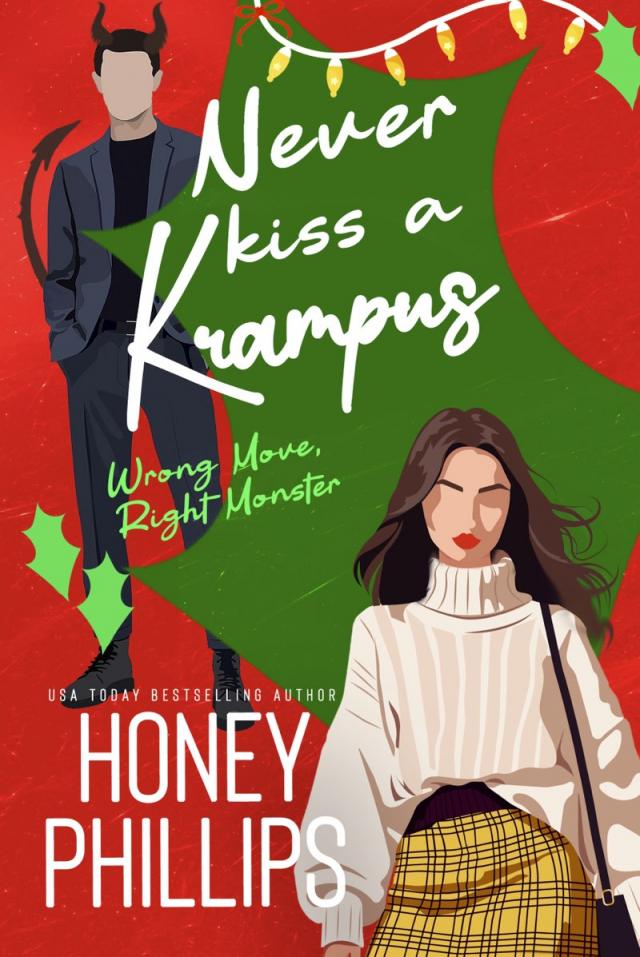
NEVER KISS A KRAMPUS
A COZY MONSTER HOLIDAY ROMANCE
WRONG MOVE, RIGHT MONSTER
HONEY PHILLIPS
CONTENTS
Chapter 1
Chapter 2
Chapter 3
Chapter 4
Chapter 5
Chapter 6
Chapter 7
Chapter 8
Chapter 9
Chapter 10
Chapter 11
Chapter 12
Chapter 13
Chapter 14
Chapter 15
Chapter 16
Chapter 17
Chapter 18
Chapter 19
Chapter 20
Chapter 21
Chapter 22
Chapter 23
Chapter 24
Chapter 25
Chapter 26
Chapter 27
Chapter 28
Epilogue
Author’s Note
Other Titles
About the Author
CHAPTER 1
The third bulb on the left died.
I stood on the stepladder, watching in dismay as the Christmas tree’s middle section went dark. One moment it blazed with cheerful white lights, the next—nothing. Just a gaping hole of shadow between the top and bottom strands, like the tree had given up halfway through its festive mission.
Perfect. Just perfect.
I climbed down and pressed my forehead against the tree’s fake pine needles. They smelled like dust and broken dreams, which was fitting because that’s exactly what this morning felt like. The artificial branches scratched my cheek, but I stayed there anyway, breathing in the scent of failure disguised as evergreen.
The jingle bells above the door of the shop stayed silent. They had been silent for two hours.
I pulled back and surveyed the damage. The tree stood in its usual spot by the bay window, still decorated with handmade ornaments and ribbon garlands I’d spent three evenings perfecting. From outside, it probably looked… fine. From inside, all I could see was the dead section and the way the whole display tilted slightly to the left because I’d never properly secured the stand.
My grandmother would have known how to fix it. She’d known how to fix everything. She’d also had this magical ability to make everyone who walked through that door feel like they’d discovered something special, something just for them. She’d built relationships and turned casual browsers into devoted customers. But Gran had been gone for two years, and apparently I hadn’t inherited her gift for sales along with the shop.
I sighed and straightened my hand-knitted red cardigan as I headed behind the counter. The ancient cash register gleamed in the morning light, its brass keys polished to a shine. I’d cleaned it yesterday during the four-hour stretch between customers. Before that, I’d reorganized the ornament display. And dusted the shelf of vintage Christmas villages. And rearranged the scented candles by color instead of scent because something had to change, even if it was just the order of “Cinnamon Spice” and “Winter Wonderland.”
“Music,” I said to the empty shop. “Music makes everything better.”
I pulled out my phone, pointedly ignoring the notification from First National Bank, and queued up my “Ultimate Christmas Cheer” playlist. Mariah Carey’s voice filled the shop, bright and hopeful and so sure that all she wanted for Christmas was… well, not a failing business and a mountain of debt.
The stack of envelopes sat exactly where I’d left them, mocking me with their official letterheads and final notice stamps. I should open them. I should face the numbers, add them up, figure out exactly how screwed I was.
Coffee. I needed coffee first.
I filled the ancient coffeemaker I’d bought at a yard sale earlier that fall and waited impatiently as it groaned and wheezed its way through the brewing cycle. When it gave a final death rattle and produced something that resembled coffee if I didn’t think too hard about it, I dumped in three spoonful’s of sugar and a healthy pour of peppermint mocha creamer.
I’d invested in the fancy creamer the previous week—a splurge I absolutely couldn’t afford—because sometimes you had to choose between paying the electric bill on time and maintaining your will to live. I chose the creamer.
The mug was one I’d painted myself with “Jolliest Elf in the Workshop” in looping gold script and tiny toys dancing around the rim. It had seemed clever at the time. Now it just felt like mockery. I took a long sip, letting the warmth spread through my chest, and peeked at the pile of envelopes, hoping it might have grown smaller. It hadn’t.
Next to the bills, folded into a neat, menacing square, was Mr. Grinchly’s latest offer. I didn’t need to open it. I’d memorized the contents of the first three. The improbably but accurately named developer wanted my building. He wanted the whole block. And he was willing to wait just long enough for desperation to do his negotiating for him.
The jingle bells chimed and I nearly dropped my mug. Coffee sloshed over the rim, burning my thumb. I bit back a curse and plastered on my best customer service smile instead.
A woman stood just inside the door, grey coat buttoned against the December chill, eyes scanning the shop with the kind of polite interest that meant she was killing time, not actually shopping. She looked to be in her forties, tired around the edges, with grocery bags hanging from both arms.
“Good morning!” I chirped, channeling every ounce of enthusiasm I could muster. “Welcome to Noelle’s Nook! I’m Noelle. Can I help you find anything?”
She smiled, but it didn’t reach her eyes. “Just browsing, thanks.”
The universal code for “leave me alone.”
I retreated behind the counter and pretended to organize receipt tape while secretly watching her drift through the aisles. She touched a snow globe, picked up a scented candle, and examined a set of hand-painted ornaments. Everything went back on the shelf.
My stomach twisted. I knew that look. That “everything’s lovely but I can’t justify the expense” look.
She made it to the clearance bin near the back. I’d marked everything down last week—fifty percent off, some items even more. Hand-knitted stockings that didn’t sell last Christmas. Specialty wrapping paper with slight creases. A collection of wooden nutcrackers with paint chips on their uniforms.
She pulled out a small ceramic angel, white with gold trim. The price tag read five dollars, marked down from fifteen.
“That’s handmade by a local artist,” I said, keeping my voice light. “Each one’s unique.”
“It’s lovely.” She turned it over in her hands. “My mother collects angels.”
She brought it to the counter, and I wrapped it carefully in tissue paper, moving slowly to make the transaction last longer. The register drawer opened with its familiar ding, and I made change from the nearly empty cash tray.
“Thank you so much for shopping locally,” I said, handing her the small red and white striped bag with Noelle’s Nook printed in silver glitter. “Have a wonderful day!”
“You too, dear.” She paused at the door. “I hope… well. Good luck with everything.”
Then she was gone, and the shop was empty again. Mariah Carey had given way to “Rockin’ Around the Christmas Tree.” I jabbed at my phone, switching to something quieter. Bing Crosby. At least Bing understood melancholy.
I grabbed my coffee and walked to the front window, looking out at Main Street. Mr. Peterson was arranging a display of rakes outside his hardware store across the way. The café three doors down was setting out their sidewalk sign with the lunch specials. Normal everyday activities.
Except it wasn’t, not really. Main Street used to glow this time of year. Every shop window was a masterpiece, competing in the informal but fiercely contested decorating war. The smell of roasted chestnuts drifted from the corner vendor. There were carolers on weekends, and a massive tree in the town square that the mayor lit with great ceremony the day after Thanksgiving.
This year’s tree was half the size of last year’s. Budget cuts, they said. The garlands strung between the lamp posts looked sparse and bedraggled, and half the businesses had skipped the window displays. The café’s sign advertised hot chocolate, but I’d walked by yesterday and seen they’d stopped using the fancy Belgian drinking chocolate and switched to the powdered stuff. The antique shop down the street had been sold in September and no business had moved in to replace it.
Stop it. Stop seeing doom everywhere.
But I couldn’t help it. Every empty parking space on Main Street felt like evidence. Every “Going Out of Business” sign—and there had been two in the past month—felt like a prophecy. The whole street felt like it was holding its breath, waiting for something to break. Everyone was struggling, not just me.
I sighed as I retrieved my notebook from under the counter and started scrolling through my plans for a “Good Deeds Extravaganza” on Christmas Eve—a last-ditch community event I’d been planning for the last month. It was intended to be something that would cut through the mall’s convenience and the internet’s efficiency and remind people that shopping local wasn’t just about buying things—it was about community. About the kind of Christmas magic my grandmother used to talk about. The kind of magic I’d stopped believing in somewhere between the third overdue notice and Mr. Grinchly’s smug smile.
I’d planned a toy drive for the local kids, carolers, and an ice-carving contest. I was hoping that all the shop owners would work toget her to encourage people to attend. I could provide free gift-wrapping. Mrs. Park from the bookshop could do story time for kids. Giuseppe from the café could provide hot chocolate. The tailor, Mr. Yoon, could… well, I’d figure something out. It would be an experience so magical, so memorable, that people would remember why they loved shopping local in the first place.
For a moment, I actually felt a wave of optimism. But then my email pinged. A message from the bank.
Subject: Appointment Confirmation
I clicked it, my stomach churning.
Dear Ms. Green,
This email confirms your appointment with our loan specialist on December 30th at 2:00 PM to reassess your current situation and discuss options moving forward.
Please bring all relevant financial documentation.
Sincerely,
First National Bank
“Reassess my situation.” In other words, prove I could make payments or they would take the shop. December 30th was less than three weeks away. Three weeks to come up with three months of back payments, two months of utilities, and enough reserve to convince them I was a viable business. Three weeks to pull off a miracle. Would I still have a home, let alone a business, next year?
I made myself a second cup of coffee—regular this time, because I needed to make the fancy creamer last—and tried very hard not to cry into it.
This is fine. Everything is fine. Something will work out.
Gran used to say that. “Something will work out, sweetheart. It always does.”
But Gran had died before she saw her granddaughter running her beloved shop into the ground.
The bells jangled and I straightened instantly, pinning on my brightest smile. “Welcome to Noelle’s Nook! Can I help you find—”
Mr. Grinchly filled my doorway like a bad omen in an expensive suit.
“Miss Green.” He adjusted his tie, a nervous habit that somehow made him seem more predatory rather than less. His beady eyes swept across my shop with the warmth of a tax assessor. “Quite the… charming establishment you have here.”
“Mr. Grinchly.” I kept my smile in place through sheer force of will. “If you’re here about your offer—”
“Just checking in.” He stepped inside, his leather shoes squeaking against my worn wooden floors. “The deadline’s coming up fast. I wanted to see how you were… managing.”
Managing. The word dripped with false concern.
“I’m doing great, actually.” The lie tasted like burnt sugar. “Holiday sales are picking up. You know how it is—everyone waits until the last minute.”
“Mmm.” He picked up one of Susan Madison’s hand-painted ornaments, a delicate glass sphere with a winter scene inside. His thumb smudged the surface. “Beautiful craftsmanship. Shame there’s no market for this sort of thing anymore.”
I resisted the urge to snatch it from his hands. “There’s always a market for quality.”
“Quality doesn’t pay the bills, Miss Green.” He set the ornament down carelessly. It wobbled. My heart wobbled with it. “Foot traffic does. Sales do. And from what I can see…”
He let the sentence hang there, suspended in the cinnamon-scented air like a noose.
“I appreciate your concern.” I moved around the counter, subtly positioning myself between him and my displays. “But I have everything under control.”
“Do you?” His sneer was almost sympathetic. Almost. “Because I’ve been watching the comings and goings on this block. Your neighbors—the bookshop, the café, the tailor—they’re all struggling just like you. One by one, they’ll realize what you’re going to realize. That holding onto the past isn’t noble. It’s just stubborn.”
“This isn’t about being stubborn—”
“It’s about being practical.” He pulled out another envelope from his jacket. “This is my final offer, Miss Green. It’s enough to set you up somewhere else. Somewhere with better… prospects.”
I didn’t take it.
“The deadline’s Christmas Eve.” His smile never reached his eyes. “After that, well. I can always wait for the bank to foreclose. But I thought I’d give you the dignity of choosing.”
Dignity. From a man who probably looked up the word in a dictionary just to make sure he was using it ironically.
“I’m not selling.”
“We’ll see.” He placed the envelope on my counter, right on top of my grandmother’s ledger. “Two weeks, Miss Green. Think about it. Really think about it. Sometimes the kindest thing we can do is let go.”
He left before I could respond, the jingle bells sounding more like a death knell than a greeting.
CHAPTER 2
I stood there after Grinchly left, surrounded by twinkling lights and unsold dreams, and felt the weight of it all pressing down on my shoulders. I had to do something, anything, to keep my mind off of the impending disaster. The window display needed refreshing, and a new display always attracted attention.
That will help, I told myself, trying to sound convincing.
I spent the next hour crafting a winter wonderland scene—vintage snow globes arranged on fake snow, white lights twinkling, with a family of stuffed penguins looking charming and not at all desperate for someone to buy them. By the time I finished, my knees ached from kneeling on the floor and my hands were covered in glitter. But it looked good, really good.
I stepped back to admire my work and nearly collided with someone standing behind me.
“Oh! Sorry, I didn’t hear you come in.”
Mrs. Haversham stood there, a large shoebox tucked under one arm, her silver hair perfectly coiffed despite the December wind. She’d taught English at the high school for forty years before retiring, and she still had the posture of someone ready to correct your grammar.
“The bell didn’t ring,” she said, which seemed impossible but I’d learned not to question Mrs. Haversham. “That’s a lovely display, dear.”
“Thank you. Can I help you find something?”
“Actually, I brought you something.” She set the shoebox on the counter and lifted the lid with careful reverence.
The box was filled with dozens of vintage ornaments wrapped in tissue paper. I recognized the style immediately—1950s, hand-blown glass, the kind collectors paid good money for.
“Mrs. Haversham, these are beautiful.”
“They were my mother’s. I thought perhaps you could sell them on consignment.” She pulled out a delicate silver bell, turned it so it caught the light. “I’m downsizing, you see, and moving to that new senior community on Maple Street. My children don’t want them, and I don’t want them locked away in someone’s attic collecting dust.”
“I’d be honored.”
We spent the next twenty minutes going through the collection, me carefully noting each piece while Mrs. Haversham shared the memories attached to them. Her mother decorating the tree while listening to radio carols, and her father pretending to be annoyed but secretly delighting in the ritual.
“Your grandmother loved these,” Mrs. Haversham said softly. “I brought them in once before, about ten years ago, just to show them to her. She held each one like it was precious.”
My throat tightened.
“She had that gift,” Mrs. Haversham continued. “The gift of making people feel like their stories mattered. You have it too, you know.”
“I’m not sure I do.”
“Hmm.” Mrs. Haversham settled herself into one of the armchairs I kept for browsing customers, her back ramrod straight and her sharp eyes fixed on me. Avoiding that knowing gaze, I picked up a glass sphere, deep blue with hand-painted silver stars. Light caught it, throwing tiny constellations across the wall.
“Your grandmother loved the stars. She used to say they were God’s way of decorating for Christmas year-round.”