

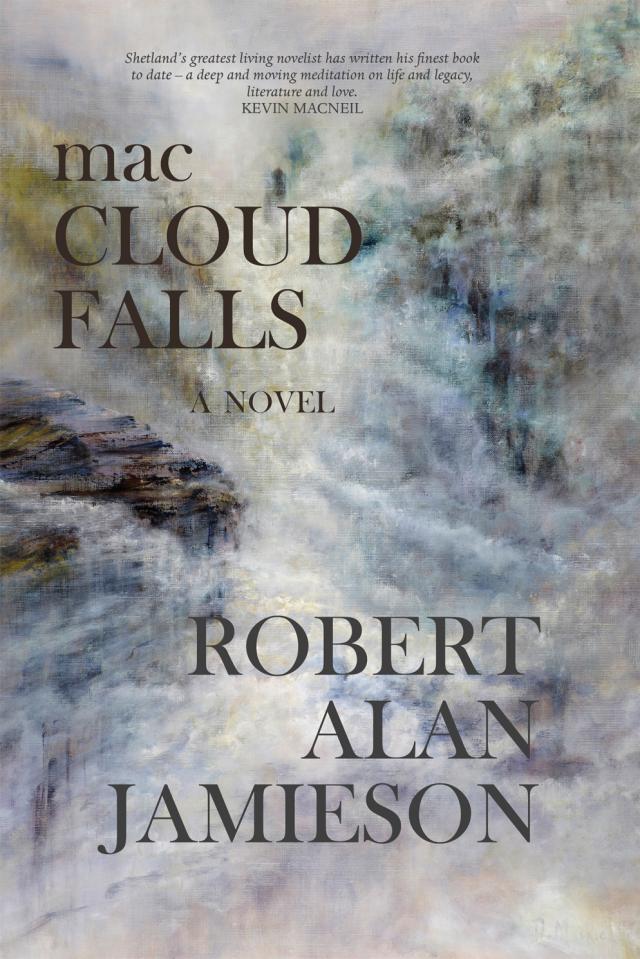
Maccloud falls, p.42
macCLOUD FALLS, page 42


When the temperature was right and depth nearly perfect, she slipped into the water. Wow. It felt good. And she lay back, thinking of how she’d played piano again, for Gil. How different it had been, that slightly out of tune upright, from the day she first played on Bowen, that perfect baby grand overlooking the straights and all the little islands in the sun. She closed her eyes and hummed the Chopin quietly to herself.
Gil was sitting on the deck out the back of the architect’s house, with Kirk Douglas and his wife. They’d been talking as they drank, and ate the barbequed food, about Cloud Falls, and the outdoor theatre. Kirk explained how the construction drew on aboriginal methods, in the detail of how the great timber was jointed. And he asked Gil about this relative of his who had lived there, and when Jimmy Lyle’s name was mentioned, Kirk said yes, of course, he knew something about him, the work he’d done for Boas and his part in the Indian Rights movement of the time. And he asked what the family connection was.
So Gil had told the tale again of how Lyle had left a pregnant woman behind when he came out to BC, and how he had suspected that this child was his father. How he’d wanted to find some evidence and hadn’t. How he’d planned to write a book about Lyle, but found he wasn’t up to it. That there was so much more to the story than he could have imagined, for all his research. How he had met Veronika on the plane, and what connected them. About the couple in Little Forks, their Burns book, the fire and the creek.
The wine had loosened his tongue. In fact, he’d been talking so much that his hosts seemed a little overwhelmed, and he stopped, realising he’d most likely been boring them with all sorts of details he found fascinating, but probably didn’t mean all that much to them, however polite they’d been.
So he asked the architect about his name, pointing out that it was as Scottish as any, and Kirk explained that, yes, his great-grandfather had indeed been Scottish, one of the Hudson’s Bay men, that he’d married a Musqueam woman. But his own background was thoroughly aboriginal, despite the surname, and he’d grown up on a reservation near Squamish. He said he’d been one of the first aboriginal students at Simon Fraser University.
‘Guess I’ve always been what the old folks would have called a lucky Indian,’ he added, with a wry smile, which seemed to Gil to have hidden within it the same testing directness he’d gently admonished Veronika with, earlier.
‘I don’t think luck could account for it,’ Kathy said. ‘You’ve worked so hard. And you’re so clever.’
Kirk shrugged. ‘Well, sure, I was a bright kid, but there has to be somebody around to notice that and help. I was lucky. I had a teacher who saw something in me. I got scholarships, all that stuff.’
‘But you deserved it.’
‘Sure, but so do lots of other kids and they don’t get lucky. That’s why it’s so important we give something back.’ And he went on to explain about some of the work he did, besides his work as an architect, committees he sat on, trusts and social concerns. ‘There’s a long road to go here in Canada,’ he said. ‘So many problems that are hidden away. But we are working to correct them.’
And they talked more about the issues around First Nations, the need for them to own their own discourse, eventually returning to Lyle’s role as the man who wrote down the BC chiefs’ wishes a hundred years before, and how important that had been, though Kirk pointed out if it hadn’t been him, then it would have been someone else.
The sun began to slip behind the trees. Gil finally got up to go, and thanked them both. The architect walked a distance up the path towards the cabin with him. As they parted, he said to Gil, ‘You must write whatever you feel you have to. Even if you can’t tell the story in a complete form, and you haven’t found the answers you were looking for, you have the right to write your partial truth, as much as anybody does. It’s all a contribution.’
Gil walked on up the last stretch himself. He’d stayed longer than he meant to, it was almost ten o’clock, and ‘Bliss’ was lying in silence in the faint gloom of a late summer evening, the VW parked outside. He didn’t see any lights on in the windows, so he took his boots off outside and opened the door as silently as he could, shushing Hero gently as he passed by where he lay sprawled, then padded across the new floor to the bathroom in semi-darkness. He was more than a little tipsy, and a wet towel she’d left on the floor tripped him up. He almost went headlong into the sunken bath, but managed to grab the towel rail and right himself.
As he came out, he noticed the main bedroom door was ajar and he heard her breathing, slow and regular. He went to the little staircase and began to climb up quietly, but when he reached the top, the step squeaked. The sound roused the sleeper below.
‘Gil?’ she called out. ‘Is that you?’
‘Who else?’ he said.
‘I waited for you.’
‘Sorry,’ he said. ‘We got talking.’ For a moment neither spoke, and he was about to carry on into the little bedroom when her voice came echoing up to him again.
‘I missed you,’ she said.
‘Sorry,’ he said again.
‘Come down here, will you?’
So he retraced his steps in the half-dark, and pushed open the main bedroom door. He could just make out her shape in the bed, as she shifted over and flicked the duvet back.
‘Sleep with me,’ she said. It was a whisper, but a command.
‘Are you sure the woman in Calgary has scripted this?’ he said, quietly.
‘Just shut up and get in,’ she whispered again, ‘But be careful, remember I’m one of the wounded. And no more words. It’s time we let our bodies talk.’
‘All right,’ he said, laying his head on the pillow. ‘But one last thing… what’s with the emus?’ He felt her body gently convulse with suppressed laughter, then her hand covered his mouth, and her thumb and index finger pinched his nostrils.
‘I should never have saved your life,’ she whispered.
Through the darkness, the sound of claws clipping over the bare floor approached, and before she could say no, a large furry creature landed heavily on the duvet on top of them. It wasn’t a bear.
* * *
Fifth Dance
‘The Best of Seven’
(Finale)
* * *
HE WALKED AGAIN along the shore that had become his retreat on his last day, the little stretch of wilderness coast on the south of English Bay. Mist enshrouded the twin peaks of Cypress and Grouse, like a steam cloud rising from the land in the heat of summer. Downtown Vancouver shimmered in the sun, as he stood on the sand watching a skein of geese fly towards the ocean. His mother used to say that was a sign of rain to come.
Tomorrow he too would fly above the city, on the first leg of the journey back to Scotland - across the Rockies where he’d first met her, then on across the vast wastes of Northern Canada, Greenland, Iceland and the Atlantic, back to the North Sea, far from this strange Pacific shore. The day of departure would carry him through the night towards home, but also towards the end of this companionship. This love he now felt. He could call it that, on his side at least.
But she had withdrawn again, since they got back to Vancouver. Though they’d met and talked, joked and laughed as they did before, she wasn’t physically present in the same way as during those few short crazy days in the Interior when they’d had to share a bed. And now he was about to leave.
But he had written – feverishly - something, not the story he’d imagined with an invented historical reality, the heroic adventures of a Scottish pioneer, but the story of what had happened to him, and how it had changed him. Meeting her. Their story. It was far from finished and he could never bring it to a conclusion here. The hours were running short. It occurred to him that time accelerates as the end of something approaches, or at least a person’s perception of it. The closer to the conclusion, the harder it seems to fit in everything that remains to be done or said, and still more things occur as the mind races in dread of ending – always, the tyranny of the undone. Once there was time for everything but now the finish looms, the bucket list is too full, it’s spilling over. Finally you give up, accept stillness, accept silence. This place of quiet by the shore. Acceptance, as with death, with the cancer and the sense he’d felt of hurtling towards non-existence, of being sucked into some invisible black hole. An unseen nothing. That river in the canyon and his urge to jump. Of course there were options, but they were all final acts, deeds to be done once, not a life plan to slowly unfold, to evolve and grow into shapes and places unimagined.
He turned and left the panorama behind, a last over-shoulder glimpse imprinted on his mind’s eye. As he headed up MacDonald Street away from the shore, a bus passed going downtown. The usual destination display read ‘GO CANUCKS GO!’, as did all such signs he’d seen in the last few days. The hockey fever had reached a peak. It was the day of the final match, Game Seven of seven, the decider with the score tied at 3-3. The Canucks were hosting the Boston Bruins and the city was full of fans, all dressed for the occasion. It was a day to make history, for the city to claim its first Stanley Cup. The citizens had all disappeared indoors to watch the showdown, and the streets were silent.
SHE was vacuuming her apartment, moving furniture, doing some serious tidying up, seeking out every little dust bunny or ancient crumb of dog biscuit. Hero was locked in her bedroom, barking periodically at his enemy, the dreaded Hoover. Since she got back from the interior, she’d felt so exhausted, so in need of downtime that the days had drifted past with the minimum of maintenance. Now that she’d restored her energy a little, the importance of restoring order in her domestic life seemed paramount.
The noise of the vacuum rang through the rooms, the growl of the roller brush beating hard floor, followed by the gentler rumbling as it passed over carpet, all punctuated by Hero’s stifled bark. She swung the electric beast around her like a reluctant dance partner - or a cowgirl roping a calf, the cord looped over her right shoulder like a lasso.
This was how she had prepared for death. Everything in place, all arrangements made, awaiting the inevitable, so that when the hour came, she would leave behind a perfect little nest, containing a record of her life laid out for anyone to find. All ends knotted, all her tangled yarn neatly sorted. She thought about what people would find afterwards. Her mother, mostly.
Yes, she had created order. She had finished her last translation, had seen all her friends, had even succeeded in ordering her mother’s phone calls and constant need for reassurance by saying the doctor told her she must rest, and so she would unplug her phone when doing so, something her mother had finally accepted.
Then Gil’s appearance in her life had brought with it a kind of chaos she was unprepared for. He had burst through the detachment she had so carefully cultivated in those final months, had caused her to feel panic and anxiety for someone’s fate other than her own. She had gone to places she had never been before; into a Canada she barely knew except for the odd news bulletin.
But that week of madness was behind her and she required tranquillity. She had said no to going out to watch the hockey with her friends. She didn’t have the energy for it, and besides it was Gil’s last night and she wanted to make it special for him. Though she hardly knew him, the time they’d had together had been so intense she felt bonded to him in a deep way, as if they had passed through some fire or forge, and had melded one to the other.
When she switched off the vacuum, she heard the sound of the buzzer and realised it was already quite late. It was almost time for puck-down.
THEY found it very different watching the game at her place, rather than in the crammed pub. Just the three of them, the sound turned quite low, and the screen rather small. Hero didn’t seem to care at all, and the humans seemed more preoccupied by the behaviour of the other than the sporting history waiting to be made. They sat on opposite chairs, the game between them. An awkwardness pervaded, their glances and smiles brief, their words light, barely circumstantial. Hero gave a sigh and lay down in front of the tv, his head by her feet, his tail by Gil’s.
Right from the first face-off, it seemed Boston were up for the fight. Three straight losses at the Canucks’ home in the series so far hadn’t blunted their self-belief. They seemed keener, skating hard and chasing their opponents down. The Canucks, the best team over the whole season’s record, looked as if their composure was busted. They looked second-best out on that ice.
When the first Boston goal went in, she stood up and left the room, shaking her head saying she knew it would end badly. That she’d had a feeling, and neither of them questioned that, after what had happened in Cloud Falls.
Gil called after her, that maybe losing the first goal would spur Vancouver on, but she ignored him, and nothing changed. They had shots aplenty from distance, but nothing to trouble the Boston goaltender, who was playing at the top of his game. At the end of the first period, the Canucks still trailed. She left the room, came back with another beer and some chips and salsa.
The second period went the same way. Vancouver huffed and puffed, blowing hard but Boston had the whip-hand, and a second goal for the visitors went in. Still time, he told her, but she scoffed at that, only half watching the match now. Then a collision between two players took out the Canucks’ goaltender too, and the puck slid slowly into the unguarded net. They waited as the referees reviewed it, to see if a foul had been committed, but the goal stood. 3-0 Boston, and the Canucks still hadn’t really threatened. It was beginning to look like the cause was lost.
She said she couldn’t stand it any longer, so they decided they should go out, but without Hero who would chase the waves madly, down to the shore he had come from, to watch the sunset. They walked to the little park at Tatlow together, side by side, step by step, in silence. Sunlight filtered through full-leafed boughs. Two little kids still clambered over the play area although it was late, while a mother waited to one side with a double stroller, studying her cell phone.
They walked on, across the little bridge and down to the steps that led to the beach. The vista opened out before them, the glittering sea hardly moving, the freighters reflecting, mountains opposite dwarfing downtown to the right, and then, emerging to their left as they approached, the sun as a disc of molten gold falling deathly slow to the ocean in the narrows between Point Grey and Bowen Island, through a sky of fire. They turned to face each other, smiling. It was truly awesome. Beyond words.
From the top of the steps, they could see the tide was right in, cutting off the path where it met the beach, so that a small gathering of people had assembled to watch the spectacle, standing in a huddle where the metal railings ended, some swinging from the rails. A posse of giant logs churning in the waves kept thumping up against the concrete of the steps, pushing against one another, twisting slowly. Escapees from some logging boom looking for a place to land.
The gathering was mainly a group of local kids who’d given up on the hockey like them. Or maybe they weren’t all that interested in the first place. They were passing round a bottle of whiskey, and a joint too, from the pungent smell. They didn’t seem to mind being joined by the two old people who stepped gingerly down the stair to where they stood.
It was all so peaceful, and hard to believe that over in the city centre, thousands of people crammed into an arena, hearts racing, blood pumping, anger mounting, as the hockey match played out.
She took hold of his hand. ‘So… tomorrow,’ she said.
He nodded. ‘Aye. I’ll miss all this. And you.’
‘Maybe you should stay.’ He glanced at her to gauge her seriousness, but her eyes were gazing out at the setting sun, at that moment merging into the horizon.
‘What would I do?’
‘You could open a bookshop,’ she smiled. But he knew that his life was back in Scotland, what remained of it, and said nothing. He had things to do there, he wasn’t ready to die, not quite yet.
Yet they both knew well that they would both die. How long it took, and where they met their end, and from what cause, all that remained unknown. But they had been to each other a kind of promise that there could be some kind of life with cancer, an existence on the other side of radiation. Of surgery. An intimation of a possible afterwards. And although they would die, probably sooner rather than later, they would not die together, unless some cataclysmic event happened to envelop them, like those lovers at Pompeii, in the next few hours.
No, they would part. But they would see each other again, as often as they could, and when the time came, one of them would be there to help the other die, the one who would mourn. They knew this somehow, though which one it would be, they did not know.
And yes, it was sad to contemplate that end, the physical and emotional pain of dying. The former at least could be soothed by drugs. But the latter could only be ameliorated by the presence of another person, the gentleness of one who understands, who is prepared to suffer loss and grief close at hand, to nurse. That was real love.
It was sad, yes, but they both knew that all stories must end.
Luath Press Limited
committed to publishing well written books worth reading
LUATH PRESS takes its name from Robert Burns, whose little collie Luath (Gael., swift or nimble) tripped up Jean Armour at a wedding and gave him the chance to speak to the woman who was to be his wife and the abiding love of his life. Burns called one of the ‘Twa Dogs’ Luath after Cuchullin’s hunting dog in Ossian’s Fingal. Luath Press was established in 1981 in the heart of Burns country, and is now based a few steps up the road from Burns’ first lodgings on Edinburgh’s Royal Mile. Luath offers you distinctive writing with a hint of unexpected pleasures.
Most bookshops in the UK, the US, Canada, Australia, New Zealand and parts of Europe, either carry our books in stock or can order them for you. To order direct from us, please send a £sterling cheque, postal order, international money order or your credit card details (number, address of cardholder and expiry date) to us at the address below. Please add post and packing as follows: UK – £1.00 per delivery address; overseas surface mail – £2.50 per delivery address; overseas airmail – £3.50 for the first book to each delivery address, plus £1.00 for each additional book by airmail to the same address. If your order is a gift, we will happily enclose your card or message at no extra charge.


